IB Results 2026 Statistics: Key Figures Explained
By Michael Thompson · Education Specialist; 10 years teaching the IB at Bromsgrove School · Published 4 September 2026 · Updated 4 October 2026
IB results 2026 statistics are published by the International Baccalaureate in the May 2026 statistical bulletin, released each year in late July or August on the IB's own website. The bulletin covers the Diploma Programme (DP) and Career-related Programme (CP) and is the only authoritative source for figures on candidate numbers, average scores, pass rates, and subject distributions. What the bulletin shows - and what it does not - matters a great deal if you are trying to interpret your own grade or compare it with previous cohorts. This guide walks through what has been confirmed for 2026, how those figures sit against 2024 and 2025, and what the score scale actually means in practice.
Key Takeaways
- Official source only: All May 2026 figures come from the IB's statistical bulletin, available as a PDF on ibo.org - no third-party blog figures are used here.
- Results released 6 July 2026: May session candidates access scores from 12:00 GMT on 6 July 2026 via candidates.ibo.org using their personal code and PIN.
- Maximum score is 45 points: Six subjects each marked 1-7, plus up to 3 bonus points from the Theory of Knowledge and Extended Essay core, giving a ceiling of 45.
- Minimum to pass is 24 points: Candidates must reach 24 total points and avoid a set of failing conditions - such as any grade below 2 - to be awarded the diploma.
- Bulletin includes year-on-year comparisons: The May 2026 PDF contains comparisons with May 2025 and May 2024 on the same measures, with caveats about grade boundary changes.
- Subject-level data is also published: The bulletin covers grade distributions by subject, though specific 2026 grade boundary numbers for individual subjects such as biology or physics are not reproduced here.
In This Article
- When the May 2026 IB results day is and how to access your grades
- Where to find the official IB results 2026 statistics bulletin
- IB results 2026 statistics: what the bulletin covers
- How the IB diploma score scale works and what different scores mean
- Comparing 2026 with 2025 and 2024: context and caveats
- Regional and country breakdowns in the IB statistics
- What to do next
1. When the May 2026 IB results day is and how to access your grades
May 2026 results were released on 6 July 2026; the statistical bulletin follows later in the summer. Per the IB Assessment FAQ, the May session release begins at 12:00 GMT on 6 July via candidates.ibo.org. For UK students that is 1pm BST on IB results day 2026, unless the school holds results back.
How to log in
- You need a personal code and PIN from your programme coordinator, not UCAS or any school portal.
- After three failed login attempts, access is blocked for 30 minutes before it resets automatically.
- Once in, you can see subject grades, total points, and your Extended Essay/Theory of Knowledge bonus points. Individual component marks are not shown at this stage.
One detail worth knowing: your school controls when you personally see your results. The IB Assessment FAQ confirms that coordinators can delay student access by up to 48 hours after the school release. If your school wants to deliver results in person, they can hold them back until 12:00 GMT on 8 July. Check with your coordinator before making plans for the morning of the 6th.
2. Where to find the official IB results 2026 statistics bulletin
The primary source for IB results 2026 statistics is the IB's own statistical bulletins page. The May 2026 DP and CP bulletin is published as a PDF directly at ibo.org, which was last updated on 26 August 2026. That date is consistent with the IB's usual pattern of releasing the statistical bulletin in late July or August, several weeks after results day itself.
A few things worth knowing before you visit:
- The November 2025 bulletin is a separate document. It sits on the same page but covers an entirely different cohort. Do not conflate the two when tracking year-on-year trends.
- Historical bulletins run back to May 2006, so year-on-year comparison is straightforward without leaving the page.
- Third-party summaries frequently lag or misquote figures. The IB occasionally updates the PDF after initial publication, and secondary sources rarely reflect those amendments. Go to ibo.org directly.
The non-obvious gotcha: the bulletin covers the Diploma Programme and Career-Related Programme in a single document, so CP-specific figures are embedded within the same tables rather than published separately. If you are looking only at DP pass rate or IB diploma average score data, check the column headers carefully before drawing conclusions.
3. IB results 2026 statistics: what the bulletin covers
The IB results 2026 statistics you actually want - pass rate, average diploma score, number of perfect 45s - are published by the International Baccalaureate in its official May 2026 statistical bulletin. That bulletin is available as a PDF from the IB's statistics page. Go to the PDF for the exact figures rather than relying on third-party summaries, which frequently misquote the IB's own framing.
What the bulletin typically contains:
- Total candidate numbers for the Diploma Programme and Career-Related Programme
- Diploma pass rate (the IB pass rate 2026 figure most readers are searching for)
- Mean total score across all candidates (the IB diploma average score 2026)
- Score distribution across the 24-45 range
- Number of candidates achieving 45 points and 40 points or above
- Bilingual diploma awards
- Subject-level grade distributions, covering everything from IB Biology grade boundaries to IB Physics grade boundaries
One detail worth knowing: the bulletin includes the IB's own grading-context caveats, stating explicitly that grade boundaries shift from session to session and that direct score comparisons across cohorts should be treated with care. This means a rise or fall in the average score does not straightforwardly tell you whether the cohort performed better. The bulletin also covers the November 2025 session in a separate document, available on the same page.
4. How the IB diploma score scale works and what different scores mean
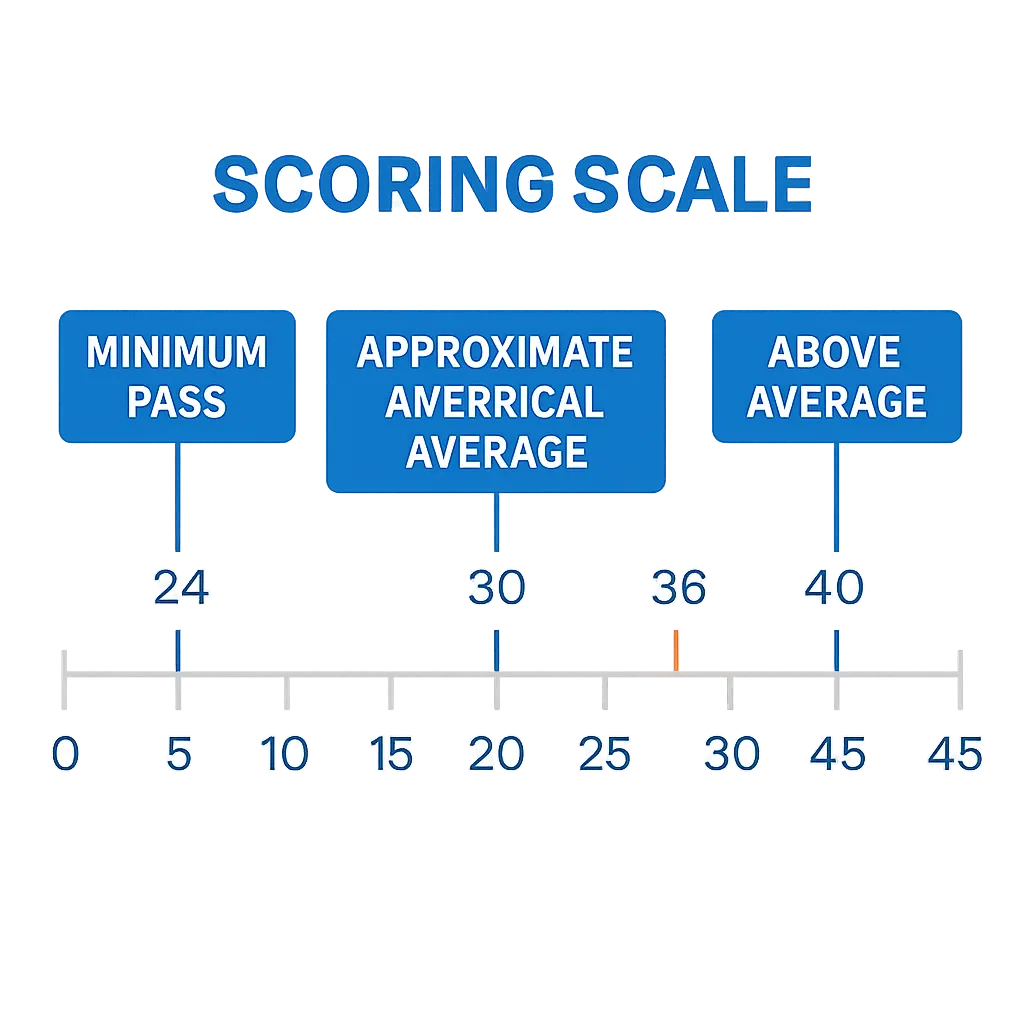
The IB Diploma uses a 45-point scale. Six subjects are each graded 1 to 7, giving a maximum of 42 points from coursework and exams. The remaining 3 points come from the Theory of Knowledge and Extended Essay core, where your combined TOK and EE grades determine how many bonus points you receive via a published matrix.
The minimum to receive a diploma is 24 points, but reaching that total alone is not enough. Per the IB's passing criteria, you must also clear several conditions simultaneously:
- No subject grade below 2
- No more than two grade 2s across all subjects
- No more than three grades of 3 or below
- At least 12 points across your Higher Level subjects
- A grade of at least D in both TOK and EE (a grade E in either one is an automatic failing condition, regardless of your points total)
That last point catches candidates off guard. A student with 28 points can still fail the diploma if they grade E on their Extended Essay.
Putting scores in context:
| Score | What it represents |
|---|---|
| ~30 | Roughly 5 per subject on average. Just above the pass threshold; solid but not exceptional in a globally competitive cohort |
| 36 | Comfortably above average; broadly competitive for most UK university offers |
| 40-42 | Top tier; well within range for highly selective programmes |
| 45 | Perfect score: grade 7 in every subject plus an A/A combination in TOK and EE. The number of students achieving this is published in the annual statistics bulletin |
One detail worth knowing for reading IB results 2026 statistics: grade boundaries vary by subject and by session. The IB subject score distribution data in the bulletin reflects this, meaning IB biology grade boundaries 2026 and IB physics grade boundaries 2026 will differ from each other and from the equivalent boundaries in 2025. A grade 6 in one subject in one year is not directly comparable to a grade 6 in a different subject or a different year.
5. Comparing 2026 with 2025 and 2024: context and caveats
The May 2026 statistical bulletin contains its own year-on-year comparison tables. Use those tables directly rather than any informal summary, including this one. The IBO builds the comparisons in, precisely because unofficial cross-year readings introduce errors.
A few specific caveats are worth understanding before drawing any conclusions:
- Grade boundaries reset each session. The IB re-calibrates boundaries after each exam window, so a total score of 30 in 2026 does not map cleanly onto a 30 from 2024. The bulletin acknowledges this and provides grading-context notes alongside the aggregate figures.
- November and May are separate populations. The November 2025 bulletin covers a smaller, southern-hemisphere-weighted cohort. Mixing November and May figures when tracking trends overstates shifts in overall performance.
- Like-for-like means May-to-May. For any claim about whether the IB pass rate or diploma average is rising or falling, restrict your comparison to May sessions only.
The less obvious gotcha: cohort size itself moves the aggregate mean. If a large, high-performing country expands IB uptake sharply in one session, the global average score can shift without any change in how individual students performed or how boundaries were set. Small year-on-year movements in the headline figures rarely signal anything conclusive.
6. Regional and country breakdowns in the IB statistics
The IB operates across more than 150 countries and territories, as listed on the IB by country and territory page. That page is a directory, not a data source. It contains no results figures, pass rates, or score distributions.
Regional breakdowns, where they exist, appear inside the May 2026 statistical bulletin PDF. The bulletin is the only authoritative source for any regional tables. Check the PDF directly rather than relying on summaries from third-party sites, which may quote selectively or conflate regional and global aggregates.
A non-obvious gotcha: the IB groups its professional development and administrative activity into three regions (Africa, Europe and Middle East; Asia-Pacific; the Americas), but those administrative boundaries do not necessarily match how results data is segmented in the bulletin. Do not assume a regional figure quoted online maps cleanly onto one of those three zones.
The IB does not publish school-by-school or country-by-country pass rates in the bulletin beyond aggregate figures. Any ranked list of countries by pass rate from a third-party source should be treated with caution.
UK-specific data, if included, would appear within the bulletin's regional tables. This guide cannot confirm the exact tables present without access to the full PDF.
7. What to do next
Your first move this week: download the May 2026 statistical bulletin PDF from the IB's statistical bulletins page and open the summary tables. Check four headline figures specifically: total candidate count, mean diploma score, pass rate, and the number of 45-point achievers. Those four numbers give you enough context to interpret your own result against the cohort.
If your grade is lower than expected, any re-mark request must go through your school's DP coordinator as an Enquiry Upon Results (EUR). The IB does not accept EUR requests directly from candidates or parents. One non-obvious detail worth knowing: a re-mark can result in a grade being lowered, not just raised, so discuss the risk with your coordinator before authorising submission.
For university places, UCAS Clearing opened on 2 July 2026 and runs until 19 October 2026. With IB results released from 12:00 GMT on 6 July, you have the full Clearing window available. The deadline for May 2026 EUR requests was 15 September 2026, and Clearing listings thin out quickly, so check them early.
FAQ
When are IB results 2026 released in the UK?
May 2026 IB results are released from 12:00 GMT on 6 July 2026 via candidates.ibo.org, which is 1pm BST in the UK, although a school can choose to hold results back for up to 48 hours.
Where can I find the official IB results 2026 statistics?
The May 2026 statistical bulletin - covering candidate numbers, pass rate, average score, and subject distributions - is published as a PDF on the IB's own statistics page at ibo.org.
What is the IB diploma pass rate for 2026?
The pass rate for May 2026 is published in the IB's statistical bulletin PDF on ibo.org; this guide cannot quote the figure without access to the full bulletin, and readers should go directly to the source.
What is the average IB diploma score for 2026?
The mean total score for May 2026 candidates is reported in the IB's May 2026 statistical bulletin; historically the average has sat around 29-30 points, but readers should check the bulletin for the confirmed 2026 figure.
How many students scored 45 in IB May 2026?
The number of candidates achieving the maximum 45 points in May 2026 is listed in the IB's statistical bulletin, available as a PDF from ibo.org; this guide does not reproduce that figure without direct access to the confirmed data.
What are the IB grade boundaries for 2026?
Grade boundaries for individual subjects - including IB biology and IB physics - are set each session and released to schools by the IB; candidates can see the boundaries either side of their own mark in the detailed results view on candidates.ibo.org, which is on by default unless their coordinator switches it off.
References
- Assessment FAQ - International Baccalaureate® - https://ibo.org/programmes/diploma-programme/assessment-and-exams/getting-results/assessment-faq
- IB Diploma stats | International Baccalaureate® - International Baccalaureate® - https://ibo.org/about-the-ib/facts-and-figures/statistical-bulletins/diploma-programme-and-career-related-programme-statistical-bulletin
- DP passing criteria - International Baccalaureate® - https://ibo.org/about-the-ib/what-it-means-to-be-an-ib-student/recognizing-student-achievement/about-assessment/dp-passing-criteria
- The IB by country - International Baccalaureate® - https://ibo.org/about-the-ib/the-ib-by-country-and-territory
- Dates and deadlines for uni applications | UCAS - https://www.ucas.com/applying/applying-to-university/dates-and-deadlines-for-uni-applications