IB Results Day 2026: Dates, Times and What to Do
By Michael Thompson · Education Specialist; 10 years teaching the IB at Bromsgrove School · Published 21 May 2026 · Updated 6 October 2026
IB results day falls on 6 July for the May examination session and on 16 December for the November session - and for most students the next 24 hours will determine whether a university place is confirmed or whether a new plan is needed. May results are released online through the IB candidate portal from 12:00 GMT on 6 July, so UK students see their grades from 1pm - often before their school has been in touch. This guide covers exact dates and access times, what your UCAS application status means the moment results drop, and the full process if you want to query a grade or enter Clearing.
Key Takeaways
- May session results arrive on 6 July: The IB Organisation releases Diploma Programme results from the May exams on 6 July, and November session results reach schools on 16 December.
- Access is via the IB candidate portal: You log in directly at candidates.ibo.org using your personal code and PIN - your school may also release results simultaneously or shortly after.
- UCAS updates automatically: Once the IB Organisation forwards results to UCAS, your application status changes to confirmed, insurance, or Clearing without you needing to do anything.
- Clearing opens from 2 July for eligible students: If you miss both your firm and insurance offers, you are entered into Clearing automatically and can search thousands of vacancies on the UCAS website.
- Remarks (Enquiry Upon Results) carry a fee and a deadline: Your school can request a re-mark for you; a fee applies unless your grade changes, and the IB deadline for May results is 15 September.
- Grade boundaries shift each session: IB grade boundaries are set after marking is complete each session, so comparing raw scores against previous years is unreliable - and courses examined for the first time in May 2027 have no past boundaries at all.
In This Article
- When Is IB Results Day - May and November Session Dates
- How to Access Your IB Results: Candidate Portal and School Release
- IB Grade Boundaries and How They Are Set
- What Happens to Your UCAS Offer on IB Results Day
- Clearing for IB Students: Timing, Process, and What to Expect
- The Enquiry Upon Results (EUR) Process: Re-marks, Fees and Deadlines
- IB November Results Day: The 16 December Release
- What to Do If Your Results Are Delayed or Unavailable
- IB Results Day vs A-Level Results Day: Key Differences for UK Students
- Your IB Results Day Checklist: What to Do Before, During, and After
1. When Is IB Results Day - May and November Session Dates
IB results day for the May examination session falls on 6 July each year - the date the IBO releases results to candidates worldwide, from 12:00 GMT. The next one is Tuesday 6 July 2027, for the May 2027 session, whose exams run from 23 April to 18 May 2027. Schools and coordinators receive results a day earlier, on 5 July.
The November examination session follows a separate cycle. Its results are released to schools on 16 December from 21:00 GMT, at staggered times by time zone, and candidates see them between 6 and 48 hours later, depending on when their school releases them. For the November 2026 session, that is Wednesday 16 December 2026.
The May release has one quirk that catches UK students off-guard: 12:00 GMT is 1pm in the UK in July. That means most UK students see their grades in the early afternoon, often before the school office has caught up. Unlike A-level results, there is no school-gates moment in the morning.
Before each session, check the IB's Getting results page and ask your coordinator when your school will release results to you.
2. How to Access Your IB Results: Candidate Portal and School Release
Your results are published at candidates.ibo.org. To log in, you need your personal IB candidate code and the PIN issued to you before your exams. These are two separate things: the candidate code identifies you, the PIN authorises access. If you have mislaid your PIN, contact your IB coordinator well before results day. On the day itself, coordinators are managing dozens of students at once, and a lost PIN is a slow problem to fix under pressure.
What your results page shows:
- Your grade (1 to 7) in each subject
- Your overall Diploma points total
- The bonus points (up to 3) from the TOK/Extended Essay matrix
By default you also get a detailed view showing your scaled total mark and the grade boundaries either side of it, unless your coordinator switches it off.
The bonus points catch students off guard. A strong Extended Essay paired with a weak TOK grade, or vice versa, can leave you with fewer bonus points than you expected even when both components feel like passes. Check the matrix result specifically, not just the total.
Some schools also gather students to open their results together and offer on-site support. Whether your school does this varies, so confirm the arrangement in advance.
One thing candidates.ibo.org does not show: your official transcript or Diploma certificate. Those are separate documents issued later by the IBO. Do not plan any administrative deadlines around the day-one portal view.
3. IB Grade Boundaries and How They Are Set
Unlike A-level grade boundaries, which Ofqual-regulated boards such as AQA and OCR publish on results day itself, IB grade boundaries are not fixed in advance and are not shared publicly before results are released. The IBO sets them after marking is complete each session, combining statistical standardisation with a senior examiner review of student work at each grade threshold. The same raw score can fall at different grades in different sessions.
IB grade boundaries for each session go to schools once results are out. Ask your coordinator for the boundaries for your subjects; if you have the detailed results view, you can also see the boundaries either side of your own mark.
May 2027 is a first sitting for several courses. The new 30-mark Extended Essay and the new Psychology, Computer Science, Design Technology and Visual Arts courses are examined for the first time, so no past boundaries exist for them. The first ones are set after the May 2027 session, and old boundaries cannot be scaled to fit.
The scoring scale runs from 1 to 7 in each subject. A full IB Diploma has a maximum of 45 points: 42 from six subjects (seven points each) plus up to 3 bonus points awarded for the combination of Theory of Knowledge (TOK) and the Extended Essay.
The non-obvious gotcha: predicting your Diploma total by applying last year's grade boundaries to your mock raw scores is unreliable. Boundaries shift enough between sessions that a student could be one raw mark above last year's grade-6 boundary and still receive a 5. Treat any pre-results boundary estimate as a rough orientation, not a target.
When grade boundaries are released, check the figures for your specific subject and level (Higher or Standard) with your coordinator, not a third-party summary.
4. What Happens to Your UCAS Offer on IB Results Day
On IB results day, most of the process happens automatically. UCAS receives your IB Diploma results from the IBO electronically, matches them to your application, and forwards them to the universities holding your offers - you do not need to send anything yourself. IB results reach UCAS on 5 July, and UCAS forwards them to universities over the following days. One check for your coordinator: UCAS only receives your results if your school has given it permission on the IB's system (IBIS); without that, decisions are delayed.
When you log in to your UCAS application on results day, your application will show one of four statuses:
- Unconditional Firm confirmed. Your place is secured. This was already the case if you held an unconditional offer before results day - your IB results do not affect that acceptance.
- Conditional Firm met. You met the conditions of your firm offer and your place is confirmed.
- Insurance place activated. Your firm conditions were not met, but your insurance offer conditions were, so that place is now yours. You can click 'Decline my place' to enter Clearing instead if you prefer a different option.
- Entered into Clearing. Neither set of conditions was met. You are now free to find a vacancy.
A typical conditional IB offer looks like this: 36 points from the IB Diploma including 6 in Higher Level English. Both the overall points total and the subject-level condition must be satisfied for the offer to be confirmed.
One non-obvious gotcha: if your qualification is not on UCAS's electronic forwarding list, the automatic matching does not happen. In that case, you must send your results or certificate directly to your firm and insurance choices upon receipt. Contact both universities proactively rather than waiting for them to chase you.
5. Clearing for IB Students: Timing, Process, and What to Expect
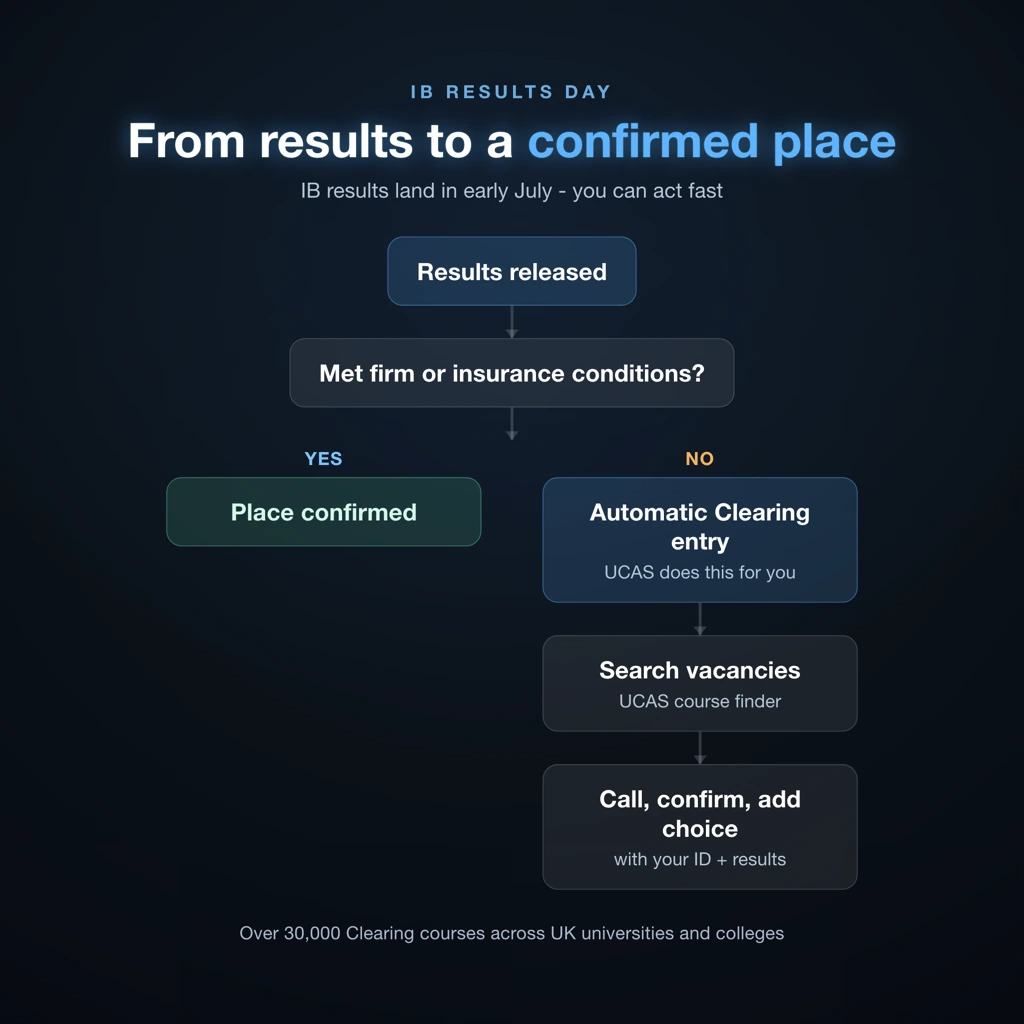
IB students are well-placed for Clearing because their results land in early July, weeks before most A-level students enter the process. That timing matters.
If you miss the conditions for both your firm and insurance choices, UCAS automatically places you in Clearing - you do not need to do anything to trigger it. You just cannot act on it until your results are actually in your hands. Once they are, you can move immediately.
The four-step Clearing process:
- Search for a vacancy on the UCAS Clearing course finder.
- Call the university admissions team directly with your UCAS Personal ID and your results.
- Get verbal confirmation that they will accept you.
- Log in to your UCAS application and add the Clearing choice.
Over 30,000 courses across UK universities and colleges are listed in Clearing, so the range is wider than most students expect.
Voluntary Clearing: the 'Decline my place' option
If you hold a confirmed place but want to explore other options, you can use the 'Decline my place' button from 2 July. Be clear on the consequences: declining cancels any accommodation or scholarship arrangements tied to that offer, and you also lose your insurance place.
The non-obvious gotcha here involves changed course offers. If your firm choice offers you a place on a different course or with a different start date, your response depends on what your insurance choice does. Where the insurance choice has already issued an unconditional offer, you must choose between the changed firm offer and the insurance place. If the insurance choice has not yet decided, you can wait before committing. Where both choices issue changed offers, you can select whichever you prefer. Do not decline anything under time pressure before checking which scenario you are in.
6. The Enquiry Upon Results (EUR) Process: Re-marks, Fees and Deadlines
If your results are not what you expected, the IBO offers a formal review process called an Enquiry Upon Results (EUR). There are three categories, and only the first is aimed at an individual student's grade.
- Category 1: re-mark - your externally assessed work in one subject is marked again. This is the route to use if you think a grade is wrong. Because a grade can go down as well as up, the IB needs your written consent before your school submits the request.
- Category 2: return of materials - copies of marked exam work are sent back to the school. This does not change a grade on its own.
- Category 3: re-moderation of internal assessment - the IB re-checks how a school's internal assessment sample for a subject was moderated. This is a school-level request, not a way to have one student's IA re-marked.
All EUR requests go through your IB coordinator. You cannot contact the IBO directly as a candidate. Your school submits the request on your behalf, so speak to your coordinator on results day itself if you are concerned, not the following week.
Each category carries a fee set by the IB, and your coordinator should tell you what it is before you decide. For a category 1 re-mark, no fee is charged if your grade changes. The critical caveat: grades can go down as well as up. A remark is not a safety net. Weigh the risk before requesting one, particularly if a borderline grade is already meeting your university offer conditions.
For the May session, schools can submit requests from 5 July until 15 September. For the November session, schools can request category 1 re-marks only between 16 and 18 December, then any category from 2 January until 15 March. Your school may set an earlier internal cut-off, and if a university place depends on the outcome, ask straight away rather than waiting for the deadline.
If you request a EUR and your grade changes in a way that affects your firm choice offer, contact the admissions team at that university immediately, in parallel with the EUR submission. Do not wait for the remark outcome before picking up the phone.
7. IB November Results Day: The 16 December Release
The November examination session serves two distinct groups: IB students in the southern hemisphere sitting their exams at the end of their academic year, and retake candidates worldwide who need another shot at specific subjects. Results for this session are released to schools on 16 December from 21:00 GMT, at staggered times by time zone, and reach candidates on candidates.ibo.org between 6 and 48 hours later, depending on when the school releases them. For the November 2026 session, whose exams run from 23 October to 13 November 2026, that is Wednesday 16 December 2026.
This date is newer than many guides suggest. November results used to come out in early January; the IB moved the release to 16 December from the November 2024 session.
For UK applicants, the December date helps. For 2027 entry, the main UCAS equal-consideration deadline is 18:00 on 13 January 2027, so a November 2026 retake candidate who has not yet applied can wait for results and still apply on time with achieved grades. The gap is short, with the school holidays in between, so have your application and reference ready before results day. The exception is Oxford, Cambridge and most medicine, dentistry and veterinary courses: their deadline is 15 October (15 October 2026 for 2027 entry), before the November exams begin, so those applications go in without the new grades.
There is a less obvious gotcha here. Universities set their own policies on resit grades. Retake candidates planning 2027 entry should contact each chosen university directly before applying to confirm how November results will be treated.
8. What to Do If Your Results Are Delayed or Unavailable
Portal outages and missing subject results are rare, but they do happen. A less obvious scenario is results withheld pending an academic integrity investigation: the IBO can hold individual subject grades while a case is reviewed, meaning your results page may show some scores but not others, with no explanation visible to you.
Your first call is to your IB coordinator. They have a direct line to the IBO and can check whether a result is technically delayed, withheld for a specific reason, or simply mis-routed. Do not assume the worst before that conversation.
If a delay looks likely to affect a UCAS offer decision, act in parallel:
- Contact your firm choice university admissions office directly on results day and explain the situation. Ask for a short extension while the issue is resolved. Admissions teams handle this more often than applicants expect, particularly for international qualifications.
- If your IB results are not on UCAS's forwarding list, UCAS advises that you send your results or certificates directly to your firm and insurance choices as soon as you receive them.
Do not enter Clearing on the assumption your results are lost. Clearing releases your firm and insurance offers permanently. Confirm the status with your coordinator first, because a withheld or delayed result can often be resolved within hours, and re-entering Clearing once a place is released cannot be undone.
9. IB Results Day vs A-Level Results Day: Key Differences for UK Students
IB results day falls in early July, more than five weeks before A-level results day in mid-August. That gap matters more than most IB students realise.
IB students can enter Clearing more than five weeks before A-level students do. University vacancy lists in July are typically longer than they will be in August, because A-level applicants have not yet entered the market. If your IB diploma results day leaves you without your firm offer, call admissions lines promptly rather than waiting to see what happens.
For context, this is how UCAS ran A-level results day in 2026:
- 07:00, 13 August - adviser portal opens
- 08:00, 13 August - students access their applications; results under embargo until this point
- 13:00, 13 August - students can add a Clearing choice
IB students are not on this timeline. Your results arrive in July, and you can act on them immediately, with no embargo window and no queue of tens of thousands of A-level applicants competing for the same places on the same morning.
One specific quirk worth knowing: the August Clearing rush is partly driven by that 13:00 embargo lift. Admissions teams handling IB results in July face no equivalent spike in call volume, which can mean more considered conversations about vacancies.
If an offer is expressed in Tariff points, note that the UCAS Tariff allocates points to IB subject grades at Higher and Standard Level. Check the UCAS Tariff calculator for the exact mapping before any Clearing call, so you can state your points precisely.
10. Your IB Results Day Checklist: What to Do Before, During, and After
IB results day moves fast. Having a short checklist means you spend the morning acting, not scrambling to remember passwords.
Before results day
- Confirm your IB candidate portal login with your school coordinator. Coordinators can reset access, but they cannot do it at 1 am.
- Log into UCAS Hub and check your firm and insurance offer details are exactly as you expect.
- Save the admissions phone numbers for both your firm and insurance choice universities. Call queues fill up within minutes of results landing.
On results day
- Log into the candidate portal at the IBO's published release time and check each subject score individually before looking at the Diploma award total. A single grade can determine whether a condition is met.
- Open UCAS Hub immediately after. Your application status will show as confirmed, insurance accepted, or Clearing.
If confirmed: check whether your accommodation booking or any scholarship has conditions attached. Declining your firm place cancels accommodation and scholarship arrangements automatically, so do not click that button without checking.
If in Clearing: search UCAS vacancies, call the university directly, get verbal permission, then add your Clearing choice in UCAS Hub. Do not wait for a better option to appear before calling. Courses close throughout the day.
If considering a remark: speak to your IB coordinator the same day. The coordinator must submit the request for you, a re-mark needs your written consent, and there is a fee unless your grade changes.
Your one action this week
Find your IB candidate portal login credentials now and email your coordinator to confirm they work. Do it before the end of the week so there is time to fix any access problem well ahead of IB results day.
Related:
- IB Results 2026 Statistics: Key Figures Explained
- IB Exam Schedule 2027: May Dates, Session Times and Results
FAQ
When is IB results day 2026?
There are two IB results days in 2026. May 2026 results came out on Monday 6 July 2026 from 12:00 GMT. November 2026 results are released to schools on Wednesday 16 December 2026 from 21:00 GMT, and candidates see them on the IB candidate results website between 6 and 48 hours later, depending on their school.
What time do IB results come out?
For the May session, the IBO releases results to candidates online from 12:00 GMT (1pm UK time) on 6 July, and schools receive them a day earlier. For the November session, schools receive results from 21:00 GMT on 16 December, and candidates see them 6 to 48 hours later.
What happens to my UCAS application when IB results come out?
The IBO sends results electronically to UCAS, which matches them to your application and updates your status automatically - you will see either your place confirmed, your insurance place activated, or an entry into Clearing.
When is IB results day 2027?
Results for the May 2027 session are released to candidates on Tuesday 6 July 2027 from 12:00 GMT (1pm UK time) on the IB candidate results website; schools receive them on 5 July. November 2027 session results are expected on 16 December 2027, following the current November pattern.
How long are IB results valid for?
IB Diploma results do not expire - your certificate remains valid indefinitely - but individual universities may have their own policies on how recently qualifications must have been obtained for entry purposes.
Can IB results go down after a remark?
Yes - an Enquiry Upon Results review can result in a grade going up, staying the same, or going down, so discuss the risks with your IB coordinator before requesting a re-mark.
References
- The results process | UCAS - https://www.ucas.com/advisers/help-and-training/guides-resources-and-training/application-overview/the-results-process
- University offers - conditional, unconditional, unsuccessful & withdrawn - https://www.ucas.com/applying/after-you-apply/types-of-offers
- Understand Your Exam Results & UCAS Application Status | Clearing - https://www.ucas.com/applying/after-you-apply/clearing-and-results-day/results-day/what-your-application-status-means
- Declining your firm place | UCAS - https://www.ucas.com/applying/after-you-apply/clearing-and-results-day/results-day/declining-your-firm-place
- Getting results | International Baccalaureate - https://www.ibo.org/programmes/diploma-programme/assessment-and-exams/getting-results/
- Assessment FAQ | International Baccalaureate - https://www.ibo.org/programmes/diploma-programme/assessment-and-exams/getting-results/assessment-faq/
- New release date set for November 2024 examination results | International Baccalaureate - https://www.ibo.org/news/news-list/new-release-date-set-for-november-2024-examination-results/
- UCAS Tariff calculator | UCAS - https://www.ucas.com/ucas/tariff-calculator