IB vs AP: Which Programme Should You Choose?
By Michael Thompson · Education Specialist; 10 years teaching the IB at Bromsgrove School · Published 21 May 2026 · Updated 6 October 2026
IB vs AP is one of the most searched decisions in secondary education, yet the two programmes are rarely compared on the same terms. The International Baccalaureate Diploma is a single, two-year credential awarded on a 45-point scale; Advanced Placement is a menu of individual exams, each scored out of 5. Where you take them, what you want to study, and which universities you are aiming for all change the calculation significantly. This guide sets out the structural differences, workload realities, and university preferences so you can make a straight comparison.
Key Takeaways
- Different structures: The IB Diploma is a fixed two-year programme with compulsory components; AP courses are standalone exams you can pick individually.
- Different scoring scales: IB grades run from 1-7 per subject with a maximum total of 45 points; each AP exam is scored 1-5.
- Workload difference: A full IB Diploma includes six subjects, Theory of Knowledge, an Extended Essay, and CAS; taking 5-6 AP exams is demanding but lacks those compulsory core elements.
- US college credit: Many US universities award course credit or exemptions for AP scores of 4 or 5, and for IB Higher Level grades of 5, 6, or 7 - but policies vary by institution.
- Russell Group recognition: UK universities accept the IB Diploma with established grade equivalencies; AP exams are less commonly listed in UK offer letters and are not assigned UCAS Tariff points.
- Neither is universally better: The right choice depends on your school's offering, your target universities, and whether you prefer breadth across disciplines or depth in chosen subjects.
In This Article
- Programme vs Course: The Fundamental Difference
- Scoring Explained: 45-Point IB Scale vs 5-Point AP Scale
- Workload Comparison: Full IB Diploma vs Taking 5-6 APs
- IB Diploma vs AP Classes: University Recognition
- Benefits of IB vs AP: Pros and Cons Side by Side
- IB vs AP vs A-Level: Where Does Each Sit?
- What to Do Next
1. Programme vs Course: The Fundamental Difference
The IB vs AP question looks simple on the surface, but the two systems are structurally different in a way that makes direct comparison tricky. One is a complete qualification; the other is a menu of individual exams. Understanding that distinction first saves a lot of confusion later.
The IB Diploma Programme is a single, integrated two-year qualification. You cannot sit one IB subject and walk away with a credential. Every IB Diploma candidate studies six subjects across prescribed groups (including a science, a humanity, a language, and mathematics), and must complete three compulsory core components: Theory of Knowledge (a philosophy-of-knowledge course with an assessed essay and exhibition), an Extended Essay of up to 4,000 words, and Creativity, Activity, Service hours. The diploma only exists as the whole package.
AP works the opposite way. A student can take one AP exam, or ten, with no required combination and no overarching framework binding them together. There is no AP equivalent of Theory of Knowledge, no mandatory extended project.
One practical constraint often gets overlooked: IB Diploma Programmes are only available at schools that hold authorisation from the International Baccalaureate Organization. AP courses, administered by College Board, are far more widely offered across US high schools and international schools, which means the choice is sometimes made for you by geography rather than preference.
The counter-intuitive trade-off: because the IB Diploma is all-or-nothing, a student who fails to meet the minimum threshold loses the full qualification, not just a single subject grade.
2. Scoring Explained: 45-Point IB Scale vs 5-Point AP Scale
The two programmes measure achievement on completely different scales, which makes direct comparison harder than it looks.
IB subjects are graded 1-7, with 7 being the highest. The full IB Diploma adds up to 45 points: six subjects can yield a maximum of 42 points, and the remaining 3 come from the combined Theory of Knowledge (TOK) and Extended Essay (EE) component. Per the IBO assessment FAQ, grade boundaries are set by reviewing candidate work quality against grade descriptors on a one-to-seven scale. When you receive your results on candidates.ibo.org, you see subject grades, total points, and your EE/TOK bonus points, but not individual component marks.
AP exams are scored 1-5 by the College Board. A 3 is typically the threshold for college credit consideration; 4 and 5 are the scores that carry weight at selective universities.
The non-obvious catch: a 7 in an IB Higher Level (HL) subject does not map cleanly onto a 5 in AP, despite both sitting at the top of their respective scales. IB grades reflect sustained coursework and a moderated boundary-setting process. AP is a single exam. A student who scores 7 in IB HL Chemistry has also completed a practical investigation and internal assessment; a student who scores 5 in AP Chemistry has not necessarily done either.
| Scale | Top score | Passing threshold | Includes coursework component? |
|---|---|---|---|
| IB Diploma | 45 points | 24 points (minimum) | Yes |
| AP | 5 | 3 (typically) | No |
3. Workload Comparison: Full IB Diploma vs Taking 5-6 APs
The full IB Diploma is a two-year package with no opt-outs. Students take six subjects across six prescribed groups, covering sciences, humanities, a second language, and mathematics simultaneously. On top of that sit three compulsory components: Theory of Knowledge (TOK), a 4,000-word Extended Essay, and Creativity, Activity, Service (CAS) hours. None of those can be dropped if you want the full Diploma.
AP works differently. Students self-select which exams to sit, typically accumulating five or six over their junior and senior years. There is no compulsory interdisciplinary layer, no word-count requirement, no service hours. You build the list around your strengths.
The less obvious trade-off is where the pressure sits, not just how much of it there is.
- IB workload is sustained across both years. Internal assessments, the Extended Essay, and CAS deadlines run in parallel with regular coursework throughout.
- AP pressure concentrates sharply around the May exam window. Outside that period, the course-by-course load is manageable.
On raw difficulty, IB Higher Level subjects (three are required for the Diploma) generally cover more content and include internally assessed components that AP equivalents do not. A student asking whether IB HL vs AP is harder is really asking about sustained depth versus periodic intensity, and those are different challenges.
The counter-intuitive point: a single rigorous AP course, such as AP Chemistry or AP Calculus BC, can match or exceed an IB Standard Level subject in content coverage. The full Diploma, though, asks you to carry six subjects at once. That combination, rather than any single course, is what makes the IB Diploma the heavier total commitment.
4. IB Diploma vs AP Classes: University Recognition
Where you apply shapes which qualification works harder for you. The two programmes carry different weight depending on the country and institution.
US Ivy League and Selective Universities
Both the IB Diploma and strong AP scores are recognised by US admissions offices as evidence of academic rigour. Neither has a clear edge. What admissions readers actually look at is course selection and grade outcome: a completed IB Diploma is a credential in itself, while AP applicants are typically expected to show scores of 4 or 5 across several exams to signal the same level of stretch. The less obvious point: an IB Diploma with a mid-range score can sometimes read as stronger than a handful of AP 5s, because the Diploma signals sustained commitment across six subjects plus the core components, rather than cherry-picked high-scoring papers.
US College Credit
Many US universities award course credit or advanced placement for AP scores of 4 or 5, and the same is true for IB Higher Level grades of 5, 6, or 7. The practical difference is consistency: AP credit policies are published subject by subject and tend to be clearly mapped. IB credit policies exist at most major universities but are applied less uniformly, and the credit awarded can vary significantly between institutions even for the same HL grade.
UK Russell Group
The IB Diploma is accepted by UK universities with published grade equivalencies. Competitive courses at selective institutions typically ask for 38 to 40 points. AP exams sit outside this framework entirely. Per UCAS, the Tariff covers Level 3 qualifications regulated by Ofqual and equivalent bodies; AP exams are not among them and carry no UCAS Tariff points. UK universities rarely list AP scores in offer conditions, which makes applying with APs alone to a Russell Group institution genuinely difficult.
International and Medical Applications
The IB Diploma functions as a recognised school-leaving qualification in over 150 countries, which matters for students who may study or work outside the US. AP recognition outside North America is more limited and inconsistent.
For medicine specifically, the subject matters more than the label. Whether you are applying via IB or AP, admissions requirements focus on Biology and Chemistry at a rigorous level, with IB Higher Level or AP scores of 4 to 5 in those subjects carrying the relevant weight.
5. Benefits of IB vs AP: Pros and Cons Side by Side
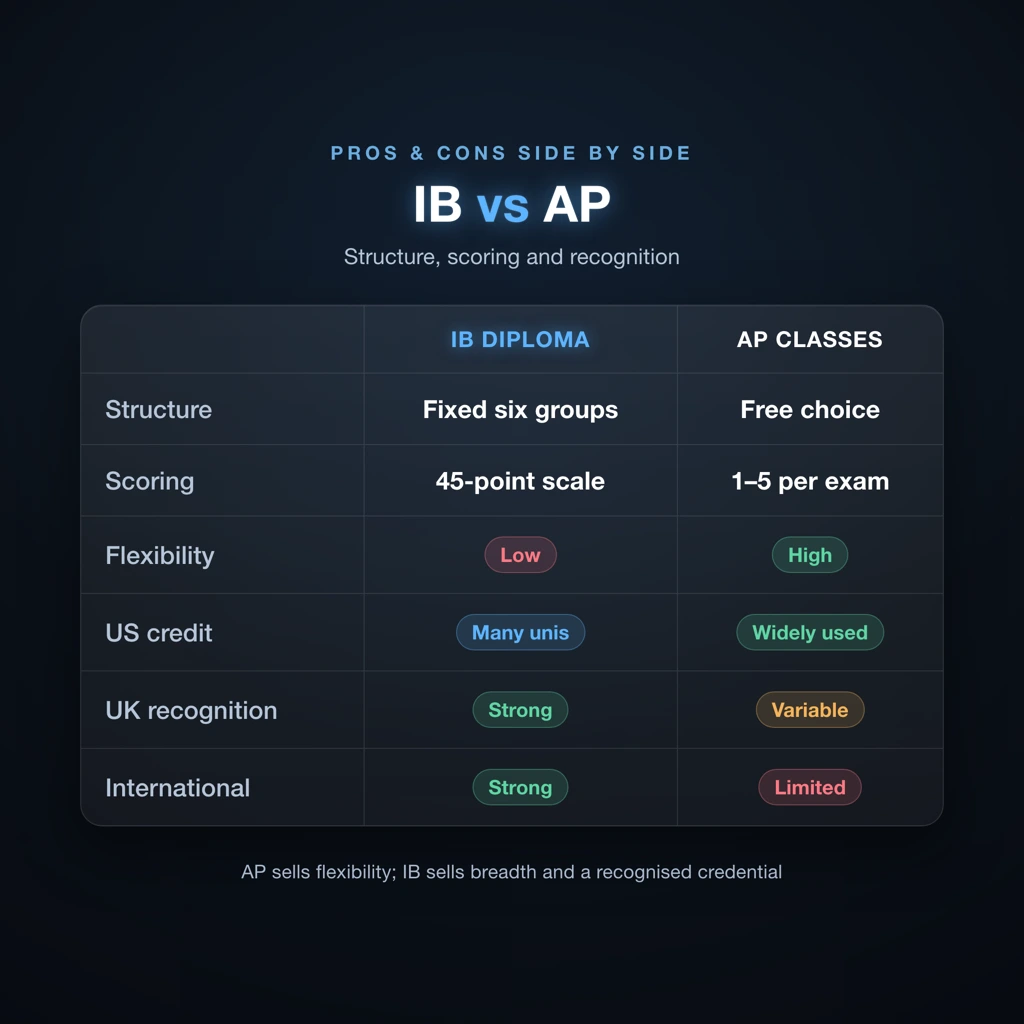
The clearest way to frame the IB vs AP trade-off: the IB Diploma Programme sells breadth and a recognised credential; AP sells flexibility and direct US college credit. Neither is objectively better, but one will fit your school, goals, and learning style considerably better than the other.
The non-obvious trade-off most students miss: AP gives you the freedom to drop a subject after a poor mock - you simply don't sit that exam. The IB does not. Every component of the Diploma (Theory of Knowledge, the Extended Essay, CAS hours) counts whether you find it useful or not. That compulsory structure is genuinely valuable for some students and genuinely punishing for others.
IB Diploma Programme
Advantages
- Recognised as a standalone qualification by universities in the UK, Europe, and beyond, not just the US
- Six subject groups ensure breadth; you cannot avoid a science, a language, and a humanity
- The Extended Essay develops independent research skills that transfer directly to undergraduate dissertations
- TOK trains explicit critical thinking in a way that has no direct AP equivalent
Disadvantages
- Only available at IB-authorised schools, which limits access
- Compulsory elements add workload regardless of student preference or strength
- Less flexibility to specialise early
AP Classes
Advantages
- Pick any subjects that match your strengths, independently of other choices
- Widely available at US high schools and increasingly via online providers
- Qualifying scores can earn direct college credit at most US institutions
- Compatible with other programmes, including A-Levels
Disadvantages
- No diploma credential: AP is a collection of individual scores, not a single qualification
- Recognition outside the US and Canada is weaker and inconsistent
- No interdisciplinary core means critical thinking and research skills depend entirely on individual teachers
Comparison Table
| Factor | IB Diploma | AP Classes |
|---|---|---|
| Structure | Fixed six-subject programme | Pick any combination |
| Scoring | 45-point scale | 1-5 per exam |
| Credential | Full diploma awarded | No diploma; individual scores only |
| Flexibility | Low | High |
| US college credit | Possible at many universities | Yes, widely accepted |
| UK university recognition | Strong | Variable; offers usually made on predicted grades |
| International recognition | Strong | Limited outside North America |
6. IB vs AP vs A-Level: Where Does Each Sit?
A-Levels, the IB Diploma, and AP courses are all demanding, but they are structured around different educational philosophies rather than different levels of difficulty.
A-Levels (offered through AQA, Edexcel, OCR, and others) ask students to study typically three subjects over two years in genuine depth. That narrowness is intentional: a student taking A-Level Further Mathematics is going considerably further into the material than an IB HL Mathematics candidate covering the same topic, because A-Level has no breadth requirement pulling time in other directions.
The IB Diploma requires six subjects, Theory of Knowledge, an Extended Essay, and CAS. That breadth is its distinguishing feature compared with A-Levels, but it does mean each subject, even at Higher Level, does not always reach the same depth as a corresponding A-Level. The counterintuitive trade-off: IB HL Chemistry is rigorous, but an A-Level Chemistry student has spent roughly the same contact hours on Chemistry alone that an IB student spread across six subjects.
AP courses sit closest to A-Levels in being subject-specific exams, but they are standalone assessments rather than a coherent qualification. A student can take one AP or ten.
For students at UK secondary schools, A-Levels remain the standard path. IB is available at authorised schools as a genuine alternative. AP is rarely a primary secondary qualification in the UK context; it appears most often when a student at an international or independent school needs to signal academic breadth to US colleges.
When comparing ib vs ap vs A-Level difficulty, the honest answer is that all three are demanding. The difference is shape: narrow and deep (A-Level), broad and structured (IB), or flexible and modular (AP).
7. What to Do Next
The clearest shortcut: check whether your school is an authorised IB World School. If it is not, the IB Diploma Programme is simply not on the table, and AP or A-Levels are your realistic options regardless of which looks better on paper. You can verify IB World School status directly through the IBO's school finder.
If your school does offer the Diploma Programme and you are targeting UK or international universities, IB is the more coherent choice. If you are in a US-curriculum school aiming at US colleges, AP gives you more flexibility to pick your subjects without committing to the full programme structure.
Two concrete next steps before you decide:
- UK applicants: Use the UCAS Tariff calculator to see exactly how IB points translate to the points figures in your university offers. Note that universities are not obligated to accept Tariff points even when a qualification appears in the table.
- Everyone: Contact each target university's admissions or registrar office directly to confirm their credit policy for IB HL and AP scores. Policies differ by department, not just by institution.
Email your school's IB coordinator or AP adviser this week and ask which qualifications your school is authorised to deliver.
FAQ
Is IB or AP better for Ivy League admissions?
Both are viewed as rigorous by Ivy League admissions offices; neither is formally preferred, but completing the full IB Diploma or taking 5+ AP exams in demanding subjects both signal academic ambition - the specific subjects and grades matter more than which programme you chose.
Does IB or AP give more college credit?
It depends on the university: many US institutions grant credit for AP scores of 4 or 5 and for IB Higher Level grades of 5-7, but IB credit policies are applied less uniformly than AP policies, so you should check the specific institution's credit transfer page.
Is IB or AP harder?
The full IB Diploma is generally considered more demanding overall because of its compulsory core (TOK, Extended Essay, CAS) on top of six subjects; individual AP courses can match IB Higher Level content depth, but there is no equivalent sustained workload across two years.
Is IB or AP better for UK universities?
The IB Diploma is the stronger choice for UK university applications - it is accepted by all Russell Group universities with published grade equivalencies, whereas AP exams are not assigned UCAS Tariff points and are rarely specified in UK offer conditions.
Is IB or AP better for medical school?
Both are accepted as pre-medical preparation; what matters for medical school entry is strong performance in relevant science subjects - Biology and Chemistry at IB Higher Level, or equivalent AP Biology and AP Chemistry scores of 4 or 5.
Are IB or AP exams harder?
IB Higher Level exams are broadly comparable in difficulty to AP exams in the same subject, though IB exams also incorporate internally assessed components (coursework and practicals) that AP largely does not, making the overall assessment more varied.
References
- Assessment FAQ - International Baccalaureate® - https://ibo.org/programmes/diploma-programme/assessment-and-exams/getting-results/assessment-faq/
- Calculate your UCAS Tariff points | UCAS - https://www.ucas.com/applying/before-you-apply/what-and-where-to-study/entry-requirements/calculate-your-ucas-tariff-points