Law Personal Statement Example for 2026 UCAS Entry
By Michael Thompson · Education Specialist; 10 years teaching the IB at Bromsgrove School · Published 4 September 2026
A law personal statement example is one of the most searched resources on UCAS applications - and also one of the most misused. For 2026 entry, the format has changed: instead of a single open essay, applicants answer three structured questions within a 4,000-character total limit. This guide gives you a complete example statement written specifically for this guide, split across all three questions, then annotates each answer so you can see exactly what is working and why. Whether you're applying to a Russell Group university, aiming for Oxford or Cambridge, or switching from a non-law A-level background, the same principles apply.
Key Takeaways
- Three questions, 4,000 characters total: The 2026 UCAS personal statement is no longer a single essay - it is split across three structured questions, each requiring a minimum of 350 characters, per UCAS guidance.
- Question 1 is your analytical showcase: Why you want to study law should be answered with a specific legal idea, case, or text that made you think - not a general statement about always loving justice.
- Work experience in a firm is not required: Reading widely, attending magistrates' court, completing a virtual work experience, or writing an EPQ on a legal topic all count as valid preparation evidence.
- Cambridge and Oxford read for intellectual engagement, not activities: Cambridge explicitly discourages statements like 'I have always wanted to study this subject' and expects applicants to follow current legal affairs.
- Non-law A-level applicants should highlight transferable analytical skills: A-level History, Politics, or English can all be mapped to legal reasoning - the key is to name the specific skill and connect it to what a law degree demands.
- Every sentence should earn its place: With only around 500 words across three answers, one vague paragraph wastes roughly 20% of your total budget.
In This Article
- The 2026 UCAS personal statement format for law applicants
- What law admissions tutors are actually looking for
- A complete law personal statement example (written for this guide)
- Question-by-question annotation: what the example is doing
- Evidencing analytical thinking without a law firm placement
- Law personal statement checklist: apply this to your own draft
- What to do next
1. The 2026 UCAS personal statement format for law applicants
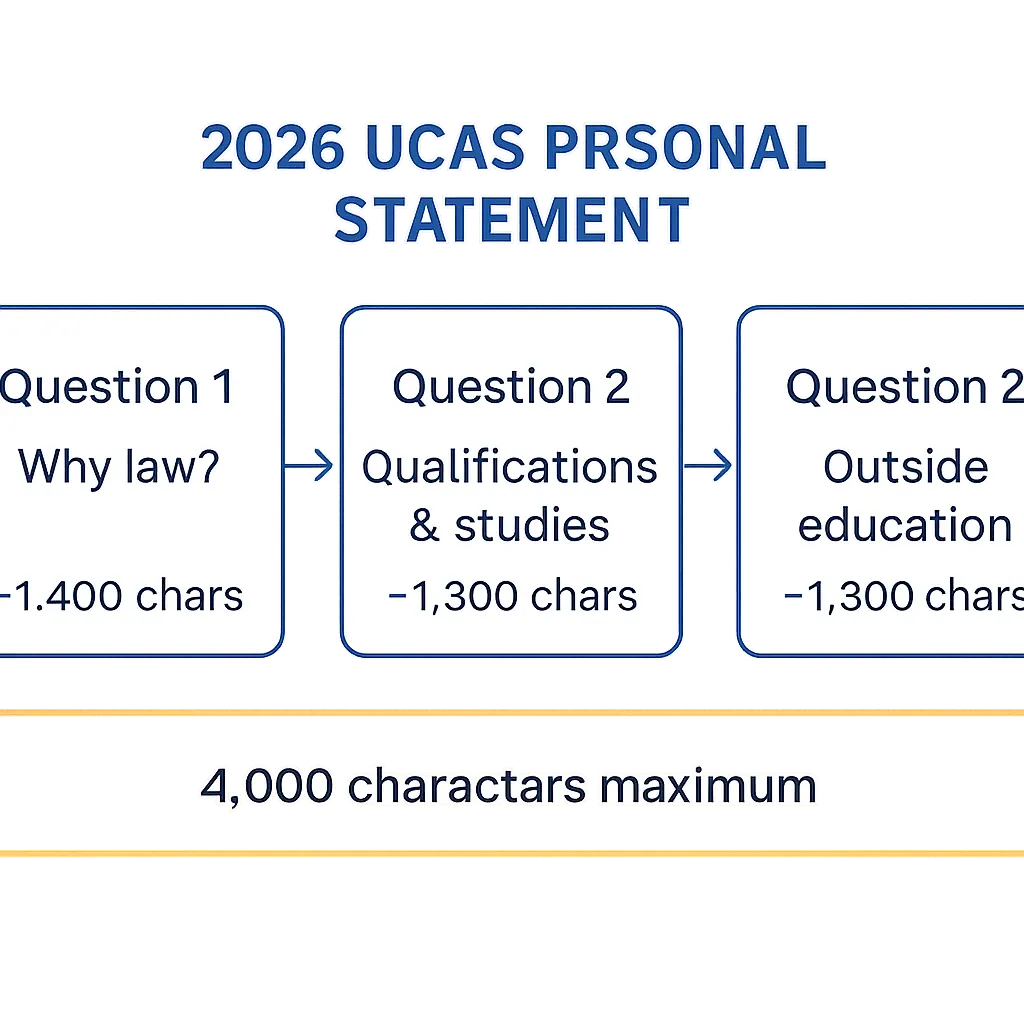
Every law personal statement example you find online was written for the old single-essay format. From September 2025, that format is gone. UCAS now requires applicants to answer three separate structured questions within a total limit of 4,000 characters, with each answer requiring a minimum of 350 characters.
The three questions are:
| Question | What it asks |
|---|---|
| Q1 | Why do you want to study this course or subject? |
| Q2 | How have your qualifications and studies helped you to prepare for this course or subject? |
| Q3 | What else have you done to prepare outside of education, and why are these experiences useful? |
One counter-intuitive point that catches applicants off-guard: UCAS is explicit that Q2 should not repeat your grades, because universities see those elsewhere on your application. Listing your A-level results there wastes characters and signals poor judgement to admissions tutors.
The other structural quirk to flag early: because the same statement goes to every university you apply to, you should not tailor it heavily to one institution. Christ's College Cambridge notes this directly, adding that Cambridge applicants can submit a separate additional statement via the My CApp Form, visible only to Cambridge. That separate route is where Oxford and Cambridge-specific framing belongs, not the UCAS statement itself.
The example and annotation below are written with this three-question structure in mind.
2. What law admissions tutors are actually looking for
According to the UCAS law personal statement guide, tutors assess three things: your understanding of the subject, your articulacy and breadth of reading, and the skills and dedication needed for both degree study and a legal career. Most applicants address the first and third. The middle one, reading breadth, is where many statements fall flat.
Cambridge raises the bar further. The UCAS guide names Cambridge specifically as a university that expects applicants to follow current affairs and engage with the legal implications of news stories. The examples given are concrete: changes to employment law and the legal consequences for consumers when personal data is stolen. A statement that references only books and ignores live legal questions will read as narrow to a Cambridge tutor.
The counter-intuitive part concerns extracurricular activity. Christ's College Cambridge is explicit: football, drama, and being head girl are classified as not relevant. What counts as relevant are super-curricular activities tied to academic preparation, including mooting, essay competitions, and work placements with legal dimensions. Christ's also states it assesses applicants only on academic criteria. Two sentences on non-academic interests is the ceiling, not the floor.
The practical implication: every activity you mention should connect to legal reasoning, independent thinking, or subject knowledge, not personal character in the abstract.
3. A complete law personal statement example (written for this guide)
The law personal statement example below was written for this guide. It is not a real applicant's submission. It is designed to show how a candidate studying History, Politics, and English Literature at A-level can make a credible, specific case for law without law-adjacent subjects or a firm placement on their CV.
The three questions follow the 2026 UCAS format: Question 1 (~1,400 characters), Question 2 (~1,300 characters), and Question 3 (~1,300 characters), totalling under 4,000 characters.
One counter-intuitive point before you read: applicants often front-load their reading list into Question 1. The stronger move is to anchor the book to a specific argument, then let Questions 2 and 3 show how your subjects and experiences test that argument from different angles.
Question 1: Why do you want to study this course or subject?
Reading Sarah Langford's In Your Defence unsettled an assumption I had held without examining it: that the law's job is to reach the correct verdict. Langford's account of a client acquitted on a technicality she privately knew was guilty forced me to separate the question of legal process from the question of moral outcome. I am not sure those two things should be the same, and I want to study law partly to work out why.
My interest sharpened when I followed the government's changes to employment law for gig-economy workers. I tracked the argument across news coverage and tried to identify where the dispute was legal rather than political. The two kept blurring. My History A-level gave me a framework for that: law does not operate outside its moment. The statutes passed in any decade carry the priorities of that decade inside them, sometimes visibly, sometimes not.
I am drawn to criminal law because it sits at the intersection of individual rights and collective power. But I am aware that corporate and commercial contexts raise structurally similar questions about who law protects and at what cost. I want to study a degree that pushes me across both.
Question 2: How have your qualifications and studies helped you to prepare for this course or subject?
History at A-level (AQA) trained me to construct an argument from incomplete and contested evidence, which is closer to legal reasoning than I initially realised. Writing an essay on the causes of the 1832 Reform Act, I had to weigh primary sources that contradicted each other without a tiebreaker. There is no answer key. That discomfort is, I think, useful preparation.
English Literature developed my sensitivity to how language performs as well as states. Studying the rhetoric of political speeches alongside poetry made me notice when an argument is doing something other than what it announces. I expect that will matter when I read judgments.
Politics A-level gave me the constitutional vocabulary to ask more precise questions: about parliamentary sovereignty, judicial review, and the limits of executive power. When I wrote a timed essay on the role of the Supreme Court, I found myself wanting a more technical grounding than the syllabus provided. That gap is what a law degree is for.
I have also completed a short online course in legal reasoning through an open university platform, which introduced me to statutory interpretation and the literal, golden, and mischief rules.
Question 3: What else have you done to prepare outside of education, and why are these experiences useful?
*Last spring I visited my local magistrates' court as a member of the public. I watched four hearings over a morning. Two were straightforward guilty pleas; one was an adjournment for legal representation; one was a bail application that turned on a single disputed fact about address. I had not expected bail decisions to feel so consequential or so fast. The UCAS law personal statement guide lists court visits as relevant experience, and I understand why: reading about procedure and watching it are different.*
I also completed a Springpod virtual work experience in law. The structured tasks included drafting a client-facing summary of a contractual dispute, which taught me that precision in writing is not the same as complexity. The hardest part was reducing without distorting.
Outside school, I have edited my sixth-form's student publication for two years, which required me to make judgment calls about accuracy under deadline pressure. I do not think editorial judgment and legal judgment are the same thing, but both require you to be precise about what you actually know versus what you are inferring.
Section 4 annotates each paragraph of this law personal statement example to explain the specific choices made and why they work.
4. Question-by-question annotation: what the example is doing
The example in section 3 is built around the three UCAS questions. Here is what each section is doing technically, and where a weaker draft would have fallen apart.
Question 1: Why do you want to study this course?
The strongest line an admissions tutor would notice is the one that identifies a specific legal tension and names a stake, rather than expressing a general love of argument or fairness. That move signals that the applicant has read around the subject, not just watched courtroom dramas.
The analytical move: the example takes a concrete scenario (a named area of law), surfaces the conflict between two competing principles, and states which way the argument cuts and why. That is legal reasoning in miniature.
Weaker version of the same paragraph:
> "I have always been fascinated by law and how it affects society. I enjoy debating and thinking about right and wrong."
Per the UCAS law personal statement guide, admissions tutors look for understanding of the subject alongside articulacy. The weaker version demonstrates neither.
Question 2: How have your qualifications and studies prepared you?
The example maps skills to legal tasks rather than listing subjects and grades. History A-level is linked to source evaluation; English Literature is linked to statutory interpretation; Philosophy is linked to identifying logical fallacies in argument. The grades are never named, because Question 2 is asking about capability, not achievement.
Weaker version:
> "I study History, English Literature, and Philosophy at A-level and these have given me a broad set of skills useful for law."
That tells an admissions tutor nothing about mechanism. The stronger version shows the bridge.
Question 3: What have you done to prepare outside education?
This is where the format quirk matters most. Cambridge's guidance states that non-academic activities must not occupy more than 20% of the section in which they are mentioned. Sport, drama, and head-girl duties are effectively dead space in a Cambridge law application, as Christ's College confirms.
The example handles the absence of a firm work placement by stacking three lighter-weight but credible signals:
- A magistrates' court visit, which the UCAS guide lists explicitly as relevant experience.
- A named book (one of the titles recommended in the same guide: In Your Defence, The Sentence, or In Black and White), with a one-sentence analytical observation drawn from it.
- A Springpod virtual work experience, also named in the UCAS guide as a recognised platform.
The counter-intuitive point: three specific, briefly handled items read as more credible than one vague claim of shadowing a solicitor. Length does not equal weight here. Keeping Question 3 tight also protects the 20% ceiling if any of the content is non-academic.
5. Evidencing analytical thinking without a law firm placement
A law firm placement looks impressive on paper, but it is not a requirement. The UCAS law personal statement guide names mini-pupillage, shadowing at a Citizens Advice Bureau, and visits to a local magistrates' court as valid experience for Question 3. These are accessible to most applicants regardless of location or connections.
Reading is equally credible, provided you analyse rather than list. The same UCAS guide recommends titles with legal dimensions, specifically In Your Defence, The Sentence, and In Black and White. The gotcha many applicants miss: naming a book earns nothing on its own. What tutors want is a sentence that extracts a legal argument from the reading and tests it against something you have observed or studied. "I read In Your Defence and found it interesting" is inert. "Sarah Langford's account of guilty plea pressures in In Your Defence made me question how the cab-rank rule interacts with defendants who cannot afford delay" signals genuine engagement.
If you are applying without law A-level, your non-law subjects carry more weight than you might expect. For Question 2, the frame is transferable analytical skills, not a subject list:
- History teaches source evaluation and contested evidence, directly relevant to how courts assess witness testimony.
- Politics or Government builds structured argument and familiarity with constitutional frameworks.
- English Literature develops close reading of language, useful when statutory interpretation depends on a single word.
Describe the skill and connect it to a legal context. One specific connection beats three vague ones.
6. Law personal statement checklist: apply this to your own draft
Run through this list before you submit. It applies whether you are targeting Russell Group universities, Oxford, Cambridge, or other institutions.
- Opening line quality. Does your first sentence say something specific about a legal idea, case, or text? If it starts "I have always wanted to study law," rewrite it. Cambridge explicitly discourages that phrase.
- Specific legal content. Does Question 1 name at least one legal concept, statute, judgment, or book you have engaged with independently?
- No grade repetition in Question 2. UCAS states you should not repeat your grades because universities already see them on your application. Replace any grade references with what the subject taught you analytically.
- Skill-to-law-degree connection. Does Question 2 explain how a qualification or study method transfers to legal thinking, not just what grade you achieved?
- Super-curricular vs extracurricular balance. Mooting, essay competitions, and relevant reading count as super-curricular and belong in Questions 1 or 2. Football or drama belongs in Question 3, briefly. Christ's College Cambridge classifies extracurriculars as not relevant to admissions.
- Cambridge 20% rule. If you are applying to Cambridge, non-academic activities must not exceed 20% of the section in which they appear. That is a firm expectation, not a suggestion.
- 350-character minimum per question. Each of the three questions requires at least 350 characters. A thin answer on Question 2 or 3 is a mechanical failure before an admissions tutor reads a word.
- Total character count under 4,000. The statement has a 4,000-character limit across all three questions. Paste your draft into a character counter before submission.
- No cliched openers or vague motivation. Remove phrases like "I have always wanted to study law," "law is everywhere," or "I am passionate about justice." Name a specific legal problem instead.
- One statement, multiple universities. The same text goes to every UCAS choice. Read it back imagining an admissions tutor at each institution on your list. If it reads as written for Cambridge alone, revise it unless Cambridge is your only choice.
7. What to do next
Open the checklist from section 6 against your current draft this week, before the October UCAS deadline window opens. One counter-intuitive habit to build now: read the statement aloud and cut any sentence that could appear in a personal statement for a different subject. Law tutors, including those at Cambridge, expect applicants to engage with the legal implications of real events, not just express enthusiasm for justice in the abstract.
Once you have a revised draft, read the UCAS law personal statement guide alongside it. The guide names specific qualities admissions tutors look for and gives concrete reading suggestions you can act on immediately.
Run the section 6 checklist against every paragraph of your draft today. Cut anything generic before you show it to a teacher.
FAQ
Can I use a law personal statement example as a template for my own?
Examples are useful for understanding structure and tone, but copying or closely paraphrasing any example - including this one - risks a plagiarism flag; use examples to identify the moves a strong answer makes, then apply those moves to your own ideas and experiences.
Do I need work experience at a law firm to write a strong law personal statement?
No - the UCAS law guide lists mini-pupillage, Citizens Advice Bureau shadowing, and magistrates' court visits as valid alternatives, and reading analytically or completing a virtual work experience can also serve as preparation evidence in Question 3.
How long should each answer be in the new 2026 UCAS personal statement format?
UCAS sets a 4,000-character total limit and a 350-character minimum per question, but there is no fixed per-question cap - most law applicants allocate roughly 1,300-1,500 characters to each of the three questions.
What do Oxford and Cambridge look for in a law personal statement?
Cambridge expects applicants to follow current affairs and engage with their legal implications, discourages generic opening statements, and advises that non-academic activities should not exceed 20% of the relevant section; Oxford's approach is similar in prioritising intellectual engagement over activities.
How do I write a law personal statement if I am not studying A-level Law?
Focus Question 2 on the transferable analytical skills your actual A-levels develop - source evaluation from History, constructing arguments from English or Politics - and connect each skill explicitly to what a law degree requires.
References
- Personal statement tips for international students: 2026 entry | UCAS - https://www.ucas.com/applying/applying-university/writing-your-personal-statement/personal-statement-tips-international-students-2026-entry
- Personal statement toolkit | UCAS - https://www.ucas.com/advisers/help-and-training/toolkits/personal-statement-toolkit
- UCAS personal statement | Christs College Cambridge - https://www.christs.cam.ac.uk/international-students/apply/statement
- Law personal statement guide | UCAS - https://www.ucas.com/applying/applying-to-university/writing-your-personal-statement/personal-statement-guides/law-personal-statement-guide
- Writing your personal statement | Undergraduate Study - https://www.undergraduate.study.cam.ac.uk/apply/how/ucas-personal-statement