Nursing Personal Statement Example: Annotated for 2026 Entry
By Michael Thompson · Education Specialist; 10 years teaching the IB at Bromsgrove School · Published 4 September 2026 · Updated 6 October 2026
A nursing personal statement example can show you what good looks like - but only if you understand what the question is actually asking. From 2026 entry, UCAS replaced the single free-text essay with three structured questions, each targeting a different part of your application. This guide gives you a complete example statement written for adult nursing, split across all three questions with realistic character budgets, then annotates it paragraph by paragraph so you can see the decisions behind every sentence. The aim is not to give you something to copy, but to show you what an admissions tutor notices - and what a weaker version of the same paragraph looks like.
Key Takeaways
- Three questions, 4,000 characters total: From 2026 entry, UCAS structures the personal statement around three distinct prompts, each with a minimum of 350 characters; you distribute the remaining budget however you like.
- Commit to one nursing field: Most admissions tutors expect applicants to apply for one specific field - adult, children's, mental health, or learning disability nursing - and your statement should reflect that focus throughout.
- Show reflection, not just a list of activities: Naming a care placement is not enough; you need to explain what you observed, what it made you think, and how it confirmed or complicated your understanding of nursing.
- Don't repeat your grades: Universities see your predicted and achieved grades elsewhere on the UCAS form; Question 2 should focus on what you did with your education, not restate the results.
- Evidence the NHS Constitution's values implicitly: Rather than quoting the document, demonstrate values like compassion, dignity, and person-centred care through concrete moments from your experience.
- Annotate before you redraft: Label every paragraph in your own draft with the job it is doing; if two paragraphs do the same job, cut or merge them.
In This Article
- The 2026 UCAS personal statement format for nursing applicants
- The complete nursing personal statement example (written for this guide)
- Annotated: what Question 1 is doing and why it works
- Annotated: what Question 2 is doing and why it works
- Annotated: what Question 3 is doing and why it works
- How to adapt this adult nursing example for other fields
- Nursing personal statement checklist: apply this to your own draft
- Where to go from here
1. The 2026 UCAS personal statement format for nursing applicants
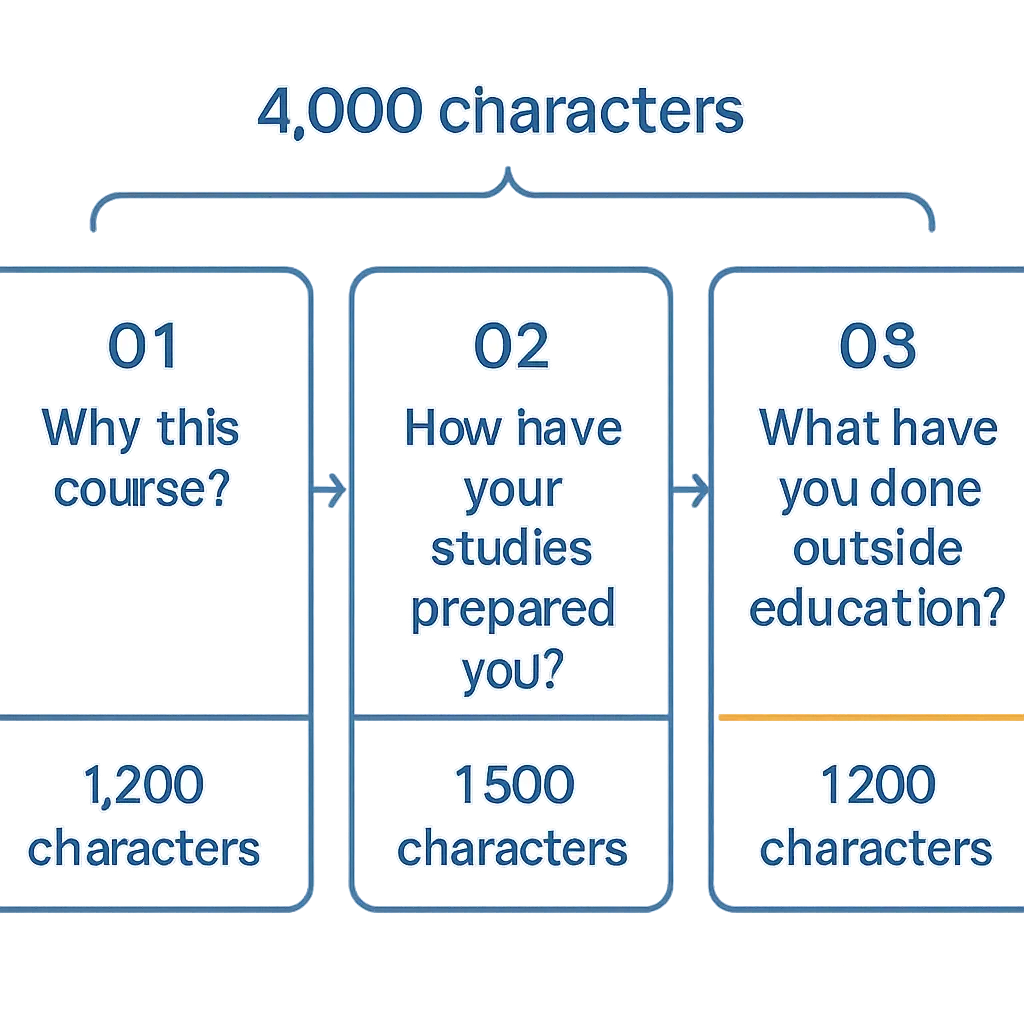
The nursing personal statement example you'll find in this guide is built around a format that changed significantly for 2026 entry. UCAS replaced the old single free-text essay with three separate structured questions, each with its own answer box. The overall character limit stays at 4,000 characters (including spaces), and each answer must be at least 350 characters.
The three questions, exactly as UCAS phrases them, are:
- Question 1: "Why do you want to study this course or subject?"
- Question 2: "How have your qualifications and studies helped you to prepare for this course or subject?"
- Question 3: "What else have you done to prepare outside of education, and why are these experiences useful?"
One non-obvious point: UCAS is explicit that there is no "wrong" question in which to place information, provided the evidence is relevant. Admissions staff read all three answers as a whole statement. That means a reflection on a care-home placement could sit in Question 1 or Question 3 depending on how you frame it - the split is a writing decision, not a rule.
The 4,000 characters are yours to distribute. There is no prescribed word count per question beyond the 350-character floor. The example in Section 2 uses a realistic split to show one way to allocate the budget without leaving any question starved.
For nursing specifically, most admissions tutors expect you to apply for one field: adult, children's, mental health, or learning disability nursing. A small number of courses allow a "dual field" application covering two fields, but this is the exception. The example below is written for adult nursing, with Section 6 covering how to adapt it for other fields.
2. The complete nursing personal statement example (written for this guide)
The example below was written for this guide. It does not represent a real applicant. It is structured around the 2026 UCAS format: three separate questions replacing the previous open-ended personal statement. Read it as a complete nursing personal statement example before the annotations in sections 3, 4, and 5 break each part down.
The focus field is adult nursing. The fictional applicant has care home experience, a hospital observation placement, and A-level study at a sixth form college.
Question 1: Why do you want to study this course or subject?
(Approx. 1,400 characters)
> Nursing is not a single skill - it is a continuous act of attention. That understanding came into focus for me during a six-month role as a care assistant at a residential home for older adults, where I supported residents with personal care, meal assistance, and mobility. What struck me was how much the quality of care depended on the small things: whether you knocked before entering, whether you used someone's preferred name, whether you paused to listen before moving on to the next task. Those choices had nothing to do with clinical technique and everything to do with treating someone as a person rather than a patient on a list. > > That experience made me want to understand the clinical side more deeply. I arranged a week-long observation placement in a general medical ward at my local NHS trust, where I watched registered nurses manage complex, competing demands: administering medication, communicating with consultants, reassessing a patient whose condition had changed mid-shift. What I noticed was that the nurses who seemed most effective were also the most deliberate, not rushed despite the pressure. Adult nursing asks you to hold both the technical and the human dimension at the same time, and I want to be trained to do that well. > > I am applying for adult nursing specifically because I want to work with people across a wide range of conditions and life stages, and because the physical and emotional demands of the role are ones I have begun to understand firsthand rather than in the abstract.
Question 2: How have your qualifications and studies prepared you?
(Approx. 1,100 characters)
> I am studying A-level Biology, Psychology, and Sociology at sixth form. Biology has given me a working understanding of body systems that I can already connect to what I observed on the ward: watching a nurse interpret fluid balance charts made far more sense once I had studied renal function. Psychology has deepened my thinking about how patients respond to illness and how communication style affects the therapeutic relationship. Sociology has introduced me to health inequalities and the structural factors that shape who accesses care and how. > > Beyond the classroom, I completed a first aid qualification and a safeguarding awareness course through my care assistant role. I also attended a study day on dementia care run by the home's senior nurse, which introduced me to person-centred models and the practical challenge of supporting someone whose capacity to express preferences fluctuates from day to day. That day shifted how I thought about consent: it is not a single conversation but an ongoing, adaptive process. > > These experiences, academic and practical together, have prepared me to engage with a nursing degree that combines scientific rigour with reflective professional practice.
Question 3: What else would you like the admissions team to know about you?
(Approx. 1,500 characters)
> Over the past year I have volunteered one evening a week at a befriending service for adults living with long-term mental health conditions. My role is straightforward: I spend time with someone who would otherwise have very little social contact that week. There is no clinical task attached to it. > > That simplicity turned out to be instructive. Early on, I assumed the value I was offering was conversation, so I prepared things to talk about and asked questions to keep the exchange moving. A supervisor observed a session and gently pointed out that I was filling silences rather than sitting with them. She was right. The person I visited was not looking for a busy conversation; they were looking for company that did not feel pressured. I adjusted, and the visits became noticeably more settled. > > That correction taught me something I think applies directly to nursing: the instinct to do can get in the way of being present. It also made me more comfortable with the emotional weight that comes with sustained contact with people who are struggling. I do not find it easy, but I no longer find it destabilising. > > I am aware that adult nursing involves shift work, physical demands, and situations where outcomes are not good. I have not experienced those pressures at scale, but I have spent enough time in care settings to understand that resilience in this context is not about being unaffected. It is about continuing to give consistent, dignified care even when a shift is hard. That is the standard I want to hold myself to.
A non-obvious point for applicants: Question 3 is where most nursing personal statement examples go generic, defaulting to statements about empathy and commitment. The example above uses a specific corrective moment from a named role to show self-awareness. That shift from assertion to evidence is what admissions tutors at nursing schools tend to mean when they say they want reflective applicants.
3. Annotated: what Question 1 is doing and why it works
Question 1 asks why you want to study your chosen subject. In a nursing personal statement, every sentence in that response needs to earn its place. Here is what each part of the example is doing.
The opening hook names a specific moment, a clinical observation during a placement, rather than a feeling. That choice is deliberate. UCAS admissions tutors advise that they are looking for genuine reflection, not declared enthusiasm. A scene-setting opener gives them something concrete to assess.
The subject motivation passage moves from that moment to a reasoned explanation of why adult nursing specifically. This is where the contrast with weaker drafts is sharpest. A common failing opener reads: "I have always wanted to help people and nursing is the perfect career for me." It tells the tutor nothing about the applicant's understanding of the role. The stronger version in this example names the relational and physical demands of nursing directly, acknowledging that care involves sustained emotional labour alongside clinical skill, not just goodwill.
The field-specific reasoning is the line an admissions tutor is most likely to pause on. It demonstrates that the applicant knows adult nursing is a distinct field, separate from children's, mental health, and learning disability nursing, and has a considered reason for choosing it. UCAS notes that most tutors expect applicants to apply to one specific field. Vague enthusiasm across all four reads as indecision.
The future ambition sentence closes the response briefly and without overreach. One non-obvious trap here: applicants who write at length about where they see themselves in ten years often crowd out the evidence of current understanding. Keep this element tight.
4. Annotated: what Question 2 is doing and why it works
Question 2 asks: "How have your qualifications and studies helped you to prepare for this course or subject?" The critical thing to understand is that your grades already appear elsewhere on the UCAS application. UCAS is explicit that grades should not be listed in the personal statement itself - so Question 2 is not a transcript summary. It is an evidence brief.
The example answer references specific content from A-level Biology (understanding of homeostasis and pharmacology) and Health and Social Care (safeguarding frameworks, person-centred approaches) to show transferable analytical skills. The move from subject content to transferable skill is what separates a strong answer from a weak one.
What a weaker version looks like:
- A-level Biology: predicted A
- A-level Psychology: predicted B
- BTEC Health and Social Care: Distinction
That tells admissions tutors nothing they cannot already read on the application form.
What the example does instead: it names a module, describes what it required the applicant to do (analyse conflicting evidence, apply a theoretical framework to a case study), and connects that directly to nursing practice.
The example also references an EPQ on pain management in post-operative patients. UCAS guidance for nursing applicants specifically highlights the EPQ as an opportunity to demonstrate academic depth beyond the standard syllabus, citing topics such as complementary therapies in NHS cancer patients as models. The counter-intuitive point: an EPQ on a nursing-adjacent topic signals independent enquiry more effectively than a higher predicted grade in a core subject, because it shows the applicant sought out the discipline rather than completing the minimum.
Accomplishments worth naming here include student ambassador roles, relevant online qualifications (such as a First Aid certificate or an NHS-endorsed health literacy course), and subject competitions. UCAS confirms these sit naturally in Question 2.
5. Annotated: what Question 3 is doing and why it works
Question 3 asks what you have done to prepare outside of education. For nursing applicants, this is where care experience, volunteering, and personal responsibilities belong. UCAS explicitly accepts virtual work experience as valid evidence here, naming Springpod as a recognised provider, so lack of in-person placement is not automatically disqualifying.
What the example does in this section
The example describes a specific shift in a care home placement: the applicant observes a senior nurse taking time to explain a procedure to a resident who is visibly anxious, rather than simply completing the task efficiently. The applicant does not just log the observation. They reflect on why the nurse slowed down, connecting it to person-centred care and the resident's dignity. That reflection is the work admissions tutors are looking for.
The line that demonstrates genuine understanding of the profession's demands is the one acknowledging that good nursing sometimes means the slower option. That is a non-obvious insight. It signals that the applicant understands nursing involves competing pressures, not just kindness.
The weaker version looks like this
> "I volunteered at a care home for six months. I helped residents with meals, activities, and conversations."
That is an activity list. It tells a tutor what you did, not what you understood. UCAS nursing admissions guidance makes clear that universities want to see how experiences have shaped your thinking, not a log of hours.
The stronger version anchors each experience to a moment of learning. One observed incident, reflected on honestly, outweighs three months of unexamined activity. Apply that standard to every experience you name in Question 3.
6. How to adapt this adult nursing example for other fields
The four nursing fields recognised by UCAS are adult, children's, mental health, and learning disability. Most admissions tutors expect you to apply for one field only, and your personal statement should reflect that specific pathway. A statement written for adult nursing will not do the same work for children's nursing, because the competencies admissions teams are screening for are different.
Here is what to swap in for each field:
- Children's nursing. Centre your evidence on family-centred care: show that you understand you will be communicating with parents and guardians as much as with the child. Reference any awareness of safeguarding responsibilities. The communication skills you demonstrate must span age and developmental stage, not just patient rapport.
- Mental health nursing. Lived experience of mental health difficulties is a legitimate motivation, and UCAS guidance from admissions tutors makes clear it should be framed around what it taught you about the profession, not presented as the sole reason for applying. The risk of the latter is that it reads as unprocessed rather than reflective.
- Nursing associate. This is a different entry point, typically delivered through an apprenticeship. Your statement should describe your existing workplace context and the specific skills you are developing there, rather than mirroring a full degree application structure.
The annotation method in sections 3 to 5 applies to all four fields. Use it to check whether your evidence matches the field you have named, not just nursing in general.
7. Nursing personal statement checklist: apply this to your own draft
Work through these questions on your draft before you submit. A "no" or "not sure" means that section needs another pass.
Field specificity
- Does Q1 name one nursing field (adult, children's, mental health, or learning disability) explicitly? UCAS advises that most admissions tutors expect applicants to apply for one specific field only.
- Can you point to one sentence in Q1 that no other applicant could have written, because it references your specific setting, patient group, or clinical moment?
Reflection quality
- Does every experience you mention have a "what this taught me about nursing" sentence attached? Not a feeling, a concrete realisation.
- If you have drawn on personal health experience, does the statement explain how it motivated you, not just that it happened? UCAS admissions tutors flag this distinction explicitly for mental health applicants.
Question 2 discipline
- Are your current grades absent from Q2? UCAS states grades appear elsewhere on the application. Q2 should focus on accomplishments: an EPQ, a competition, a student ambassador role.
- Does Q2 contain at least one transferable academic skill rather than a subject summary?
Question 3 specificity
- Is there one concrete, datable moment in Q3 (a shift, a conversation, a patient interaction) rather than a general statement about wanting to help people? The phrase "I have always wanted to help people" is a signal to a reader that the question is not answered.
Character budget
- Have you used at least 350 characters in each answer? That is the minimum per question, as set by UCAS.
- Is your total across all three answers close to 4,000 characters? Leaving more than 400 characters unused is rarely a strength.
One final check Some universities score personal statements against their own published selection criteria, separate from UCAS guidance. Check the admissions pages of each university you are applying to before you submit.
8. Where to go from here
Open your draft now and read each paragraph in isolation. Write a single label above it: 'motivation', 'clinical evidence', 'placement reflection', 'academic readiness', 'understanding of the role'. If you cannot name the paragraph's job in one short phrase, that paragraph needs rewriting before anything else. This is a faster diagnostic than re-reading for tone, because it exposes the real problem: paragraphs that try to do three things at once end up doing none of them.
One counter-intuitive point worth remembering: admissions tutors read nursing personal statement examples in batches. A paragraph that is clearly doing one job, done well, reads faster and lands harder than a dense paragraph that covers more ground.
For planning and structure from an earlier stage, the nursing personal statement guide covers how to build the draft from scratch.
Label every paragraph this week, before you change a single word.
FAQ
How long should a nursing personal statement be for UCAS 2026 entry?
The total limit is 4,000 characters across all three questions, with a minimum of 350 characters per answer; there is no fixed split between questions, so you can distribute the budget based on how much you have to say in each section.
Can I use the same personal statement for adult nursing and children's nursing?
Most nursing admissions tutors expect applicants to write for one specific field, so a statement written for adult nursing will read as generic or misaligned if submitted for children's nursing without significant revision.
Should I mention the NHS Constitution in my nursing personal statement?
Rather than quoting the NHS Constitution directly, admissions tutors look for evidence of its values - compassion, dignity, person-centred care - demonstrated through concrete moments from your experience.
What work experience counts for a nursing personal statement?
In-person placements in care homes, hospitals, or community settings are the most direct evidence, but virtual work experience is also accepted; what matters in Question 3 is what you observed and what you reflected on, not just the hours logged.
Do I need to mention my A-level grades in the personal statement?
No - universities see your predicted and achieved grades elsewhere on the UCAS application, so Question 2 should focus on what you did with your studies, such as relevant modules, an EPQ, or positions of responsibility, rather than repeating results.
Can I include personal mental health experience in a mental health nursing personal statement?
Yes, but UCAS advises that applicants who reference their own mental health experience should explain how it has motivated them to become a nurse, rather than letting it stand as the sole reason for applying.
References
- How to write your personal statement: 2026 entry onwards | UCAS - https://www.ucas.com/applying/applying-to-university/writing-your-personal-statement/how-to-write-your-personal-statement-for-2026-entry-onwards
- Nursing personal statement guide | UCAS - https://www.ucas.com/applying/applying-to-university/writing-your-personal-statement/personal-statement-guides/nursing-personal-statement-guide
- Personal statement toolkit | UCAS - https://www.ucas.com/advisers/help-and-training/toolkits/personal-statement-toolkit