Medicine Personal Statement: Complete Guide for 2026 Entry
By Michael Thompson · Former IB Diploma Programme coordinator; 10 years at Bromsgrove School · Published 5 July 2026
A medicine personal statement for 2026 entry works differently from what most applicants expect: instead of one free-text essay, UCAS now asks three separate questions within a shared 4,000-character limit. Admissions tutors are not looking for a list of work-experience placements - they want evidence that you have reflected on what those experiences taught you about patient care, clinical pressure, and the realities of practising medicine. The statement also works alongside your UCAT score and academic grades rather than carrying the application alone, so the question is not how to impress with volume but how to make limited space count. This guide maps each question to medicine, shows you the difference between describing and reflecting, and explains what subject-specific preparation actually signals to a selector.
Key Takeaways
- Three questions, one 4,000-character pool.: From 2026 entry, UCAS splits the personal statement into three distinct questions; each needs at least 350 characters, and you decide how to distribute the rest.
- Reflection beats description every time.: Tutors want to know what a work-experience shift taught you about medicine - not just that you completed one; the difference is shown in the before/after section below.
- The statement works alongside your UCAT.: Most UK medical schools use admissions tests to shortlist, so the personal statement is read in context with test scores and grades, not as a standalone document.
- Depth over breadth for Cambridge and Oxford.: Both institutions explicitly prefer detailed engagement with a few activities over a long list - Cambridge guidance states it is 'better to focus on a few activities in detail'.
- IB applicants have specific evidence to draw on.: Your extended essay, science internal assessments, and CAS caring roles are concrete pieces of evidence for Questions 2 and 3 - use them.
- Medicine and dentistry applicants are capped at four course choices.: Because UCAS limits medicine, dentistry, and veterinary medicine to four choices, every word of your statement has to work for all four schools simultaneously.
In This Article
- What the 2026 UCAS Format Means for Medicine Applicants
- What Medicine Admissions Tutors Actually Reward
- Mapping the Three Questions to Your Medicine Application
- Description vs Reflection: Before-and-After Examples
- Subject-Specific Super-Curriculars That Carry Weight
- IB Students: Using Your Diploma as Evidence
- Medical Personal Statement Format and Practical Dos and Don'ts
- Oxford and Cambridge: What Their Guidance Actually Says
- Medicine and Dentistry Personal Statements: Key Differences
- What to Do Next
1. What the 2026 UCAS Format Means for Medicine Applicants
A medicine personal statement for 2026 entry looks nothing like the one your older sibling wrote. UCAS has replaced the single free-text essay with three structured questions, each carrying a minimum of 350 characters. The total character ceiling stays at 4,000 (including spaces), and you can distribute those characters across the three answers in any proportion you choose.
The three questions are:
- Why do you want to study this course or subject?
- How have your qualifications and studies helped you prepare?
- What else have you done to prepare outside of education, and why are these experiences useful?
Admissions staff read all three answers as a single whole, so repeating the same work experience or insight across two questions simply burns characters you cannot get back.
**The less obvious constraint for medicine applicants is the four-course cap.** Medicine, dentistry, and veterinary medicine each count against a dedicated limit of four applications, and one statement must serve every school you apply to. A detail that reads well for a research-heavy medical school can sit awkwardly for a graduate-entry programme with a different weighting, so your answers need to work across all four simultaneously rather than being tailored to a single institution.
The minimum of 350 characters per question also rules out leaving any section near-blank as a tactical choice. Every question demands a substantive answer.
2. What Medicine Admissions Tutors Actually Reward
Admissions tutors are not counting placements. A student who lists six shadowing experiences and says nothing about what those experiences taught them will score lower than one who describes two and reflects carefully on both. Sustained, reflective engagement is what distinguishes a strong medicine personal statement from a schedule.
Oxford's published selection criteria name the personal characteristics selectors are looking for:
- Empathy - genuine awareness of patients as people, not cases
- Motivation - a realistic, evidence-based reason for choosing medicine
- Communication - clarity under pressure, not just interpersonal warmth
- Honesty and integrity - Oxford states it may check claims made in personal statements, and fabricated or exaggerated material can bring suitability to practise into question
- Ethical awareness - recognition that clinical decisions involve competing values
- Ability to work with others - evidence from team settings, not assertion
The counter-intuitive point about the statement's weight: for A100 Medicine at Oxford, UCAT scores and GCSEs are predominantly used to determine interview shortlisting. The personal statement becomes more important precisely where those scores are borderline. That means a weaker UCAT result raises, rather than lowers, the stakes for what you write. It is not a box-ticking formality for borderline candidates - it is often the deciding document.
Reflection on patient care, clinical pressure, and the reality of the role is what turns a list of activities into evidence.
3. Mapping the Three Questions to Your Medicine Application
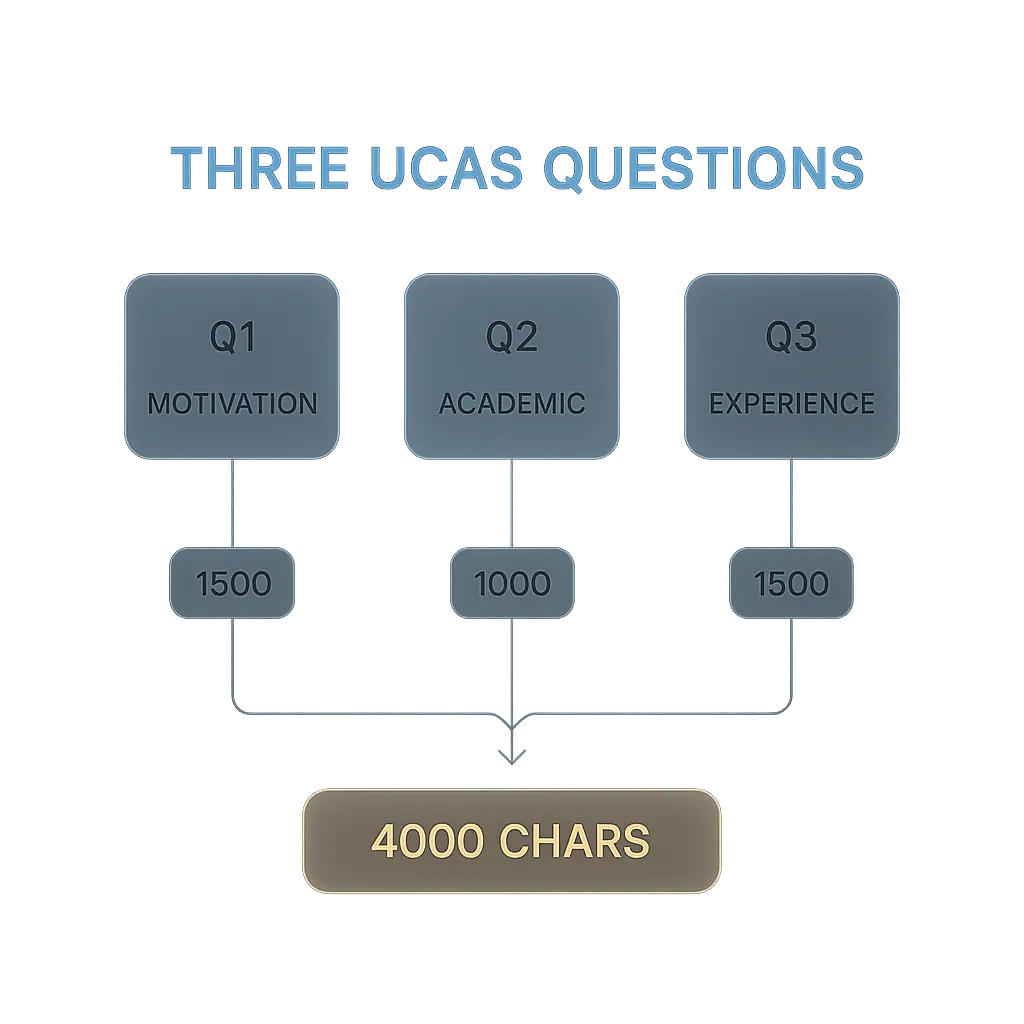
UCAS structures the 2026 personal statement as three distinct questions, each with a minimum of 350 characters. For medicine, each question has a specific job to do, and conflating them wastes your character budget.
Question 1: Why do you want to study medicine?
This is not a space for "I want to help people." Every applicant wants to help people. Admissions tutors are looking for evidence that you understand what clinical medicine actually involves: diagnostic uncertainty, patient non-compliance, end-of-life conversations, the gap between treatment and cure. Your answer should trace how specific experiences shaped that understanding. A conversation with a GP about the limits of evidence-based guidelines carries more weight than a general statement about compassion. Honest awareness of medicine's pressures, including the emotional cost of clinical work, signals maturity rather than weakness.
Question 2: How have your qualifications and studies prepared you?
UCAS explicitly excludes grades from this answer, because universities see them elsewhere in the application. The focus is on what you learned and how you learned it. A well-executed EPQ on a pharmacology topic, an AQA or OCR A-level independent investigation, or a short online university course all belong here. The less obvious point: briefly naming the method matters as much as the topic. Explaining that your extended project taught you to evaluate conflicting primary literature is more useful to a reader than listing its title.
Question 3: What else have you done outside education?
UCAS describes Question 3 as covering preparation outside formal education, including work experience, volunteering with vulnerable people, reading around medical ethics, and engagement with current healthcare issues. The activity itself is almost beside the point. What matters is the reflection: what did the experience reveal about clinical environments, about patients, or about your own assumptions? A single ward-shadowing shift, examined honestly, outweighs a list of ten activities with no analysis attached.
4. Description vs Reflection: Before-and-After Examples
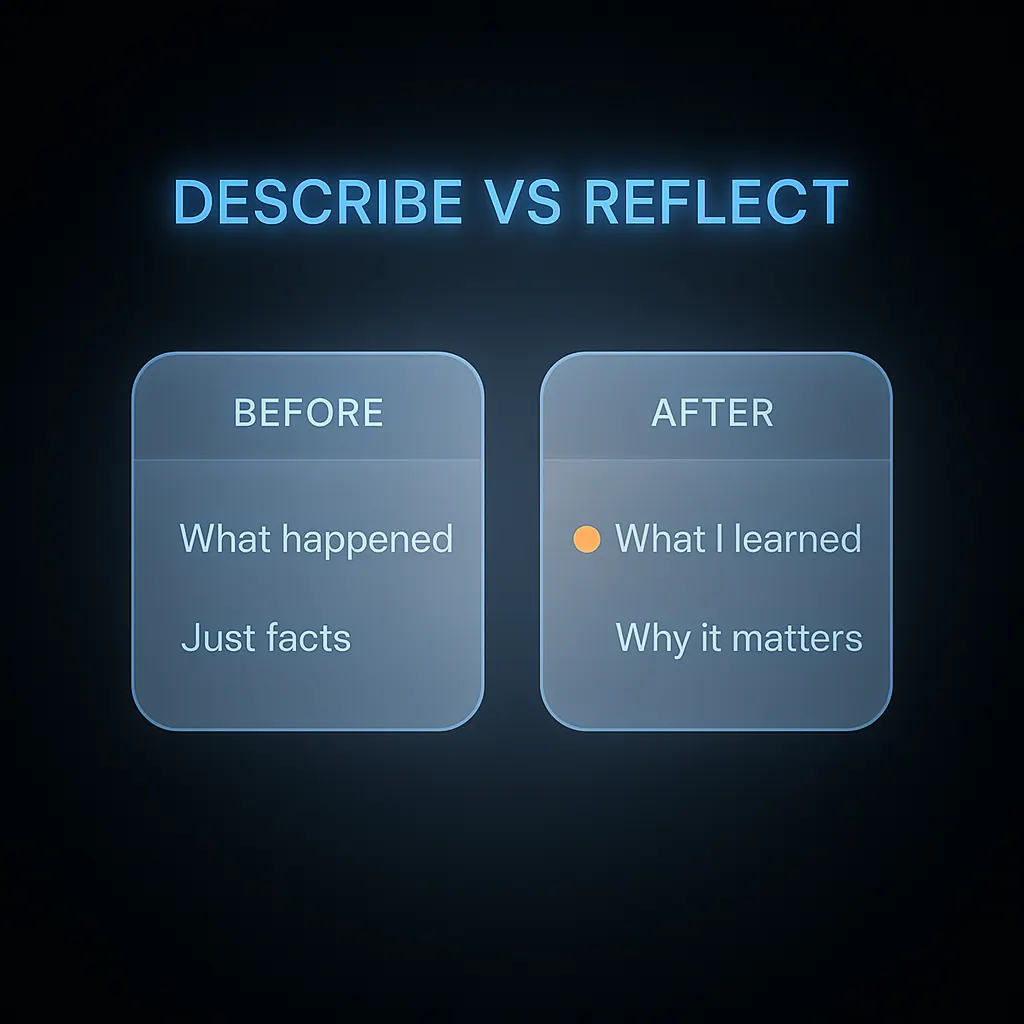
Most medicine personal statement drafts fail the reflection test not because the experiences are weak, but because the writing records events rather than thinking about them.
Before (descriptive): > "I spent a week on a hospital ward and observed doctors consulting patients."
This sentence confirms attendance. It tells an admissions tutor nothing about what you noticed, questioned, or changed your mind about. It could have been written by anyone in the building.
After (reflective): > "When a patient declined a recommended procedure, the consultant paused and spent ten minutes walking through the alternatives without once trying to persuade her. At the time I assumed this was inefficient; later I realised it was the job - that medicine's authority is technical, not directive, and that informed consent is the point where clinical knowledge meets patient autonomy."
The second version earns its place because it identifies a specific moment, names the tension it created, and shows thinking that shifted. That shift is the evidence admissions tutors are reading for.
The analytical principle behind the difference is precise. As the University of Cambridge's Reflective Practice Toolkit puts it, reflective writing is analytical rather than descriptive: it asks "why" rather than recording "what happened." The same source lists phrases that signal genuine reflection, including "At the time I felt..." and "Later I realised...", and distinguishes this mode of writing from a simple account of events.
One non-obvious gotcha: students often front-load reflection onto the most dramatic experience (a resuscitation, a bereavement) and describe the quieter shifts flatly. Admissions tutors read hundreds of statements built around high-drama moments. A genuinely observed small moment, reflected on carefully, reads as more credible than a spectacular one described in the same flat register as the rest.
5. Subject-Specific Super-Curriculars That Carry Weight
Admissions tutors can tell the difference between a student who read one book the week before applying and one who has been genuinely curious for months. The activities that carry weight are those that show sustained engagement with medicine as an intellectual and ethical field, not just as a career path.
Three categories signal genuine engagement most reliably:
- Medical ethics and debate - end-of-life care (the legal status of assisted dying in England vs Scotland), resource allocation in the NHS, and informed consent in clinical trials are all live debates with real policy stakes. Naming the specific tension you found interesting is far more convincing than citing a book title alone.
- Current issues in health systems - workforce pressures, NHS waiting times, or global health challenges such as antimicrobial resistance give you material to show you understand medicine as a profession embedded in public systems, not just a set of clinical skills.
- Structured volunteering reflection - work with elderly residents, patients with disabilities, or hospice visitors counts most when you describe what it changed in your thinking, not just how many hours you did.
The counter-intuitive point: listing six activities weakens a statement more than it helps. Cambridge's guidance is explicit that it is "better to focus on a few activities in detail" and that non-academic activities should not occupy more than 20% of the relevant section. The same principle applies across medical schools generally. One well-examined experience outweighs five briefly mentioned ones.
Practical rule: for each super-curricular, write one sentence on what you did and two sentences on what it made you think or question.
6. IB Students: Using Your Diploma as Evidence
Most UK medical schools require Higher Level chemistry as a minimum, and many also ask for a second HL science, typically biology or physics. Requirements vary enough between schools that checking each institution's official admissions page is not optional. To illustrate how specific these requirements get: Oxford Graduate Entry Medicine requires an overall IB score of 36 including core points, a minimum grade of 6 in all HL subjects, and HL Chemistry plus at least one of Biology, Physics, or Mathematics. Undergraduate programmes at other schools set their own thresholds, so confirm each one separately.
The counterintuitive point for IB students is that your diploma already contains ready-made evidence for Questions 2 and 3 of the UCAS form, provided you frame it correctly rather than simply listing components.
Where each IB element maps to your personal statement:
- Extended Essay in biology, chemistry, or psychology - demonstrates independent research, engagement with primary literature, and intellectual curiosity beyond the classroom syllabus. Name your EE topic and state what it revealed or challenged, not just that you wrote it.
- Science Internal Assessments - a well-chosen IA on a physiologically relevant topic (enzyme kinetics, reaction rates in biological contexts) is a concrete example of designing and evaluating an investigation.
- CAS caring or community roles - direct patient-facing or care-adjacent CAS hours map naturally onto the work experience evidence medical schools expect. Describe what you observed and what you questioned, not the number of hours logged.
Generic phrases like "the IB broadened my thinking" carry no weight. Specific content does.
7. Medical Personal Statement Format and Practical Dos and Don'ts
The character limits
Per UCAS, the total cap is **4,000 characters including spaces**, split across three questions. Each question requires a minimum of 350 characters. You can distribute the remaining budget however you like, so a longer answer to Question 1 (your motivation) at the expense of Question 2 is entirely permitted. UCAS states admissions staff read all three answers as a single whole, which means repeating the same experience across questions wastes characters and signals poor planning.
Dos
- Write in the first person throughout. Passive constructions ("it was observed that...") read as evasive.
- Name the experience and the idea it provoked. "Shadowing a respiratory consultant" is a starting point; the reflection on what you saw is the content.
- Check every claim for accuracy. Oxford's guidance states explicitly that fabricated or exaggerated material discovered during admissions, or later as a student, may bring your suitability to practise medicine into question. That is not a minor editing note.
- Keep grades out. UCAS confirms Question 2 explicitly excludes grades, which appear elsewhere in the application.
Don'ts
- **Don't open with a quote or a generic "I have always wanted to help people" sentence.** Admissions tutors read thousands of statements; this framing signals nothing specific about you.
- Don't list placements without reflection. A catalogue of work experience is not evidence of insight.
- Don't write for one specific university. The same text reaches all four schools you apply to, so any reference tailored to a single institution's programme reads as an error to the other three.
- Don't repeat content across the three answers. UCAS flags this directly.
The non-obvious trap: because the minimum per question is only 350 characters, it is technically possible to write a very short answer to one question and a very long answer to another. That flexibility is real, but an answer hovering near the minimum will almost always read as thin. Plan the distribution before you draft.
8. Oxford and Cambridge: What Their Guidance Actually Says
Oxford and Cambridge both take a similar formal position: neither institution gives the personal statement a numerical score. But that similarity conceals a meaningful difference in how each uses what you write.
At Oxford, UCAT scores and GCSEs do the heavy lifting at shortlisting stage. The statement becomes more important precisely when those numbers sit in a borderline zone. Once you are invited to interview, Oxford uses the statement as a direct source of interview questions, which means anything you write is fair game to be probed in depth. Oxford also states it may check claims made in the statement, and that fabricated or exaggerated material could call your suitability to practise medicine into question. That is a harder consequence than a rejected application.
At Cambridge, the official guidance is blunt on extracurriculars: non-academic activities "will not increase your chances of receiving a Cambridge offer," and they should occupy no more than 20% of the section in which they appear. Cambridge also warns against reflecting on classroom-based learning at length. The counterintuitive implication: a long passage about your A-level Biology coursework harms you almost as much as a paragraph about your Duke of Edinburgh award.
Both institutions recommend focusing on a few activities in depth rather than listing many. If you apply to Cambridge, note that you can also submit a shorter, course-specific statement via My Cambridge Application, which is worth using if your Medicine application differs significantly from your other UCAS choices.
9. Medicine and Dentistry Personal Statements: Key Differences
Medicine and dentistry share the same four-course UCAS cap, so an applicant combining both disciplines must produce one statement that works for two different selection panels simultaneously. That constraint is tighter than most applicants realise.
Dentistry selectors look for qualities that overlap significantly with medicine: clinical awareness, empathy, and an understanding of the patient experience. The distinguishing factor is manual dexterity. Dental programmes expect candidates to acknowledge the practical, hands-on nature of the work, and a statement that never references this reads as generic to a dental selector even if it impresses a medical one.
The motivation question is where the two disciplines diverge most sharply. Shadowing a dentist and observing how oral health connects to systemic conditions (cardiovascular disease, diabetes, nutritional deficiency) gives you dentistry-specific material that a medicine selector will still find relevant. Generic clinical exposure in a hospital ward does the opposite: it reads well for medicine and signals nothing particular to dentistry.
If you are applying to both, the practical approach is to build your statement around shared themes:
- Patient communication and the ethical weight of clinical decisions
- The gap between a patient's expectations and clinical reality
- Observing how preventive care changes outcomes
Avoid framing any single experience as the reason you want to be a doctor specifically. That one word can quietly undermine your dentistry applications without you noticing it until after submission.
10. What to Do Next
The statement doesn't improve by thinking about it longer. It improves by writing a draft and getting specific feedback on it.
Start this week with Question 1. Use the before-and-after reflection framework from Section 4: describe one moment, then write two sentences explaining what it changed in how you think about medicine. That single paragraph, done properly, is harder to write than it sounds, and it is the piece admissions tutors read most carefully.
Before you draft, check the entry requirements for every school on your list at the Medicine subject hub. Entry requirements vary meaningfully across UK universities, and a statement written without knowing your actual five choices risks mismatched emphasis.
Once you have a draft, submit it to the Personal Statement Review for line-level feedback. Write your Question 1 answer today, then book your review.
FAQ
How long is a medicine personal statement for 2026 entry?
The total limit is 4,000 characters including spaces, split across three questions each requiring a minimum of 350 characters; you decide how to distribute the remaining characters.
How should I structure my medicine personal statement?
Use the three UCAS questions as your structure: Question 1 covers motivation, Question 2 covers academic preparation, and Question 3 covers outside-education experience - admissions staff read all three as one whole, so avoid repeating content.
What should a medical personal statement include?
Reflective accounts of work experience and volunteering, evidence of engagement with medical ethics and current healthcare issues, honest understanding of clinical pressures, and academic preparation - described analytically rather than as a list.
How do I start a medicine personal statement?
Open Question 1 with a specific moment or experience that genuinely shaped your motivation, rather than a quote or a generic statement about wanting to help people - selectors read thousands of statements and a concrete, specific opening is more memorable.
Does the personal statement matter more than UCAT for medicine?
At most schools, including Oxford, UCAT scores and academic grades drive shortlisting, with the personal statement read more carefully where those scores are borderline - the statement works alongside test performance rather than replacing it.
Can IB students use their Extended Essay in a medicine personal statement?
Yes - an Extended Essay in biology, chemistry, or a related science is strong evidence for Question 2, and CAS caring roles or community service work can support Question 3, provided you reflect on what each taught you rather than simply listing them.
References
- How to write your personal statement: 2026 entry onwards | UCAS - https://www.ucas.com/applying/applying-to-university/writing-your-personal-statement/how-to-write-your-personal-statement-for-2026-entry-onwards
- Reforming admissions | UCAS - https://www.ucas.com/about-us/news-and-insights/reforming-admissions
- Medicine: Writing your Personal Statement - University of Oxford, Medical Sciences Division - https://www.medsci.ox.ac.uk/study/medicine/pre-clinical/applying/ps
- Personal statement tips for international students: 2026 entry | UCAS - https://www.ucas.com/applying/applying-university/writing-your-personal-statement/personal-statement-tips-international-students-2026-entry
- Reflective writing - Reflective Practice Toolkit - LibGuides at University of Cambridge Subject Libraries - https://libguides.cam.ac.uk/reflectivepracticetoolkit/reflectivewriting
- Writing your personal statement | Undergraduate Study - https://www.undergraduate.study.cam.ac.uk/apply/how/ucas-personal-statement
- Graduate Entry Medicine: Entry Requirements - University of Oxford, Medical Sciences Division - https://www.medsci.ox.ac.uk/study/medicine/graduate-entry-medicine/graduate-entry-medicine-entry-requirements