Personal Statement Examples for UCAS 2026 Entry
By Michael Thompson · Former IB Diploma Programme coordinator; 10 years at Bromsgrove School · Published 5 July 2026
Personal statement examples are the fastest way to understand what the 2026 UCAS format actually asks of you - and where most drafts fall short. From 2026 entry onwards, the familiar single essay is replaced by three separate questions, each with a minimum of 350 characters and a combined limit of 4,000 characters including spaces. The three examples below cover a science subject, a humanities subject, and a vocational route, each fully annotated so you can see exactly which sentences answer which question and why they work. One section also shows a weak-to-strong rewrite so you can see the specific edits - cutting clichés, adding reflection - that move a draft from generic to convincing.
Key Takeaways
- Three questions replace one essay: From 2026 entry, UCAS splits the personal statement into Question 1 (motivation), Question 2 (qualifications), and Question 3 (wider experience), each requiring at least 350 characters.
- 4,000 characters total: The overall limit stays at 4,000 characters including spaces; you decide how to distribute that budget across the three answers.
- Avoid repeating yourself: Admissions staff read all three answers as a whole, so information placed in one answer should not reappear in another.
- Evidence beats adjectives: Every character spent on words like 'passionate' or 'dedicated' is a character not spent on a specific book, experiment, or project that actually demonstrates your claim.
- IB applicants have distinct material to draw on: The Extended Essay, HL subject depth, and CAS activities map neatly onto Questions 2 and 3 - the examples below show you exactly how.
- Structure adapts by subject: A science, a humanities subject, and a vocational route each use the same three-question frame differently - the examples here show what changes and what stays constant.
In This Article
- What the 2026 UCAS Personal Statement Format Actually Asks
- How to Read the Annotated Examples Below
- Personal Statement Example 1: Biology (A-Level Applicant)
- Personal Statement Example 2: History (Humanities Applicant)
- Personal Statement Example 3: Nursing (Vocational Applicant)
- IB Applicant Example: Weaving HL Subjects, Extended Essay and CAS into Your Answers
- Weak-to-Strong Rewrite: Personal Statement Opening Lines That Actually Work
- UCAS Personal Statement Structure: Character Budget and Common Pitfalls
- What to Do Next
1. What the 2026 UCAS Personal Statement Format Actually Asks
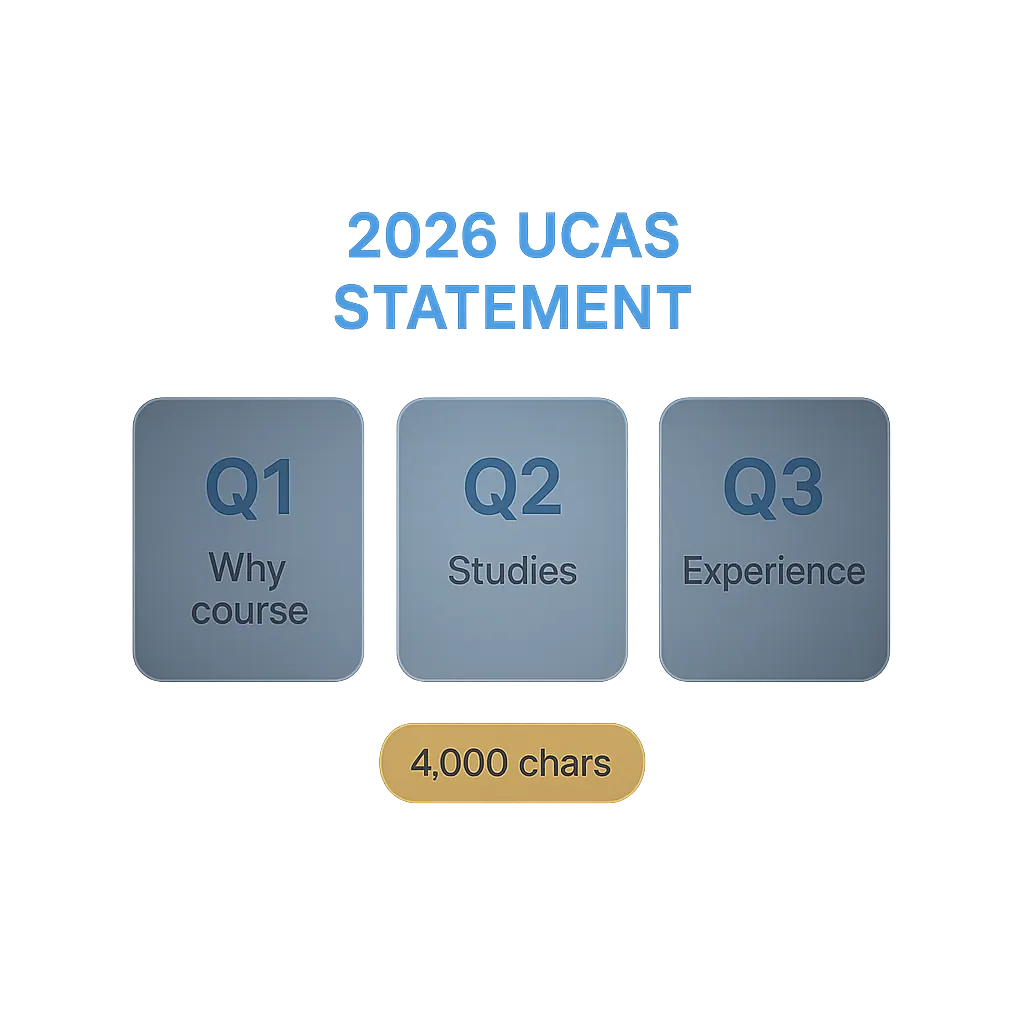
The personal statement examples in this guide are built around a format that changed significantly for 2026 entry. UCAS replaced the single free-form essay with three separate questions, each requiring its own focused answer. If you have older personal statement writing examples in front of you, check when they were written: anything structured as one continuous essay follows the pre-2026 format and should not be used as a template.
The three questions are:
- Question 1: "Why do you want to study this course or subject?"
- Question 2: "How have your qualifications and studies helped you to prepare for this course or subject?"
- Question 3: "What else have you done to prepare outside of education, and why are these experiences useful?"
The total character limit is 4,000 characters, including spaces, with a minimum of 350 characters per question. You can distribute the remaining budget however you like across the three answers, so a student applying to a highly competitive science course might reasonably weight Question 2 more heavily than someone applying to a vocational programme.
One non-obvious consequence of the new structure: admissions staff read all three answers as a whole, and UCAS explicitly discourages repeating information across answers. That means a work experience placement belongs in Question 3, not echoed in Questions 1 and 2 as well. Deciding where a piece of evidence fits best is now a deliberate editorial choice, not just a writing style question.
2. How to Read the Annotated Examples Below
Each example in sections 3 to 5 is a fictional composite, not a real student's statement. They are written to illustrate common patterns, not to be copied.
Annotations are labelled by question number. The new UCAS format asks three distinct questions (covered in section 1), so callouts in the examples are tagged [Q1], [Q2], or [Q3] to show which prompt each passage is answering. If a sentence is doing double duty, that gets flagged too, because it usually means one answer is being shortchanged.
A second lens runs alongside the question tags: character efficiency. The 4,000-character budget is tight, and annotations will point out specifically where words are spent on empty adjectives rather than evidence. A phrase like "I have always been passionate about science" costs roughly 45 characters and tells an admissions reader nothing a competing applicant would not also write. Annotations mark those passages and show a tighter alternative.
Three subject areas are covered, deliberately chosen for contrast:
- Science - Biology (A-level, AQA or OCR pathway)
- Humanities - History (essay-based, transferable-skills focus)
- Vocational - Nursing and Healthcare (where Q2 on work experience carries extra weight)
The non-obvious thing to watch for: the vocational example is where most character waste appears. Nursing applicants tend to over-narrate placement hours and under-explain what they observed. The annotations make that trade-off visible sentence by sentence.
3. Personal Statement Example 1: Biology (A-Level Applicant)
This composite example is written for a student applying to BSc Biology. Per UCAS, the three answers share a single 4,000-character budget, with each answer requiring at least 350 characters. The split below is approximate: Q1 roughly 1,500 characters, Q2 roughly 1,400, Q3 roughly 1,000.
Question 1: Why do you want to study Biology?
> My interest in biology sharpened the moment I read about CRISPR-Cas9 editing in a review paper linked by my AQA Biology teacher. What struck me was not the technique itself but the specificity problem: how do you prevent a guide RNA from binding to near-identical sequences elsewhere in the genome? That question sent me to primary literature I could barely parse, but the effort of working through it confirmed that I want to spend the next several years thinking about molecular genetics. I am particularly drawn to programmes that let undergraduates handle gene-editing tools in second-year lab modules, because theory and bench work reinforce each other in ways lecture notes alone cannot replicate.
Callout - Q1: The student names a specific mechanism (CRISPR off-target binding) rather than writing "I have always been passionate about science." The word "passionate" does not appear. Notice also that a future plan is implied, not stated as vague ambition.
Cut this: If the draft had said "fascinating research into CRISPR," cut "fascinating." Replace it with what actually made it fascinating: the specificity problem.
Question 2: How have your qualifications prepared you?
> A-level Biology (AQA) gave me the vocabulary to read molecular genetics literature with some confidence; A-level Mathematics (Edexcel) built the statistical reasoning I use when evaluating experimental results. My EPQ asked whether golden rice adoption has been limited more by regulation than by agronomic failure. Researching it required me to read policy documents and crop-trial data alongside each other, which is the same skill set a research biologist needs when situating lab findings in a broader context. In A-level Chemistry (OCR), practical coursework on enzyme kinetics introduced me to the idea that reaction rates are not linear, a concept that reappeared in my reading on metabolic flux analysis.
Callout - Q2: Three named subjects, three named exam boards, one named EPQ topic. Admissions readers can see exactly which qualifications map to which course skills. The EPQ is not described as "interesting" or "rewarding" - it is described by what it made the student do differently.
Question 3: What else have you done that is relevant?
> I spent two weeks observing at a local NHS microbiology lab, where I watched staff run PCR diagnostic tests during a respiratory-virus season. Watching the same bench technique I had only seen as a diagram in a textbook being used to return a clinical result within hours made the gap between theory and application feel very small. Outside school, I write a short-form science blog aimed at GCSE students, which has made me think carefully about which analogies actually work and which ones mislead. Explaining why "the cell is like a factory" breaks down at the membrane level is harder than it sounds.
Callout - Q3: The NHS placement is specific (microbiology, PCR, diagnostic context). The science communication activity is framed around a concrete intellectual problem, not as a hobby. The counter-intuitive point about the factory analogy signals that the student thinks critically about the models they use, not just about the subject matter.
The non-obvious structural point: UCAS guidance says admissions staff read all three answers together and discourages repetition across them. That means your Q1 motivation and your Q3 activity cannot carry the same story. If you mention the NHS placement in Q1 as the thing that sparked your interest, you have used up your best Q3 material. Keep cause and evidence in separate answers.
4. Personal Statement Example 2: History (Humanities Applicant)
The 2026 UCAS format splits the personal statement into three questions with a shared 4,000-character limit. Below is a composite example for a History applicant, followed by annotations on what each answer does well or wastes.
Question 1 - Why do you want to study History? (approx. 1,400 characters)
> The question of why Tudor monarchs retained popular legitimacy despite doctrinal reversals is what pulled me into early modern history. Reading Eamon Duffy's The Stripping of the Altars forced me to reconsider whether the Reformation was experienced as rupture or continuity at parish level - a tension that no single textbook resolved. I want to study History at university because that kind of irresolution is intellectually generative. My longer-term interest is in how religious identity shaped political allegiance, and I hope to pursue archival work as part of my degree.
Annotation: The opening names a specific historiographical debate and a named historian, rather than stating a vague 'love of history'. Admissions tutors reading dozens of personal statements will notice the difference between "I have always found the past fascinating" and "Duffy's argument changed my reading of continuity."
Question 2 - How have your qualifications prepared you? (approx. 1,400 characters)
> My A-Level History coursework required me to construct an extended argument across 4,000 words, weighing primary sources against competing interpretations. That process taught me to handle disagreement between historians as evidence of a genuine problem rather than an error to resolve. In my wider reading I worked through sections of David Cannadine's The Undoing of Britain to stress-test claims from my coursework against a different methodological lens. I also completed a six-week online course on palaeography through the University of London's online provision, which introduced me to reading secretary hand in sixteenth-century documents.
Annotation - skills not grades: Notice there are no marks or grades here. Per UCAS guidance, grades already appear elsewhere on the application and should not be repeated in the personal statement. Framing around skills developed ("handle disagreement between historians as evidence") gives admissions staff something they cannot read off a grade sheet.
- Strong analytical sentence: "That process taught me to handle disagreement between historians as evidence of a genuine problem rather than an error to resolve." This is precise and shows intellectual maturity.
- Filler sentence to cut: Any variant of "I found this experience very rewarding and it deepened my passion for the subject" adds zero information and burns characters from a 4,000-character budget.
Question 3 - What else have you done to prepare? (approx. 1,100 characters)
> I have volunteered as a gallery guide at a local museum's permanent medieval collection for eighteen months. The role required me to translate specialist historical content for non-specialist visitors, which reinforced how much interpretive work sits between an artefact and any account of it. I also attend a school historical society where we hold structured debates on historiographical questions - most recently whether the term 'industrial revolution' obscures more than it reveals.
Annotation: The volunteering role connects directly back to course preparation: the skill described (translating specialist content for non-specialist audiences) maps onto seminar and tutorial work at university. It is not a list of activities. The counter-intuitive trade-off here is that a single well-explained activity is stronger than three briefly named ones, because UCAS notes that admissions staff read all three answers as a whole and penalise repetition, not brevity.
Takeaway: For humanities applicants, the test of a good Q1 is whether it names the specific intellectual problem that drove you to the subject. A named historian, a named debate, or a named primary source all pass that test. "I love history" does not.
5. Personal Statement Example 3: Nursing (Vocational Applicant)
Nursing applications lean harder on Question 3 than almost any other subject. Admissions tutors on pre-registration programmes want evidence of patient-facing exposure before you arrive, not just academic ability. The composite example below is a fictional but representative applicant: an Edexcel BTEC Level 3 Health and Social Care student with weekend care-home work and a completed First Aid at Work certificate.
Question 1 - Why do you want to study this course? (~1,300 characters)
> "My grandmother was admitted to hospital for a hip replacement the week I started sixth form. Watching the ward nurses manage her pain, explain the post-operative plan to my family, and still remember her name when they passed the bay made me want to understand what that kind of care actually requires. I have since read the NHS Long Term Workforce Plan summary and the NMC Code to understand what nurses are accountable for. Both documents made clear that nursing is a discipline built on clinical judgment and communication in equal measure. I want to develop that combination at degree level and qualify as a registered nurse working in acute settings."
Annotation - Q1: The opening grounds motivation in a specific, personal encounter rather than a general claim about "caring for people." The reference to the NMC Code signals that the applicant understands the regulatory framework of the profession, which is a detail admissions tutors notice. Avoid the common trap of saying "I have always wanted to help people" with no grounding event.
Question 2 - How have your qualifications prepared you? (~1,100 characters)
> "My Edexcel BTEC Level 3 Health and Social Care Diploma covers units directly relevant to the nursing curriculum: anatomy and physiology, infection prevention, and the principles of safeguarding. The distinction-level work I produced on dementia care required me to read primary sources, evaluate care models, and write evidence-based recommendations. This mirrors the assignment structure used in Year 1 of most pre-registration programmes. I have also completed an online course in medical terminology through a university open-learning platform, which I used to make sense of clinical documents during my care work."
Annotation - Q2: The BTEC is named by awarding body and level, not described vaguely as "my college course." Mapping specific units to nursing programme content demonstrates subject knowledge, not just effort. The counter-intuitive point here: BTEC applicants sometimes undersell their qualification because it feels "less academic" than A-levels, but the unit-based structure maps more directly onto nursing module content than most A-level subjects do.
Question 3 - What else have you done to prepare? (~1,350 characters)
> "I have worked weekend shifts at a residential care home for eighteen months. My role involves personal care, medication prompting under supervision, and supporting residents with dementia during periods of agitation. One resident became distressed during a routine task; I stayed calm, used the low-stimulus approach I had read about in a unit assignment, and then documented the incident in the care notes. Reflecting on it afterwards, I recognised that I had applied theory in a pressured moment rather than just following a script. I completed a First Aid at Work certificate in January, which changed how I think about initial assessment: the primary survey framework taught me to observe before acting. I also attend a student nursing society at my college, where I have discussed placement experiences with undergraduates. That has given me a realistic view of what pre-registration training involves, including the shift patterns and emotional demands of clinical placements."
Annotation - Q3: This answer is deliberately longer than Q3 in the Biology or History examples. Nursing programmes require applicants to demonstrate patient-facing experience, so the character allocation reflects that priority. The key structural move is reflection after each activity: not "I did personal care" but "I recognised that I had applied theory in a pressured moment." Listing duties without that reflective step is the most common weakness in nursing personal statements, and admissions tutors are trained to spot it.
Per UCAS, each question has a minimum of 350 characters and the three answers share the 4,000-character total, distributed however the applicant chooses. A vocational applicant has good reason to give Q3 the largest share.
6. IB Applicant Example: Weaving HL Subjects, Extended Essay and CAS into Your Answers
The IB Diploma Programme gives applicants a lot to work with, but the risk is treating it as a list of credentials rather than evidence of thinking. The composite example below shows an Economics applicant doing it well.
Applicant profile: IB Diploma candidate, Higher Level subjects: Economics, Mathematics, Psychology. Extended Essay in Economics. Applying to study Economics at a UK university.
Composite example (annotated)
Question 2 extract (qualifications and preparation):
> "Studying Economics, Mathematics and Psychology at Higher Level has given me frameworks I expect to use throughout a degree. In HL Economics I modelled price elasticity using real commodity data for a class presentation, which pushed me to read beyond the syllabus into behavioural economics. My Extended Essay examined whether loss aversion, as described by Kahneman and Tversky, can explain consumer switching behaviour in the UK mobile phone market. Conducting my own primary survey and applying regression analysis introduced me to the limits of self-reported data in a way that no textbook exercise replicated."
Annotations:
- "Economics, Mathematics and Psychology at Higher Level" - naming the HL subjects signals academic weighting to admissions tutors, who know HL is a distinct standard. Writing "my IB subjects" instead loses that signal entirely.
- The Extended Essay research question is named - "loss aversion... consumer switching behaviour in the UK mobile phone market" is concrete. An admissions reader can immediately see independent research with a methodology. Compare the weaker version: "I wrote an Extended Essay on economics" - that tells a reader almost nothing.
- "Regression analysis" - a skill claim backed by a method. Naming the technique is more credible than "I developed strong analytical skills."
Question 3 extract (wider experience, and why study in the UK):
> "Through CAS, I ran a weekly financial literacy workshop at a local secondary school for six months. Explaining compound interest to 14-year-olds forced me to identify exactly where my own understanding was thin. That experience sits behind my interest in behavioural nudges in public financial education, an area I want to pursue at a UK university because of the depth of research coming out of institutions such as the LSE and the FCA's collaboration with UK academics."
Annotations:
- CAS activity placed in Q3, not Q2 - per UCAS guidance, Q2 covers formal education. CAS sits outside formal qualifications, so Q3 is the right home for it.
- Reflection over description - the applicant explains what the CAS activity revealed about their subject knowledge, not just what they did. "Forced me to identify where my own understanding was thin" is the kind of evaluative thinking admissions tutors expect at degree level.
- Why study in the UK - UCAS explicitly identifies Q3 as the appropriate place for international students to explain why they want to study in the UK. The applicant names specific institutions and a research collaboration rather than writing "the UK has excellent universities," which contributes nothing.
The non-obvious trade-off: IB applicants sometimes try to mention TOK in Q2 because it feels academic. In practice, TOK is a course component rather than a subject with a distinct content body, and it reads as padding unless you tie it to a specific argument or perspective shift. The Extended Essay, by contrast, has a research question, a methodology, and a word count. It belongs in Q2 and it earns its place there.
7. Weak-to-Strong Rewrite: Personal Statement Opening Lines That Actually Work
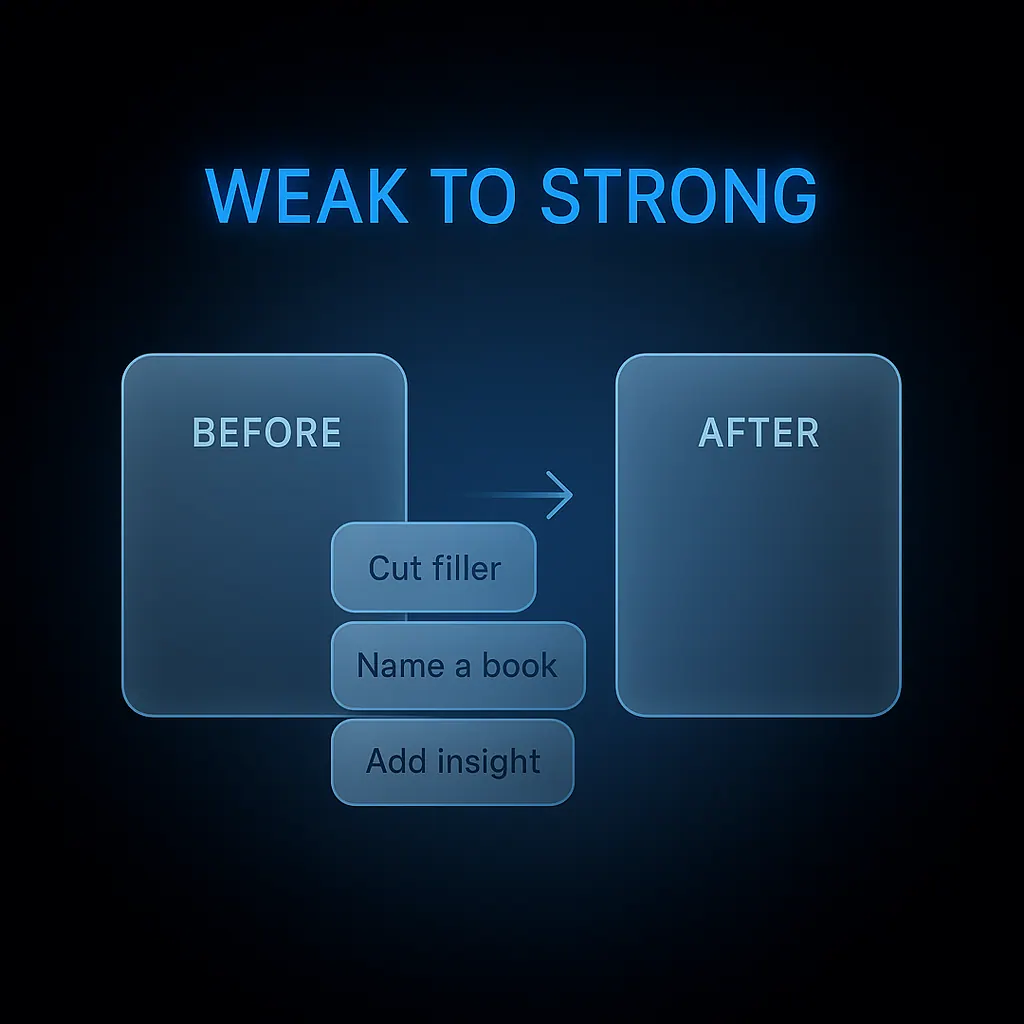
The most common mistake in a Q1 opening is not bad grammar. It is starting with a feeling instead of a fact. Admissions readers have seen thousands of statements that open with emotion and deliver no evidence. The fix is the same every time: replace the feeling with the moment that caused it.
Q1 opening: weak vs. strong
Weak version
> "I have always been passionate about Biology and from a young age I knew I wanted to study it at university."
Why it fails:
- "Always been passionate" is unverifiable and signals nothing about intellectual development.
- "From a young age" is a filler phrase that takes up character budget without advancing the answer.
- The sentence could be copied by any applicant to any science course. It has no specific weight.
Strong version
> "Reading Nick Lane's The Vital Question at sixteen, I hit a claim I couldn't accept: that the origin of the eukaryotic cell was the single most improbable event in the history of life. I wanted to know whether the biochemistry supported it."
What changed:
- A named text (The Vital Question) replaces the vague claim of passion.
- A specific, contestable idea replaces generic enthusiasm.
- The opening sentence creates a question the reader wants to see answered.
The counter-intuitive point worth noting: **starting with disagreement or doubt works better than starting with admiration**. Admissions tutors are assessing intellectual readiness. Showing that you pushed back on an argument demonstrates exactly that.
Q3 sentence: weak vs. strong
| Version | Text |
|---|---|
| Weak | "I worked in a care home and enjoyed it." |
| Strong | "During a placement at a residential care home, I noticed that residents became visibly distressed during handover shifts, when familiar staff left and new faces arrived. That pattern made me think differently about continuity of care as a clinical outcome, not just a scheduling preference." |
The weak version names an activity and attaches a positive adjective. The strong version names a specific observation, then states what it changed in the writer's thinking. The edit removes "enjoyed" entirely and replaces it with a described situation and a named concept.
Every edit in this section follows the same rule: remove empty adjectives and generic claims, and replace them with named, verifiable specifics. That rule is what the annotated personal statement examples earlier in this article are also demonstrating.
8. UCAS Personal Statement Structure: Character Budget and Common Pitfalls
UCAS confirms the total allowance is 4,000 characters across all three answers, with each answer requiring at least 350 characters. You can split that budget however you like. A reasonable starting point:
| Question | Focus | Suggested characters |
|---|---|---|
| Q1 - Why this subject? | Motivation, intellectual interest | ~1,400 |
| Q2 - How have your studies prepared you? | Qualifications, skills, coursework | ~1,300 |
| Q3 - Other preparation and experience | Work, activities, wider context | ~1,300 |
The counter-intuitive point: a short Q3 is often stronger than a long one. Cambridge's guidance states that non-academic activities should not occupy more than 20% of the section in which they are mentioned, keeping the academic case central in Q1 and Q2. That principle holds even if you are not applying to Cambridge.
Common structural pitfalls across personal statement examples:
- Blending Q1 and Q2. Writing about how a textbook deepened your interest belongs in Q1; writing about how your A-level coursework built a specific skill belongs in Q2. Mixing the two wastes the structure's main advantage.
- Treating Q3 as a CV list. Admissions readers want reflection, not a bullet-pointed inventory of clubs and jobs. One activity with genuine analysis outweighs five activities named and dropped.
- Repeating the same point across two answers. UCAS explicitly discourages this, and it burns characters you cannot afford to waste.
- Listing grades. Do not include predicted or achieved grades anywhere in your answers. They appear on the application form already, and restating them wastes characters on information admissions staff already have.
9. What to Do Next
Draft Q1 of your own statement this week. Open the UCAS application portal alongside the Biology example annotation from section 3, and check that your opening paragraph answers the same prompt in an equally specific way. A common trap: students write a Q1 that sounds like a cover letter for a job rather than an answer to why this subject, at degree level, now. The annotation framework exists precisely to catch that.
Once you have a first draft, get it read by someone who can judge the argument, not just the spelling. Get line-by-line feedback on your draft through our personal statement review before your school submits its internal UCAS batch, which at most UK schools falls several weeks ahead of the October deadline.
Write the draft first. Then book the review.
FAQ
How do you start a personal statement for UCAS 2026?
Question 1 opens with your motivation for the subject, so the strongest first sentence names a specific text, question, or experience that sparked your interest rather than a generic 'I have always been passionate about' phrase.
How long should each answer be in the new three-question format?
UCAS sets a combined limit of 4,000 characters and a minimum of 350 characters per question; you choose how to distribute the total, so a rough split of around 1,400 / 1,300 / 1,300 is a practical starting point.
Can I use the same personal statement for different courses?
UCAS allows one personal statement for all your choices, so if you are applying for different but related courses, Q1 should address the overlapping motivation without naming individual universities.
How do I include my IB Extended Essay in the personal statement?
The Extended Essay fits best in Question 2 as evidence of independent research - name your research question or argument specifically rather than just noting that you completed one.
Should I mention grades in my personal statement?
No - UCAS guidance states that grades appear elsewhere on the application and should not be repeated in the personal statement; focus on skills and experiences instead.
How do I end a personal statement on the 2026 format?
Question 3 is typically the natural close: end with a reflective sentence that connects your wider experience back to what you want to develop at university, giving admissions staff a clear picture of your readiness.
References
- How to write your personal statement: 2026 entry onwards | UCAS - https://www.ucas.com/applying/applying-to-university/writing-your-personal-statement/how-to-write-your-personal-statement-for-2026-entry-onwards
- Personal statement tips for international students: 2026 entry | UCAS - https://www.ucas.com/applying/applying-university/writing-your-personal-statement/personal-statement-tips-international-students-2026-entry
- Writing your personal statement | Undergraduate Study - https://www.undergraduate.study.cam.ac.uk/apply/how/ucas-personal-statement
- Writing your personal statement | UCAS - https://www.ucas.com/undergraduate/applying-university/writing-personal-statement