Business Personal Statement Example: UCAS 2026 Format Annotated
By Michael Thompson · Education Specialist; 10 years teaching the IB at Bromsgrove School · Published 4 September 2026 · Updated 6 October 2026
A business personal statement example only makes sense once you know what you are actually being asked - and for 2026 entry, that has changed significantly. UCAS has replaced the single open-ended essay with three separate, structured questions totalling 4,000 characters. This guide walks through a complete example statement written for a business or business management applicant, with each question annotated to show what works, what a weaker version looks like, and why an admissions tutor would notice the difference. Use it alongside your own draft, not as a template to copy.
Key Takeaways
- Three questions, not one essay: From 2026 entry, UCAS personal statements are split into three distinct questions with a combined limit of 4,000 characters and a minimum of 350 characters per answer.
- Question 1 is about motivation and subject curiosity: It asks why you want to study the course - this is where commercial awareness, specific business concepts you have engaged with, and your reasons for choosing business go.
- Question 2 covers formal study, not grades: UCAS explicitly advises against repeating grades here; instead, highlight specific content you studied, competitions, EPQ work, or IB Business Management topics that shaped your thinking.
- Question 3 is where enterprise and part-time work belong: Work experience, running a small enterprise, volunteering, and personal responsibilities all go in Question 3 as evidence of commercial understanding outside the classroom.
- Each paragraph should do a specific job: The annotations in this guide name the function of every paragraph - claim, evidence, reflection - so you can check your own draft does the same.
- A short checklist closes the guide: Before submitting, run your draft through the section-by-section checklist to confirm each answer is doing what admissions tutors expect.
In This Article
- The UCAS 2026 personal statement format for business applicants
- Business personal statement example - full text
- Question 1 annotated: why business and why you
- Question 2 annotated: qualifications and business studies evidence
- Question 3 annotated: enterprise, part-time work, and experience outside the classroom
- Business management, international business, and economics variants - what changes
- Pre-submission checklist for your business degree personal statement
- What to do next
1. The UCAS 2026 personal statement format for business applicants
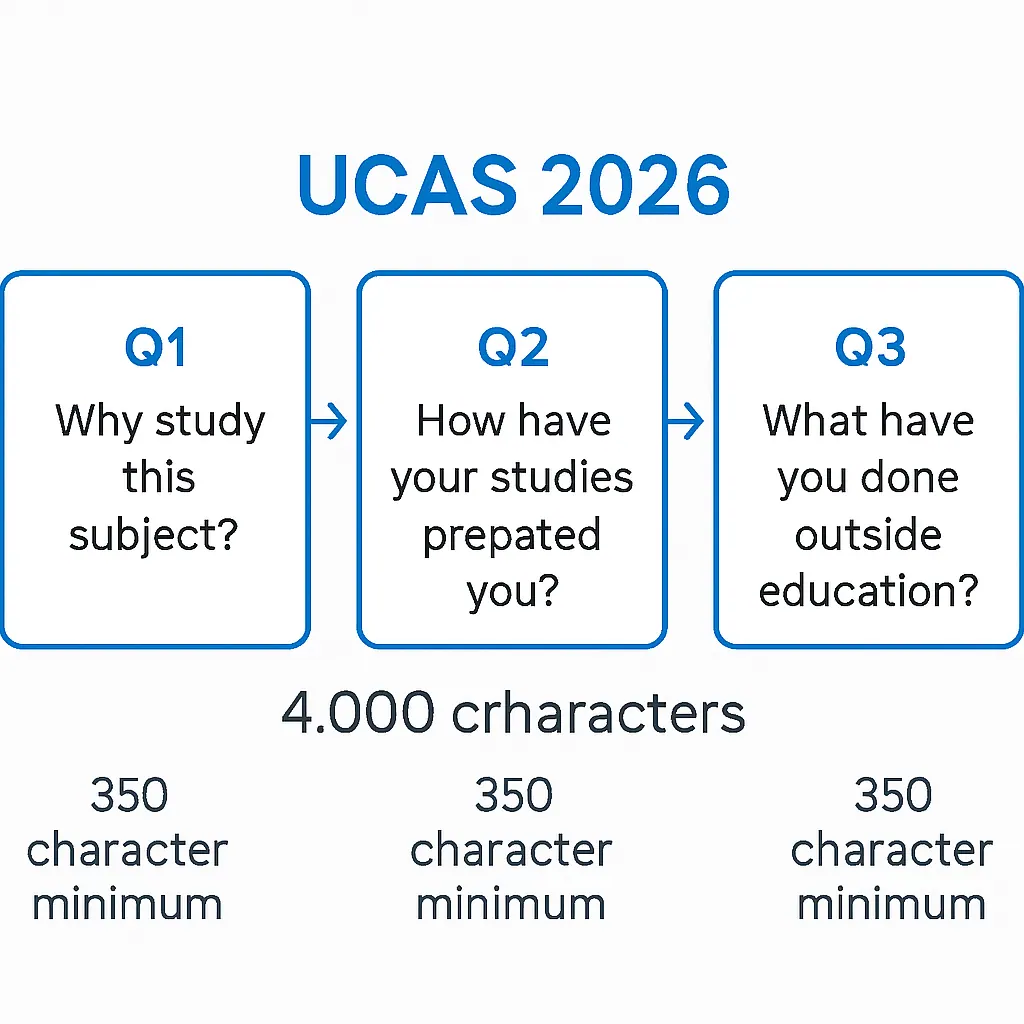
From 2026 entry, every business personal statement example you find written as a single flowing essay is already out of date. UCAS has replaced the open-ended format with three separate questions, each requiring a minimum of 350 characters, within a total limit of 4,000 characters including spaces.
The three questions, worded exactly as UCAS phrases them, are:
- "Why do you want to study this course or subject?"
- "How have your qualifications and studies helped you to prepare for this course or subject?"
- "What else have you done to prepare outside of education, and why are these experiences useful?"
For business applicants, that maps cleanly onto three types of evidence:
| Question | What belongs here |
|---|---|
| Q1 | Your motivation for business, economics, or management as a field |
| Q2 | A-level Business Studies, Economics, Maths, EPQ findings, or equivalent IB or SQA subjects |
| Q3 | Work experience, part-time jobs, enterprise projects, competitions |
One counter-intuitive point worth knowing: UCAS explicitly advises against repeating your grades in Question 2, because admissions tutors already see them elsewhere in your application. Use that space to discuss what you did with your studies, not what grades they produced.
The sections below walk through a full example built around this structure, then annotate each question in detail.
2. Business personal statement example - full text
The business personal statement example below was written for this guide. It is not a real applicant's submission. It is structured for the 2026 UCAS format, which splits the personal statement across three separate questions rather than one continuous essay. Each question has its own character budget; the approximate allocations here reflect a competitive application.
One counter-intuitive point worth flagging before you read: Question 1 rewards specificity over breadth. Admissions tutors at business schools report that statements referencing a named concept, such as price elasticity or principal-agent theory, stand out more than those listing multiple work experiences in general terms. Save the experience for Question 3.
Question 1: Why do you want to study this subject, and why does it interest you?
Approximate character budget: 1,600
> Watching my uncle close his independent hardware shop after a larger competitor opened nearby prompted a question I have not stopped asking: how do firms survive in markets that keep shifting against them? That question led me to IB Business Management at Higher Level, where I first encountered Porter's Five Forces as a formal tool for analysing competitive pressure. Applying it to the hardware market showed me that the threat of substitutes and buyer bargaining power had both increased simultaneously, a combination my uncle had no framework to anticipate. > > What draws me to business as a discipline is that it sits at the intersection of theory and decision-making under uncertainty. In my IB Business Management course I studied the difference between short-run and long-run cost curves, and I began to understand why a firm might accept losses in a period where a competitor cannot. This kind of reasoning, where the right answer depends on a time horizon as much as a balance sheet, is what I want to develop at degree level. > > I extended this thinking through independent reading. Studying how firms in different national contexts respond to the same market shock, such as a sudden input cost rise, made me interested in the relationship between organisational culture and strategic flexibility, a theme I hope to explore further in modules covering international business and organisational behaviour.
Question 2: How have your qualifications prepared you for this course?
Approximate character budget: 1,200
> My IB Diploma Programme subjects map directly onto the demands of a business degree. Higher Level Business Management has given me a grounding in financial analysis, including ratio interpretation and investment appraisal using net present value. Higher Level Economics has developed my ability to model market behaviour quantitatively, particularly in unit topics covering price mechanisms and externalities. Standard Level Mathematics supports both, giving me confidence with the quantitative methods that appear in finance and economics modules. > > My Extended Essay, written on whether a named local firm's pricing strategy was consistent with profit maximisation theory, required me to gather primary data through structured interviews and then test it against established microeconomic models. The process taught me that real pricing decisions are rarely as clean as textbook models assume, which I take as a reason to study business and economics together rather than separately. > > For applicants to business administration or business and finance programmes, I note that my Business Management coursework included a research project using real company accounts, which involved applying Edexcel-style ratio analysis frameworks even though I sat the IB, because my teacher drew on both traditions deliberately.
Question 3: What else have you done that prepares you for higher education?
Approximate character budget: 1,100
> For fourteen months I worked twelve hours a week at a busy city-centre cafe, first as a kitchen assistant and then on the till. The shift from back-of-house to customer-facing work happened because the manager needed someone who could handle a simple stock discrepancy at the end of service. Dealing with that discrepancy, cross-referencing the point-of-sale records with the physical count, made me understand that operational decisions and financial records are connected in ways that are easy to overlook when studying business through case studies alone. > > Separately, I co-founded a small enterprise with two classmates selling custom tote bags to other students through a school market stall. We priced the product at a level that covered variable costs and contributed to fixed costs in the second month of trading, which meant accepting a loss in month one. That decision, which mirrors the short-run pricing logic I studied in IB Economics, was the most educational thing I did outside the classroom. Revenue was modest, but the experience of setting a price, watching demand respond, and adjusting, is the kind of feedback loop that a business personal statement example from a textbook cannot replicate.
Total approximate character count: 3,900. The sections above form the raw material that the annotations in Section 3 work through line by line.
3. Question 1 annotated: why business and why you
Question 1 asks: "Why do you want to study this course or subject?" For business applicants, this covers motivations, subject knowledge, super-curricular engagement, and future direction. Admissions tutors read it to separate students who understand what business is from those who think they do.
Paragraph-by-paragraph breakdown
| Paragraph | Function | The line a tutor notices |
|---|---|---|
| Opening | Hook + specific trigger | A named company decision (not "I've always been interested in business") |
| Second | Subject engagement | A named concept applied to a real situation, e.g. price elasticity to a supermarket's own-brand strategy |
| Third | Future direction | A stated area (finance, operations, international markets) with a reason, not just "I want a good career" |
The counter-intuitive point about commercial awareness: tutors are not looking for the word "commercial awareness." They are looking for evidence of it. Naming Porter's Five Forces in the abstract signals nothing. Applying it to explain why a specific retailer lost market share signals genuine reading beyond the syllabus.
What a weak opening looks like
> "I have always been passionate about business and believe that studying it will help me achieve my goals in the corporate world."
This fails on three counts: "always been passionate" gives no origin point, "help me achieve my goals" states ambition without content, and "corporate world" is so broad it could describe any commercial degree. There is no named company, no named concept, no evidence of reading or experience. An admissions tutor cannot distinguish this from any other applicant.
What to do instead
Replace the vague claim with the specific incident that caused the interest. A sentence that opens with a decision you observed, a business failure you read about, or a concept from your A-Level Economics or Business Studies course that you then tested against a real case does more in 30 words than three sentences of stated enthusiasm.
4. Question 2 annotated: qualifications and business studies evidence
UCAS guidance is explicit: do not repeat your grades in Question 2. Universities already see them elsewhere on the application. The question asks what you have learned and applied, not what you scored.
What belongs here instead:
- Specific topics, units, or concepts from your qualification (for example, AQA Business A-Level Unit 3 on financial decision-making, or IB Business Management HL topics on organisational structure)
- Competition entries: UKMT, the Smallpeice Trust, or a Young Enterprise company
- An EPQ whose findings connect directly to the degree subject
- Short online university courses that extended beyond the taught syllabus
Weak vs strong: a direct comparison
| Version | What it says | Why it fails or works |
|---|---|---|
| Weak | "I study Business at A-Level and enjoy it." | Names the subject, states nothing specific. Adds no evidence. |
| Strong | "Studying AQA Business Unit 3 introduced me to contribution costing. I applied the same framework when pricing my Young Enterprise product line, which helped us reach breakeven three weeks ahead of schedule." | Names the unit, names the concept, shows application to a real project. |
The non-obvious trap here: students who study IB Business Management HL often write about their HL Internal Assessment without specifying the business tool they used (for example, a SWOT or Ansoff Matrix analysis of a real organisation). The tool name and the organisation name are what make the paragraph credible. Dropping either turns a strong paragraph into a vague one.
A well-executed Question 2 treats your qualification as a source of analytical vocabulary, then demonstrates that vocabulary in action.
5. Question 3 annotated: enterprise, part-time work, and experience outside the classroom
Question 3 asks: "What else have you done to prepare outside of education, and why are these experiences useful?" The "why are these useful" clause is doing most of the work. Listing activities without answering that question is the most common way to waste this section.
Enterprise activity: frame it as commercial evidence, not a hobby
The example describes running a small print-on-demand side business during sixth form. What makes it work is the framing: the applicant explains how monitoring conversion rates on a Shopify storefront taught them the difference between marketing reach and actual demand. That is commercial understanding stated in commercial language. An admissions reader for a business management or international business programme recognises it immediately. Compare that to a bare line like "I ran an online shop," which reads as a hobby unless the reflection follows.
Part-time work: show the mechanism, not the job title
The example mentions weekend work in a fast-food outlet, but the detail that earns its place is specific: the applicant observed how queue length correlated with upsell success and what that suggested about customer decision-making under time pressure. That is consumer behaviour analysis from a real operations context, not CV padding.
The interview-bait line
The sentence "I realised the promotional pricing strategy was eroding our margin faster than volume could compensate" is the one most likely to prompt a follow-up question at interview. It implies knowledge of contribution margin and breakeven, and an interviewer will test whether the applicant actually understands those concepts or just borrowed the phrasing. That is intentional: specific reflection invites a conversation you can prepare for, whereas vague claims about "developing communication skills" invite nothing.
6. Business management, international business, and economics variants - what changes
The three-question UCAS structure is the same regardless of which business-related course you are applying for. What changes is the emphasis you place on certain evidence within each answer.
The counter-intuitive trap here: business management and business administration applications are not interchangeable. Management programmes tend to foreground organisational behaviour and leadership evidence, so your Question 3 experience (the part-time job, the enterprise project) should be framed around decisions you made and people you coordinated, not just tasks you completed.
Use the table below to check which elements of the example statement need to shift for each variant.
| Course variant | Strengthen in Q1 (motivation) | Strengthen in Q2 (qualifications) | Strengthen in Q3 (experience) |
|---|---|---|---|
| Business management | Leadership rationale | Business Studies, EPQ on org theory | Team or supervisory role |
| International business | Cross-cultural curiosity, global markets | A-Level or IB language, Geography | Travel, language exchange, overseas work |
| Business economics | Economic theory interest | Economics A-Level or IB, maths grade | Data project, market analysis work |
| Business and finance | Financial decision-making | Maths, accounting modules, EPQ | Work in financial services or budgeting role |
One specific note for international business personal statement examples: admissions tutors at programmes with a compulsory year abroad will read your language skills section carefully. Mentioning a language at GCSE level without any active use is weaker than describing a specific context where you used it, even informally.
For business economics, the shift is largely in Question 2. A strong Economics A-Level result matters more than in a straight business application, and referencing a specific economic concept you engaged with, rather than the subject in general, signals genuine preparation.
7. Pre-submission checklist for your business degree personal statement
Run through each question before you submit. A yes to every item means your draft is in good shape; a no tells you exactly where to revise.
Question 1
- [ ] Does your opening name a specific business concept, event, or text that sparked your interest, rather than a generic statement about wanting to study business?
- [ ] Have you linked your motivation to the academic content of the course, not just a career outcome?
Question 2
- [ ] Have you described what you learned from your A-level, BTEC, or IB modules, without listing grades? Per the UCAS personal statement toolkit, universities see grades elsewhere on your application, so repeating them here wastes your character budget.
- [ ] If you completed an EPQ or equivalent, does your answer name the topic and explain what it taught you about business thinking, not just confirm you did it?
Question 3
- [ ] Does each experience include a moment of reflection, what you observed or changed your mind about, rather than a bare description of your role?
- [ ] Have you avoided restating anything already covered in Question 2?
Across all three answers
- [ ] Read Q1, Q2, and Q3 back to back. Do they build a coherent picture of one applicant, or do they read like three unconnected lists?
- [ ] Search your draft for "passionate", "always been interested in", and "valuable experience". Delete or replace each one. These phrases appear in a large proportion of personal statements and add no differentiation.
8. What to do next
The annotated example and variant notes above are only useful if you act on them before your draft hardens into something you stop seeing clearly.
This week, open the UCAS Hub and paste your current answer to Question 1 into the character counter. Read only that answer aloud. If you cannot say, in the first two sentences, what specifically drew you to business rather than economics, law, or politics, that is the gap to fix first. Admissions readers at competitive programmes see answers that open with generic enthusiasm about "the business world" far more often than answers that name a specific mechanism, market event, or module. Yours should not open that way.
Draft a sharper Question 1 opening this week, then paste it into the UCAS Hub character counter and confirm it sits within the field limit before you show it to anyone else.
FAQ
Can I use a business personal statement example as a template?
Examples are useful for understanding structure and annotation, but copying or closely paraphrasing any example risks plagiarism detection - UCAS checks submissions, so your statement must be written in your own words and reflect your own experiences.
Should a business personal statement mention specific modules or just the subject generally?
Specific is stronger - naming a topic you studied in IB Business Management, a unit from A-Level Business, or a concept from an online course gives admissions tutors something concrete to assess, whereas general enthusiasm does not differentiate you.
Does a business personal statement example work for business management and international business too?
The three-question structure is identical across all business-related UCAS courses, but the emphasis shifts - international business applications should foreground cross-cultural awareness or language skills, while business economics applications should show engagement with quantitative or economic reasoning.
How long should each question be in a business personal statement?
There is no set split, but each answer requires at least 350 characters and the total across all three must not exceed 4,000 characters; most applicants weight Question 1 most heavily, with Questions 2 and 3 receiving roughly equal shares of the remaining budget.
Will universities see which question each piece of information is in?
Yes - from 2026 entry, universities receive the three answers separately, so information placed in the wrong question (for example, putting work experience in Question 2 instead of Question 3) may be read as a misunderstanding of the format.
References
- Reforming admissions | UCAS - https://www.ucas.com/about-us/news-and-insights/reforming-admissions
- Personal statement tips for international students: 2026 entry | UCAS - https://www.ucas.com/applying/applying-university/writing-your-personal-statement/personal-statement-tips-international-students-2026-entry
- Personal statement toolkit | UCAS - https://www.ucas.com/advisers/help-and-training/toolkits/personal-statement-toolkit