Law Personal Statement: Complete Guide for 2026 Entry
By Michael Thompson · Former IB Diploma Programme coordinator; 10 years at Bromsgrove School · Published 5 July 2026
A law personal statement has one job: show admissions tutors that you can read closely, build an argument, and engage with legal questions analytically - not that you watch courtroom dramas or want to help people. The 2026 UCAS format splits what was a single essay into three separate questions, each with a 350-character minimum, inside a shared 4,000-character limit. That structure is actually useful for law applicants, because it forces you to separate your motivation from your preparation from your wider engagement - which is exactly how tutors read you anyway. This guide maps each question to what law tutors want, shows you how to turn vague interest into precise reflection, and covers the super-curriculars and IB angles that carry real weight.
Key Takeaways
- Three questions, one 4,000-character limit: UCAS now asks why you want to study, how your qualifications prepare you, and what else you've done - you can distribute characters in any proportion across the three answers.
- Tutors want analytical engagement, not stated passion: Naming a case, statute, or legal question and explaining what it revealed about your reasoning is worth far more than saying you find law 'fascinating'.
- Question 2 is where your IB subjects earn their place: History, English, or language HL subjects demonstrate the sustained analytical writing law rewards; your Extended Essay and Theory of Knowledge give direct evidence of structured argument.
- Super-curriculars must be written up with analysis: Reading a judgment, following a live case, or mooting only counts if you explain what you noticed and questioned - name-dropping the activity without reflection adds nothing.
- LNAT applies to a specific set of courses: If any of your five UCAS choices require the LNAT, check the official LNAT website for registration deadlines and the specific cut-off dates for each institution.
- Cambridge lets you write a separate additional statement: If Cambridge is one of your choices and your course differs significantly from your other applications, the My Cambridge Application portal accepts a shorter, course-specific statement.
In This Article
- What law admissions tutors are actually looking for
- How the 2026 UCAS format works for law applicants
- Mapping Question 1 to law: motivation grounded in a specific legal issue
- Mapping Question 2 to law: how your qualifications show analytical preparation
- Mapping Question 3 to law: super-curriculars that carry weight
- Law personal statement dos and don'ts
- Law personal statement brainstorming: finding your specific angle
- Writing for Oxford, Cambridge, and other competitive law courses
- Disability, extenuating circumstances, and the personal statement
- What to do next
1. What law admissions tutors are actually looking for
A strong law personal statement does not open with a courtroom scene or a declaration that justice has always fascinated you. Admissions tutors at law faculties across the UK read hundreds of those every cycle, and the ones that get attention are doing something different: they show a mind that has already started [thinking like a lawyer](/guides/how-to-get-into-law-school-uk).
The counter-intuitive thing is that analytical engagement with a specific legal question matters more than ambition. A paragraph that works through why the rule in Rylands v Fletcher sits awkwardly alongside modern negligence doctrine tells a tutor far more than three sentences about wanting to help people. It signals that you have read beyond your syllabus and that you can hold two competing ideas at once, which is the core skill of a law seminar.
Tutors are also reading your statement as a writing sample. Sentence structure, paragraph logic, the way you set up a claim before you test it: all of it is treated as a preview of how you will perform in timed essays and tutorials. Clumsy transitions or unsupported assertions suggest the same habits will appear in first-year assessed work.
Three things admissions tutors consistently reward:
- Specific legal curiosity: engagement with property law, statutory interpretation, or tort reform rather than generic references to "the law"
- Argument construction: setting up a position, acknowledging the counter-argument, then resolving the tension
- Precision in language: choosing the right word, not the impressive-sounding one
The statement is not an audition for advocacy. It is a short piece of analytical writing with a bibliography behind it.
2. How the 2026 UCAS format works for law applicants
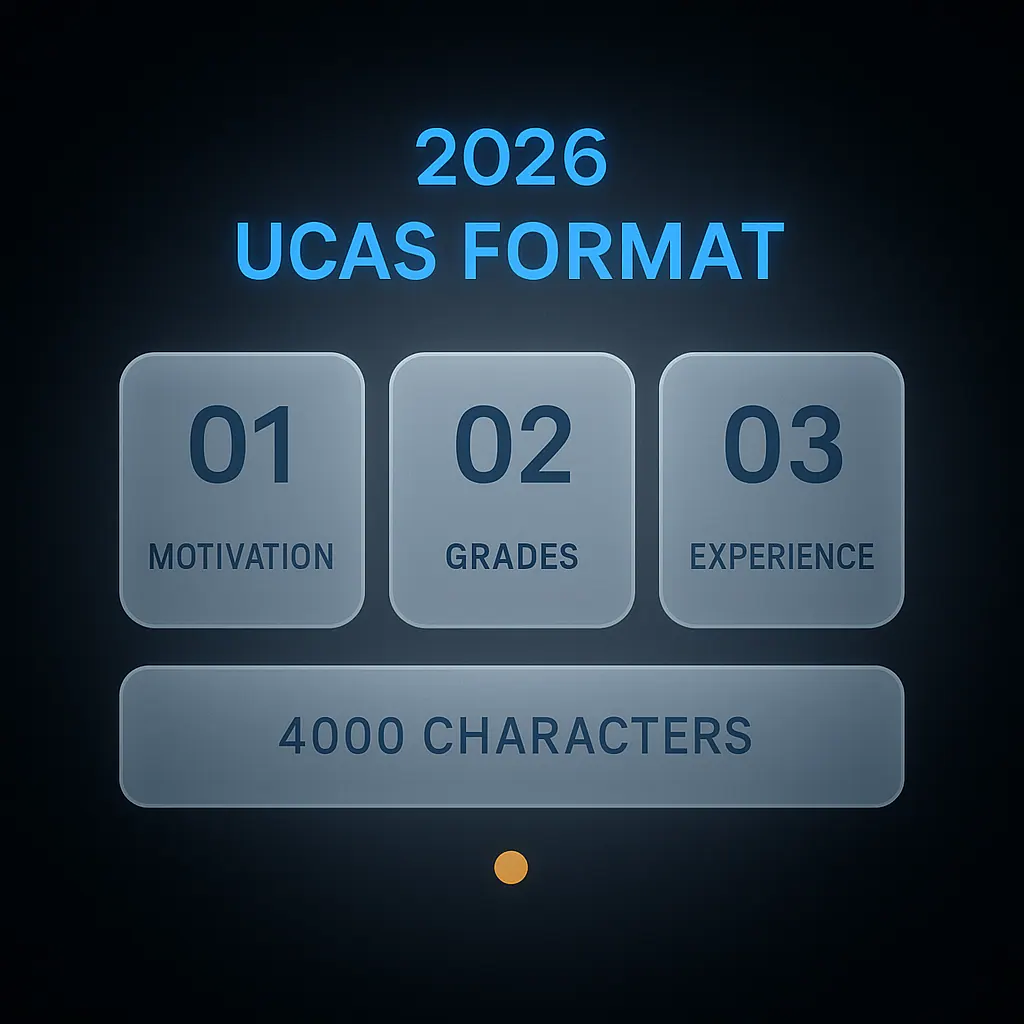
From 2026 entry, UCAS replaced the single open-ended personal statement with three structured questions, each doing a specific job:
- Question 1 - why you want to study the subject, covering motivations, subject knowledge, super-curricular activities, and future plans.
- Question 2 - how your formal qualifications and studies have prepared you, including specific modules, EPQ, or relevant short courses.
- Question 3 - wider preparation and skills beyond your taught curriculum.
The total character limit stays at 4,000 characters (including spaces), and each question carries a minimum of 350 characters. Beyond that floor, you can distribute characters in any proportion across the three answers.
For law applicants, that flexibility matters. A student whose case for law rests on sustained independent reading and a specific legal issue they have followed closely will likely weight Questions 1 and 3 heavily, leaving Question 2 leaner.
The non-obvious trap: UCAS explicitly advises against repeating information across answers. Admissions staff read all three responses as a single whole, so if you mention a work-experience placement in Question 1 to explain motivation, restating it in Question 3 wastes characters and reads as padding. Each answer should earn its space independently, while the three together form one coherent argument for why you are ready to study law.
3. Mapping Question 1 to law: motivation grounded in a specific legal issue
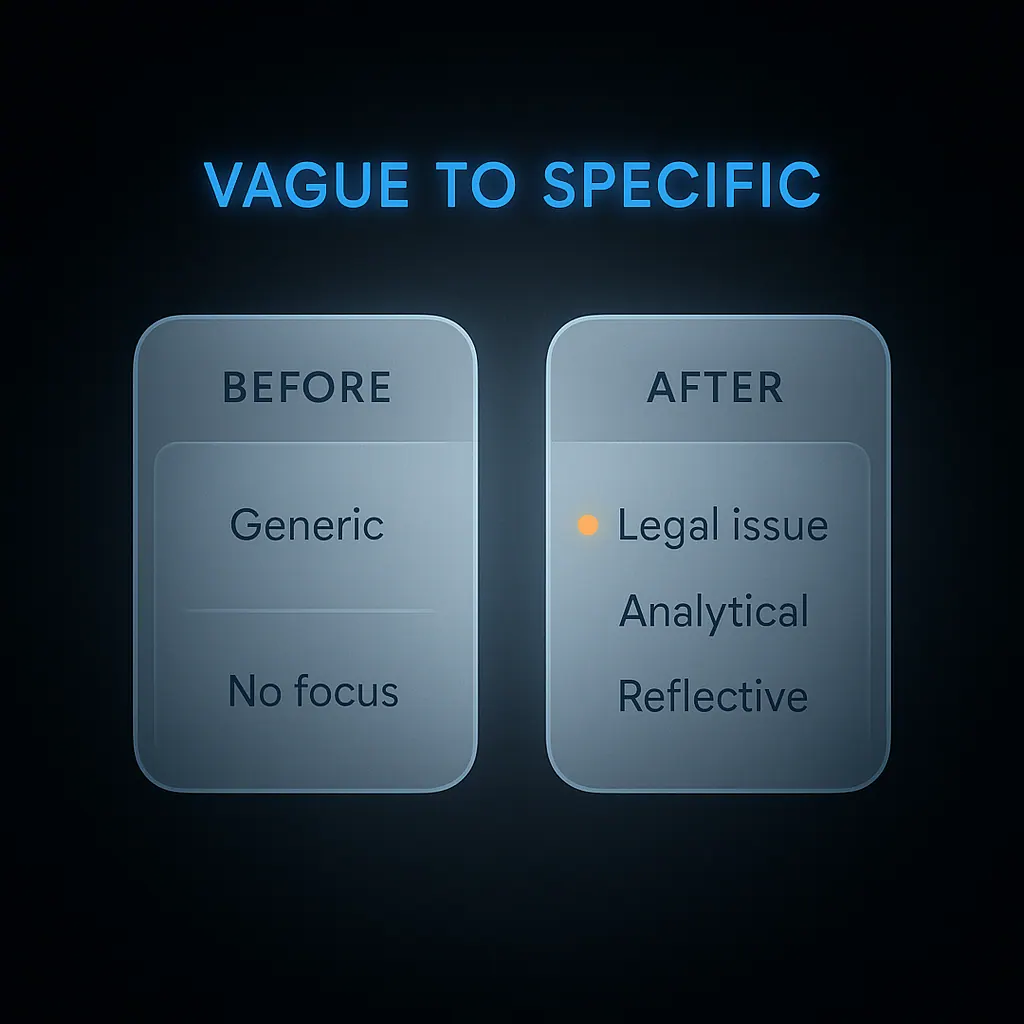
Question 1 asks why you want to study the course. For law applicants, "why" needs to be anchored to something concrete: a named case, a statute, a legal argument you encountered in reading. General curiosity about justice, or a vague interest in current affairs, tells an admissions tutor nothing they can assess.
The counter-intuitive point: Question 1 also covers future plans, but mentioning career prestige here tends to undermine the answer rather than strengthen it. Tutors are selecting students for an academic course. Showing that a specific legal question genuinely occupied your thinking does more work than naming a prestigious practice area.
| Draft | Revised |
|---|---|
| "I read the news regularly and find legal issues interesting, which is why I want to study law." | "Reading about the Supreme Court's judgment in Uber BV v Aslam [2021] made me question how courts define employment status when economic dependence and formal contracts point in opposite directions. That tension between contractual language and substantive reality is what I want to study." |
The revised version names a specific case and identifies the legal tension it exposed. It shows analytical engagement rather than passive news consumption.
A few principles for this answer:
- Name the specific thing that prompted the interest: a case, a statute (such as the Human Rights Act 1998), a journal article, or a visiting speaker.
- State what it revealed about legal reasoning, not just what the outcome was.
- Connect future plans to intellectual interest, not salary or status. If you mention a career direction, tie it back to a question the subject raises rather than the profession it leads to.
One gotcha worth flagging: applicants sometimes write about a case they have only read about in a newspaper rather than in a legal source. Tutors notice when the analysis stays at headline level. Reading the judgment itself, even a summary from a law school blog, gives you the vocabulary to go one layer deeper.
4. Mapping Question 2 to law: how your qualifications show analytical preparation
Question 2 covers formal education only: school, college, training providers, and short online university courses. For law applicants, this is where you connect specific subjects to the thinking skills a law degree demands. The key word there is specific. Listing subjects is not the same as explaining what they taught you to do.
UCAS is explicit that grades appear elsewhere on the application and should not be repeated here. The question is about what the learning revealed, not the result. A student who got an A in History is less interesting to a reader than one who explains how reconstructing competing historical arguments taught them to identify what evidence a claim actually needs.
If you're applying with A-levels, subjects like Politics, Philosophy, or English Literature are worth naming in context rather than simply listing them. A Philosophy student who engaged with the is-ought distinction has practical preparation for statutory interpretation; an English Literature student who has written comparative essays has practised the skill of holding two arguments simultaneously and evaluating their relative force. Name the activity, not the grade.
**For IB Diploma applicants**, the structure offers particularly strong material. HL History, HL English, or a Language HL all require the kind of sustained analytical essay-writing that law rewards. The Extended Essay is worth highlighting directly: it is one of the few pre-university tasks that demands a sustained, independently structured argument over thousands of words. Theory of Knowledge adds something distinct, demonstrating comfort with questioning assumptions and handling genuinely contested claims, which maps directly onto legal reasoning under uncertainty.
A counter-intuitive point worth knowing: an IB student who wrote their Extended Essay on a non-law topic, economics or literature, can still use it here effectively, because the argument is about analytical process, not subject matter.
Before writing this section, check each university's course page for any subject-specific requirements. Some law courses specify preferred or required subjects, and your Question 2 answer should reflect those expectations where relevant.
5. Mapping Question 3 to law: super-curriculars that carry weight
Question 3 asks what you have done to prepare outside formal education. For law applicants, this is where the work happens. The activities that carry weight are not the ones that sound impressive in a list; they are the ones you can write about with genuine analytical depth.
Three types of evidence tend to land well for law:
- Reading a judgment. Not just noting the outcome, but identifying the reasoning. A strong write-up might explain which limb of a Court of Appeal test the dissenting judge rejected, and why you found that dissent more persuasive. That shows you can read law, not just read about it.
- **Tracking legislation in progress.** Following a parliamentary bill through committee stage, noting where amendments were proposed and why, demonstrates that you understand law as something made and contested, not handed down.
- **Mooting or competitive debating.** The most useful thing to write about here is not that you won, but where the weaker argument sat and how you handled it. Admissions tutors want to see that you can assess the strength of a position, not just advocate for one.
The counter-intuitive trap here: quantity hurts more than it helps. Cambridge explicitly advises focusing on a few activities in depth rather than listing many, with the emphasis on what you learned and how your thinking developed. Three activities analysed well will outperform eight activities named and abandoned.
One practical note on LNAT. If any of your five UCAS choices require the LNAT, check the official LNAT website for registration deadlines and institution-specific test windows, as these vary. Tutors at LNAT-requiring universities will read your personal statement alongside your score, so the two need to feel coherent: if your statement claims a deep interest in legal reasoning, your LNAT Critical Thinking score will be read in that light.
6. Law personal statement dos and don'ts
The law personal statement is itself a piece of analytical writing. Vague, breathless prose signals to tutors exactly what they do not want to see in a first-year seminar. The formatting rule also matters: UCAS explicitly advises against repeating information across the three questions, and admissions staff read all three answers as a single whole, so anything you say in Question 1 should not reappear in Question 2 or 3.
Do:
- Name specific legal texts, cases, or statutes and say something about their reasoning. "I found Donoghue v Stevenson [1932] compelling because Lord Atkin's neighbour principle extended tortious liability beyond contract in a way that..." is more useful to a tutor than "I am interested in tort law."
- Show the line of thinking, not just the conclusion. Admissions tutors want to see whether you can follow an argument, so write precisely and let the structure of your answer do that work.
- Keep every sentence load-bearing. Four thousand characters across three questions is not generous, and UCAS states grades should not be restated in the personal statement because they appear elsewhere on the application.
Don't:
- Open with a quote you haven't engaged with analytically. A line from Cicero followed by "this made me want to study law" tells the reader nothing about how you think.
- Claim you have "always wanted to be a lawyer." It reads as filler and replaces space where a specific intellectual interest could sit.
- List activities without explaining the analytical takeaway. What you did matters far less than what you drew from it.
For career-change and non-traditional applicants: if your background is in another field, the tail of Question 1 or Question 3 is the right place to explain what drew you to law from that starting point. Tutors read a deliberate switch as evidence of intellectual direction, not a gap to apologise for. The counter-intuitive move is to be specific about the moment of transition: a particular piece of legislation you encountered professionally, or a case that unsettled an assumption from your previous discipline, will land better than a general statement about wanting a new challenge.
7. Law personal statement brainstorming: finding your specific angle
Most law personal statement drafts go wrong at the starting point, not the writing stage. The instinct to open with "I have always wanted to study law" is almost universal, and almost always a dead end. Start instead with a specific legal question that you could not quite resolve - a case outcome that struck you as wrong, a statutory phrase that seemed to contradict its own purpose, a news story you read twice and still had questions about.
That specificity is what a law personal statement needs to earn attention. Admissions tutors read hundreds of statements that describe a general interest in justice. They read far fewer that name a concrete tension and show the applicant sitting with it.
Use these prompts before you write a single sentence of a draft:
- What legal news story have you returned to more than once? What question did it leave open?
- Which part of a case or statute struck you as ambiguous or unfair? What would you argue on the other side?
- If you had to defend the conclusion you disagree with, what is the strongest version of that argument? (This is the move admissions tutors are actually testing for.)
For IB Diploma Programme students, the Extended Essay is worth revisiting here. Even if your EE topic sits in history or philosophy, the moment you had to qualify your own thesis, to acknowledge where your argument broke down, is direct evidence of analytical thinking. That moment belongs in your brainstorming list.
Produce a rough list of specific moments, readings, or cases before you touch the draft. The law personal statement should emerge from that list. If it emerges from a template instead, the tutor will notice.
8. Writing for Oxford, Cambridge, and other competitive law courses
Neither Oxford nor Cambridge asks you to address the personal statement to them directly. The UCAS statement is read as a single document sent to all five of your choices, and Cambridge reads it in full without assigning it a formal score. That last point is worth sitting with: because there is no score, a fluent list of activities is unlikely to move the needle. What readers are looking for is evidence that you think analytically about legal questions.
One specific constraint matters for Cambridge applicants: non-academic activities must not occupy more than 20% of the section in which they are mentioned. If Question 3 covers extra-curriculars, keep the bulk of it on academic development, with work experience or volunteering in a supporting role.
Cambridge also offers a separate, shorter statement through My Cambridge Application. This is recommended if your applied course differs significantly from your other UCAS choices, but it is not compulsory. If you are applying to Law at Cambridge alongside four other law courses, the UCAS statement alone is sufficient.
The counter-intuitive trade-off for highly competitive courses generally: **depth beats breadth**. A close reading of a single judgment, where you identify the ratio, engage with a dissenting opinion, and explain why the reasoning interests you, is stronger than listing five legal texts you have read. Cambridge's own guidance makes this explicit: focus on a few activities in depth, emphasising what you learned and how your interest developed.
To compare law courses and entry requirements across UK universities, see our law subject guide.
9. Disability, extenuating circumstances, and the personal statement
The personal statement is not where disability disclosure belongs by default. UCAS provides a separate section of the application for this, and every university has its own disability and access team that handles adjustments through a dedicated process. Putting a disclosure into the personal statement instead of the correct channel can mean it reaches the wrong people at the wrong stage.
That said, there is one scenario where a disability or extenuating circumstance belongs in the statement: when it directly shaped your understanding of law. If navigating a tribunal process, an access to justice issue, or a legal dispute gave you genuine intellectual insight into how the legal system works, that experience can carry real weight in Question 1 or Question 3. The framing matters. Write about what the experience revealed about the law, not about the difficulty itself. Admissions tutors are reading for analytical awareness, not personal hardship.
A counter-intuitive point: including a disability for context without connecting it to a specific legal idea is likely to weaken the answer, not strengthen it. Relevance is the only test.
If you are unsure whether or how to include something, contact your school's UCAS advisor or the admissions team at your chosen university directly before submitting.
10. What to do next
Open the UCAS personal statement worksheet this week. Use it to list three specific legal cases, texts, or questions that have genuinely engaged you, then write one sentence for each explaining what it revealed about your thinking. That list becomes the backbone of Question 1, and it is harder to write than it sounds: most applicants find they can name a case but cannot immediately say what it changed in how they reason. Closing that gap early is the work.
One counter-intuitive step before you finalise anything: compare the actual entry requirements and course structures for every law programme you are applying to at law courses and entry requirements across UK universities, because the way you frame your interest should reflect what each course teaches.
Then get feedback on your law personal statement draft before you submit.
FAQ
How long should a law personal statement be?
The 2026 UCAS personal statement has an overall limit of 4,000 characters shared across three questions, each with a minimum of 350 characters - there is no separate word count, and characters can be distributed in any proportion across the three answers.
How do I start a law personal statement?
Start with the specific legal question, case, or text that genuinely engaged you - not a quote or a general statement about justice - because tutors use the opening of Question 1 to assess whether the applicant thinks analytically or just states enthusiasm.
What should a law personal statement include?
A strong law personal statement includes a specific legal issue or reading that grounds your motivation (Question 1), named subjects or courses that have built analytical writing skills (Question 2), and super-curriculars written up with reflection - such as following a live case or mooting - rather than just listed (Question 3).
Do I need to mention the LNAT in my personal statement?
No - the LNAT is a separate assessment submitted independently, not referenced within the UCAS personal statement itself; check the official LNAT website for the registration deadline and each institution's specific cut-off date.
Can IB students use their Extended Essay in a law personal statement?
Yes - the Extended Essay is directly relevant to Question 2 because it demonstrates sustained independent argument and the ability to qualify a thesis, which is precisely the analytical skill law tutors want evidence of.
How do I write a law personal statement if I am changing careers?
Use Question 1 or the end of Question 3 to explain what prompted the move toward law from your existing background - frame it around a specific legal question or encounter that changed your direction, because tutors read deliberate intellectual motivation as a strength, not a gap.
References
- How to write your personal statement: 2026 entry onwards | UCAS - https://www.ucas.com/applying/applying-to-university/writing-your-personal-statement/how-to-write-your-personal-statement-for-2026-entry-onwards
- Writing your personal statement | Undergraduate Study - https://www.undergraduate.study.cam.ac.uk/apply/how/ucas-personal-statement
- https://www.ucas.com/sites/default/files/ucas-personal-statement-worksheet.pdf - https://www.ucas.com/sites/default/files/ucas-personal-statement-worksheet.pdf