Economics Personal Statement Example: Annotated for 2026 Entry
By Michael Thompson · Education Specialist; 10 years teaching the IB at Bromsgrove School · Published 4 September 2026
An economics personal statement example can only be useful if you know what question it is answering - and for 2026 entry, that has changed significantly. UCAS has replaced the single open-ended essay with three structured questions sharing a 4,000-character total, and the logic of a strong economics statement has shifted with it. This guide contains a full example written specifically for this article, split across all three questions with realistic character budgets, followed by annotation explaining what each section is doing and where a weaker version would fall short. Use it alongside the main economics personal statement guide rather than instead of it.
Key Takeaways
- Three questions, one budget: The 2026 UCAS format gives you 4,000 characters across three structured questions, each with a 350-character minimum - plan your budget before you write a word.
- Question 1 is the intellectual case: Admissions tutors want evidence that you think like an economist - show how reading and current affairs become analysis, not just enthusiasm.
- Question 2 is about academic preparation: Highlight relevant modules, maths skills, and qualifications such as EPQ or UKMT competitions - do not repeat your grades, which appear elsewhere on the application.
- Question 3 covers outside-education preparation: Work experience, virtual programmes, wider reading, and relevant competitions all belong here; avoid padding with unrelated extracurricular activities.
- Avoid repetition across questions: UCAS states admissions staff read all three answers as a whole, so treat each question as a distinct part of a single argument, not three versions of the same paragraph.
- Annotate before you imitate: Understanding why each sentence earns its place in the example below is more valuable than copying its structure without knowing its function.
In This Article
- The 2026 UCAS Personal Statement Format for Economics
- What Economics Admissions Tutors Are Looking For
- Full Economics Personal Statement Example (2026 Format)
- Question 1 Annotated: Showing Intellectual Curiosity and Economic Analysis
- Question 2 Annotated: Evidencing Quantitative Strength and Academic Preparation
- Question 3 Annotated: Work Experience, Personal Statement Without a Traditional Role
- Economics Personal Statement Checklist: Apply This to Your Own Draft
- What to Do Next
1. The 2026 UCAS Personal Statement Format for Economics
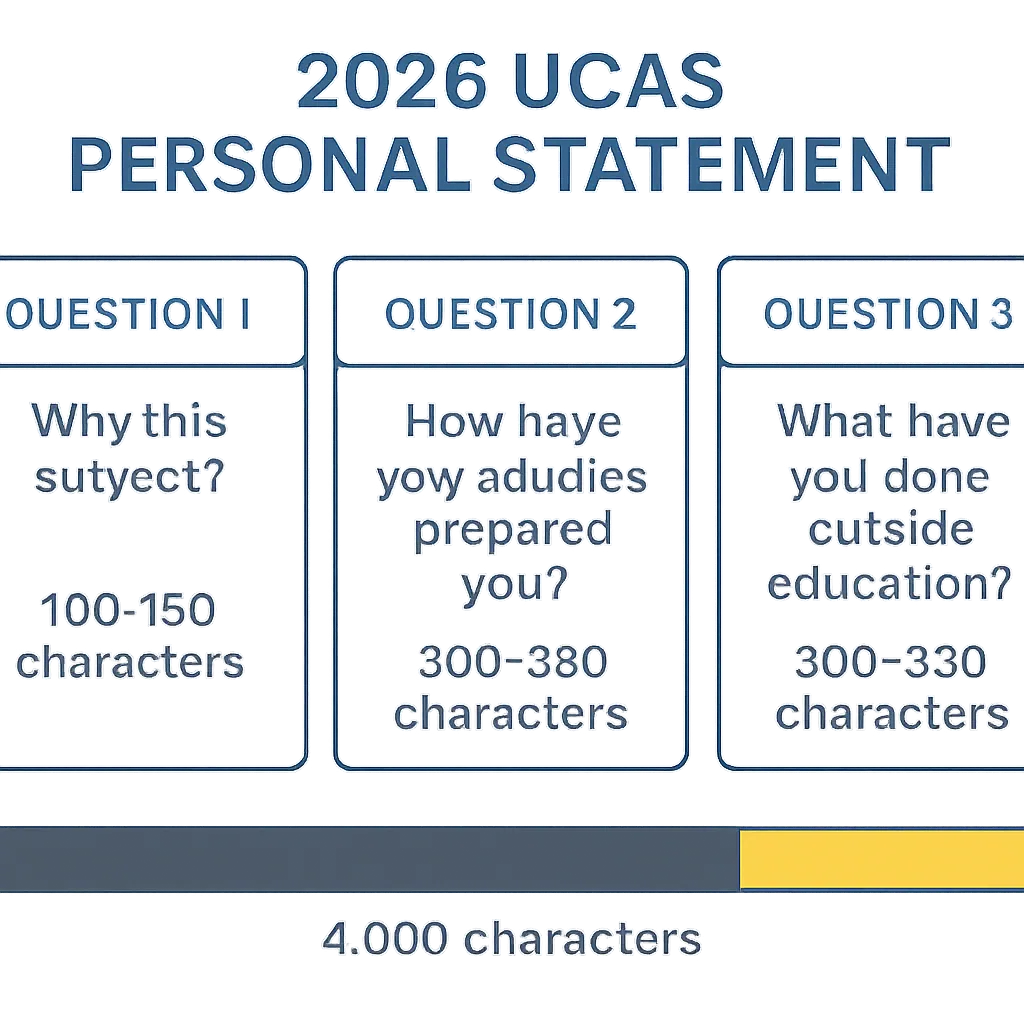
If you are looking at an economics personal statement example written before 2025, put it down. The format changed, and an approach built for the old single-essay structure will actively work against you under the new rules.
Per UCAS, the personal statement for 2026 entry moved from one open-ended piece of writing to three separate, structured questions, with a shared 4,000-character limit (including spaces) and a minimum of 350 characters per question. You can distribute the remaining characters across the three answers in any proportion you choose.
The three questions are:
- Question 1: "Why do you want to study this course or subject?"
- Question 2: "How have your qualifications and studies helped you to prepare for this course or subject?"
- Question 3: "What else have you done to prepare outside of education, and why are these experiences useful?"
One detail that catches applicants out: UCAS explicitly states you should not repeat your grades in Question 2, because universities already see them elsewhere on the application. Use that space for substance instead.
For economics specifically, the three-question structure creates three distinct analytical tasks. Question 1 demands genuine intellectual motivation, not a career pitch. Question 2 is where A-Level or IB Diploma content, an EPQ, or a UKMT result can be connected directly to economic thinking. Question 3 handles everything outside the classroom. Admissions staff read all three answers as a whole, so repeating the same point across questions wastes your character allowance.
2. What Economics Admissions Tutors Are Looking For
Tutors are not looking for the most impressive CV. They are looking for evidence that you think like an economist.
The University of Bristol puts it plainly: "A straightforward personal statement that gets all the core points across in a coherent way serves the purpose best." Clarity beats cleverness. A statement that drifts across four themes without landing on any of them will lose out to one that makes three points well.
Cambridge does not assign a formal score to personal statements and expects them to focus on academic detail throughout. Non-academic activities must not exceed 20% of any section in which they appear. Christ's College Cambridge makes the underlying principle explicit: the college assesses academic ability and potential, not which school you attended, whether you play sport, or whether you have acted in school productions.
What "thinking like an economist" looks like on the page:
- Current affairs linked to theory. The UCAS guide cites the war in Ukraine's effect on global commodity markets as the kind of event worth analysing, not just naming.
- Quantitative reasoning evidenced. Mentioning probability or statistics in the context of a project carries more weight than a general claim that you "enjoy maths."
- Reading beyond the curriculum. Referencing a specific argument from a book, and stating whether you found it convincing, signals independent thought. Listing titles does not.
3. Full Economics Personal Statement Example (2026 Format)
This is a purpose-written example for this guide, not a real applicant's statement. It is calibrated for a competitive applicant targeting a range of universities including strong red-brick and newer Russell Group departments, not solely Oxbridge. The character counts shown are approximate and sit within the 4,000-character total limit set by UCAS.
One non-obvious point worth flagging: because the three questions share a single 4,000-character pot, spending too heavily on Question 1 leaves Question 3 thin. Most applicants under-write Question 3, which is precisely where tutors look for evidence of self-directed learning beyond the classroom.
Question 1: Why do you want to study this course? (~1,850 characters)
> Reading about the UK energy price cap in 2022 made me want to understand not just the policy, but the market failure that made it feel necessary. Energy suppliers were exiting the market rather than absorbing losses from the price spike triggered by reduced Russian gas supply, an outcome that standard competitive-market theory does not predict cleanly. That gap between the textbook and the news was the moment I knew I wanted to study economics. > > I started with the basics of supply and demand, then began reading around price regulation and its unintended consequences. Digging into the economics of the war in Ukraine's effect on European energy markets, as the UCAS economics personal statement guide suggests as a relevant contemporary case, showed me how quickly macro shocks transmit through microeconomic incentives. I became interested in how governments choose between price controls, subsidies, and allowing markets to clear, and what the welfare trade-offs of each look like. > > My longer-term interest is in public policy and regulatory economics. I want to study economics specifically because it gives me the tools to move beyond opinion: elasticity, welfare analysis, game theory. Those frameworks let me ask whether a policy actually works, not just whether it sounds reasonable.
Question 2: How have your qualifications prepared you? (~1,200 characters)
> A-level Mathematics has been the most directly useful preparation. The statistics content, covering probability distributions, hypothesis testing, and correlation, maps closely onto how economic data is analysed. In Economics, the Edexcel specification introduced me to quantitative demand analysis and national income accounting, which gave me a working vocabulary before I read anything beyond the syllabus. > > My EPQ examined whether minimum wage increases in the UK reduced youth employment, a question that required me to find and critically read labour market datasets rather than rely on textbook summaries. That process taught me that real data is messier than model assumptions, and that controlling for confounding variables matters as much as the central argument. > > I also completed a Springpod Virtual Work Experience in economics, recommended by UCAS as a way to build subject knowledge outside school. It reinforced the gap between macroeconomic forecasting and actual outcomes.
Question 3: What have you done to prepare outside education? (~900 characters)
> Over six months I ran a weekly reading group with three classmates, working through accessible economics writing and then debating the arguments. We used this to stress-test ideas rather than just absorb them. One session on behavioural economics, prompted by reading about predictive modelling and probability, led me to question whether rational-agent assumptions hold in housing markets, a question I am still not sure how to answer cleanly. > > I also spent four weeks volunteering with a local citizens' advice service, helping clients understand benefit entitlement calculations. That experience made the economics of means-testing concrete in a way that no textbook had. Seeing where official policy assumptions break down in individual cases gave me a different kind of analytical instinct, one that I think will sit alongside, not replace, formal economic modelling.
This full economics personal statement example distributes characters unevenly by design: Question 1 carries the intellectual argument, Question 2 evidences preparation without listing grades (as UCAS explicitly requires), and Question 3 shows self-direction. Sections 4, 5, and 6 annotate each question in detail.
4. Question 1 Annotated: Showing Intellectual Curiosity and Economic Analysis
Question 1 asks why you want to study the course. In the example, three paragraphs do three distinct jobs - and understanding that structure is more useful than copying the sentences themselves.
Paragraph 1 (the intellectual hook) opens with a specific observation: a named market failure with a concrete mechanism attached. That move signals analytic thinking before a single textbook is mentioned. Compare it with the weaker version:
> Weaker: "I have always been interested in economics because it explains the world around us."
> Stronger (from the example): [A named phenomenon] prompts a question that formal economic theory only partially answers.
The weaker version is enthusiasm without evidence. The UCAS economics guide makes the same point implicitly: it suggests engaging with topics like "how the war in Ukraine affected the global economy" - not as proof of watching the news, but as raw material for economic reasoning. Reading and current affairs only count when the applicant converts them into a claim about incentives, externalities, or trade-offs.
Paragraph 2 (the theoretical link) names a specific concept from beyond the A-level syllabus and connects it back to the opening observation. This is where an admissions tutor at a place like Christ's College, which interviews over 80% of applicants and assesses on academic criteria alone, looks for intellectual depth rather than breadth of reading.
Paragraph 3 (future direction) signals what the applicant wants to investigate at degree level, not what they enjoyed at school. The specific line an admissions tutor notices is the one that moves from "I read X" to "X made me question Y, which I want to pursue through Z." That three-part chain is the difference between a list and an argument.
On quantitative strength in Q1: the example doesn't restate grades. Per the UCAS guide, grades appear elsewhere in the application and do not belong here. Instead, quantitative aptitude is shown through the type of reasoning: referencing probability, engaging with a statistical claim from a source, or noting where a model's assumptions break down. That approach demonstrates mathematical thinking without turning Question 1 into a transcript summary.
5. Question 2 Annotated: Evidencing Quantitative Strength and Academic Preparation
Question 2 asks how your qualifications and studies have prepared you for the course. UCAS explicitly states that grades appear elsewhere on the application, so do not list them here. The question is about transferable skills and academic preparation, not results.
What strong Q2 evidence looks like
The UCAS economics personal statement guide names probability, statistics, and projects involving qualitative data as worth highlighting explicitly. A named project lands harder than a subject title because it shows application, not just exposure.
Strong version:
> "My EPQ on price elasticity in regional housing markets required me to construct and interpret a regression dataset, developing the statistical reasoning I expect to use in first-year econometrics."
Weaker version:
> "Studying maths and economics has given me strong analytical and problem-solving skills."
The weaker version lists subjects. It claims skills without evidence. Admissions tutors read hundreds of paragraphs shaped exactly like it.
The UKMT counter-intuitive point
Most applicants treat UKMT as a signal of raw ability. It is more useful framed as evidence of comfort with formal mathematical reasoning under unfamiliar conditions, which maps directly onto proof-based economics modules. Name the competition and the round, not just "maths competitions."
The UCAS guidance also lists online courses as valid Q2 content. If you completed a quantitative course, name the platform and topic rather than describing it generically.
One rule covers everything in Q2: claim a skill, name the evidence, connect it to economics study. If you cannot do all three, cut the sentence.
6. Question 3 Annotated: Work Experience, Personal Statement Without a Traditional Role
Question 3 asks: "What else have you done to prepare outside of education, and why are these experiences useful?" The key word is why. Admissions tutors are not collecting a timetable of your activities. They want to see what economic thinking you developed as a result.
What counts if you have no formal work experience
You do not need a placement or an internship. The UCAS economics guide names Springpod as a provider of virtual Subject Spotlights and virtual work experiences specifically suited to economics applicants. Online courses, economics competitions, relevant podcasts, and independent reading (including less obvious choices such as Tom Chivers' Everything Is Predictable, flagged in the same guide) all qualify.
Weak vs. strong Q3
| Version | What it does |
|---|---|
| Weak | "I completed a Springpod virtual programme, listened to economics podcasts, and entered a competition." |
| Strong | "The Springpod virtual programme modelled how a firm prices under imperfect competition. Hearing the same margin-squeezing dynamic described in a podcast on UK retail convinced me that microeconomic theory has direct predictive power, not just descriptive value." |
The weak version lists. The strong version connects an activity to a specific insight and then explains why that insight matters for economics as a discipline.
The Cambridge 20% rule
Cambridge states that non-academic content must not exceed 20% of any section in which it appears. Under the new three-question format, Q3 is the designated home for outside-education material, so the cap applies per question, not across the whole statement. In practice: if your Q3 answer runs to roughly 150 words, no more than 30 of them should describe the activity itself. The rest must connect it to academic understanding.
Joint-honours applicants
If you are applying for economics and finance, politics and economics, or economics and management, Q3 is the right place to show preparation specific to the joint element. A politics and economics applicant might cite engagement with the UK's fast-changing political landscape as a route into understanding policy trade-offs. An economics and finance applicant might reference a markets simulation or a specific corporate case study, then explain what it revealed about capital allocation decisions.
7. Economics Personal Statement Checklist: Apply This to Your Own Draft
Run through each item question by question before you submit.
- Character budget in range? Your three answers total no more than 4,000 characters (including spaces), and each answer clears the 350-character minimum, per UCAS.
- Q1 opens with an intellectual hook? The first sentence names a specific economic concept, event, or question, not a vague statement about "always being interested in how the world works."
- Q1 links theory to the real world? At least one idea is tracked from abstract principle to a concrete example, such as a named market failure, policy outcome, or empirical puzzle.
- Q2 contains quantitative evidence? A specific skill or module is named, for instance a maths A-level topic, an EPQ, or a UKMT entry, rather than a general claim about being analytical.
- Q2 contains no grade repetition? UCAS explicitly states grades appear elsewhere on the application, so repeating them wastes characters.
- Q3 activities are tied to a learning outcome? Each activity outside formal education leads to a stated intellectual takeaway, not just a role description.
- No information is repeated across questions? Admissions staff read all three answers as a whole, so the same book, project, or experience should not appear twice.
- No unrelated extracurricular padding? Sport, music, or volunteering appears only if it connects to an economic or analytical point you are making.
- Every book or article you cite is one you can discuss in depth? Christ's College Cambridge advises applicants to briefly revisit texts mentioned in the statement, because interviewers may ask about them directly. Listing a title you read once, two years ago, is a risk.
- The draft reads as a single coherent case? After reading all three answers, a tutor should be able to state in one sentence what kind of economist you are becoming, and why this course is the right next step.
8. What to Do Next
The new UCAS format separates your responses into three distinct questions, which means a single polished draft is no longer enough. A common pitfall is writing all three answers in the same register, so they read as one long statement cut into thirds rather than three genuinely different responses.
This week, open a blank document and write the heading for each of the three questions at the top of its own page. Under Question 1, note the single piece of economics writing or reading that changed how you think about a concept, and write two sentences explaining the mechanism, not just the title. That constraint forces analytical depth before you draft a word of prose.
Check the UCAS application portal for the confirmed character limits for your cycle before you write a single full answer.
FAQ
Can I use an economics personal statement example as a template?
Examples are useful for understanding structure and tone, but copying or closely paraphrasing any example risks plagiarism detection - use them to identify what each section must do, then write your own version from scratch.
Do economics personal statement examples still work for the new 2026 format?
Older single-essay examples do not map directly onto the new three-question structure, so any example written before the 2026 format change should be treated as a source of ideas rather than a structural model.
Should economics personal statement examples mention specific books or economists?
Yes - naming a specific book, article, or economist and explaining what it made you think is stronger than a general claim of interest, and Christ's College Cambridge advises briefly revisiting anything you mention in case interviewers ask about it.
Will an economics personal statement example written for LSE or Cambridge work for other universities?
The same UCAS personal statement is seen by all universities you apply to, so the statement should make a strong academic case for economics generally, not be written exclusively for one institution.
Does a politics and economics or economics and finance personal statement follow the same three-question structure?
Yes - all UCAS applicants use the same three-question format for 2026 entry, but joint-honours applicants should ensure their Q1 and Q3 answers address both subjects rather than treating the statement as a single-subject economics application.
What should I put in an economics personal statement if I have no work experience?
Question 3 does not require formal employment - virtual programmes, online courses, economics podcasts, relevant competitions, and independent reading all count as outside-education preparation under the UCAS guidance for the new format.
References
- How to write your personal statement: 2026 entry onwards | UCAS - https://www.ucas.com/applying/applying-to-university/writing-your-personal-statement/how-to-write-your-personal-statement-for-2026-entry-onwards
- Economics personal statement guide | UCAS - https://www.ucas.com/applying/applying-to-university/writing-your-personal-statement/personal-statement-guides/economics-personal-statement-guide
- Writing your personal statement | Undergraduate Study - https://www.undergraduate.study.cam.ac.uk/apply/how/ucas-personal-statement
- Personal Statement | Christs College Cambridge - https://www.christs.cam.ac.uk/how-apply-1/uk-support/personal-statement
- UCAS personal statement | Christs College Cambridge - https://www.christs.cam.ac.uk/international-students/apply/statement
- Personal statement tips for international students: 2026 entry | UCAS - https://www.ucas.com/applying/applying-university/writing-your-personal-statement/personal-statement-tips-international-students-2026-entry