Medicine Personal Statement Example: 2026 UCAS Format Annotated
By Michael Thompson · Education Specialist; 10 years teaching the IB at Bromsgrove School · Published 4 September 2026
A medicine personal statement example is the fastest way to understand what separates a strong application from a forgettable one - but only if you know what format you are writing for. From 2026 entry, UCAS replaced the single free-text essay with three separate questions totalling 4,000 characters, and many students are still planning their statements around the old format. This guide contains a complete example statement written specifically for this article, split across all three questions with realistic character budgets. Each section is annotated so you can see exactly what an admissions tutor notices, what the weaker version of the same paragraph looks like, and how to use work experience and reading as evidence rather than biography.
Key Takeaways
- Three questions, not one essay: The 2026 UCAS personal statement is structured around three separate prompts with a combined limit of 4,000 characters and a minimum of 350 characters per answer.
- Don't repeat your grades: UCAS and individual medical schools explicitly advise against listing grades in the personal statement because universities already see them elsewhere in the application.
- Evidence beats diary entries: Work experience, volunteering, and reading carry weight only when you explain the specific quality or insight each one gave you - not when you list them chronologically.
- Oxford and Cambridge don't score the statement formally: Both universities read the personal statement carefully but use it primarily as a source of interview questions rather than a scored admissions filter.
- Cambridge does not expect uniform work experience: Christ's College Cambridge explicitly states it does not expect all medicine applicants to have access to the same work experience opportunities - reflect on what you have accessed.
- Fabrication carries serious consequences: Oxford states that claims made in personal statements may be verified, and exaggerated or fabricated material can bring into question an applicant's suitability to practise medicine.
In This Article
- The 2026 UCAS personal statement format for medicine
- How medicine admissions tutors use the personal statement
- Complete medicine personal statement example (2026 format)
- Annotation: what each answer is doing and what a weaker version looks like
- Using work experience, volunteering and reading as evidence - not a diary
- Graduate entry medicine personal statement: what changes
- Medicine personal statement checklist: apply this to your own draft
- What to do next
1. The 2026 UCAS personal statement format for medicine
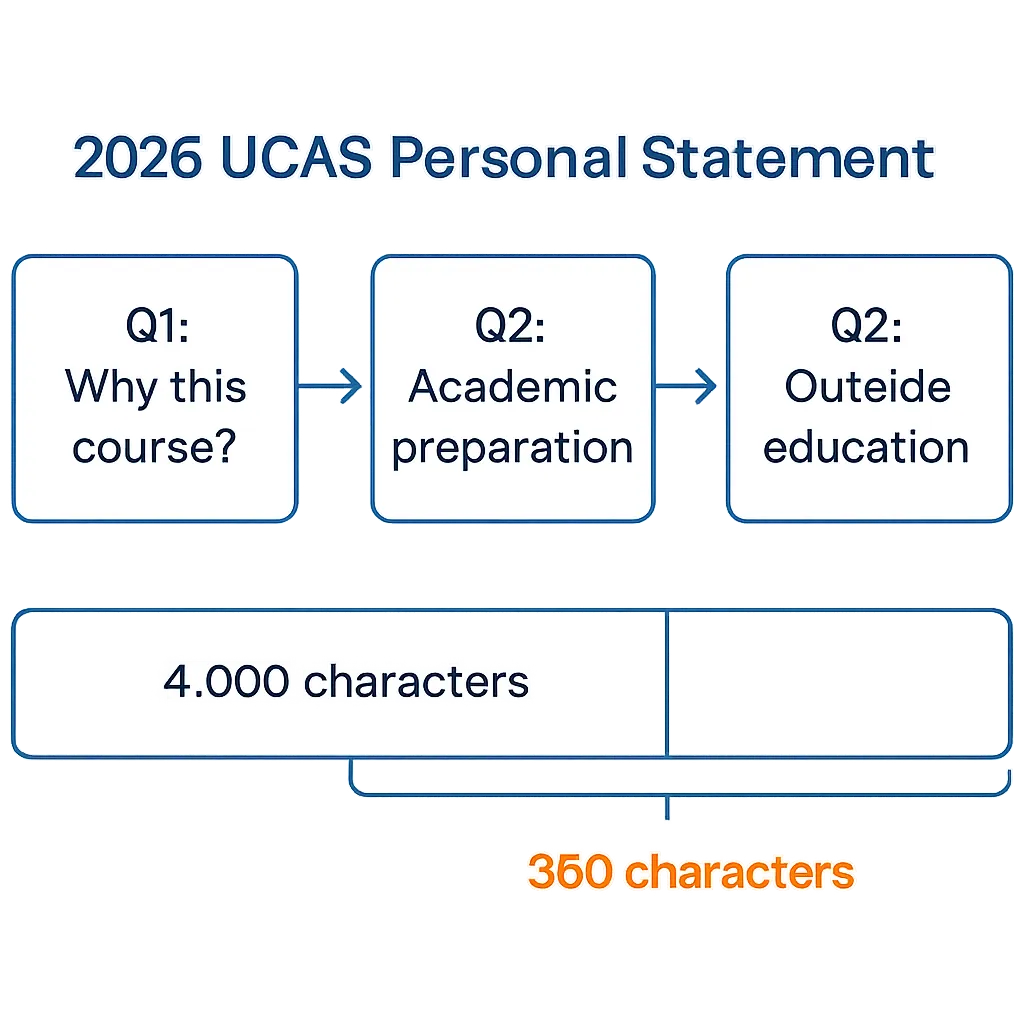
Every medicine personal statement example you find online from before 2026 is built around a format that no longer exists. UCAS has replaced the single free-text essay with three structured questions for 2026 entry onwards, and the shift changes how admissions tutors read your application at every stage.
The overall character limit stays at 4,000 characters (including spaces), but it is now distributed across three answers, each with a minimum of 350 characters. You decide the split. Spend 2,000 characters on question one and 1,000 on each of the others if that suits your material. There is no prescribed proportion.
The three questions are:
- Question 1: "Why do you want to study this course or subject?"
- Question 2: "How have your qualifications and studies helped you to prepare for this course or subject?"
- Question 3: "What else have you done to prepare outside of education, and why are these experiences useful?"
Two details catch applicants out. First, UCAS guidance is explicit that you should not describe your grades in Question 2, because universities already see them elsewhere in your application. The space is for subject insight, not a transcript recap. Second, admissions staff read all three answers as a single whole, and UCAS flags repeating information across questions as something to avoid. Think of it as one document with three entry points, not three separate mini-essays.
2. How medicine admissions tutors use the personal statement
The personal statement rarely decides whether you get an interview on its own. Per UCAS, many medical schools no longer formally score it in the selection process. But "not scored at shortlisting" does not mean "ignored." Tutors read it, and they use it to build interview questions.
How each school weighs it varies considerably:
- Oxford (A100). UCAT scores and GCSEs are the primary shortlisting tools. The personal statement carries more weight only for applicants who are borderline on those metrics, and then it is used to shape interview questions rather than award points.
- Cambridge. Christ's College states that Cambridge evaluates on academic criteria only, meaning ability and potential. The practical consequence: any book, paper, or placement you mention is fair game at interview, so Cambridge advises briefly revisiting any texts you plan to reference before interview season.
- Bangor. Has a harder requirement than most: applicants must demonstrate awareness of the UK healthcare system within the statement itself, not just at interview.
The Oxford verification warning is the one most applicants underestimate. Oxford explicitly states it may verify claims made in personal statements, and that fabricated or exaggerated material discovered during admissions or later in study "may bring into question your suitability to practise Medicine." That is not a standard disclaimer - it connects misrepresentation directly to fitness-to-practise, which has consequences well beyond a rejected application.
Write every claim as if a tutor will ask you about it in detail. That is the practical standard the statement needs to meet.
3. Complete medicine personal statement example (2026 format)
This example was written for this guide and does not represent a real applicant. It is designed to show how a strong medicine personal statement example reads under the 2026 UCAS three-question format. Use it as a structural model, not a template to copy.
Character budget across the three questions:
| Question | Focus | Characters used |
|---|---|---|
| Q1 | Why you want to study medicine | ~1,400 |
| Q2 | How your studies have prepared you | ~1,200 |
| Q3 | What you have done outside education | ~1,400 |
| Total | ~4,000 |
One non-obvious point worth knowing: the three questions do not carry equal weight at every school. Oxford's selection process weighs personal statements alongside academic record, UCAT score, school reference, and interview performance, and tutors are likely to discuss the content at interview. That means a vague Q1 is not just a weak opener - it becomes a liability in the room.
Q1: Why do you want to study medicine? (~1,400 characters)
> My interest in medicine sharpened during a conversation with my grandfather's cardiologist, who explained how his atrial fibrillation was being managed with rate control rather than rhythm control because of his age and comorbidities. I was struck that the same diagnosis could require a different treatment decision for a different patient. That distinction - between a condition and a person's context - is what drew me towards medicine rather than biomedical science. > > I followed up that experience by reading Atul Gawande's Being Mortal, which challenged me to think about what good care looks like when cure is not the goal. It pointed me towards geriatric medicine as an area I want to understand better. I am also aware that any future specialism will require a broad foundation, and I want to use medical school to test those interests rigorously before I commit to a direction.
Q2: How have your studies prepared you? (~1,200 characters)
> Studying AQA A-level Biology gave me a grounding in how the cardiovascular system regulates cardiac output through stroke volume and heart rate - concepts that became concrete when I saw a patient's ECG trace during shadowing. A-level Chemistry (Edexcel) extended that: understanding enzyme kinetics and drug-receptor interactions helped me make sense of why beta-blockers slow the heart rather than simply stopping arrhythmia. > > To go further, I completed a free online course in clinical pharmacology through FutureLearn, which covered how drug half-life affects dosing intervals. I also read sections of Clinical Medicine by Kumar and Clark to build clinical vocabulary ahead of any interview. Current grades appear elsewhere in my UCAS application, so I have focused here on what the content taught me rather than listing results.
Q3: What have you done outside education to prepare? (~1,400 characters)
> From February of my upper sixth year, I volunteered weekly at a residential care home, helping residents with meals and supporting a resident with advanced dementia who needed assistance with feeding. The work required patience when verbal communication was limited, which pushed me to develop non-verbal ways of building trust - reading body language and adjusting pace. This mirrors what medical schools describe as preparation through care home experience. > > I also completed a hospital placement that included time in A and E, Radiology, and Obstetrics and Gynaecology. One case I observed involved an infant on an ECMO machine after birth with Meconium Aspiration Syndrome. Watching the clinical team explain the situation to the parents, calmly and clearly under pressure, showed me what effective communication looks like when the stakes are highest. > > Alongside these, I worked part-time as a sales assistant for eighteen months. Managing difficult customer conversations - particularly complaints and distressed shoppers - required the same structured listening I hope to use with patients. It also taught me to adjust my communication style depending on the person in front of me, a skill I expect to use constantly in clinical settings.
4. Annotation: what each answer is doing and what a weaker version looks like
Reading all three answers together is exactly how UCAS says admissions staff approach the statement. That means repetition across questions doesn't just feel lazy - it quietly shrinks your usable character budget.
Question 1: what the stronger version does
A strong Q1 answer names a specific trigger. In the annotated example in section 3, the writer identifies a precise clinical moment (an infant on an ECMO machine following Meconium Aspiration Syndrome, observed during a hospital placement) as the point where theoretical knowledge became something visceral and real. An admissions tutor reading that has an immediate interview question ready.
Weaker version: "Ever since I was young, I have wanted to be a doctor." This tells the reader nothing about the applicant. It could have been written by any of the 20,000+ people applying to medicine that cycle. There is no intellectual content to probe at interview.
Question 2: turning subjects into evidence
The stronger answer connects a curriculum topic to independent reading or a specific concept encountered outside lessons. That movement from course content to self-directed inquiry signals academic engagement rather than passive attendance.
Weaker version: "I study Biology, Chemistry and Maths." UCAS guidance explicitly says not to describe grades, because universities already see them. Simply listing subjects commits the same error at one step removed.
Question 3: experience as evidence, not diary
The counter-intuitive gotcha here is that frequency data ("every Tuesday", "two years") sounds impressive but proves nothing on its own. What matters is attributing a named quality to the experience. Oxford's selection criteria include empathy, communication, ethical awareness, and honesty and integrity. A strong Q3 answer uses a specific incident, such as supporting a care home resident who needed patient, physical assistance with meals, to demonstrate one of those named qualities directly. A weaker version is a calendar entry with no conclusion drawn.
One rule across all three: if a quality, experience, or idea appears in Q1, it should not reappear in Q3. UCAS flags repetition explicitly as something to avoid. Each answer should earn its own share of the 4,000-character total.
5. Using work experience, volunteering and reading as evidence - not a diary
Mentioning an experience is not the same as using it. A diary entry says "I volunteered at a care home for three months." Evidence says what you noticed there, what that forced you to think about, and what it confirmed or complicated about your understanding of medicine. The difference matters, because admissions tutors are not counting hours.
A useful pattern to apply to every experience you include:
- What you did - the context, briefly.
- What you observed or realised - the specific moment or pattern that stuck.
- What quality this developed or confirmed - named precisely, not "communication skills."
- Why that quality matters in clinical practice - the connection to medicine, not just to being a good person.
One non-obvious gotcha: a prestigious placement described superficially does less work than a local GP shadowing session described with genuine insight. Christ's College Cambridge states explicitly that it does not expect all medicine applicants to have access to the same work experience opportunities. Depth of reflection is the variable being assessed, not the prestige of the setting.
The same principle applies to reading. If you cite a book or article, Cambridge advises applicants to briefly revisit any texts they plan to mention, because interviewers ask about them directly. Only reference material you have genuinely engaged with, and say what it changed or challenged in your thinking.
On placement: UCAS guidance designates Question 3 as the natural home for extracurricular evidence, but notes there is no single correct question. Put each piece of evidence where it fits the argument best.
6. Graduate entry medicine personal statement: what changes
The UCAS application structure is identical for graduate applicants: three questions, 4,000 characters total. What shifts is the expected content in each answer.
Most graduate entry courses run for four years, one year shorter than the standard five-year undergraduate route. That compressed timeline is part of why admissions tutors weight the personal statement differently: they need evidence you can handle clinical intensity without the buffer of a longer course.
The minimum entry bar is a 2:1 degree alongside relevant work experience, at most graduate entry programmes. This means Q2 (your reasons for studying medicine academically) should reference degree-level learning and any research you have done, not A-level biology. A-levels are irrelevant to a graduate reader.
Q3 carries the most weight for graduate applicants. Post-degree clinical exposure, healthcare employment, and sustained patient-facing roles belong here. For school-leavers, a week of GP shadowing is notable; for a graduate applicant, it is the baseline.
One non-obvious catch: Oxford's graduate entry programme is restricted to science graduates, whereas Cambridge accepts any degree discipline. Your statement should reflect the course you are actually applying to. Describing how a history degree developed your analytical thinking reads well at Cambridge; it will not rescue a non-science application at Oxford, because Oxford will not consider it.
7. Medicine personal statement checklist: apply this to your own draft
Run through this list on your draft before submitting. Each item maps to a specific requirement or pitfall in the 2026 format.
Format and length
- [ ] Total character count (including spaces) is under 4,000, and each individual answer is at least 350 characters, as required by UCAS
- [ ] No information appears in more than one answer - UCAS explicitly flags cross-question repetition as a problem
Question 1 (Why medicine?)
- [ ] The opening identifies a specific intellectual or clinical moment, not a generic statement about wanting to help people
- [ ] There is no reference to a childhood aspiration presented as a self-sufficient reason
Question 2 (Qualifications and studies)
- [ ] Curriculum content is discussed in terms of ideas and skills, not grades - UCAS guidance states universities already see grades elsewhere in the application
- [ ] At least one area of study is linked forward to a clinical or scientific question in medicine
Question 3 (beyond qualifications)
- [ ] Each experience is paired with a named quality (empathy, ethical awareness, ability to work under pressure) rather than described as a sequence of events
- [ ] Counter-intuitive detail: listing more experiences does not strengthen this answer - one experience with three specific observations outperforms five experiences with none
Accuracy and integrity
- [ ] Every book, paper, or article mentioned is one you have genuinely read and could discuss at interview without prompting
- [ ] No claim is fabricated or exaggerated - Oxford states explicitly that false material may call into question your suitability to practise medicine
8. What to do next
Take your current draft, or open a blank document if you haven't started, and paste each paragraph under the question it actually answers. The question that most often swallows content from the other two is Question 2, which UCAS limits to qualifications and formal study. If you find clinical insight or volunteering reflection sitting there, move it to Question 1 or Question 3. Then scan for repetition: per UCAS, admissions staff read all three answers as a single whole, and repeating information across questions is explicitly flagged as something to avoid.
Before you submit, confirm the current character limits on the UCAS 2026 guidance page, as the rules apply to 2026 entry onwards and could be updated.
This week, open your draft and run the three-question audit described above. Check the UCAS guidance page for the latest rules before your next writing session.
FAQ
Why use a medicine personal statement example rather than writing from scratch?
An annotated example shows the structural logic behind each paragraph - why a specific opening works, what a weaker version looks like, and how to link experience to evidence - in a way that abstract advice alone cannot.
How do I write a personal statement for medical school under the new 2026 format?
Answer each of the three UCAS questions in turn - motivation, academic preparation, and extracurricular preparation - within a combined 4,000-character limit, with at least 350 characters per answer, avoiding repetition across sections.
Do medical schools still read the personal statement if they don't score it?
Yes - many medical schools no longer use the personal statement to filter applicants at shortlisting, but tutors still read it and it is commonly used as a basis for interview questions.
How long should a medicine personal statement be for 2026 entry?
The total limit is 4,000 characters across all three answers, with a minimum of 350 characters per question; there is no fixed split, so applicants can weight answers according to where they have most to say.
What work experience do I need to mention in a medicine personal statement?
There is no fixed minimum; Cambridge explicitly states it does not expect all applicants to have access to the same opportunities, so the key is to reflect meaningfully on whatever patient-facing or healthcare experience you have accessed.
References
- How to write your personal statement: 2026 entry onwards | UCAS - https://www.ucas.com/applying/applying-to-university/writing-your-personal-statement/how-to-write-your-personal-statement-for-2026-entry-onwards
- Medicine personal statement guide | UCAS - https://www.ucas.com/applying/applying-to-university/writing-your-personal-statement/personal-statement-guides/medicine-personal-statement-guide
- Medicine: Writing your Personal Statement - University of Oxford, Medical Sciences Division - https://www.medsci.ox.ac.uk/study/medicine/pre-clinical/applying/ps
- Personal Statement | Christs College Cambridge - https://www.christs.cam.ac.uk/how-apply-1/uk-support/personal-statement
- Medicine: Anatomy of a Personal Statement - University of Oxford, Medical Sciences Division - https://www.medsci.ox.ac.uk/study/medicine/pre-clinical/applying/anatomy-of-ps
- Medicine as a Second Degree | Oxford University Careers Service - https://www.careers.ox.ac.uk/medicine-as-a-second-degree