Nursing Personal Statement: Complete Guide for 2026 Entry
By Michael Thompson · Former IB Diploma Programme coordinator; 10 years at Bromsgrove School · Published 5 July 2026
A nursing personal statement is the part of your UCAS application where you explain why you want to study nursing, how your studies and experiences have prepared you, and what you have done outside education to get ready for the course. From 2026 entry, UCAS replaces the single essay with three structured questions sharing a 4,000-character limit - and nursing admissions tutors read all three answers as a whole. The bar is specific: tutors want evidence of the NMC's core values (integrity, fairness, respect, equity, and effectiveness) shown through real interactions, not adjectives. This guide maps each question to what nursing courses actually want, gives before-and-after phrasing examples, and covers field-specific angles for adult, child, learning disability, and dental nursing, as well as the nursing associate route.
Key Takeaways
- Three questions, 4,000 characters total: From 2026 entry, UCAS splits the personal statement into three questions with a 350-character minimum each and no individual maximum - you distribute the budget unevenly based on your strongest material.
- Show values through evidence, not adjectives: Saying 'I am compassionate' tells tutors nothing; describing a specific caring interaction and what it taught you about dignity or teamwork is what values-based recruitment actually looks for.
- Understand the demands of the role: Nursing admissions tutors want to see that you know shift patterns, physical and emotional demands, and the realities of NHS placement - not just that you 'want to help people'.
- IB applicants can use CAS and science subjects as direct evidence: Biology at Higher or Standard Level addresses academic readiness, while CAS service roles in care settings map directly onto Question 3's experience requirement - check each course's entry requirements page.
- Align explicitly with the NMC's five values: Integrity, fairness, respect, equity, and effectiveness are the regulatory values behind nursing; weaving them into your statement signals that you understand what professional nursing actually means.
- Two well-reflected placements outperform five superficial ones: For Question 3, depth of reflection on one or two caring experiences - what happened, what you observed, what you learnt - carries more weight than a long list of activities.
In This Article
- What Nursing Admissions Tutors Are Actually Looking For
- How the 2026 UCAS Format Works for Nursing Applications
- Mapping Each Question to Your Nursing Personal Statement
- Showing NMC Values Through Evidence, Not Adjectives
- Field-Specific Angles: Adult, Child, Learning Disability, and Dental Nursing
- Guidance for IB Students Applying to Nursing Degrees
- Common Mistakes That Weaken a Nursing Personal Statement
- A Before-and-After Example for Your Nursing Degree Personal Statement
- How to Structure and Draft Your Nursing Personal Statement
- What to Do Next
1. What Nursing Admissions Tutors Are Actually Looking For
A strong nursing personal statement does one thing above everything else: it shows a tutor that you understand what nursing actually involves, and that your values align with the profession before you set foot on a ward. Generic phrases about wanting to help people are the single most common reason a statement gets put to one side.
UK nursing programmes select on values as much as grades. The Nursing and Midwifery Council identifies five core values that underpin professional practice: integrity, fairness, respect, equity, and effectiveness. Admissions tutors are trained to look for evidence of these qualities in your writing, not just a list of adjectives claiming you possess them.
The counter-intuitive part: demonstrating realistic awareness of the role carries more weight than enthusiasm. Tutors want to see that you know nursing means rotating shift patterns, sustained physical demands, and emotional exposure to illness, death, and distress. A statement that acknowledges difficulty and explains why you still want to do the job reads as far more credible than one that presents nursing as a reward.
Your evidence base matters too. Caring experience does not have to be formal. Healthcare assistant work, care home placements, shadowing, or unpaid family caring roles all count, provided you reflect on what you observed and what it taught you. The reflection is the point. Raw hours without analysis tell a tutor nothing about how you think.
2. How the 2026 UCAS Format Works for Nursing Applications
From 2026 entry, UCAS replaces the single personal statement essay with three separate questions, each with a 350-character minimum and no individual maximum. The total budget stays at 4,000 characters including spaces.
The three questions are:
- Q1 - Why do you want to study this course? Cover your motivations, subject knowledge, and what you plan to do with the degree.
- Q2 - How have your qualifications and studies prepared you? Focus on formal education and transferable skills. UCAS is explicit that you should not repeat your grades here because admissions tutors already see them elsewhere in your application.
- Q3 - What have you done outside education, and why is it useful? Work experience, volunteering, and any other relevant activity belongs here.
The counter-intuitive part: you do not have to split the 4,000 characters equally. The budget can be distributed unevenly, so a nursing applicant with strong clinical placements might weight Q3 more heavily than Q1. What matters is that every question clears the 350-character floor.
Admissions staff read all three answers as a whole, so repeating the same experience across questions wastes characters and signals poor planning. Strong applicants use 85-95% of the 4,000-character budget; anything around 2,500 characters reads as under-prepared.
Treat the three questions as one connected argument, not three separate mini-essays.
3. Mapping Each Question to Your Nursing Personal Statement
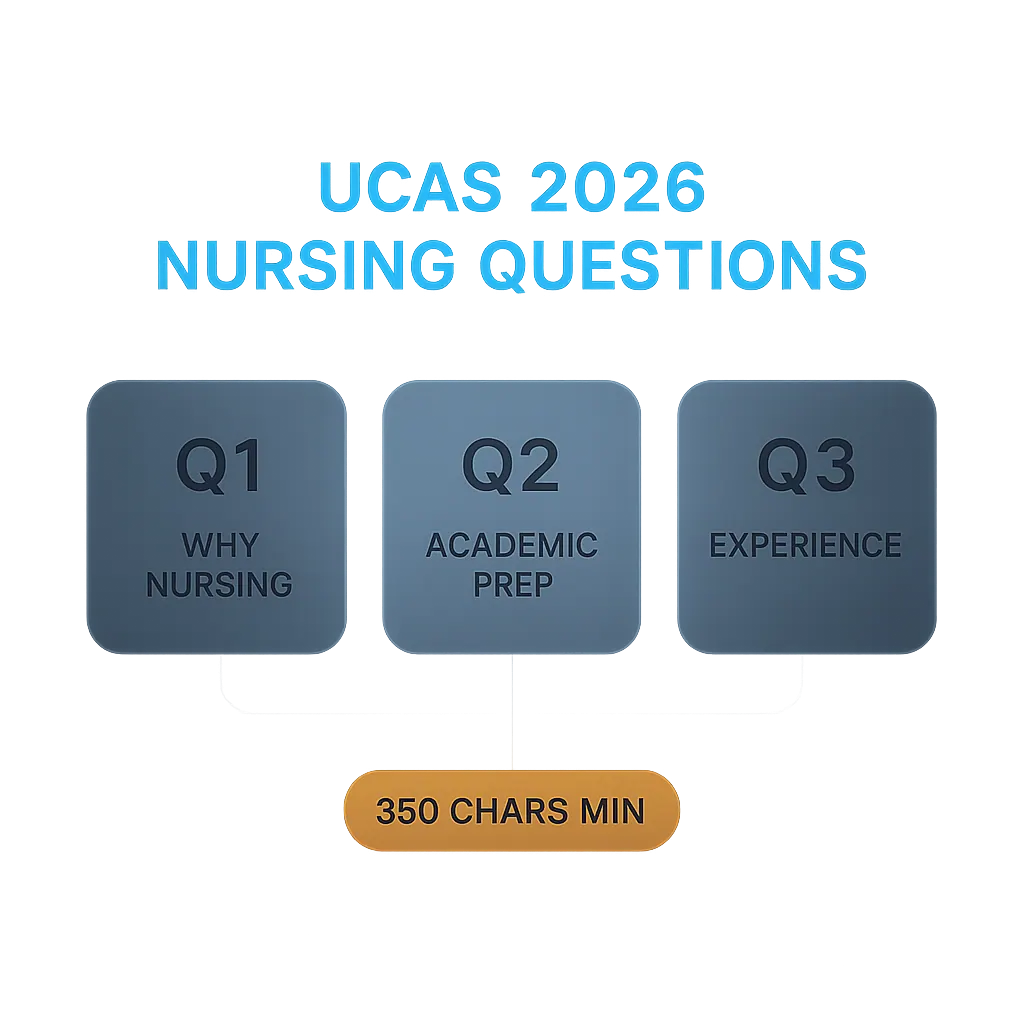
The new format gives each question a distinct job. Per UCAS, admissions staff read all three answers as a whole, so repeating the same point across questions wastes your limited 4,000 characters. Treat each question as a separate lane.
Quick-reference map
| Question | What it covers | Nursing application component |
|---|---|---|
| Q1 - Why this course? | Motivation, field choice, future direction | Your reason for choosing adult, child, learning disability, or dental nursing, or the nursing associate route |
| Q2 - Academic preparation | Formal study, qualifications, analytical skills | Sciences, psychology, sociology, IB Biology HL/SL, Theory of Knowledge |
| Q3 - Outside education | Work, volunteering, caring roles | Healthcare assistant shifts, care home placements, CAS service, shadowing |
Q1 - Motivation. Start with a real observation, not a feeling. Admissions tutors at nursing programmes see through generic openings. Access Pathways explicitly flags "I have always been passionate..." as taking up space without adding value. Instead, open with something specific you noticed: a moment during a care shift, a conversation with a district nurse, or a pattern you observed across several placements. Field choice matters here too. If you are applying for child nursing or learning disability nursing, name that field and explain what draws you to it rather than nursing generally.
Q2 - Academic preparation. Your grades appear elsewhere in the application, so UCAS advises against repeating them in Q2. The counter-intuitive move is to explain mechanism, not achievement: describe how A-Level Biology or IB Theory of Knowledge built a specific type of thinking relevant to nursing practice, such as evaluating conflicting evidence or understanding research methodology. Psychology and sociology A-Levels map directly onto mental health awareness and person-centred care models.
Q3 - Outside education. This is where your nursing personal statement earns real weight. NextGenMedPrep notes that two well-reflected placements outperform five superficial ones. The Access Pathways nursing example is specific: a care assistant applicant who monitored a resident's declining mobility over two weeks, kept accurate records, escalated the change, and contributed to a fall-risk review. That level of detail signals genuine understanding of nursing realities, not just goodwill.
Each question has a 350-character minimum, so even your shortest answer must go beyond a sentence or two.
4. Showing NMC Values Through Evidence, Not Adjectives
Admissions tutors reading a nursing personal statement are trained to spot values-based evidence, not self-reported character traits. The NMC's five core values - integrity, fairness, respect, equity, and effectiveness - underpin how universities assess fit through values-based recruitment. The question tutors ask is not "does this applicant claim to be caring?" but "can I see caring behaviour in what they describe?"
The NHS 6Cs from Compassion in Practice (DoH 2012) - care, compassion, competence, communication, courage, and commitment - give you a second useful lens. Together, the NMC values and the 6Cs form the vocabulary tutors are already using when they read your application. Write to that vocabulary through scenes, not sentences.
Adjective-stacking is the most common and most penalising mistake. A line like "I am compassionate, dedicated, and hardworking" tells a tutor nothing they could not read in every other application that day. One specific interaction shows more than five adjectives ever could.
Here is what that looks like in practice:
| Version | What it does |
|---|---|
| Before: "I am a caring person who wants to help people." | States a trait. Gives the tutor nothing to assess. |
| After: "During a shift as a care assistant, I noticed a resident becoming withdrawn at mealtimes. I sat with her, asked open questions, and learned she was anxious about a procedure the following day. I flagged this to the senior nurse, who arranged a pre-procedure chat with the ward sister. Afterwards the resident said she felt heard." | Demonstrates respect and integrity (NMC values), communication and courage (6Cs), and shows how the applicant recognised a need and acted on it. |
The counter-intuitive point: you do not need a dramatic incident. The example above is mundane. What makes it strong is the structure - what you noticed, what you did, what happened, and what it taught you. UCAS guidance for 2026 entry confirms that universities are not expecting rare achievements; they are looking for evidence of fit and understanding of what nursing involves.
When you draft your reflective accounts, check each one against this prompt: which NMC value or 6C does this moment evidence? If you cannot name one, the scene probably needs more reflection, not more description.
5. Field-Specific Angles: Adult, Child, Learning Disability, and Dental Nursing
Each nursing field has a distinct clinical focus, and admissions tutors read enough personal statements to spot a generic one immediately. The most common mistake is describing the field in terms of what you expect to receive from it rather than what you understand about its demands.
Adult nursing is the broadest field, but that breadth is a trap. Applicants often focus on acute hospital settings and miss what tutors want to see: awareness of long-term condition management, the reality of multidisciplinary teamwork across community and hospital settings, and the emotional and ethical weight of end-of-life care. If your work experience included a care home or a community health visit, say what you observed there specifically.
Child nursing is not simply adult nursing with smaller patients. Family-centred care, where parents and carers are active partners in treatment decisions, sits at the heart of the field. You also need to show communication awareness across developmental stages - explaining a procedure to a four-year-old and to a fourteen-year-old require entirely different approaches. Safeguarding awareness matters here too; tutors will expect you to acknowledge it.
Learning disability nursing is the field most applicants misrepresent. The role centres on advocacy, person-centred planning, and adapting communication to the individual, but tutors also want to see that you understand the significant health inequalities this group faces, including diagnostic overshadowing, where physical symptoms are wrongly attributed to a learning disability rather than investigated clinically.
Dental nursing sits outside the NMC and is regulated by the General Dental Council. Your statement should reflect infection control protocols, the technical precision the role demands, and your approach to patients presenting with dental anxiety, which is common and requires a specific, calm communication strategy.
Nursing associate applicants should centre their existing healthcare support worker experience and explain clearly how the nursing associate role bridges that support work and registered nursing, because most programmes are degree apprenticeships where that distinction matters to employers as well as universities.
Compare entry requirements and course structures across providers using the nursing subject hub at /subjects.
6. Guidance for IB Students Applying to Nursing Degrees
IB Diploma students have a structural advantage in nursing applications that is easy to miss: the three-question format that UCAS introduced for 2026 entry maps almost perfectly onto the IB's own learning framework.
Entry requirements first. Many UK nursing programmes specify a science subject at Higher or Standard Level, with Biology HL or SL the most commonly named requirement. Standard Level is often accepted, but some universities require Higher Level, so check each course's official admissions page directly. Do not rely on what a classmate's offer said.
How each IB element lines up with the three questions:
- **Biology HL/SL - Q2.** Describe how the subject built concrete understanding relevant to nursing: membrane transport and pharmacokinetics, the nervous system and pain pathways, or homeostasis and fluid balance. These are not abstract academic topics; they are the science behind clinical reasoning.
- CAS service activities - Q3. Volunteer hours in hospitals, hospices, care homes, or community health projects count as direct work experience. A CAS log gives you dates and reflection notes, which means you can write about a specific situation with precision rather than in vague terms.
- TOK - Q2. Analytical and ethical reasoning demonstrated in TOK, particularly around knowledge and certainty, supports Q2 by showing you can think critically about evidence, which is directly relevant to clinical decision-making.
One gotcha worth knowing: IB predicted grades arrive as a total points score, but nursing conditional offers often specify individual subject grades as well as the total. Confirm with your IB coordinator that your predicted grades are recorded at subject level before the UCAS deadline, not just as an overall points figure.
7. Common Mistakes That Weaken a Nursing Personal Statement
Six errors account for most of the weak nursing personal statements admissions tutors see. Fix these before anything else.
**Opening with a quote or a passion declaration.** Phrases like "I have always been passionate about nursing" or a Florence Nightingale quote take up characters without telling the reader anything about you. UCAS guidance for 2026 entry explicitly flags these as openers that consume space without adding value. Start with a real observation or an experience that changed how you understood care.
Listing activities without reflection. Naming five placements but not explaining what any of them taught you signals surface engagement. UCAS guidance is clear: two well-reflected placements outperform five superficial ones. Describe what you noticed, what you did, what it revealed.
Naming a specific university. UCAS sends the same statement to every institution on your list, so naming one university penalises every other application simultaneously.
Using only around 2,500 characters. Strong applicants use 85-95% of the 4,000-character budget. A half-empty statement reads as under-preparation.
Repeating grades in Q2. Universities already see your predicted or achieved grades elsewhere in the UCAS application. Q2 is for explaining how your studies prepared you, not for restating numbers.
Writing generically across nursing fields. A nursing personal statement for child nursing should contain field-specific observations, developmental awareness, family-centred care. An adult nursing personal statement needs different evidence entirely. Generic statements read as generic to tutors who read hundreds of field-specific applications each cycle.
8. A Before-and-After Example for Your Nursing Degree Personal Statement
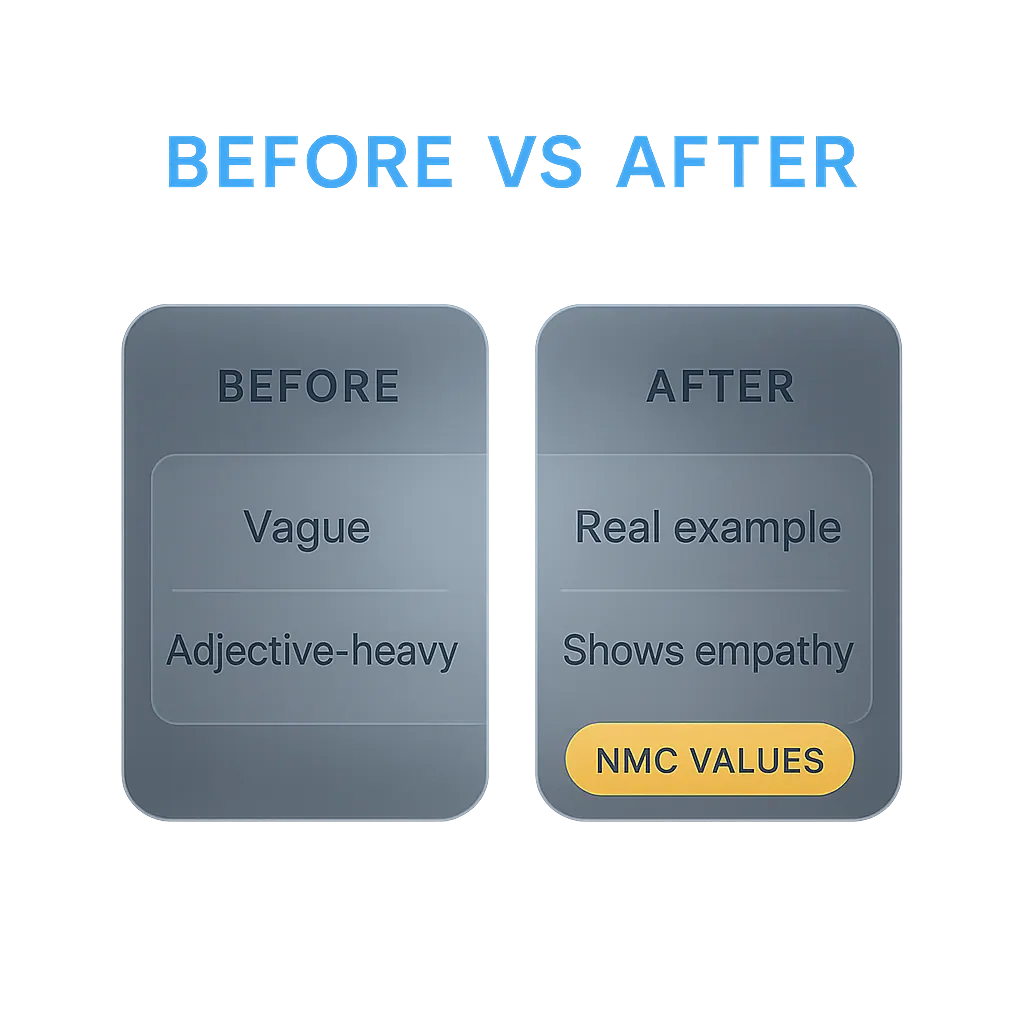
The gap between a weak and a strong nursing personal statement is rarely about word count. It is about the ratio of claim to evidence. The examples below use roughly the same character count to show what that shift looks like in practice.
Before: vague and adjective-heavy
> "I am a caring and compassionate person who has always wanted to help others. I volunteer at a care home and enjoy speaking with residents. This has made me certain that nursing is the right career for me."
Every sentence here makes a claim but proves nothing. "Caring and compassionate" are adjectives the applicant has applied to themselves. "Enjoy speaking with residents" describes a preference, not a contribution. An admissions tutor learns nothing about how this person thinks or acts under pressure.
After: specific and evidence-led
> "During my care assistant role, I noticed a resident's walking pace slow noticeably over two weeks. I kept a written log of the changes and raised them with the senior nurse on shift. That escalation contributed to a fall-risk review and a change in her care plan. The experience showed me that observation without communication is incomplete, and that accurate record-keeping carries real weight in a team."
This version, drawn from the nursing example in Access Pathways, names a specific incident, describes a concrete action, and draws a reasoned conclusion.
How the 'after' version maps onto NMC values
The Nursing and Midwifery Council defines five core values: integrity, fairness, respect, equity, and effectiveness.
| Moment in the 'after' example | NMC value it evidences |
|---|---|
| Noticing and logging the resident's decline | Effectiveness: using observation to improve outcomes |
| Escalating the concern to a senior nurse | Integrity: taking responsibility and doing what is right |
| Contributing to the fall-risk review | Respect: protecting the resident's dignity and safety |
The counter-intuitive point: the 'before' version actually signals more confidence in the applicant's suitability ("certain that nursing is the right career") while the 'after' version expresses more uncertainty and responsibility. Admissions tutors read that uncertainty as a sign of genuine understanding. Overconfidence at application stage is a quiet red flag.
9. How to Structure and Draft Your Nursing Personal Statement
UCAS recommends drafting between May and July, well ahead of the 15 October deadline for competitive courses. Aim to have a working first draft by July. That gives you two to three months to revise rather than one frantic week.
Start with Q3, not Q1. Your work experience and care-based activities usually generate the most specific, concrete material. Once you have written out what you did and why it matters, the motivations for Q1 often become much clearer. Writers who start with Q1 frequently produce vague statements about "wanting to help people" before they have mined the evidence that would make those motivations credible.
For Q2, resist listing every qualification. Pick two or three subjects where you can draw a direct line to nursing knowledge or a named skill. A Biology A-level module on physiology, or an AQA Health and Social Care unit on safeguarding, does more work than a catalogue of grades. UCAS explicitly advises against repeating grades in Q2 because they are visible elsewhere on your application.
Before writing a single sentence of your nursing personal statement, use the UCAS personal statement worksheet as a planning tool to map evidence against each question.
Finally, get subject-specific feedback. Someone who knows what nursing admissions tutors look for will catch a weak reflection far faster than a general reviewer who tells you "this reads well."
10. What to Do Next
Open UCAS's personal statement guidance for 2026 entry and confirm the character limits now: 4,000 characters total, with a minimum of 350 characters per question. One detail that catches applicants off guard is that the three questions share that 4,000-character pool, so spending heavily on Q1 leaves less room for Q2 and Q3.
This week, write a single paragraph answering Q3 based on one specific caring experience. One paragraph, one memory, one concrete detail. That constraint forces the clarity that admissions tutors are looking for.
Before drafting further, compare nursing courses and entry requirements across UK universities to match your field, whether that is adult, child, learning disability, or dental nursing, to the right programme.
When your draft is ready, submit it for expert personal statement review, where a reviewer will check your evidence, structure, and NMC values alignment before the UCAS deadline.
FAQ
How long should a nursing personal statement be?
From 2026 entry, the UCAS personal statement is split across three questions with a combined limit of 4,000 characters (including spaces) and a 350-character minimum per question; strong applicants typically use 85-95% of the total budget.
What should a nursing personal statement include?
A nursing personal statement should cover your motivation for the specific field of nursing (Q1), how your academic subjects have built relevant knowledge (Q2), and concrete caring or health experience with reflection on what it taught you about professional nursing values (Q3).
How do I start a nursing personal statement?
Open with a real observation, a specific moment in a caring role, or an experience that shaped your understanding of nursing - avoid 'I have always been passionate about nursing' or a famous quote, as these use up characters without telling tutors anything specific about you.
Why is a nursing personal statement important?
Nursing courses in the UK use values-based recruitment, meaning the personal statement is the primary place where tutors assess whether an applicant understands the demands of the role and can demonstrate the values - such as integrity, respect, and compassion - that the NMC expects of registered nurses.
Can I use the same personal statement for different fields of nursing?
It is possible but inadvisable - a statement written for adult nursing will read as generic to a child nursing or learning disability nursing admissions tutor, and the three-question format makes it easier to tailor your answers to the field-specific skills and awareness each course expects.
What experience counts for a nursing personal statement?
Healthcare assistant roles, care home volunteering, hospital shadowing, hospice volunteering, community health projects, and family caring roles all count, provided you reflect on what each experience taught you about the realities of nursing rather than simply listing where you went.
References
- Our values - The Nursing and Midwifery Council - https://www.nmc.org.uk/about-us/our-role/our-values-and-mission
- How to write your personal statement: 2026 entry onwards | UCAS - https://www.ucas.com/applying/applying-to-university/writing-your-personal-statement/how-to-write-your-personal-statement-for-2026-entry-onwards
- UCAS 2026 Personal Statement - The New Three-Question Format Explained | NGMP - https://nextgenmedprep.com/resources/ucas-2026-personal-statement
- UCAS Personal Statement Examples for 2026 Entry » Access Pathways - https://accesspathways.co.uk/hub/ucas-personal-statement-examples
- Values-Based Nursing and Fitness to Practice Issues | Nurse Key - https://nursekey.com/values-based-nursing-and-fitness-to-practice-issues-2