Psychology Degree Entry Requirements: UK Guide
By Michael Thompson · Former IB Diploma Programme coordinator; 10 years at Bromsgrove School · Published 5 July 2026
Psychology degree entry requirements in the UK vary more than most guides admit - the same course code can carry offers from AAA at Cambridge down to BBC at some Scottish institutions. Whether you are a strong sciences student weighing a BSc against a BA, or someone who missed the standard grades and needs to know about foundation-year routes, the spread matters. Two structural questions cut across every application: does the course require a science subject, and is it accredited by the British Psychological Society? The BPS accreditation question is make-or-break if you ever want to train as a clinical, forensic, or child psychologist.
Key Takeaways
- BSc versus BA shapes the science requirement: BSc psychology courses more often ask for at least one science A-level; BA routes - including Cambridge's Psychological and Behavioural Sciences - tend to be more flexible, though they still carry specific subject conditions.
- BPS accreditation is non-negotiable for professional training: Only a degree accredited by the British Psychological Society grants the Graduate Basis for Chartered Membership, which is a mandatory entry condition for doctoral-level clinical, forensic, and counselling psychology training.
- A-level Maths is not always required but is widely welcomed: Psychology degrees are statistics-heavy; many courses flag Maths as advantageous even when it is not compulsory, and it can strengthen a contextual offer.
- IB applicants need to check Higher Level subject conditions, not just points totals: Edinburgh, for example, asks for at least one HL subject at grade 5 from a defined science list alongside its points range of 34-42.
- Foundation years and contextual offers open the door below standard grades: Most universities with integrated foundation years set noticeably lower grade thresholds, and contextual admissions schemes can reduce the standard offer by one to two grades.
- Psychology A-level is rarely required and not always counted as a science: At Cambridge it is not a prerequisite at all; at Edinburgh it does count toward the science subject condition, but you should verify each course's exact wording before applying.
In This Article
- What Are the Typical Psychology Degree Entry Requirements in the UK?
- BSc vs BA Psychology: How the Degree Type Affects What You Need
- Science and Maths Requirements: What Each Course Actually Asks For
- BPS Accreditation and the Graduate Basis for Chartered Membership
- Comparison Table: Psychology Courses from Ambitious to Accessible
- IB, Scottish Highers, and Other Qualifications
- Routes In with Lower Grades: Foundation Years and Contextual Offers
- What to Do Next
1. What Are the Typical Psychology Degree Entry Requirements in the UK?
Psychology degree entry requirements in the UK span a wider range than most applicants expect. At the selective end, Cambridge asks for A\A\A at A-level, while accessible entry points such as Heriot-Watt University start at BBC. Between those poles sit universities like Cardiff, which typically offers AAA to ABB, and Edinburgh, which ranges from A\A\A down to a minimum of ABB. Calibrating where you sit on that spectrum early saves a lot of wasted applications.
One point that catches applicants out: most research-intensive universities do not accept UCAS Tariff points in place of a grade profile. Edinburgh, Cardiff, and Heriot-Watt all state this explicitly. That means converting your predicted grades into a Tariff total and comparing it to an offer is not a valid shortcut. The grade combination is what counts.
Subject conditions are equally common. Cambridge requires at least one of Mathematics, Biology, Chemistry, Computer Science, or Physics, and Edinburgh sets a similar condition across a list that includes Biology, Chemistry, Geography, Maths, Physics, Computer Science, and Psychology. The counterintuitive part: A-level Psychology itself is rarely required, and at Cambridge it is explicitly not a prerequisite. Admissions tutors care more about your scientific or quantitative background than whether you have already studied the subject.
2. BSc vs BA Psychology: How the Degree Type Affects What You Need
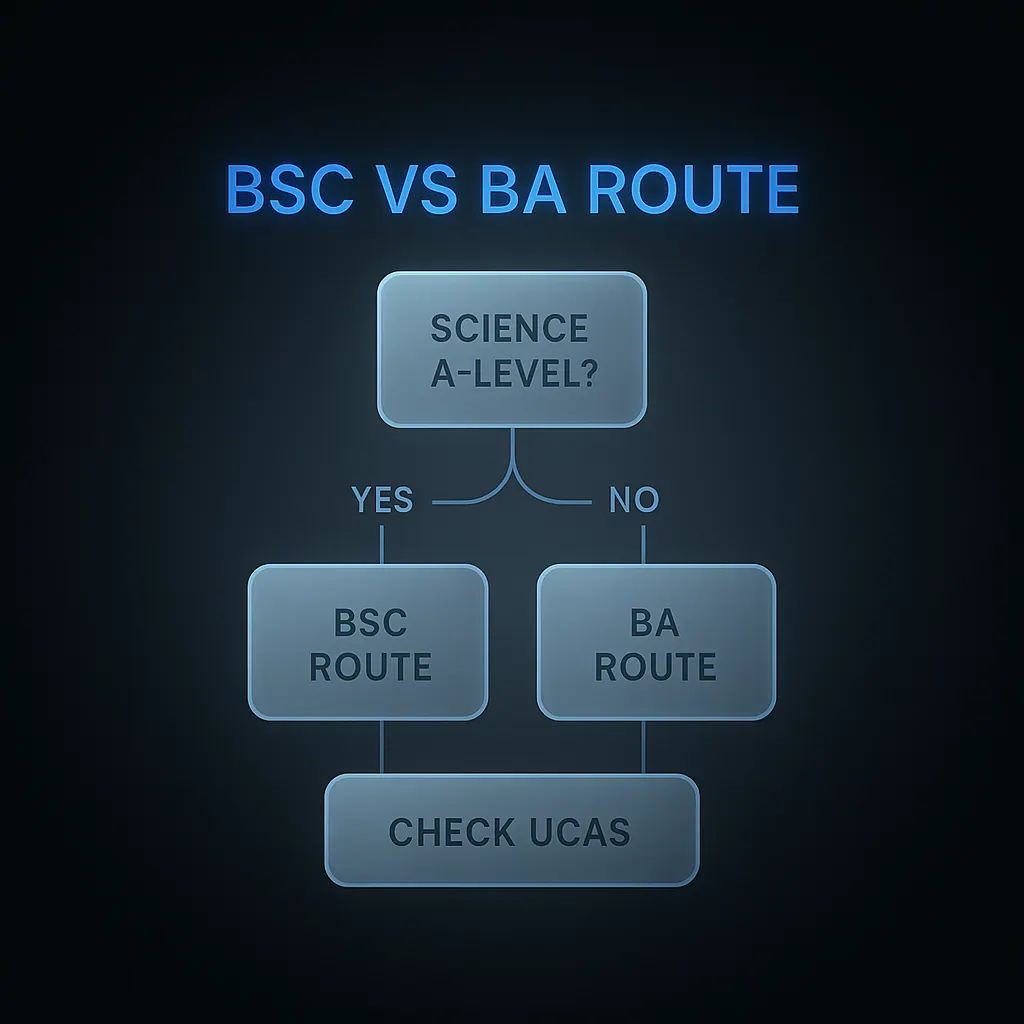
The BSc/BA split is one of the more practical decisions in psychology applications, because it directly shapes which A-levels universities want to see.
BSc routes tend to specify at least one science A-level from a recognised list, biology, chemistry, maths, physics, or sometimes computer science. The reasoning is straightforward: BSc courses lean harder on statistics, research methods, and neuroscience, and admissions tutors want evidence you can handle quantitative work.
BA routes are generally more flexible on subject mix. A humanities or social sciences profile is less likely to work against you. But flexible does not mean unconditional, and this is where applicants get caught out.
Cambridge's Psychological and Behavioural Sciences BA (Hons) illustrates the point. It is a BA, yet candidates must hold the equivalent of at least one qualifying science A-level, drawn from mathematics, biology, chemistry, computer science, or physics. Some Cambridge colleges tighten this further by requiring maths or biology specifically. The BA label does not remove the science condition.
One counter-intuitive detail worth noting: A-level Psychology is not treated as a qualifying science at Cambridge PBS, and the same exclusion appears at a number of other universities. Always check the exact wording of a course's subject requirements rather than assuming Psychology A-level covers a science slot.
In practical terms: if your strongest subjects are sciences, a BSc is usually the natural fit. If your profile is mixed or humanities-heavy, a BA may work, but verify each course's conditions individually before ruling anything out.
3. Science and Maths Requirements: What Each Course Actually Asks For
The science question trips up a lot of applicants because the wording varies sharply between universities. Some courses impose a hard science condition; others have no science requirement at all. Read the exact subject condition for each course, not just the grade offer.
Two concrete examples show how far apart the requirements can be:
- University of Edinburgh requires at least one A-level at grade B from a defined list: Biology/Human Biology, Chemistry, Computer Science, Geography, Geology, Mathematics, Physics, or Psychology. Psychology A-level satisfies this condition at Edinburgh. (UCAS course listing)
- Cambridge PBS requires the equivalent of at least one of Maths, Biology, Chemistry, Computer Science, or Physics. Psychology A-level is explicitly not on Cambridge's qualifying list, and some Colleges specifically require Maths or Biology. (Cambridge PBS entry requirements)
That distinction matters practically: a student holding A-level Psychology plus two arts subjects meets Edinburgh's science condition but not Cambridge's.
Maths A-level is worth considering even where it is not required. Psychology degrees are heavily quantitative, covering inferential statistics and experimental design from the first year. Arriving with A-level Maths removes a significant workload cliff. It also strengthens applications at universities that list Maths as a preferred, though not compulsory, subject.
If you hold neither a science nor Maths A-level, Cambridge does offer a narrow exception: candidates without qualifying science A-levels may still be interviewed if they hold two or more science GCSEs at grade 8 or 9. (Cambridge PBS entry requirements) That is a thin path, not a standard route.
4. BPS Accreditation and the Graduate Basis for Chartered Membership
The Graduate Basis for Chartered Membership (GBC) is the British Psychological Society's formal recognition that a psychology degree meets its standards for professional practice. It is not an optional credential. GBC is the mandatory prerequisite for entry onto doctoral-level clinical, forensic, counselling, and educational psychology training programmes across the UK.
The critical point: only a BPS-accredited degree automatically confers GBC, and only if the graduate achieves at least second-class Honours. Graduates from non-accredited courses must apply to the BPS for membership separately and may face additional requirements before they can progress to postgraduate training.
Oxford's DClinPsych programme makes this concrete. The Oxford Institute of Clinical Psychology Training and Research lists GBC as an essential criterion, noting that "candidates from non-GBC accredited courses must apply for membership themselves." There are no exceptions for strong grades or relevant experience.
How to check whether a course is BPS-accredited:
- Look for a BPS accreditation statement on the UCAS course page or the university's own course page.
- The following courses all carry accreditation: Cambridge Psychological and Behavioural Sciences BA, Edinburgh BSc Psychology, Cardiff BSc Psychology, and Heriot-Watt BSc Psychology.
The non-obvious gotcha: a course titled "Psychology" is not automatically accredited. Interdisciplinary degrees, some joint honours courses, and psychology modules embedded in broader programmes often lack accreditation. If a career in clinical or forensic psychology is your target, check the BPS statement before you apply, not after you graduate.
5. Comparison Table: Psychology Courses from Ambitious to Accessible
The table below spans a wide range of psychology degree entry requirements, from one of the most selective courses in the UK to a more accessible Scottish entry point. One non-obvious quirk: Cambridge PBS is a BA, not a BSc, yet it carries BPS accreditation and qualifies graduates for the Graduate Basis for Chartered Membership just as a BSc would.
| University / Course | Degree Type | Typical A-level Offer | IB Offer | Science Required? | BPS-Accredited? |
|---|---|---|---|---|---|
| Cambridge PBS | BA | A\A\A | 40-42 pts, 776 HL | Yes - Maths, Biology, Chemistry, Computer Science, or Physics at A-level | Yes |
| Edinburgh Psychology | BSc | A\A\A to AAA | 37-42 pts, 666-766 HL | Yes - one A-level at grade B from a defined list including Biology, Chemistry, Maths, or Physics | Yes |
| Cardiff Psychology | BSc | AAA to ABB | 36-32 pts | No hard science requirement stated | Check with Cardiff |
| Heriot-Watt Psychology (Scotland) | BSc | BBC (Year 1) | 29 pts (Year 1) | No specific science stated | Yes |
Note: Entry requirements change year to year. Always verify the current offer on the university's own admissions page or its UCAS course listing before applying. The figures above reflect published data at the time of writing.
To explore a wider range of options, compare UK psychology courses and their published entry requirements.
6. IB, Scottish Highers, and Other Qualifications
**IB Diploma applicants** face two separate hurdles: the points total and the Higher Level (HL) subject condition. Hitting the points threshold is not enough on its own.
Points ranges by institution:
- Cambridge: 40-42 with 776 at HL
- Edinburgh: 34-42 with 655-766 at HL; at least one HL subject at grade 5 from Biology, Chemistry, Computer Science, Geography, Maths, Physics, or Psychology
- Cardiff: 32-36 overall, with 6 in one HL subject or 666-665 across three HL subjects
- Heriot-Watt: 29 for Year 1 entry
The non-obvious gotcha: a student with 35 IB points but no science or maths at HL may be rejected by Edinburgh while being accepted at Cardiff, where the HL condition is about grade rather than subject area. Check the subject conditions before assuming your points total is the deciding factor.
Scottish Highers suit students applying to institutions running a 4-year Honours structure. Edinburgh typically asks for AAAB by end of S5 or AAAA by end of S6, with BBB required within one sitting year. Heriot-Watt asks for AABB at Highers for Year 1, but currently has no vacancies for Scotland-domiciled applicants.
**BTEC Extended Diploma** holders should note that both Cardiff (DDD-DDM in Applied or Forensic Science) and Heriot-Watt (DMM in a relevant subject) accept this qualification, but subject-area conditions apply. Check individual course pages before applying.
7. Routes In with Lower Grades: Foundation Years and Contextual Offers
If your predicted grades fall short of the standard offer, two routes are worth understanding properly: integrated foundation years and contextual admissions.
Integrated foundation years (Year 0) sit within the degree itself. You apply directly to the psychology foundation programme, typically enter with lower A-level grades than the full honours course requires, and progress automatically to Year 1 on successful completion. The grades required vary, but two to three A-levels at lower grades is a common threshold. The trade-off is a four-year degree instead of three, and not every university offers it for psychology specifically, so check each course individually.
Contextual offers are more widely available. Most UK universities now flag applicants whose circumstances, school performance data, neighbourhood deprivation indices, or care-leaver status meet certain criteria, and make an adjusted offer, typically one to two grades below the standard requirement. Cardiff University, for example, allows an EPQ grade A to lower the A-level offer by one grade: a standard AAA offer becomes AAB, provided subject-specific requirements are still met. That is a meaningful discount, and it rewards preparation rather than relying solely on exam performance.
The non-obvious catch: contextual flags are usually applied automatically from UCAS data, but your personal statement is where you can explain circumstances the system may not capture. Register any relevant background during your UCAS application, and look for the "contextual offer" or "alternative entry" section on each university's admissions page before applying.
8. What to Do Next
This week, open the UCAS course search and pull up every psychology course on your shortlist. For each one, confirm three things: the required science subject (some courses accept any science; others specify Biology or a lab-based option), whether the course carries BPS accreditation, and whether a foundation-year or contextual offer route is available for your predicted grades. Do not assume accreditation from the university's name alone - a department can offer both accredited and non-accredited pathways, sometimes under almost identical titles.
One non-obvious step most applicants skip: check the admissions page directly rather than relying on the UCAS entry, because contextual offer thresholds are rarely published on UCAS itself.
For a closer look at specialisms including clinical, forensic, and child psychology, visit our psychology subject guide.
FAQ
Do I need A-level Psychology to apply for a psychology degree?
A-level Psychology is not required by most UK universities - Cambridge explicitly states it is not a prerequisite - but some courses count it toward a science subject condition, so check each course's exact wording.
Do I need a science A-level to get onto a psychology degree?
It depends on the course: Edinburgh requires at least one science A-level from a defined list, and Cambridge requires the equivalent of one qualifying science, but other universities such as Cardiff do not state a hard science requirement.
What is BPS accreditation and why does it matter for psychology?
BPS accreditation means the degree is approved by the British Psychological Society; graduates with at least a 2:2 from an accredited course receive the Graduate Basis for Chartered Membership, which is a mandatory condition for applying to doctoral clinical, forensic, and counselling psychology programmes.
What are the psychology degree entry requirements in Scotland?
Scottish universities typically follow a 4-year Honours structure; Edinburgh's typical Scottish Highers offer is AAAB by end of S5 or AAAA by end of S6, while Heriot-Watt asks for AABB at Highers for Year 1 entry, though Scottish-domiciled applicants should check current vacancy status.
Can I get into a psychology degree with lower grades?
Yes - integrated foundation-year routes and contextual admissions schemes allow entry below standard grade thresholds; Cardiff, for example, will lower its A-level offer by one grade for applicants who achieve an EPQ at grade A.
What IB score do I need for a psychology degree in the UK?
IB requirements vary widely: Cambridge asks for 40-42 points with 776 at Higher Level, Edinburgh asks for 34-42 points with 655-766 at HL, Cardiff asks for 32-36 points, and Heriot-Watt accepts 29 points for Year 1 entry.
References
- Entry requirements and How to Apply | Psychological and Behavioural Sciences Tripos - https://www.pbs.tripos.cam.ac.uk/prospective/howtoapply
- Psychology | Heriot-Watt University | UCAS - https://www.ucas.com/explore/courses/a501dab9-6a15-bdf3-df46-cbc6992751c7/course
- Psychology | Cardiff University | UCAS - https://www.ucas.com/explore/courses/0f8e1156-5671-8595-29a7-4213260428ee/course
- Psychology | The University of Edinburgh | UCAS - https://www.ucas.com/explore/courses/145d6c26-2883-40a0-91c7-a60937852db4/course
- Essential Criteria | Oxford Institute of Clinical Psychology Training and Research - https://oxicptr.site.ox.ac.uk/dclinpsych-entry-requirements
- Psychological and Behavioural Sciences, BA (Hons) | Undergraduate Study - https://www.undergraduate.study.cam.ac.uk/courses/psychological-behavioural-sciences-ba-hons