Common Oxbridge Interview Mistakes (and How to Avoid Them)
By Michael Thompson · Education Specialist; 10 years teaching the IB at Bromsgrove School · Published 21 May 2026 · Updated 6 October 2026
Common Oxbridge interview mistakes rarely come from not knowing enough - they come from misunderstanding what the interview is actually for. Oxford and Cambridge interviews are designed to test how you think, not what you've memorised, and that distinction catches out a surprising number of well-prepared candidates. Interviewers want to hear you reason through a problem in real time, show intellectual curiosity, and engage with ideas you've never seen before. This guide covers the mistakes that most reliably derail strong applicants, and what to do instead.
Key Takeaways
- The interview tests thinking, not recall: Oxford and Cambridge use the interview to assess whether you'd benefit from tutorial teaching - so reasoning aloud matters more than knowing the right answer.
- Over-rehearsed answers backfire: Scripted responses ignore what the interviewer actually asked and signal that you can't adapt - one of the qualities tutors most want to see.
- Silence when stuck is the worst option: Interviewers expect you to think aloud and make educated guesses; a reasoned wrong answer is far more valuable than a frozen pause.
- Personal statement claims get stress-tested: If you list a book, idea, or project on your personal statement, assume you will be asked to go much deeper than the surface summary you prepared.
- Logistics matter more than candidates think: Arriving late, ignoring the dress code, or not reading the interview details sent by the college can unsettle you before you've said a word.
- Asking clarifying questions is a strength: On ambiguous or unfamiliar problems, pausing to check your understanding shows exactly the kind of intellectual rigour tutors are looking for.
In This Article
- What Oxbridge interviews are actually testing
- Mistake 1: Giving over-rehearsed answers that ignore the actual question
- Mistake 2: Refusing to think aloud when stuck - what thinking aloud in interviews means
- Mistake 3: Personal statement claims that collapse under follow-up
- Mistake 4: Misjudging dress code, timing, and pre-interview logistics
- How to prepare without sounding rehearsed
- Where to go from here
1. What Oxbridge interviews are actually testing
The most common Oxbridge interview mistakes share a single root cause: candidates prepare for the wrong kind of conversation. Understanding what the format is actually designed to do changes everything about how you should approach it.
Both Oxford and Cambridge model their undergraduate interviews on their core teaching methods, the Oxford tutorial and the Cambridge supervision. These are small-group sessions where a student works through problems with an academic in real time. The interview replicates that format. St Anne's College, Oxford is explicit that the purpose is to assess how candidates think and whether they would benefit from that teaching style, not to test knowledge recall alone.
The structure of the conversation reflects this. According to University of Cambridge guidance drawn from over 1,000 Oxbridge students, interviewers typically begin with familiar material before moving toward increasingly unfamiliar ideas and problems. That progression is deliberate. The moment the questions become strange is the point of the interview, not a sign that something has gone wrong.
The counter-intuitive implication: arriving with polished answers to predictable questions is close to the wrong preparation. What interviewers are watching for is whether you can engage with a problem you have never seen before, reason through it openly, and update your position when pushed. A candidate who sounds fluent on rehearsed ground but freezes when the question shifts is demonstrating exactly the limitation the format is designed to detect.
2. Mistake 1: Giving over-rehearsed answers that ignore the actual question
The most common version of this mistake looks like competence: a fluent, well-structured answer delivered with confidence. The problem is that it often has nothing to do with what the interviewer actually asked. The candidate heard a topic they recognised, found the nearest prepared monologue, and delivered it. The tutor noticed.
Oxford and Cambridge interviews follow a tutorial model, which means the interviewer will often phrase a question in a specific, deliberate way, then adjust it mid-conversation based on your response. A scripted answer cannot adapt to that. If your answer would fit any question on the topic, it fits none of them. St Anne's College, Oxford is explicit that what tutors are assessing is how you think, not whether you can recite.
Treating the interview like a job application makes this worse. Structured "tell me about a time" answers, polished delivery, and corporate-style signposting ("I'm passionate about this field because...") all read as deflection. Tutors are trained to spot the gap between a rehearsed performance and actual reasoning.
The counter-intuitive fix is to slow down, not speed up. When a question lands:
- Pause and register the exact wording, not just the subject area.
- Identify what the question is specifically asking you to do: analyse, compare, evaluate, define.
- Respond to that instruction, even if it pulls you away from what you prepared.
A candidate who says "that's a slightly different angle than I'd considered, let me think about it this way" is demonstrating precisely the flexibility tutors want.
3. Mistake 2: Refusing to think aloud when stuck - what thinking aloud in interviews means
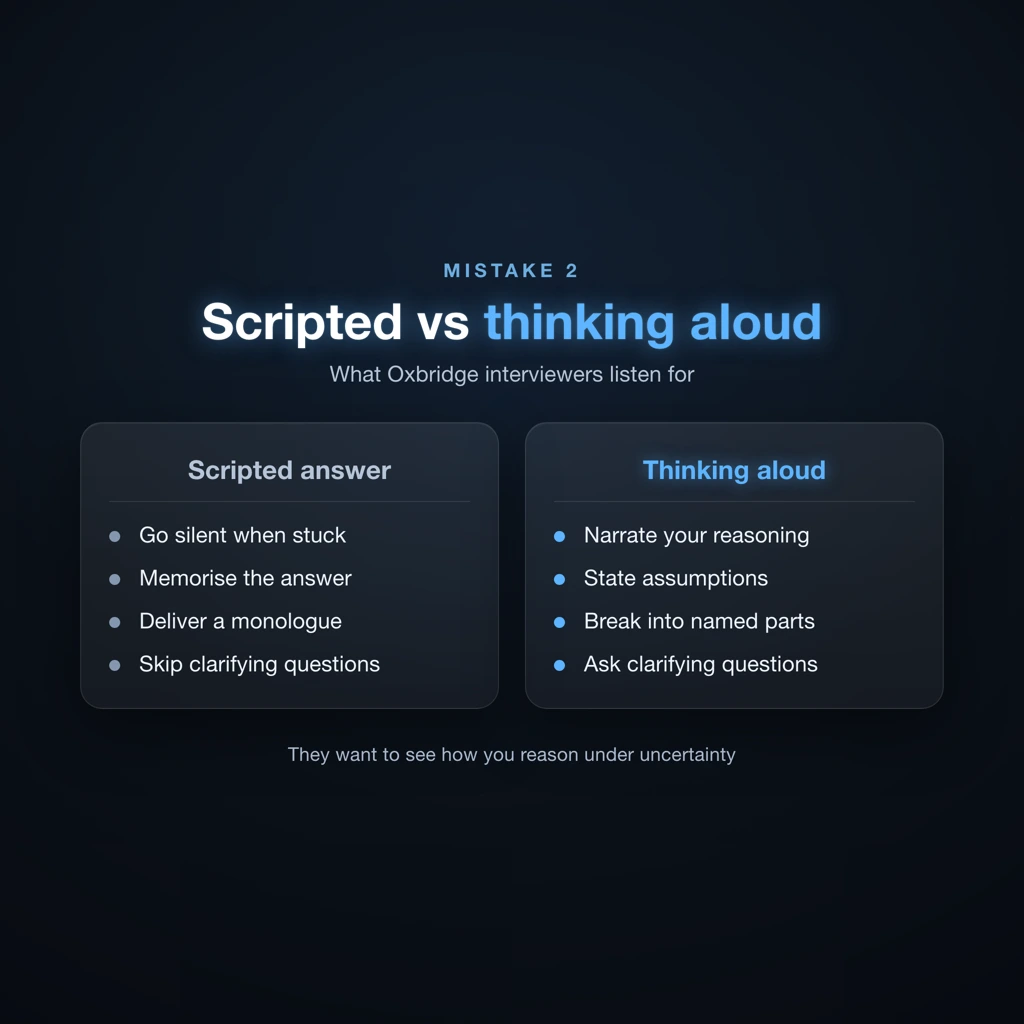
Going silent is the wrong move. When an Oxford or Cambridge interviewer puts an unfamiliar problem in front of you and you say nothing, or offer a flat "I don't know," you have cut off the thing they are actually trying to observe: how you reason under uncertainty.
St Anne's College, Oxford states explicitly that interviewers expect spoken reasoning, and recommends using signposting language such as "I might start here" or "I would think about it this way." The interview format mirrors the Oxford tutorial, where academic conversation between tutor and student is the whole point. A candidate who thinks silently and then announces an answer gives the interviewer nothing to work with.
Thinking aloud in interviews means narrating your reasoning as it happens, not delivering a polished conclusion. In practice, that sounds like:
- "I'd start by asking whether the problem assumes X or Y."
- "One approach might be to break this into two simpler cases."
- "I'm not sure, but if I assume the values are roughly equal, then..."
The ruler experiment, cited by Oxford in published sample questions, is a useful illustration. Most candidates expect both fingers, placed under either end of a ruler, to slide inward at different rates and reach their respective ends at different times. The actual result, that both fingers meet in the middle simultaneously, surprises almost everyone. The physics involves the difference between static and dynamic friction coefficients. Oxford engineering tutor Prof Steve Collins of University College Oxford reserves this question for later in the interview precisely because the counterintuitive result forces candidates to abandon their first instinct and reconstruct their reasoning out loud. That reconstruction is the answer the interviewer is listening for.
A related error is failing to ask clarifying questions before attempting an ambiguous problem. Checking your understanding before you start is a sign of intellectual rigour, not a sign that you are lost.
Practical steps for thinking aloud:
- State your assumptions explicitly before calculating or concluding.
- Break the problem into named parts out loud, then tackle each one.
- Ask the interviewer directly whether a simplification is reasonable: "Can I treat this as a closed system for now?"
Practising out loud with a teacher or parent beforehand, as St Anne's College recommends, is the most direct way to build this habit before the interview room.
4. Mistake 3: Personal statement claims that collapse under follow-up
Your personal statement is not a finished document by the time you walk into the interview room. It is a list of prompts tutors use to probe what you actually know. Every book you called influential, every project you described as self-directed, every idea you flagged as fascinating is fair game.
The weak pattern looks like this: a candidate writes that they volunteered in a hospital and found it inspiring. The tutor asks what it made them think about the ethics of triage. The candidate has no answer, because they were describing an experience rather than analysing it.
The specific gotcha worth knowing: admissions tutors at St Anne's College, Oxford and elsewhere flag personal statements that list activities without evidence of what the applicant concluded from them. A 2007 study found that 5% of personal statements contained borrowed or clichéd content, including a recurring anecdote about a student burning a hole in their pyjamas with Chemistry at age eight. Tutors read hundreds of statements. Repeated material stands out immediately, and so does material that was clearly written to sound impressive rather than to reflect genuine thinking.
How to prepare: for every claim on your personal statement, practise going two levels deeper.
- What did you actually conclude from the experience or the book?
- What questions did it leave unresolved for you?
- Where did it lead you next, in terms of reading, thinking, or doing?
If you cannot answer those three questions out loud without hesitation, the claim is not ready for an interview.
5. Mistake 4: Misjudging dress code, timing, and pre-interview logistics
Logistics feel trivial compared to the intellectual preparation, which is exactly why applicants underestimate them. Arriving flustered, having misread a room number, is a self-inflicted problem.
St Anne's College, Oxford notes that colleges send applicants all interview details including date and time, and that failing to read this carefully is a genuine preparation error. Before any question is asked, you have already made decisions about clothing, transport, and timing. Getting those wrong doesn't disqualify you, but it adds friction you don't need.
A few specifics worth pinning down in advance:
- Dress code. Formal colours work well; jeans and trainers are best avoided, per UCAS interview guidance. The more useful test: wear something you won't think about once you're sitting down.
- Multiple interviews in one day. Per University of Cambridge, applicants normally receive two interviews in the course of a single day. Build buffer time between them, not just before the first one.
- The 15 October deadline context. St Anne's confirms the early application deadline for Oxford and Cambridge is 15 October every year. Fumbling the logistics at interview stage, months after clearing that hurdle, is an avoidable waste of the groundwork already done.
Confirm your room, building, and contact name the evening before. That is the entire action required.
6. How to prepare without sounding rehearsed
The difference between being well-prepared and sounding rehearsed comes down to what you've actually practised. Preparation builds habits of reasoning; rehearsal builds scripts. The first helps in an Oxbridge interview. The second tends to hurt, because a script collapses the moment the interviewer takes the question somewhere you didn't anticipate.
St Anne's College, Oxford explicitly recommends practising out loud with friends, family, and teachers before your interview. The goal isn't to memorise answers. It's to make spoken reasoning fluent, so that thinking aloud in an interview feels natural rather than performed.
A few practical approaches that build that habit:
- Simulate unfamiliar territory. Ask a friend to name a topic adjacent to your reading and practise working through it aloud in real time. Don't wait until you have an answer. The discomfort of not knowing is exactly what you're training for.
- Use Oxford's published sample questions as process practice. Oxford released sample interview questions collected from admissions tutors across multiple subjects. The point isn't to memorise model answers. It's to use them as prompts for the thinking-aloud method.
- Try InsideUni. Founded by two Cambridge students, the platform draws on tips from over 1,000 Oxbridge students, has been used more than 20,000 times, and specifically recruits volunteers to help applicants from state schools who may have less access to coaching.
The counter-intuitive gotcha: candidates who over-prepare specific answers often perform worse on follow-up questions than those who practised less content but more reasoning. Interviewers at Oxford and Cambridge move deliberately from familiar ground toward unfamiliar problems. A memorised answer to question one offers no protection when question two goes somewhere your script never went.
7. Where to go from here
This week, go to Oxford's published sample questions (BBC News, 2015) and pick one. Do not draft a model answer. Set a five-minute timer and narrate your reasoning aloud, start to finish, including the dead ends. That single habit does more than any scripted preparation, because the interview rewards audible thinking, not stored conclusions.
One counter-intuitive detail worth knowing: Oxford published those sample questions specifically to reduce the advantage private-school coaching gives candidates. Using them to rehearse polished answers defeats the point entirely.
Two other resources worth bookmarking now:
- Oxford Outreach Calendar (St Anne's College, Oxford) lists in-person interview workshops run regionally for prospective applicants.
- InsideUni (insideuni.org), built by Cambridge students and used more than 20,000 times across 111 countries, carries subject- and college-specific tips from over 1,000 Oxbridge volunteers.
Check the Outreach Calendar this week and register for the nearest available workshop before places close.
FAQ
Why do so many candidates make common Oxbridge interview mistakes?
Most mistakes come from preparing for the wrong kind of interview - candidates practise polished, scripted answers when Oxbridge interviewers are looking for live, spoken reasoning and intellectual flexibility.
Is it okay to say 'I don't know' in an Oxbridge interview?
A plain 'I don't know' without any attempt to reason through the problem is one of the least useful responses - interviewers want to hear your thinking process, even if your conclusion is uncertain or wrong.
Do Oxbridge interviewers care about body language and presentation?
Logistics like punctuality and appropriate dress matter because they affect your own confidence and composure, but interviewers are primarily assessing how you think, not how you look or present yourself.
How closely do Oxbridge interviewers check personal statements?
Very closely - admissions tutors read personal statements before the interview and will probe any claim, book, project, or experience you mention, often pushing well beyond the surface level you've prepared.
What does thinking aloud in an Oxbridge interview actually look like?
It means narrating your reasoning as you go - saying things like 'I'd start by asking whether...' or 'if I assume X then...' rather than going silent while you think and only speaking once you have an answer.
References
- Making a Competitive Application | St Anne's College, Oxford - https://www.st-annes.ox.ac.uk/study-here/undergraduate/outreach/students/making-a-competitive-application/
- Students submit tips on preparing for University interviews | University of Cambridge - https://www.cam.ac.uk/news/students-submit-tips-on-preparing-for-university-interviews
- Oxford University publishes sample interview questions - BBC News - https://www.bbc.co.uk/news/education-34505485
- How to prepare for a job interview | UCAS - https://www.ucas.com/careers-advice/how-to-prepare-for-a-job-interview