Oxford Interview Preparation: The Complete Guide
By Michael Thompson · Education Specialist; 10 years teaching the IB at Bromsgrove School · Published 21 May 2026 · Updated 6 October 2026
Oxford interview preparation starts earlier than most applicants realise, and it requires a different approach from polishing answers. The interviews are designed to replicate the Oxford tutorial system - an academic conversation in which tutors probe how you think, not how much you have memorised. Each year, shortlisted candidates face one or two interviews per college, typically 20-30 minutes each, with subject tutors asking questions that deliberately push beyond A-level or IB Diploma Programme material. This guide explains what the format looks like, what each subject area expects, and how to build a preparation plan that actually reflects what Oxford is testing.
Key Takeaways
- Thinking aloud is the point: Oxford tutors are assessing your reasoning process and how you respond to guidance - a confident wrong answer handled well beats a right answer delivered in silence.
- Format varies by subject: Maths, Physics, and Engineering candidates work through problems on a shared board or screen; Humanities candidates typically respond to a pre-read passage or source text.
- Pre-interview admissions tests shape shortlisting: Tests like the LNAT (Law), TMUA (Maths/Computer Science), ESAT (Engineering/Science) and TARA (PPE, Economics and Management and other social sciences) close before or around the UCAS deadline - missing registration is a common and avoidable mistake.
- Over-rehearsed answers are a red flag: Rote-learning prepared answers leaves you exposed when tutors probe or redirect; Oxford explicitly publishes sample questions to demystify format, not to hand you a script.
- Preparation should start in summer before Year 13: A realistic timeline gives you time to sit any required admissions test, deepen subject reading, and practise thinking aloud before December interviews.
- Clarification is expected, not a weakness: Asking a tutor to clarify or rephrase a question is normal behaviour in a tutorial - refusing to do so when confused is the more costly mistake.
In This Article
- What Oxford interviews actually test
- The Oxford interview format explained
- Subject-specific Oxford interview questions and formats
- Pre-interview admissions tests: LNAT, TMUA, ESAT, UCAT, and TARA
- Oxford interview preparation timeline: when to start and what to do
- How to practise thinking aloud - the core Oxford interview skill
- Common Oxford interview mistakes and how to avoid them
- Oxford interview tips by subject: a quick-reference overview
- Where to go from here
1. What Oxford interviews actually test
Oxford interview preparation trips up a lot of candidates before they walk through the door, because they prepare for the wrong thing. The Oxford interview is not a job interview, a quiz, or a test of how much you have memorised. It is designed to replicate the tutorial system that sits at the heart of Oxford's undergraduate teaching.
Oxford's education and outreach director, Dr Samina Khan, described it plainly: the interview is "an academic conversation in a subject area between tutors and candidate, similar to the undergraduate tutorials which current Oxford students attend every week." That framing matters. Tutors are not scoring your confidence or your polish. They are asking: can I teach this person? Will they think when pushed?
The questions are built to take you somewhere unfamiliar. Whether the subject is chemistry, law, or history, the point is to apply A-level or IB Diploma Programme concepts to situations the syllabus never covered. Lincoln College's student account of the interview process confirms this directly: questions are designed to push thinking "beyond the A-level curriculum by applying familiar concepts to unfamiliar situations, not to test memory."
One specific quirk worth knowing: tutors will often check what you already know before introducing a problem. They are not trying to catch you out with unfamiliar material cold. The harder question typically arrives later in the interview, once you have had a chance to settle into the conversation.
The takeaway: stop rehearsing answers. Start practising how you think out loud when you do not immediately know where you are going.
2. The Oxford interview format explained
Most candidates sit one or two interviews per college, each lasting around 20 to 30 minutes, with at least two interviewers present. Per Christ Church, shortlisted candidates are typically interviewed at their first-choice college and may then be called to interview at one or more additional colleges. The interviewers are almost always the subject tutors who would teach you if you were admitted.
The format is closer to an Oxford tutorial than a job interview. Tutors are not looking for a polished, pre-rehearsed performance. According to Lincoln College, tutors check whether a candidate is familiar with the relevant concept before introducing a harder question, adjusting the difficulty in real time based on your responses. That means stumbling on one question does not end the interview. The point is to see how far your thinking can be pushed.
The counter-intuitive detail many candidates miss: demonstrating uncertainty well is often more useful than appearing confident. Tutors want to observe the reasoning process, not receive a memorised answer.
Christ Church conducts all its interviews online. This is consistent with the format used across Oxford during and since the pandemic. Lincoln College notes that if a technical problem occurs during an online interview, the college can reschedule it, so a dropped connection is not automatically a lost opportunity.
Before tutors join the call, current student helpers typically spend around ten minutes with you to answer logistical questions, according to Lincoln College. Use that window to check your audio and settle, not to cram.
3. Subject-specific Oxford interview questions and formats
The format of your Oxford interview depends heavily on your subject. A History candidate and a Physics candidate are having structurally different conversations, and preparing for the wrong format is a common mistake.
STEM subjects: Maths, Physics, Engineering, Computer Science
Expect to work through a problem you have never seen before, using school-level mathematics applied in an unfamiliar context. The point is not whether you reach the right answer but whether you can reason aloud under pressure.
A well-documented example comes from Professor Steve Collins at University College Oxford: candidates place a 30cm ruler on one finger from each hand, then slowly bring their fingers together. Both fingers reliably meet at the centre. The explanation involves the difference between static and dynamic friction coefficients. Oxford's own sample questions confirm this was released publicly, and Collins noted it would only appear later in the interview, after candidates had discussed something familiar first. That sequencing matters: tutors ease you in before introducing the unfamiliar problem.
Humanities: History, Law, English, Modern Languages
Christ Church confirms that humanities candidates are typically given a text in advance with preparation time before responding in the interview. The specific material depends on subject:
- History: a source text; personal statement super-curricular activities are also fair game
- Law: a legal statute
- English / Modern Languages: a poem or literary extract
- History of Art: an image
The non-obvious point here is that preparation time is not relaxation time. Tutors expect you to have formed a position before you walk in.
Economics, Management, and cross-disciplinary subjects
These interviews tend to use scenario questions that test economic reasoning rather than content recall. One published example: "Do bankers deserve their high pay?" Tutors look specifically for candidates who question whether banking labour markets are genuinely competitive, not for those who simply recite a definition of market efficiency.
Oriental Studies and similar humanities
Dr Alison Salvesen at Mansfield College uses questions such as "Can archaeology prove or disprove the Bible?" The expected move is to distinguish between literary and non-literary evidence, not to give a yes or no answer. Candidates who treat it as a factual question miss the point entirely.
Medicine and Biology
Christ Church notes that Biology candidates may be presented with physical subject materials, such as a tray of butterflies or shells, and asked to observe, classify, and reason about what they see. Oxford interview questions medicine candidates face are grounded in the same principle: observable evidence first, conclusions second.
Oxford publishes these sample questions specifically to counter myths about trick questions, according to its education and outreach director Dr Samina Khan. Treat them as evidence of the format, not as a script to memorise.
4. Pre-interview admissions tests: LNAT, TMUA, ESAT, UCAT, and TARA
Before Oxford can invite you to interview, it needs a way to compare thousands of applicants with similar predicted grades. Admissions tests are that filter. A weak test score can rule you out before a tutor ever reads your personal statement, regardless of your A-level predictions.
Per UCAS, Oxford currently uses five separate tests depending on your course:
| Test | Oxford courses | Also used by |
|---|---|---|
| LNAT | Law | Cambridge, LSE, UCL, and others |
| TMUA | Mathematics, Computer Science and joint courses | Several other universities |
| ESAT | Engineering and Science subjects | Cambridge, Imperial College London, UCL |
| UCAT | Medicine | Wide NHS-aligned medical schools |
| TARA | PPE, Economics and Management, Experimental Psychology, Human Sciences, History and Economics, History and Politics, Psychology and Philosophy, Psychology and Linguistics, Philosophy and Linguistics | UCL |
One counter-intuitive point worth knowing: the TARA is still relatively new - UCL first used it for 2026 entry and Oxford adopts it for 2027 entry - which means there is limited published score data to benchmark against. Early sitters have less historical context to judge what a strong score looks like.
Timing is the biggest practical trap. Most tests take place between August and November in the year before you start, and some registration deadlines fall before the UCAS application deadline itself. Miss the registration window and you cannot sit the test that cycle, which effectively ends your Oxford application for that year.
Check your specific course requirements via the UCAS course search rather than relying on secondhand advice. Course-level requirements differ even within the same subject area, and Oxford's course pages are updated annually.
5. Oxford interview preparation timeline: when to start and what to do
Oxford interview preparation is not a November sprint. The process has hard external deadlines that force early action, regardless of how confident you feel about your subject.
The non-obvious gotcha: some admissions test registration deadlines fall before the UCAS deadline, which means an applicant who waits until October to "sort out the application" can miss the window to sit the test entirely, and with it, any realistic chance of an Oxford offer.
Here is a phase-by-phase breakdown:
| Phase | When | What to do |
|---|---|---|
| Early preparation | Summer before Year 13 / IBDP Year 2 | Confirm which admissions test your course requires (UCAT, LNAT, TMUA, ESAT, or TARA); register before deadlines; start reading beyond the A-level or IB syllabus |
| Applications and tests | September - October | Sit your admissions test; finalise your personal statement; begin thinking-aloud practice on unfamiliar problems |
| Interview preparation | November - December | Run mock interviews with a teacher or tutor who will probe and redirect, not just listen; work through Oxford's published sample questions for your subject |
A few things worth noting on each phase:
- Summer: Use this time to check UCAS course search and confirm your test, since UCAT, ESAT, LNAT, TMUA, and TARA each have separate registration portals and separate deadlines.
- September - October: The tests themselves are largely sat during this window. Cramming subject content here is less useful than practising the reasoning habits the tests and interviews share.
- November - December: A mock interview where the interviewer simply nods is not useful practice. Find someone willing to ask "why?", "are you sure?", and "what would happen if we changed that assumption?" Those are the moves Oxford tutors actually make.
6. How to practise thinking aloud - the core Oxford interview skill
Tutors are not waiting for a correct answer delivered in silence. They want to hear how you think. The reasoning you speak aloud, including the dead ends, is the evidence they are assessing.
Oxford's own careers guidance flags rote-learning pre-formed answers as explicitly unhelpful: when a tutor redirects unexpectedly, an over-rehearsed candidate has nowhere to go. The candidates who recover well are the ones practising a process, not a script.
What thinking aloud actually looks like in practice:
- Say what you notice first: "The wording here is unusual because..."
- Name what you are trying: "I'll start by breaking this into cases..."
- Narrate what you reject and why: "That approach falls apart if the value is negative, so..."
- Ask for clarification when you need it. As Lincoln College's account of Oxford interviews makes clear, tutors ask candidates whether they are familiar with a concept before pressing further. Refusing to engage when confused is the more costly mistake.
Structuring your practice by subject:
- STEM subjects: Work through TMUA or ESAT-style problems aloud, alone or with a partner, before checking any solution. The point is to externalise every step.
- Humanities subjects: Pick a short unseen passage, set a two-minute timer, then speak your analytical response: what the argument assumes, where it is weak, what you find interesting.
The counter-intuitive point most candidates miss: solo rehearsal in front of a mirror builds fluency but not adaptability. Mock interviews with someone who will interrupt mid-sentence, ask "why did you assume that?", and push back on your conclusions are far more useful. That discomfort is the skill being tested.
7. Common Oxford interview mistakes and how to avoid them
Most interview errors come down to misreading what the interview is for. It is not an exam you pass by recalling the right answer. It is a tutorial, and tutors are watching how you think, not what you already know.
Over-rehearsing a fixed answer is the most common trap. Rote-learning pre-formed answers is explicitly flagged as poor preparation because an unexpected follow-up question leaves you with nowhere to go. Tutors probe and redirect constantly. A memorised answer runs out after two exchanges; a genuine line of reasoning does not.
Going silent under pressure is the second. If you stop talking, tutors lose the only evidence they have of your reasoning process. Thinking aloud, including through uncertainty, is the whole point.
Not asking for clarification when you are genuinely confused is treated as a mistake by most candidates but is actually expected behaviour in a tutorial. Oxford describes its interviews as "an academic conversation... similar to the undergraduate tutorials which current Oxford students attend every week," per Oxford's own published sample questions. Asking a clarifying question is what a good tutorial student does.
Underestimating admissions tests is a structural risk. Candidates who treat the LNAT, UCAT, or ESAT as an afterthought may not reach the interview stage at all.
Neglecting the personal statement catches Humanities candidates off guard. Christ Church tutors interviewing History applicants may draw questions directly from super-curricular activities listed there, so anything you wrote needs to be something you can discuss in depth.
Treating the interview as adversarial misses the point entirely. A tutor who pushes back on your answer is not trying to trip you up. They are checking whether you can refine a position under scrutiny, which is what tutorials require every week for three years.
8. Oxford interview tips by subject: a quick-reference overview
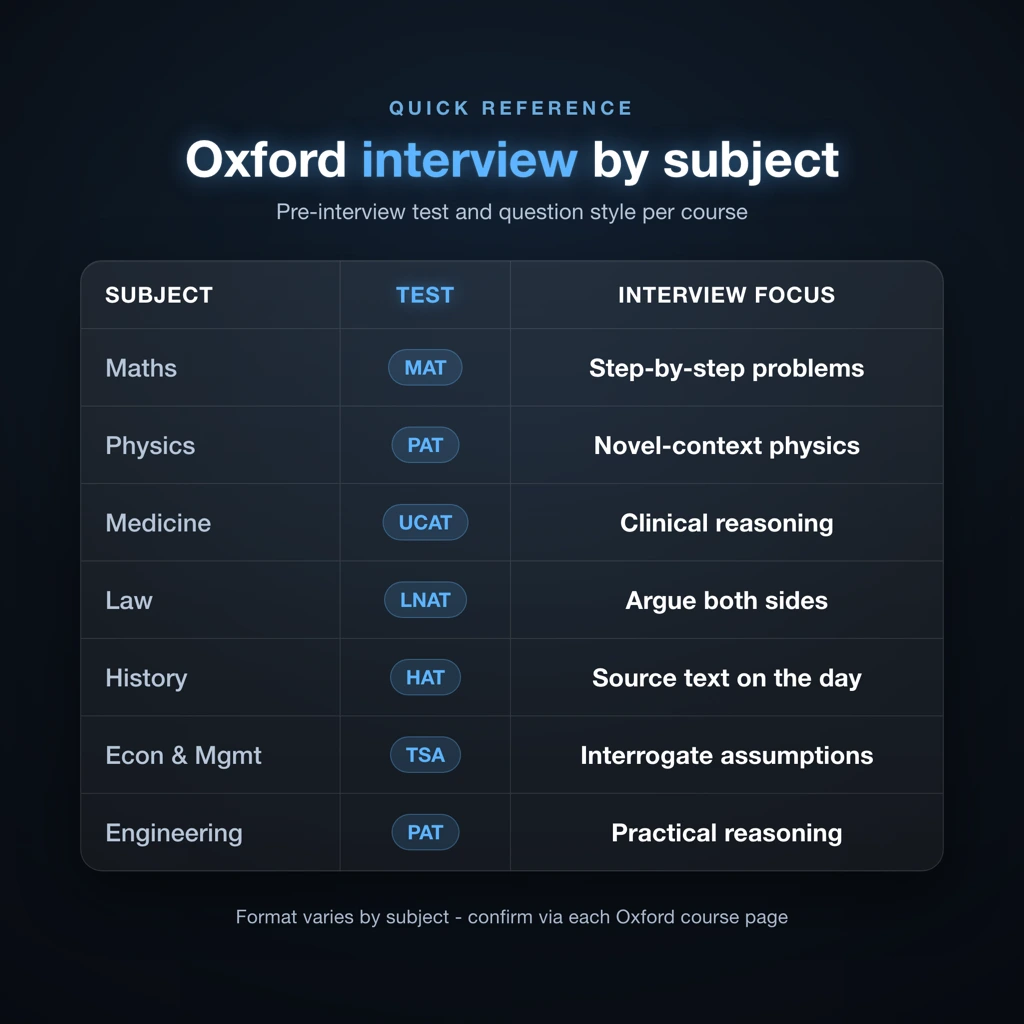
The format varies significantly by subject. What counts as good preparation for Law is almost irrelevant for Physics. Here is what each subject area actually demands.
| Subject | Key pre-interview test | What the interview involves |
|---|---|---|
| Maths / Further Maths | TMUA (UCAS) | Unfamiliar problems worked step-by-step; no theorem recall expected |
| Physics | ESAT (UCAS) | School-level physics applied to novel contexts, often on a whiteboard |
| Medicine | UCAT (UCAS) | Bioethical scenarios and clinical reasoning alongside subject knowledge |
| Law | LNAT (UCAS) | Legal statute or scenario provided; tutors test argument on both sides |
| History | None specified | Pre-read source text in interview; personal statement reading probed in depth |
| Economics and Management | TARA | Market-logic questions that require interrogating assumptions, not reciting theory |
| Engineering | ESAT (UCAS) | Practical reasoning problems; mock interview by Prof Malcolm McCulloch available online |
A few subject-specific details worth knowing:
- Engineering: the ruler-and-friction problem, in which you balance a 30cm ruler on one finger from each hand and bring them together, is a real Oxford example. As the University College Oxford tutor who designed it noted, it would only appear later in the interview, after you have talked through something familiar. The point is explaining the physics, not just observing the result.
- Law: Christ Church confirms that a legal statute may be provided during the interview itself. Practise arguing a proposition both ways so you are not caught only able to defend your first instinct.
- History: tutors at Christ Church may ask directly about super-curricular activities listed in your personal statement, so vague reading claims are a risk if you cannot discuss the argument of each book in detail.
- Economics and Management: the sample question published by Oxford asks whether bankers deserve high pay. The expected move is not to answer yes or no, but to question whether banking labour markets are genuinely competitive. Reciting economic theory without interrogating its assumptions is the wrong approach.
The concrete takeaway: identify exactly which material your subject provides in the room (statute, source text, problem sheet, or nothing) and build your practice around that format.
9. Where to go from here
The interview is the final stage of a preparation arc that starts earlier than most applicants expect. For several Oxford courses, including Law (LNAT), Medicine (UCAT), Mathematics (TMUA), and Engineering and Science subjects (ESAT), the admissions test registration deadline falls before the UCAS application closes, according to UCAS. Miss that window and the interview becomes irrelevant.
This week, open the UCAS admissions tests page, confirm which test your course requires, and check the registration deadline. If you have not registered, do it now.
Once your test is booked, the best free resources for interview work are Oxford's own published sample questions and the mock interview videos on the Oxford University website, which include a demonstration Engineering interview by Professor Malcolm McCulloch.
FAQ
How do I prepare for an Oxford interview?
Start in the summer before Year 13 by registering for any required admissions test, reading beyond your syllabus, and practising thinking aloud on unfamiliar problems - the interview tests reasoning process, not memorised answers.
Are Oxford interview questions related to your course?
Yes - questions are set by subject tutors and are directly tied to your chosen course, often involving a problem, passage, or object specific to that discipline.
Does Oxford interview preparation actually help?
Practising thinking aloud and working through past admissions test problems genuinely helps, but drilling polished answers does not - tutors redirect scripted responses and assess how candidates handle unfamiliar territory.
Is there a scoring system for Oxford interviews?
Oxford does not publish a detailed public scoring rubric, but tutors assess academic potential, ability to engage with feedback, and clarity of reasoning rather than factual recall or presentation polish.
How many Oxford interviews will I have?
Shortlisted candidates typically receive one or two interviews at their first-choice college, each with at least two interviewers, and may also be interviewed at one or more additional colleges.
When do Oxford interviews take place?
Oxford undergraduate interviews are held in December, so admissions test registration (which closes in autumn) and interview preparation need to be well underway before that point.
References
- Oxford University publishes sample interview questions - BBC News - https://www.bbc.co.uk/news/education-34505485
- Interviews | Christ Church, University of Oxford - https://www.chch.ox.ac.uk/college/undergraduate/interviews
- Oxford Interviews: What are they really like? | Lincoln College Oxford - https://lincoln.ox.ac.uk/blog/oxford-interviews-what-are-they-really-like
- University Admissions Tests | UCAS | UKCAT, BMAT, LNAT And More - https://www.ucas.com/applying/before-you-apply/what-and-where-to-study/entry-requirements/admissions-tests
- Interview Technique | Oxford University Careers Service - https://www.careers.ox.ac.uk/interview-technique
- TARA | UAT-UK - https://esat-tmua.ac.uk/about-the-tests/tara/