IB Requirements for Oxford and Cambridge: Full Guide
By Michael Thompson · Education Specialist; 10 years teaching the IB at Bromsgrove School · Published 21 May 2026 · Updated 4 October 2026
IB requirements for Oxford and Cambridge typically sit between 38 and 42 points overall, with Higher Level grades of 6,6,6 or 7,6,6 depending on the course - but the headline number is only part of the picture. Both universities set subject-specific conditions that can be stricter than the overall total suggests, and admissions tests add another filter before most applicants ever reach interview. If you are sitting the IB Diploma and targeting Oxbridge, you need to know exactly what each course demands at HL, which tests you must register for, and how your predicted grades shape the shortlist. This guide covers all of that, course by course, with Cambridge and Oxford data side by side.
Key Takeaways
- Typical offers are 38-42 points overall with Higher Level grades of at least 6,6,6; competitive courses at Trinity Hall Cambridge require 42 points with 7,7,6 at HL.
- Subject-specific HL conditions often matter more than the total: Oxford Medicine requires Chemistry at HL plus a 7,6,6 profile; Oxford Biomedical Sciences sets the same HL grade pattern with two sciences or Maths at HL.
- Most science, engineering, and law applicants must sit an admissions test: Cambridge has used the ESAT and TMUA since 2024, and from the October 2026 sitting Oxford uses them too - the ESAT replaces the PAT and the TMUA replaces the MAT. Both universities use the LNAT for Law.
- Predicted grades are the first serious filter: Both universities use predicted IB scores to decide who gets shortlisted for interview, so a prediction well below 40 will likely stop an application early.
- IB and A-Level applicants are assessed on the same criteria at interview: Tutors look for subject-specific aptitude, not qualification type, so IB candidates are not disadvantaged - but subject coverage at HL must match what A-Level applicants take.
- You cannot apply to both Oxford and Cambridge in the same cycle: UCAS rules mean you must choose one or the other as an undergraduate applicant in any given year.
In This Article
- Does Oxford accept the IB - and what does Cambridge say?
- Typical Oxford and Cambridge IB offers at a glance
- Entry requirements for Oxford and Cambridge: subject by subject
- IB Maths: Analysis and Approaches vs Applications and Interpretation
- Admissions tests: ESAT, TMUA, LNAT and who sits them
- Predicted grades: how Oxbridge uses IB predictions to filter applicants
- The interview process: how IB candidates are assessed alongside A-Level applicants
- Can you apply to both Oxford and Cambridge - and what about international students?
- IB vs A-Levels for Oxbridge: what the evidence actually shows
- Where to go from here
1. Does Oxford accept the IB - and what does Cambridge say?
Both Oxford and Cambridge formally accept the IB Diploma Programme for undergraduate entry. The ib requirements for oxford and cambridge are published alongside A-Level equivalents, so IB students are assessed on the same terms as applicants sitting A-Levels - there is no structural penalty for holding a Diploma rather than three A-Levels.
Cambridge lists the IB as a recognised qualification on its international entry requirements page, with course-level offer figures available through its qualifications tool. Oxford's faculty pages follow the same pattern: the Medical Sciences Division, for example, publishes an IB offer of 39 points (with Higher Levels of 7, 6, and 6) directly alongside the A-Level equivalent of A*AA.
The non-obvious detail worth knowing early: offer levels can vary between individual Cambridge Colleges for the same course, and some courses are only available at certain Colleges. That means the IB score you need for Engineering at one College may differ from what another College asks. Checking the central Cambridge page is a starting point, not the final word.
2. Typical Oxford and Cambridge IB offers at a glance
Oxford's standard IB offers sit between 38 and 40 points for most courses, with Higher Level grades of 7,6,6 or 6,6,6 depending on the subject. Oxford Medicine, for instance, requires 39 points with 7,6,6 at HL, and Chemistry must be one of those Higher Level subjects.
Cambridge is a different picture. Colleges set their own offers, and some are notably higher than Oxford's headline figures. Trinity Hall requires 42 points with 7,7,6 at HL as its standard offer. That is close to the maximum achievable score, which matters when you factor in the Extended Essay and Theory of Knowledge component contributing up to 3 points.
A quick reference table:
| University / College | Typical IB points | Typical HL grades | A-Level equivalent |
|---|---|---|---|
| Oxford (most courses) | 38-40 | 7,6,6 or 6,6,6 | A*AA |
| Oxford Medicine | 39 | 7,6,6 | A*AA |
| Trinity Hall Cambridge | 42 | 7,7,6 | AAA or AA*A |
The non-obvious gotcha: because Cambridge colleges set offers independently, two students applying to different colleges for the same course can receive offers that differ by three or four points. Checking the specific college's requirements, not just the university's general guidance, is essential before you apply.
Both universities offer contextual or adjusted offers for eligible applicants, but these are less commonly published for the IB than for A-Levels, so you should contact admissions offices directly if contextual consideration is relevant to your application.
3. Entry requirements for Oxford and Cambridge: subject by subject
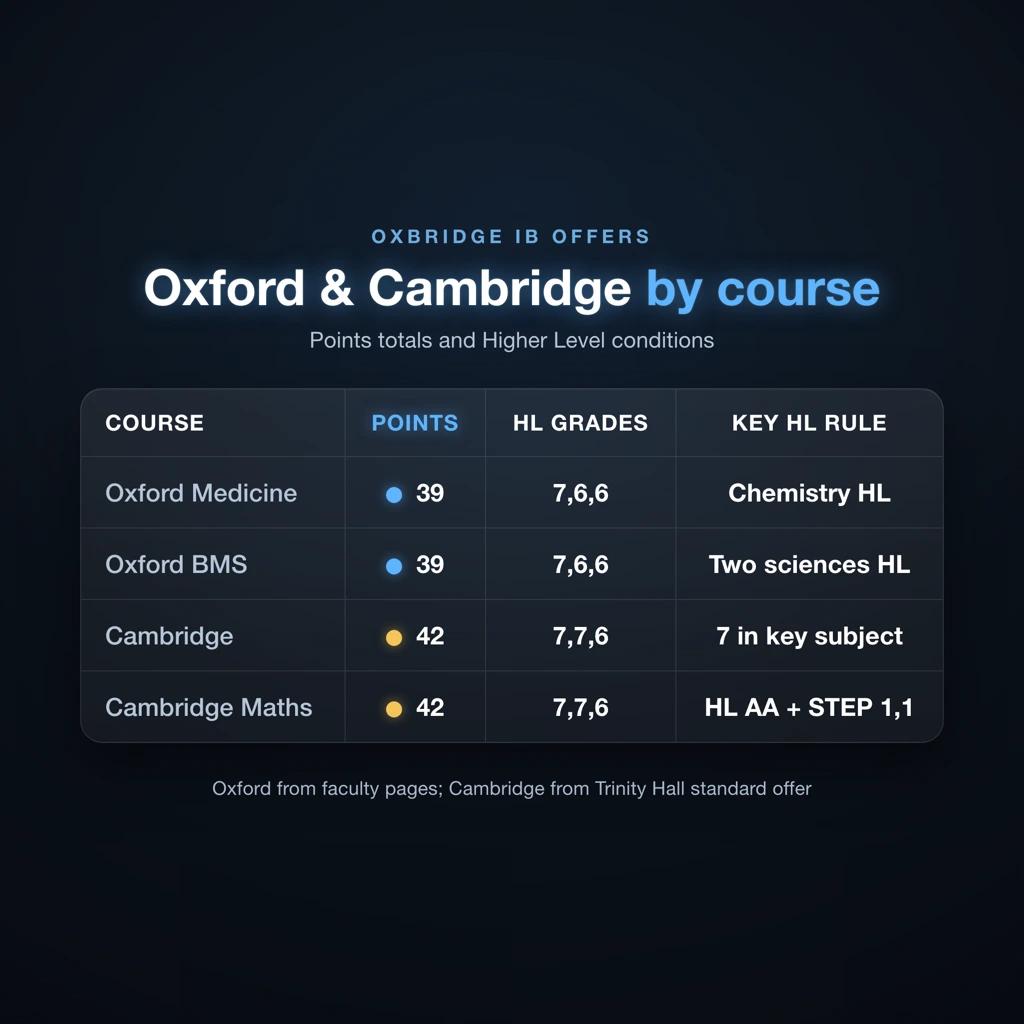
The headline numbers are well-known: Oxford typically asks for less than Cambridge. What catches applicants off guard is how much the subject-level conditions vary, even within a single university.
Oxford Medicine
Per the University of Oxford Medical Sciences Division, the standard IB offer is 39 points overall (including core points), with 7, 6, 6 at Higher Level. Chemistry at HL is compulsory. You must also take at least one of Biology, Physics, or Mathematics at HL. Oxford states no preference between Maths Analysis and Approaches and Applications and Interpretation if you choose Maths as that second science.
Oxford Biomedical Sciences
The Oxford BMS entry requirements page sets the same points threshold: 39 overall, 7, 6, 6 at HL. The difference from Medicine is the subject rule: two subjects from Biology, Chemistry, Mathematics, and Physics must be at HL, rather than one named compulsory subject plus a wildcard. This matters if you were planning to sit Chemistry at SL and rely on another science at HL.
Cambridge (Trinity Hall example)
Trinity Hall's entry requirements illustrate the standard Cambridge position: 42 points out of 45, with 7, 7, 6 at Higher Level. Some courses require a 7 in a specific HL subject, so a 42-point total that includes a 6 in the required subject will not meet the condition even if you hit the overall score.
For the Mathematics course, the requirement goes further: you must take IB HL Analysis and Approaches, not Applications and Interpretation, and you will also need to sit STEP papers (the minimum is grades 1, 1 in STEP Papers 2 and 3, though some colleges ask for S, 1). Applications and Interpretation is not accepted for Mathematics at Cambridge, which is worth knowing before you make your IB subject choices in Year 11.
For Medicine, Natural Sciences (Biological), and Psychological and Behavioural Sciences, Analysis and Approaches is recommended for the most competitive application, but Applications and Interpretation is considered.
| Course | University | IB overall | HL grades | Key subject condition |
|---|---|---|---|---|
| Medicine | Oxford | 39 | 7, 6, 6 | Chemistry compulsory at HL |
| Biomedical Sciences | Oxford | 39 | 7, 6, 6 | Two from Bio/Chem/Maths/Physics at HL |
| Most courses | Cambridge | 42 | 7, 7, 6 | 7 in specific HL subject (course-dependent) |
| Mathematics | Cambridge | 42 | 7, 7, 6 | HL AA only; STEP 1,1 also required |
Oxford Law
The UCAS listing for Oxford Law states "there are no specific entry requirements for this course" and publishes no IB subject prerequisites. That does not mean the course is less selective. It means the published minimum is a floor, not a target. Check ox.ac.uk/uglaw directly for current guidance, as the detail that matters tends to sit there rather than on UCAS.
The practical takeaway: confirm your specific HL subjects against the course page at your target college before your UCAS application deadline, not after. Subject conditions can disqualify an otherwise competitive application regardless of total points.
4. IB Maths: Analysis and Approaches vs Applications and Interpretation
The choice between these two courses carries real consequences at Oxbridge, and the rules are not symmetric between the two universities.
Cambridge draws a hard line for its Maths Tripos. Per Trinity Hall Cambridge, IB applicants to Mathematics must take Higher Level Analysis and Approaches. Applications and Interpretation (AI) is not accepted for that course, full stop. No amount of a strong overall score compensates for the wrong variant.
For other mathematically demanding Cambridge courses, the picture is softer but still directional. Trinity Hall's entry requirements specify that for Medicine, Natural Sciences (Biological), and Psychological and Behavioural Sciences, Analysis and Approaches is recommended for the most competitive application, but AI will be considered.
Oxford Medicine is the notable exception. The Oxford Medical Sciences Division explicitly states no preference between AA and AI when Mathematics is the chosen HL science alongside compulsory Chemistry.
The practical gotcha for science and engineering applicants: the ESAT and TMUA admissions tests (used for Cambridge Engineering and Natural Sciences and, from the October 2026 sitting, the equivalent Oxford courses) draw heavily on calculus and proof-based reasoning that sits squarely in the AA syllabus. AI candidates are not disqualified from sitting these tests, but they will encounter content their course did not systematically cover.
Default rule: unless your specific course page explicitly accepts AI at HL, choose Analysis and Approaches.
5. Admissions tests: ESAT, TMUA, LNAT and who sits them
Which test you sit depends entirely on your course, not your qualification. IB students face the same tests as A-level applicants, on the same dates.
Cambridge overhauled its science and maths testing from October 2024. The Engineering and Science Admissions Test (ESAT) now covers Engineering, Natural Sciences, Chemical Engineering and Biotechnology, and Veterinary Medicine at Cambridge. The Test of Mathematics for University Admission (TMUA) applies to Economics and Computer Science at Cambridge. Both are delivered by Pearson VUE at more than 5,500 centres across more than 180 countries, which means an IB student sitting exams in Singapore or Nairobi can take the test locally rather than travelling to the UK.
A practical gotcha worth knowing: Cambridge applicants must sit the Autumn sitting in mid-October. The early January sitting exists, but it is too late for a Cambridge UCAS application. Missing the October window effectively ends your Cambridge application for that cycle.
Here is a quick reference by course:
| Test | Oxford | Cambridge |
|---|---|---|
| ESAT | Physics, Engineering Science, Biomedical Sciences (from October 2026, replacing the PAT) | Engineering, Natural Sciences, Chemical Engineering and Biotechnology, Veterinary Medicine |
| TMUA | Mathematics, Computer Science and joint courses (from October 2026, replacing the MAT) | Economics, Computer Science |
| MAT | Discontinued after the 2025 cycle - replaced by the TMUA | No |
| LNAT | Law | Law |
| TARA | PPE, Economics and Management, Experimental Psychology, Human Sciences, History and Economics, History and Politics, Psychology and Philosophy, Psychology and Linguistics, Philosophy and Linguistics (from October 2026) | No |
| UCAT | Medicine | Medicine (from 2025 entry) |
Oxford has retired its in-house tests: from the October 2026 sitting the TMUA replaces the MAT for Mathematics and Computer Science courses, and the ESAT replaces the PAT for Physics and Engineering Science and is also used for Biomedical Sciences. The new TARA is used for PPE, Economics and Management, Experimental Psychology, Human Sciences and several joint courses in history, psychology and linguistics (UAT-UK publishes the full course list). Oxford applicants now register for the same Pearson VUE-delivered tests as Cambridge applicants.
Fee waivers are available for UK-based applicants eligible for free school meals or meeting other widening participation criteria, covering the administration fee for the new Cambridge tests.
6. Predicted grades: how Oxbridge uses IB predictions to filter applicants
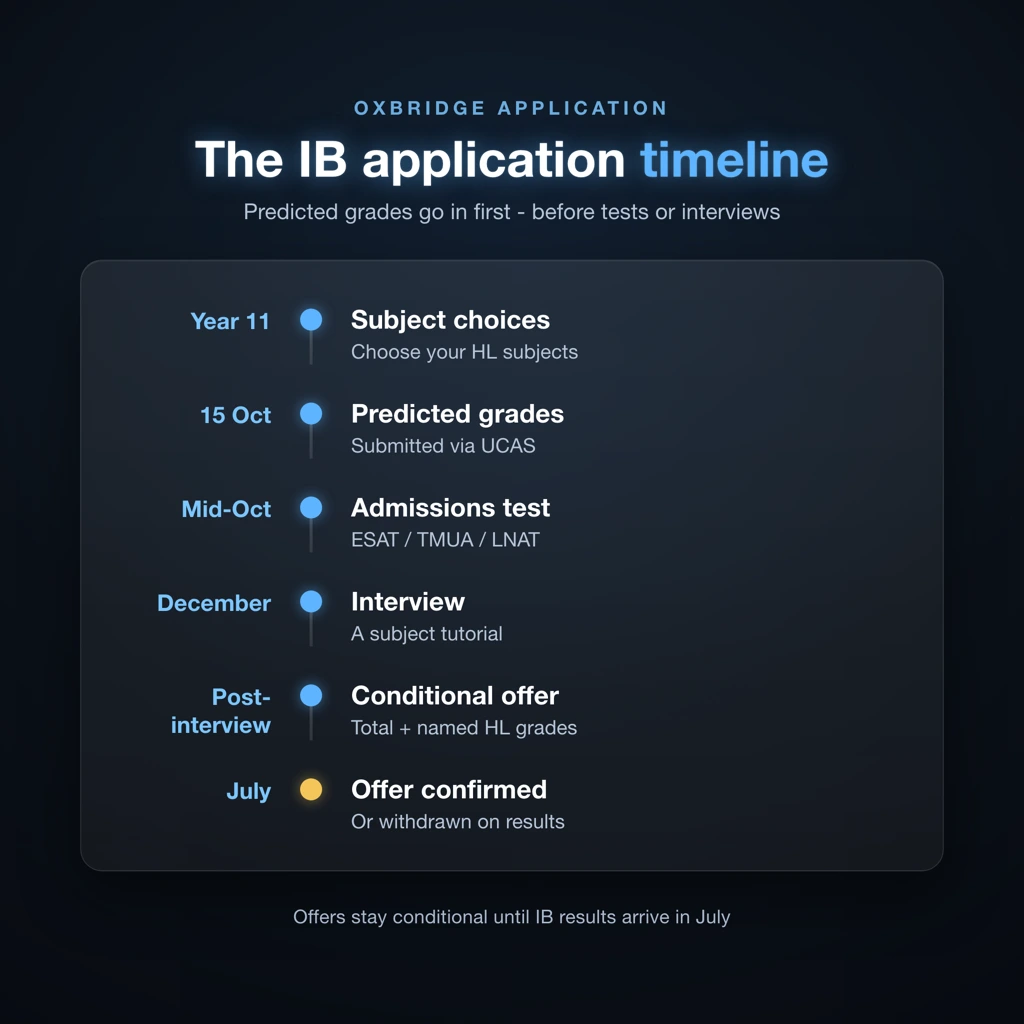
Your predicted grades are the first filter. Both Oxford and Cambridge shortlist for interview primarily on predictions, which means an application with a score well below 40 is likely to be set aside before admissions tutors weigh anything else - personal statement, reference, or admissions test score included.
IB predicted grades are issued by your school's IB coordinator and submitted to universities via UCAS. Because final results are not available at application time (the UCAS deadline is mid-October; IB results arrive the following July), predictions carry substantial weight. The number your coordinator submits is, in practice, the score Oxbridge is evaluating you on.
The non-obvious point here: aim to be predicted at or above the typical offer, not merely at the minimum. Trinity Hall Cambridge publishes a standard offer of 42 points, with 776 at Higher Level. A prediction of 38 is therefore unlikely to progress for competitive courses, even if 38 would technically clear a lower threshold elsewhere.
One structural quirk worth understanding is how the 45-point total breaks down. The Extended Essay and Theory of Knowledge together contribute up to 3 bonus points to a candidate's IB total. Admissions tutors know this. A predicted score of 42 built on strong HL grades reads differently from one propped up by an anticipated A grade in both EE and TOK components, and a tutor reading the full UCAS application can see the breakdown. Make sure your coordinator's prediction reflects genuine HL performance, not optimistic bonus-point assumptions.
7. The interview process: how IB candidates are assessed alongside A-Level applicants
Oxbridge interviews are subject tutorials, not qualification audits. Tutors push candidates on analytical reasoning and subject-specific thinking, and they are broadly indifferent to whether you arrived via the IB Diploma Programme or A-Levels. What they are not indifferent to is the depth of your knowledge in the relevant subject area.
This is where a specific gap can open up for IB candidates. HL subject content must map closely onto the syllabus depth expected from A-Level applicants in that same discipline. An IB HL Chemistry candidate, for instance, will be probed on material that an A-Level AQA or OCR Chemistry student would have covered in full. If your HL course treated certain topics lightly, that is a practical disadvantage in the room regardless of your overall points score.
The IB's broader programme structure, the six-subject spread, Theory of Knowledge, the Extended Essay, and CAS, is not held against you. But do not expect a tutor to weigh it as extra credit. Depth in your relevant HL subjects is the only currency that matters in a subject interview.
One timing quirk worth knowing: interviews take place in December, well before IB final exams in May. This means no final IB grades exist at offer stage. Any offer you receive is conditional, typically specifying both a total IB points threshold and minimum scores in named HL subjects. Meeting both conditions, not just the total, is what converts a conditional offer into a place.
8. Can you apply to both Oxford and Cambridge - and what about international students?
UCAS rules bar you from applying to both Oxford and Cambridge in the same undergraduate admissions cycle. You must pick one. Submitting an application to both will result in UCAS withdrawing both, so the choice is not administrative detail - it is a hard constraint with real consequences.
Postgraduate applicants are not subject to this restriction. If you are considering a master's or doctoral programme, you can apply to both universities simultaneously through their separate postgraduate admissions systems.
International applicants
International students apply through exactly the same UCAS process as UK applicants. Cambridge's international entry requirements page lists the IB Diploma as an accepted qualification for undergraduate entry, and notes that entry requirements for a specific course may differ between individual Cambridge Colleges. This college-level variation is easy to overlook: two students applying for the same subject can receive offers with different conditions depending on which college considers their application.
One non-obvious gotcha: if your country is not listed on Cambridge's international requirements page, your national qualifications are unlikely to be accepted. Cambridge directs country-specific queries to overseas@admin.cam.ac.uk rather than publishing a universal catch-all policy. Applicants from non-majority English-speaking countries (as defined by the UK Home Office) must also meet Cambridge's separate English language requirements, on top of any IB score conditions.
9. IB vs A-Levels for Oxbridge: what the evidence actually shows
Neither Oxford nor Cambridge states a preference for one qualification over the other. Both appear side by side in official entry requirement tables with equivalent offer structures: Oxford Medicine, for example, lists A*AA at A-Level and 39 points with 7,6,6 at IB Higher Level as parallel conditions, not a ranked ordering.
The depth requirement is identical in practice. A-Level applicants present three subjects studied in depth; IB applicants present three Higher Level subjects. Tutors are assessing the same thing: sustained engagement with a subject at a level close to first-year undergraduate work.
The IB does carry one structural feature A-Levels lack: every diploma candidate completes six subjects, Theory of Knowledge, and an Extended Essay by design. Tutors may notice this breadth, but neither university formally weights it in offer conditions.
The less-discussed risk runs the other way. If your school does not offer a specific HL subject, you cannot meet a subject condition regardless of your overall points score. Oxford Medicine requires Chemistry at Higher Level, full stop. A student at a school that offers Chemistry only at Standard Level cannot satisfy that condition through the IB pathway, whereas an A-Level student at the same school might still have access to A-Level Chemistry. Check your school's HL timetable before committing to the IB route, not after.
That single timetabling constraint is the most consequential practical difference between the two qualifications for competitive Oxbridge applications.
10. Where to go from here
Start this week, not in January. Open the admissions page for your specific course at your target university now - requirements vary by college, and Trinity Hall's IB offer of 42 points with 776 at Higher Level differs from other Cambridge colleges. For Oxford Medicine, the authoritative figures (39 points, with 7, 6, 6 at Higher Level, and compulsory Chemistry HL) sit on the Medical Sciences Division page, not in general prospectuses.
Two registration deadlines cannot be recovered if you miss them. Register for the relevant admissions test - ESAT, TMUA, or LNAT - by its booking deadline, which closes in September, weeks before the mid-October test window. Then confirm with your IB coordinator that your predicted grades will reach UCAS before the 15 October Oxbridge deadline. Coordinators submit predictions centrally; do not assume it happens automatically. Contact your IB coordinator this week and ask them to confirm the submission date in writing.
FAQ
Does Oxford accept the IB diploma?
Yes - Oxford accepts the IB Diploma for all undergraduate courses and publishes IB-equivalent offers alongside A-Level requirements on individual faculty admissions pages.
What IB score do you need for Oxford and Cambridge?
Oxford typically requires 38-40 points with 7,6,6 or 6,6,6 at HL depending on the course; Cambridge colleges such as Trinity Hall set their standard offer at 42 points with 7,7,6 at HL.
Can you apply to both Oxford and Cambridge at the same time?
No - UCAS rules prevent undergraduate applicants from applying to both Oxford and Cambridge in the same admissions cycle; you must choose one.
What IB subjects does Oxford Medicine require?
Oxford Medicine requires Chemistry at Higher Level and at least one of Biology, Physics, or Mathematics at Higher Level, with an overall score of 39 points and grades of 7,6,6 at HL.
Do IB students have to sit admissions tests for Cambridge?
Yes - IB applicants sit the same admissions tests as A-Level applicants: the ESAT for science and engineering courses, the TMUA for maths-based courses such as Economics, Mathematics, and Computer Science, and the LNAT for Law, all sat in mid-October.
Can international students apply to Oxford or Cambridge with the IB?
Yes - Cambridge explicitly lists the IB as an accepted qualification on its international entry requirements page, and both universities accept IB applicants from any country through the standard UCAS process.
References
- International entry requirements | Undergraduate Study - https://www.undergraduate.study.cam.ac.uk/international-students/international-entry-requirements
- Medicine: Academic Entry & Age Requirements - University of Oxford, Medical Sciences Division - https://www.medsci.ox.ac.uk/study/medicine/pre-clinical/requirements/academic
- Entry Requirements - Trinity Hall Cambridge - https://www.trinhall.cam.ac.uk/study-with-us/undergraduate-study/entry-requirements/
- Biomedical Sciences: Academic Requirements - University of Oxford, Medical Sciences Division - https://www.medsci.ox.ac.uk/study/bms/applying/entry-requirements
- Law | University of Oxford | UCAS - https://www.ucas.com/explore/courses/7aab8620-ae00-b369-eec4-70ad6d1fa476/law
- New admissions tests for 2024 | University of Cambridge - https://www.cam.ac.uk/news/new-admissions-tests-for-2024
- TARA | UAT-UK - https://esat-tmua.ac.uk/about-the-tests/tara/