Oxbridge Engineering Interview: The Complete Guide
By Michael Thompson · Education Specialist; 10 years teaching the IB at Bromsgrove School · Published 21 May 2026 · Updated 12 June 2026
The oxbridge engineering interview is not a test of what you already know - it is a test of how you think when you are stuck. Both Oxford and Cambridge use the interview to watch candidates reason through unfamiliar problems in real time, often on a whiteboard or shared screen, with a tutor asking follow-up questions designed to push beyond your first answer. The ESAT, which replaced the ENGAA from 2024 and from the October 2026 sitting also replaces Oxford's PAT, now filters who gets invited in the first place, so your interview preparation starts earlier than most applicants realise. This guide covers the structure of each interview, the question types you will face, how interviewers actually probe your thinking, and what preparation genuinely moves the needle.
Key Takeaways
- One broad course, specialisation later: Both Oxford Engineering Science and Cambridge Engineering are single-entry courses where you choose a specialism in your second or third year - applying for a sub-discipline at interview stage is not required.
- The ESAT gates your interview invitation: Both universities use ESAT scores to decide who to shortlist before any interview offer is made - Cambridge since 2024, Oxford from the October 2026 sitting - so strong test preparation is a prerequisite, not an optional extra.
- Two interviews, not one: Shortlisted candidates at both Oxford and Cambridge typically receive two separate interviews, often with tutors from different colleges.
- Interviewers use Socratic extension questions: A correct first answer does not end the question - tutors escalate difficulty deliberately to find where your reasoning breaks down.
- Silence is the most penalised mistake: Tutors want to hear your thinking as it happens; saying nothing while you think looks like a blank page, whereas talking through a wrong approach shows recoverable potential.
- Background reading helps only if it builds physical intuition: Superficially dropping book titles into conversation impresses no one; reading that deepens your feel for mechanics, waves, or circuits will show up when you tackle unseen problems.
In This Article
- Oxford Engineering Science vs Cambridge Engineering - the course structure
- The ESAT: what it tests and how it affects your interview chances
- What the oxbridge engineering interview looks like on the day
- Typical question categories: physics, mechanics, circuits, and maths derivations
- How interviewers probe - the Socratic method in practice
- Oxford and Cambridge engineering interview acceptance rates
- Oxford engineering interview prep: what background reading actually helps
- Cambridge engineering interview practice questions - worked examples
- Common mistakes - and how to avoid them
- Where to go from here
1. Oxford Engineering Science vs Cambridge Engineering - the course structure
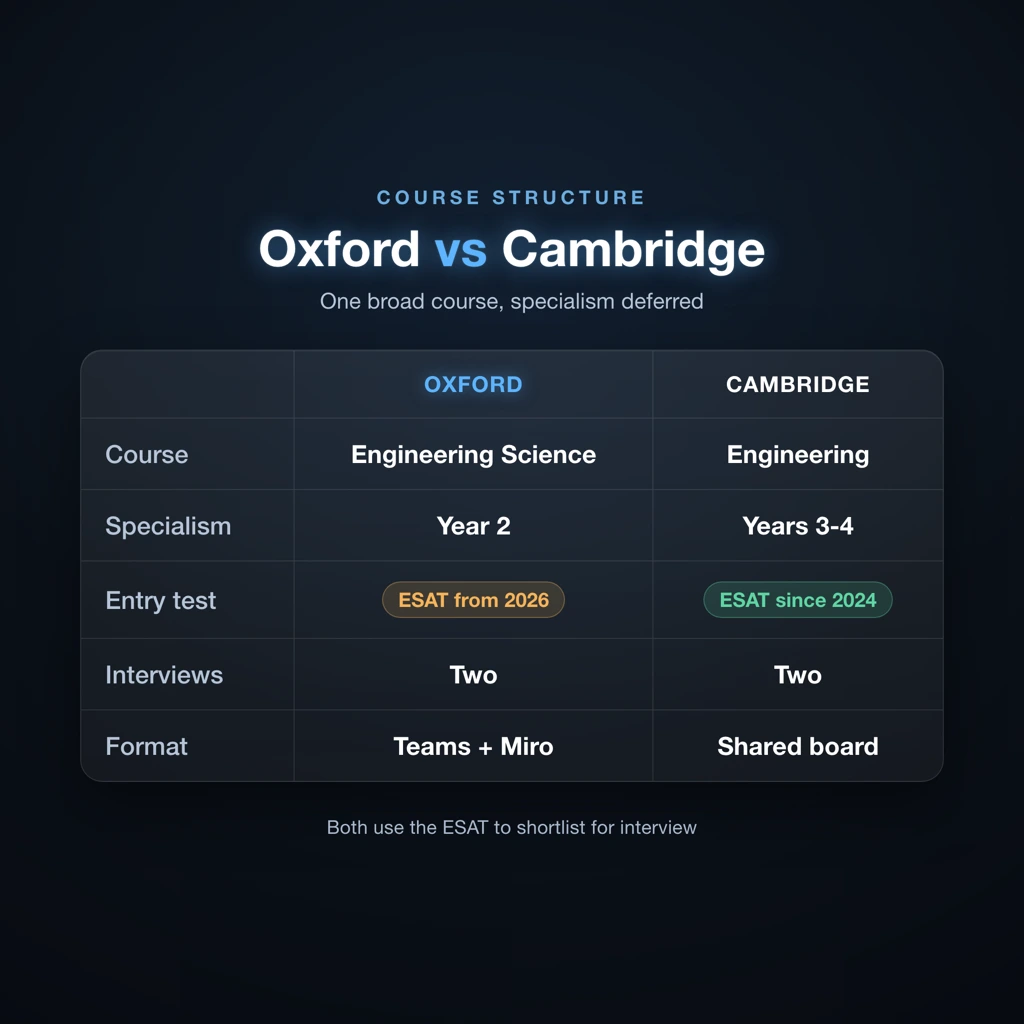
The oxbridge engineering interview is one of the few university admissions processes where your choice of specialism is, deliberately, not the point. Both Oxford and Cambridge admit students to a single broad engineering course, and neither expects you to arrive with a fixed identity as a mechanical, civil, or electrical engineer.
At Oxford, the course is called Engineering Science. It covers all major engineering disciplines in the first year, and students choose their specialisation pathway partway through Year 2. Cambridge Engineering works similarly: the first two years are largely common to all students, with meaningful specialism deferred to Years 3 and 4.
The counter-intuitive implication for your interview preparation is this: interviewers are not looking for a candidate who has read deeply into structural analysis or power electronics. They are assessing whether you can reason from first principles at A-level depth, under pressure, in real time. Pitching yourself as a future civil engineer will not help you, and may suggest you have misunderstood what the course actually is.
What both departments are selecting for at interview is the same thing: mathematical fluency, physical intuition, and the willingness to say "I'm not sure, but if I assume..." and keep going. Specialism is something the course builds. Curiosity and analytical grip are what you are expected to bring on the day.
2. The ESAT: what it tests and how it affects your interview chances
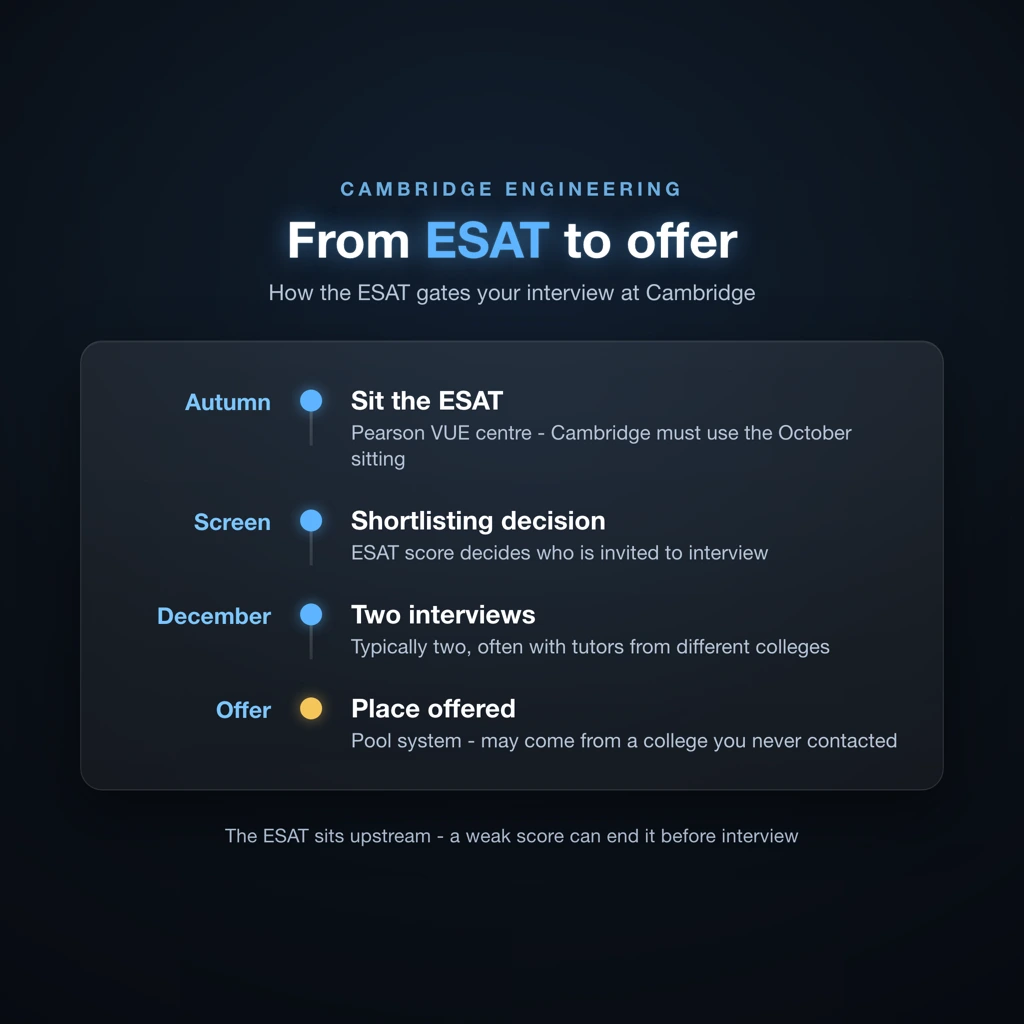
From 2024, Cambridge replaced the ENGAA with the Engineering and Science Admissions Test (ESAT), a joint venture with Imperial College London delivered by Pearson VUE. Oxford follows from the October 2026 sitting, with the ESAT replacing the PAT for Engineering Science. The shift matters because the ESAT sits upstream of the interview: Cambridge uses the score to decide whether to shortlist you for interview at all, so a weak result can end your application before anyone reads your personal statement properly.
The test is computer-based, sat at a Pearson VUE test centre near you, not at your Cambridge college. It covers mathematics, physics, and chemistry. Crucially, the test is deliberately designed so that almost no one achieves full marks, and some strong candidates may not finish in the allotted time. That is not a flaw in the design, it is the design: the aim is discrimination at the top of the grade distribution, where A-level results alone cannot separate candidates.
One non-obvious detail: there are two annual sittings, mid-October and early January, but Cambridge applicants must take the autumn sitting. The January option exists for Imperial and other institutions. If you miss the October window as a Cambridge applicant, you cannot substitute the January date.
Chemical Engineering and Biotechnology applicants at Cambridge sit the same ESAT as Engineering applicants, so oxbridge chemical engineering interview preparation begins with identical pre-interview test requirements.
Fee waivers are available for UK applicants eligible for free school meals or meeting other widening-participation criteria. Registration is required in advance, so check the Pearson VUE registration deadlines well before the October sitting opens.
3. What the oxbridge engineering interview looks like on the day
The practical setup matters more than most applicants expect, so it is worth knowing exactly what you are walking into before the day arrives.
You will almost certainly have two interviews, not one. Hertford College confirms that all shortlisted Oxford candidates receive one interview with their college's tutors and a second with tutors from a different college. Cambridge follows the same pattern: per the Cambridge Engineering Department, applicants typically receive two interviews across their interview day.
At Oxford, every oxbridge engineering interview is conducted remotely via Microsoft Teams. The less obvious requirement: you need a Miro whiteboard account and a touchscreen device with a stylus for writing equations. Turning up without one is avoidable and costly.
At Cambridge, your two interviews may not both be at the college you applied to. Cambridge has 29 undergraduate-admitting colleges, and a second college can pull you in independently, which also means you could ultimately be offered a place by a college you never contacted.
The format itself is problem-solving on a shared board, not a personal statement review. Interviewers work through maths and physics from school-level content, pushing your reasoning step by step. The counter-intuitive detail: interviewers may not reach a final answer due to time constraints. How you think under pressure is the data they are collecting, not whether you closed the problem neatly.
4. Typical question categories: physics, mechanics, circuits, and maths derivations
Hertford College confirms that interview content focuses on maths and physics at school level, and that candidates may say "we haven't covered that yet" without penalty. The questions are not trick questions. What they are is deliberate: designed to see how you reason, not what you have memorised.
Physics problems
Expect projectile motion, energy conservation, and wave behaviour set at A-level standard. The non-obvious catch: getting the right numerical answer matters less than narrating the physics as you go. An interviewer from Hertford's panel, Dr Zsolt Laczik, covers electricity and control, so electricity questions can arrive alongside classical mechanics in the same session.
Estimation and Fermi problems
Order-of-magnitude questions test physical intuition, not memorised constants. "How much power does a cyclist produce climbing a hill?" requires you to estimate a sensible mass, a plausible gradient, and a reasonable speed, then combine them coherently. The answer can be off by a factor of two. An answer with no physical structure scores nothing.
Electrical circuits
Questions may ask you to sketch a circuit, apply Kirchhoff's current or voltage laws, and then reason through what changes when one component is modified. The insight most candidates miss: interviewers want to see what your mental model of the circuit does before you write a single equation.
Maths derivations
You may be asked to differentiate under a constraint, integrate by parts, or derive a geometric result from first principles. The key word is derive: reciting a formula is not sufficient. Hertford's tutors will not always push a question to a final answer due to time constraints, so do not expect neat closure.
Chemical engineering applicants
Oxford chemical engineering applicants face the same physics and maths question types. Thermodynamics reasoning and chemical equation balancing may also appear, extending the scope slightly beyond what a pure engineering applicant should expect.
5. How interviewers probe - the Socratic method in practice
Getting the first answer right does not end the question. At both Oxford and Cambridge, a correct response is the signal to go harder. Interviewers are mapping the ceiling of your understanding, not confirming that you revised the right topics. Hertford College's engineering guidance makes this explicit: tutors may not even finish a question due to time pressure, because what they want to see is how far your reasoning extends, not whether you can reach a tidy conclusion.
The escalation follows a recognisable pattern:
- Concrete numerical problem - a specific value, a working answer.
- Generalisation - "Now do it for an arbitrary angle / resistance / mass."
- Proof - "Can you show that holds in general?"
- Breakdown question - "Where does this stop being valid? What happens at the extremes?"
That final step is where most candidates freeze, because school physics rarely asks you to identify the limits of your own model. Spotting that your beam-bending formula assumes small deflections, or that your circuit analysis ignores parasitic capacitance at high frequency, is exactly the kind of self-awareness tutors are testing for.
Wrong starts are not penalised in the way candidates fear. Cambridge students who contributed tips via InsideUni consistently flag one piece of advice: think aloud throughout. The reason is practical. A tutor watching you reason can offer a targeted hint the moment you go off track. A tutor watching silence cannot help you at all.
Willingness to abandon a wrong method mid-calculation is rated more highly than reluctance to lose the work already on the page. If a redirect from the interviewer makes your current approach look shaky, say so and change course. That flexibility is the signal they are looking for.
6. Oxford and Cambridge engineering interview acceptance rates
Not every applicant reaches interview. At Cambridge, the ESAT acts as a filter: colleges use the test score to decide whether to invite a candidate to interview at all, before any supervisor sees the full application. A strong personal statement does not compensate for a weak ESAT score at the shortlisting stage.
Cambridge has 29 colleges admitting undergraduates, and the pool system means the college you applied to may not be the one that ultimately makes you an offer. If a college is impressed by your application but has no remaining places, it can pass you into a central pool where other colleges can pick you up. This is not a consolation prize. Some strong candidates are pooled simply because their chosen college received an unusually competitive cohort that cycle.
Oxford works similarly: you may be admitted by a college different from the one you originally selected, particularly if your first-choice college is oversubscribed in engineering that year.
Engineering at Cambridge is consistently one of the more competitive courses on offer. Without a verifiable figure from UCAS or Cambridge's own published data, specific acceptance percentages should be treated with scepticism wherever you read them.
The concrete insight worth knowing: because the ESAT is sat before shortlisting, your interview preparation and your test preparation are not independent. A below-threshold ESAT score ends the process before the oxbridge engineering interview begins. Prioritise accordingly.
7. Oxford engineering interview prep: what background reading actually helps
The counterintuitive truth about background reading is that going deeper into A-level material almost always beats reading ahead. An interviewer who asks you to derive the equations of motion for a damped oscillator does not care that you have read a popular science book about it. They care whether you can do it, on the whiteboard, under pressure.
Revisit your A-level derivations from first principles. Work through AQA or OCR mechanics proofs without looking at your notes. If you cannot re-derive something from scratch, you do not own it yet, and interviewers will find that gap quickly.
Reading that builds physical intuition does help, provided you can speak to the mechanism, not just the title. Books that explain why suspension bridges develop resonance, how a capacitor behaves when a circuit is switched under load, or why fatigue causes metals to fail at stresses well below their yield point give you the vocabulary to reason out loud. That reasoning is what interviewers are assessing.
Vanity reading is transparent. Tutors with decades of interviewing experience recognise immediately when an applicant name-drops a book they cannot explain. It signals poor self-awareness and wastes interview time you could spend demonstrating real ability.
Practise Fermi estimation regularly. "How many piano tuners are in London?" is a cliche, but the underlying skill, building a quantitative answer from rough physical reasoning, maps directly onto the kind of open problems Cambridge interviewers set.
For peer-level advice on what preparation actually worked, InsideUni offers free guidance drawn from over 1,000 Oxbridge students, with hundreds of state-school volunteers contributing specifically to reduce the access gap.
8. Cambridge engineering interview practice questions - worked examples
These four examples reflect the school-level maths and physics focus that Oxford's Hertford College admissions guidance describes. They are illustrative question types, not official past questions. The point is not to memorise answers but to practise the habit of deriving, stating assumptions, and narrating your thinking aloud.
Mechanics: projectile angle
"A ball is thrown horizontally from a cliff. After time t, at what angle does it hit the ground? Derive it, do not guess."
Horizontal velocity stays constant at u. Vertical velocity grows to gt (gravity alone, downward). The angle below horizontal is arctan(gt / u). The non-obvious move: candidates who jump to "45 degrees" reveal they have not thought about the role of time. The angle depends on t, so it increases without bound as t grows.
Estimation: wind force on a cyclist
"How much force does the wind exert on a moving cyclist?" State every assumption. A workable path: estimate frontal area (roughly 0.5 m2), air density (1.2 kg/m3), relative wind speed (say 10 m/s), and use F = 0.5 rho A Cd v2 with Cd near 1. Interviewers want to see explicit assumptions, not a precise number.
Circuits: RC charging
"Sketch the voltage across a capacitor charging through a resistor. What happens if you double the resistance?"
The curve rises exponentially toward the supply voltage with time constant RC. Double R and the time constant doubles: the capacitor charges more slowly but reaches the same final voltage. A common slip is claiming the final voltage changes. It does not.
Maths: differentiating x^x
"Differentiate x^x from first principles using logarithms. Explain each step."
Let y = x^x. Take natural logs: ln y = x ln x. Differentiate both sides with respect to x: (1/y)(dy/dx) = ln x + 1. Multiply through by y: dy/dx = x^x(ln x + 1). The instruction to explain each step matters. As Hertford's guidance notes, interviewers may not reach a final answer due to time constraints, so demonstrating method at every stage carries more weight than the result.
9. Common mistakes - and how to avoid them
The most damaging errors in an Oxbridge engineering interview are rarely about not knowing enough physics. They are process errors - habits that hide perfectly good thinking.
Sitting in silence while you think. Tutors read silence as a blank page. Narrate instead: "I think this might involve energy conservation, let me check whether there are non-conservative forces here..." That running commentary is what interviewers are actually assessing. A wrong direction spoken aloud is far more useful to them than a correct answer that arrived invisibly.
Writing the formula before sketching the setup. The instinct under pressure is to reach for F = ma immediately. Resist it. Tutors want to see the physical model first: forces, constraints, a rough free-body diagram. The algebra follows from the picture, not the other way around.
Treating a correction as a verdict. When an interviewer nudges you toward a different approach, that is an invitation to keep reasoning, not a signal that you have failed. Hertford College's guidance notes explicitly that there are no trick questions and that candidates can say "we haven't covered that yet" - the process matters more than the destination.
Over-preparing the personal statement, under-preparing problems. The interview rarely dwells on your statement. It focuses on live reasoning under time pressure. Redirect that revision time to worked problems.
Skipping a whiteboard rehearsal. Oxford interviews run via Microsoft Teams, with Miro recommended for writing mathematical notation. Fumbling with the stylus or screen-share on interview day wastes the first two minutes of a twenty-minute session. Test the setup the week before, not the morning of.
10. Where to go from here
This week, visit cam.ac.uk/assessments and confirm the ESAT registration window for your application cycle. Cambridge applicants must use the Autumn sitting, and registration is not automatic - missing the window means missing the interview shortlist entirely.
For interview accounts from people who have sat in that room, InsideUni is free, not-for-profit, and built by Cambridge engineering students. It has been used more than 20,000 times across 111 countries, and hundreds of contributors have volunteered specifically to help state-school applicants.
If you applied to Oxford, find the equivalent page for your college. Hertford's engineering interview page names the interviewing tutors and sets out the format in plain terms. Most colleges publish something similar.
The candidates who perform best in an Oxbridge engineering interview are those who have been talking through physics problems with themselves, or anyone who will listen, for months before the day. Start that conversation now. Check the ESAT registration deadline at cam.ac.uk/assessments before the end of this week.
FAQ
Is the oxbridge engineering interview hard?
The interview is deliberately designed to push beyond what you already know - tutors expect candidates to struggle on extension questions and are assessing how you reason when stuck, not whether you get the right answer immediately.
What percentage of Oxford engineering applicants get an interview?
Oxford does not publish a fixed interview invitation rate for Engineering Science; the ESAT score (used by Cambridge since 2024 and by Oxford from the October 2026 sitting) and pre-interview screening mean only a proportion of applicants are shortlisted, and the exact figure varies by year and college.
When are Cambridge engineering interviews held?
Cambridge undergraduate interviews for Engineering typically take place in December; the exact dates vary by college, and applicants are notified after the ESAT results are used for shortlisting.
Does the oxbridge engineering interview ask about your personal statement?
Occasionally, but the majority of interview time at both Oxford and Cambridge Engineering is spent on unseen maths and physics problems, not on reviewing what you wrote in your application.
What is the ESAT and how does it affect Cambridge engineering interview chances?
The Engineering and Science Admissions Test (ESAT), which replaced the ENGAA from 2024, is taken before shortlisting and Cambridge uses the score to decide who to invite to interview, making it a prerequisite filter rather than a parallel assessment.
Can you fail the oxbridge engineering interview by starting with a wrong answer?
No - interviewers expect wrong starts and watch for how candidates respond to hints and redirection; the ability to self-correct is one of the qualities the interview is specifically designed to reveal.
References
- New admissions tests for 2024 | University of Cambridge - https://www.cam.ac.uk/news/new-admissions-tests-for-2024
- Admission tests and assessments | Undergraduate Study - https://www.cam.ac.uk/assessments
- Engineering - Hertford College | University of Oxford - https://www.hertford.ox.ac.uk/applicants/subjects/engineering-interviews/
- Students submit tips on preparing for University interviews | Department of Engineering - https://www.eng.cam.ac.uk/news/students-submit-tips-preparing-university-interviews