Oxford Interview Dates 2026: Every Course and Invitations
By Michael Thompson · Education Specialist; 10 years teaching the IB at Bromsgrove School · Published 26 October 2026 · Updated 28 October 2026
Oxford interviews for 2027 entry run online from 7 to 18 December 2026, with the Foundation Year courses interviewing in March. This page lists the interview dates for every one of Oxford's 48 undergraduate courses from the University's own course pages, with the number of interviews, the length where Oxford states one, and what the course asks you to do before the day. Invitations for Medicine usually arrive from mid-November; the other course pages give dates only.
Key Takeaways
- Window: 7 to 18 December 2026 for the main round; Foundation Year courses interview in March.
- All online: every course interviews online, usually with two tutors.
- Two interviews is the norm: most courses describe two or more, often at two colleges; languages give one per language.
- Invitations: the Medicine page says mid-November to early December; other pages publish dates only.
In This Article
- Oxford interview dates 2026 at a glance
- Interview dates by course
- How many interviews, and how long
- Before the interview: tests, written work and reading
- The Foundation Year courses
- How this page was built
- What to do next
1. Oxford interview dates 2026 at a glance
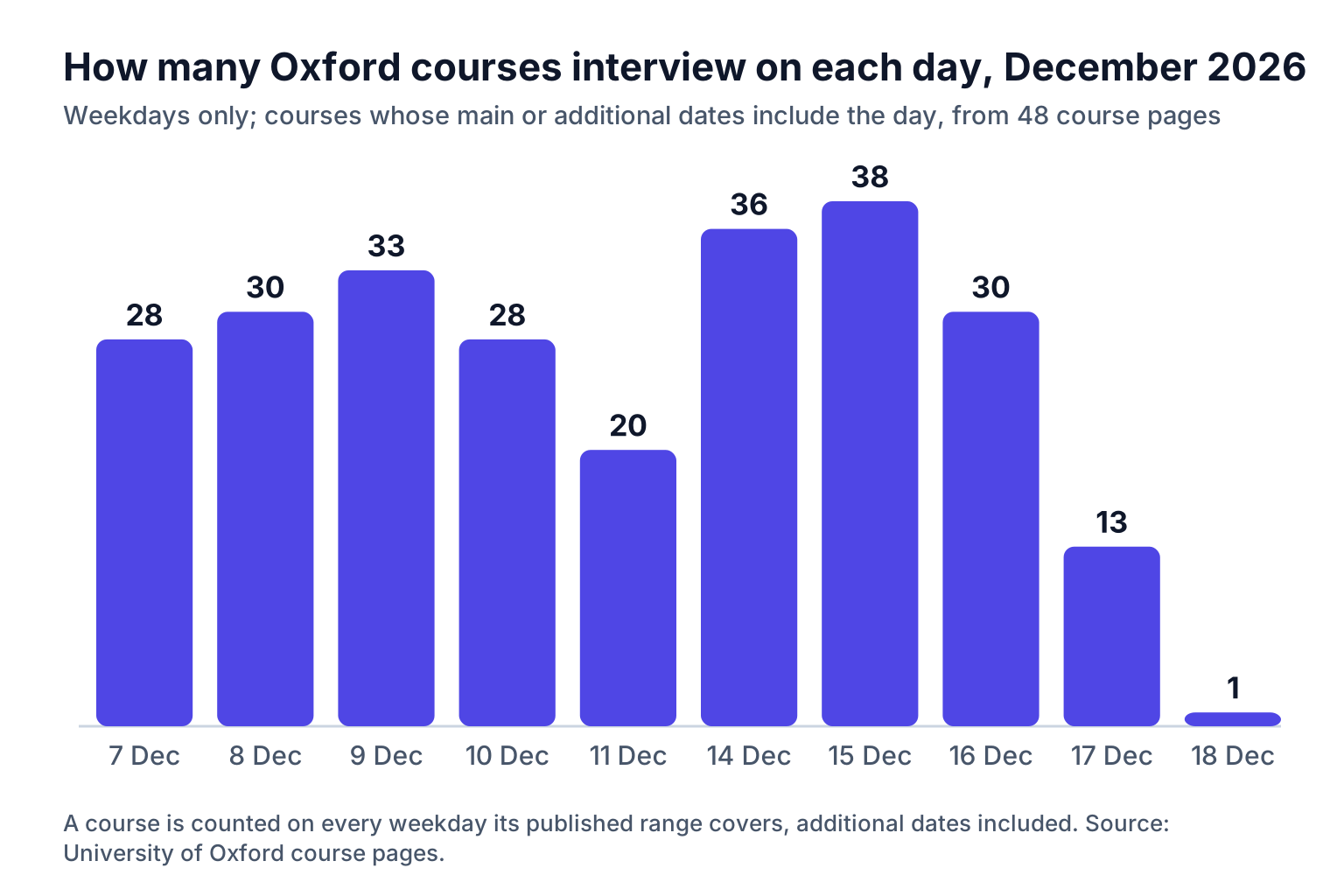
Oxford interviews every shortlisted applicant on 48 undergraduate courses from 7 to 18 December 2026, and all of them are held online. Thirty-two courses list additional dates after their main ones; if you are given one, your invitation says so. The four Foundation Year courses interview later, in March.
Most courses fit into a handful of windows, so the Oxford interview timetable is shorter than 48 rows: each row below is one set of dates with every course that uses it, in the order the first interviews start.
| Interview dates | Courses |
|---|---|
| 7-10 December 2026 | Biochemistry (Molecular and Cellular), Philosophy and Theology, Theology and Religion |
| 7-11 December 2026 | Biology |
| 7-10 December 2026; additional 15-16 December 2026 | Chemistry |
| 7-8 December 2026; additional 11-15 December 2026 | Classical Archaeology and Ancient History |
| 7-10 December 2026; additional 14-16 December 2026 | Classics, Classics and Modern Languages, English and Modern Languages, History and Modern Languages, Modern Languages, Modern Languages and Linguistics, Philosophy and Modern Languages |
| 7-10 December 2026; additional 10-16 December 2026 | Classics and Asian and Middle Eastern Studies, European and Middle Eastern Languages |
| 7-9 December 2026; additional 14-16 December 2026 | Classics and English, English Language and Literature |
| 7-9 December 2026; additional 11 December 2026 | Fine Art, Law (Jurisprudence) |
| 7-11 December 2026; additional 14-17 December 2026 | History, History (Ancient and Modern), History and Economics, History and English, History and Politics |
| 7-8 December 2026 | History of Art |
| 7-9 December 2026; additional 14 December 2026 | Music |
| 7-9 December 2026; additional 11-16 December 2026 | Philosophy, Politics and Economics (PPE) |
| 7-11 December 2026; additional 10-15 December 2026 | Religion and Asian and Middle Eastern Studies |
| 8-11 December 2026; additional 10-15 December 2026 | Asian and Middle Eastern Studies |
| 8-11 December 2026; additional 15 December 2026 | Human Sciences |
| 9-10 December 2026 | Biomedical Sciences |
| 9-11 December 2026; additional 15-16 December 2026 | Economics and Management |
| 9-16 December 2026 | Geography |
| 9-15 December 2026 | Physics, Physics and Philosophy |
| 10-16 December 2026 | Materials Science |
| 14-15 December 2026; additional 17 December 2026 | Archaeology and Anthropology |
| 14-17 December 2026; additional 16-17 December 2026 | Computer Science, Computer Science and Philosophy, Mathematics / Mathematics and Statistics, Mathematics and Computer Science, Mathematics and Philosophy |
| 14-16 December 2026 | Earth Sciences (Geology), Psychology (Experimental), Psychology, Philosophy and Linguistics |
| 14-17 December 2026 | Engineering Science |
| Mon 14 or Tue 15 December 2026; invitations usually mid-November to early December | Medicine |
| Thu 17 December 2026 (first college) and Fri 18 December 2026 (second college); invitations usually mid-November to early December | Medicine (graduate-entry / accelerated) |
The Medicine course page is the one that says when to expect the invitation: usually from mid-November to early December. The other course pages publish the dates only, so treat the Medicine timing as the best published guide and check your email, including the junk folder, from the middle of November.
2. Interview dates by course
Every Oxford course that interviews, with the dates, the number of interviews the course page describes and the length where Oxford states one. Every interview is online. Course names link to the course's page in our directory, which carries the entry requirements and the admissions test.
| Course | Interview dates 2026 | Interviews | Length |
|---|---|---|---|
| Archaeology and Anthropology | 14-15 December 2026; additional 17 December 2026 | at least 2 (college of preference + another college) | not stated |
| Asian and Middle Eastern Studies | 8-11 December 2026; additional 10-15 December 2026 | Faculty interview plus college interview(s) | not stated |
| Biochemistry (Molecular and Cellular) | 7-10 December 2026 | 2 (two different colleges) | not stated |
| Biology | 7-11 December 2026 | 2 (two different colleges) | not stated |
| Biomedical Sciences | 9-10 December 2026 | at least 1 | not stated |
| Chemistry | 7-10 December 2026; additional 15-16 December 2026 | at least 2 at the first-assigned college; possibly more at other colleges | not stated |
| Classical Archaeology and Ancient History | 7-8 December 2026; additional 11-15 December 2026 | at least 1 | not stated |
| Classics | 7-10 December 2026; additional 14-16 December 2026 | at least 1 | not stated |
| Classics and Asian and Middle Eastern Studies | 7-10 December 2026; additional 10-16 December 2026 | Faculty interview plus college interview(s) | not stated |
| Classics and English | 7-9 December 2026; additional 14-16 December 2026 | at least 1 | not stated |
| Classics and Modern Languages | 7-10 December 2026; additional 14-16 December 2026 | typically one per language/subject | approximately 30 minutes |
| Computer Science | 14-17 December 2026; additional 16-17 December 2026 | usually 2 at the first-choice college + at least 1 at another college | around 30 minutes each |
| Computer Science and Philosophy | 14-17 December 2026; additional 16-17 December 2026 | usually 2 at the first-choice college + at least 1 at another college | around 30 minutes each |
| Earth Sciences (Geology) | 14-16 December 2026 | 2 (one more quantitative, one more qualitative) | around 30 minutes each |
| Economics and Management | 9-11 December 2026; additional 15-16 December 2026 | at least 1 | not stated |
| Engineering Science | 14-17 December 2026 | 2 | about 30-45 minutes (first interview); about 30 minutes (second interview, at another college) |
| English and Modern Languages | 7-10 December 2026; additional 14-16 December 2026 | typically one per language/subject | approximately 30 minutes |
| English Language and Literature | 7-9 December 2026; additional 14-16 December 2026 | usually 2 | not stated |
| European and Middle Eastern Languages | 7-10 December 2026; additional 10-16 December 2026 | typically one per language/subject | approximately 30 minutes |
| Fine Art | 7-9 December 2026; additional 11 December 2026 | 1-2 (Ruskin panel; some candidates also a college panel) | not stated |
| Geography | 9-16 December 2026 | usually at one college only | not stated |
| History | 7-11 December 2026; additional 14-17 December 2026 | standard 1 (some colleges give two interviews of 15 minutes); possible second interview at a different college | 30 minutes (or two interviews of 15 minutes at some colleges) |
| History (Ancient and Modern) | 7-11 December 2026; additional 14-17 December 2026 | standard 1 (some colleges give two interviews of 15 minutes); possible second interview at a different college | 30 minutes (or two interviews of 15 minutes at some colleges) |
| History and Economics | 7-11 December 2026; additional 14-17 December 2026 | 2 (one for each side of the course) | 30 minutes (or two interviews of 15 minutes at some colleges) |
| History and English | 7-11 December 2026; additional 14-17 December 2026 | 2 (one for each side of the course) | 30 minutes (or two interviews of 15 minutes at some colleges) |
| History and Modern Languages | 7-10 December 2026; additional 14-16 December 2026 | History: 2 (one for each side of the course); Modern Languages: typically one per language/subject | History: 30 minutes (or two interviews of 15 minutes at some colleges); Modern Languages: approximately 30 minutes |
| History and Politics | 7-11 December 2026; additional 14-17 December 2026 | 2 (one for each side of the course) | 30 minutes (or two interviews of 15 minutes at some colleges) |
| History of Art | 7-8 December 2026 | 2 | not stated |
| Human Sciences | 8-11 December 2026; additional 15 December 2026 | at least 1 | not stated |
| Law (Jurisprudence) | 7-9 December 2026; additional 11 December 2026 | at least 2 at the first college | no more than 30 minutes |
| Materials Science | 10-16 December 2026 | 2 (college of choice + another college) | not stated |
| Mathematics / Mathematics and Statistics | 14-17 December 2026; additional 16-17 December 2026 | 1-2 at the first-choice college + at least 1 at another college | about 25 minutes each |
| Mathematics and Computer Science | 14-17 December 2026; additional 16-17 December 2026 | Mathematics: 1-2 at the first-choice college + at least 1 at another college; Computer Science: usually 2 at the first-choice college + at least 1 at another college | Mathematics: about 25 minutes each; Computer Science: around 30 minutes each |
| Mathematics and Philosophy | 14-17 December 2026; additional 16-17 December 2026 | 1-2 at the first-choice college + at least 1 at another college | about 25 minutes each |
| Medicine | Mon 14 or Tue 15 December 2026; invitations usually mid-November to early December | interviews at two colleges | not stated |
| Medicine (graduate-entry / accelerated) | Thu 17 December 2026 (first college) and Fri 18 December 2026 (second college); invitations usually mid-November to early December | interviews at two colleges | not stated |
| Modern Languages | 7-10 December 2026; additional 14-16 December 2026 | typically one per language/subject | approximately 30 minutes |
| Modern Languages and Linguistics | 7-10 December 2026; additional 14-16 December 2026 | typically one per language/subject | approximately 30 minutes |
| Music | 7-9 December 2026; additional 14 December 2026 | at least 2 (two different colleges); possible third, panel interview | not stated |
| Philosophy and Modern Languages | 7-10 December 2026; additional 14-16 December 2026 | typically one per language/subject | approximately 30 minutes |
| Philosophy and Theology | 7-10 December 2026 | Theology: at least 2 (Theology and Religion interviews in at least two colleges); Philosophy: plus a Philosophy interview in at least one college | about 25-30 minutes |
| Philosophy, Politics and Economics (PPE) | 7-9 December 2026; additional 11-16 December 2026 | at least 1 | not stated |
| Physics | 9-15 December 2026 | normally 2 at the first college (sometimes 1 long or 3 short); + 1 at a randomly assigned second college | not stated |
| Physics and Philosophy | 9-15 December 2026 | Physics: normally 2 at the first college (sometimes 1 long or 3 short); + 1 at a randomly assigned second college; Philosophy: + one or more Philosophy interviews | not stated |
| Psychology (Experimental) | 14-16 December 2026 | two colleges by default | not stated |
| Psychology, Philosophy and Linguistics | 14-16 December 2026 | two colleges by default | not stated |
| Religion and Asian and Middle Eastern Studies | 7-11 December 2026; additional 10-15 December 2026 | Theology: at least 2 (Theology and Religion interviews in at least two colleges); AMES: plus an interview at the AMES Faculty | about 25-30 minutes |
| Theology and Religion | 7-10 December 2026 | at least 2 (Theology and Religion interviews in at least two colleges) | about 25-30 minutes |
3. How many interviews, and how long
Oxford does not run one standard interview. Twenty-nine of the 48 courses describe two or more interviews, usually at two different colleges or one for each side of a joint course; the rest say at least one, one per language, or a faculty interview plus a college one.
Twenty-three course pages state a length, and almost all sit between 25 and 45 minutes; the History courses add that some colleges give two interviews of 15 minutes instead. The Length column above gives each course's wording. The other 25 course pages give no length, and tutors there tend to use the time the problem needs rather than a fixed slot.
Interviews are with Oxford academic tutors, typically two tutors per interview; the Medicine page adds that Fellows, Junior Research Fellows and graduate academics may sit on the panel. Our guide to what an Oxford interview is like sets out, course by course, what the tutors hand you and what they are assessing.
4. Before the interview: tests, written work and reading
Shortlisting happens before the dates above; where a course sets an admissions test, it is sat in October or November. The table lists every course whose page sets a task for the interview itself: written work to send, reading to do, or material to prepare.
| Course | Before or at the interview |
|---|---|
| Archaeology and Anthropology | written work (three pieces of writing); possibly a short passage to read before the interview |
| Asian and Middle Eastern Studies | written work (two pieces of writing) |
| Biochemistry (Molecular and Cellular) | short article to read beforehand (some interviews) |
| Classical Archaeology and Ancient History | written work (two pieces of writing) |
| Classics | written work (two pieces of writing) |
| Classics and Asian and Middle Eastern Studies | written work (two pieces of writing) |
| Classics and English | written work (two pieces of writing) |
| Classics and Modern Languages | written work (one piece of writing) |
| English and Modern Languages | written work (one piece of writing) |
| English Language and Literature | written work (one piece of writing) |
| Fine Art | portfolio (submitted online via SlideRoom); second submission of recent work after shortlisting |
| History | written work (one piece of writing) |
| History (Ancient and Modern) | written work (one piece of writing) |
| History and Economics | written work (one piece of writing) |
| History and English | written work (two pieces of writing) |
| History and Modern Languages | written work (one piece of writing) |
| History and Politics | written work (one piece of writing) |
| History of Art | written work (two pieces of writing) |
| Music | written work (three pieces of writing); performance video (up to five minutes) before interview |
| Philosophy and Theology | written work (one piece of writing) |
| Religion and Asian and Middle Eastern Studies | written work (one piece of writing) |
| Theology and Religion | written work (one piece of writing) |
Twenty-six courses set no task for the interview itself; what comes before it is the application, with any admissions test or written work the course asks for. The page on how many applicants Oxford interviews, course by course shows how many applicants each test lets through to interview.
5. The Foundation Year courses
Oxford's Foundation Year courses interview separately from the main December round. All four list March:
| Course | Interview dates | Places |
|---|---|---|
| Foundation Year (Chemistry, Engineering and Materials Science) | March | 12 |
| Foundation Year (PPE) | March | 8 |
| Foundation Year (Law) | March | 8 |
| Foundation Year (Humanities) | March | 18 |
6. How this page was built
Interview dates, the number and length of interviews and the mode come from each course's page in the University of Oxford's undergraduate course listing. Each page was read on 18 October 2026 and the figures were exported on 21 October 2026; nothing on this page is estimated, and where a university does not publish a figure the page says so. Universities change interview arrangements between cycles, so treat the course page you are applying to as the final word and this page as the way to compare courses side by side.
7. What to do next
Find your course in the table and put both its main dates and any additional dates in your diary now, then keep the whole of 7 to 18 December 2026 free: Oxford tells you which days are yours in the invitation, not before. Read what an Oxford interview is like for the number of interviews and what happens in them, and how many applicants Oxford interviews, course by course if you want to know how likely an invitation is for your course. Then start practising out loud with someone who will push back: the step-by-step guide to how to prepare for an Oxford interview covers what to practise, and the mistakes Oxbridge interviewers see most what to avoid.
FAQ
When are Oxford interviews in 2026?
From 7 to 18 December 2026 for the main round, with each course using a few days inside that window; the Foundation Year courses interview in March. The table on this page gives the exact dates for every course.
Are Oxford interviews online in 2026?
Yes. Every Oxford course page lists the interview as online, and that applies to all 48 courses in the December round.
When do Oxford interview invitations arrive?
Oxford's Medicine page says invitations usually arrive mid-November to early December. Other course pages publish the interview dates only, so check your email from mid-November.
How many interviews does Oxford give?
It depends on the course: most describe two or more, often at two different colleges or one for each half of a joint course, some say at least one, and the languages courses give one per language.
How long is an Oxford interview?
Where a course page states a length it is usually between 25 and 45 minutes, for example about 25 minutes for Mathematics and around 30 minutes for Computer Science; some History colleges give two interviews of 15 minutes. Most pages give no fixed length.
References
- University of Oxford: undergraduate course listing - https://www.ox.ac.uk/admissions/undergraduate/courses/course-listing