Oxford Interview Format: How Many, How Long, What Happens
By Michael Thompson · Education Specialist; 10 years teaching the IB at Bromsgrove School · Published 26 October 2026 · Updated 28 October 2026
Oxford interviews are online, usually with two tutors, and most courses give two of them, each between 25 and 45 minutes where a length is published. This page sets out the format for every Oxford undergraduate course from the University's own course pages: how many interviews, how long, who interviews you, what you are given to work on, what the tutors are assessing, and the tests and written work that come first.
Key Takeaways
- Online, two tutors: every course in the December round; 29 of 48 describe two or more interviews.
- 25 to 45 minutes: where Oxford states a length (23 courses), or two 15-minute interviews at some History colleges; most pages do not.
- A task, not a quiz: problems, unseen texts, data or a discussion of your written work, depending on the course.
In This Article
- What an Oxford interview is
- The Oxford interview format by course: how many interviews
- How long an Oxford interview is
- What happens in the interview
- What the tutors assess
- Before the interview: tests, written work and reading
- How this page was built
- What to do next
1. What an Oxford interview is
An Oxford interview is a conversation with academic tutors about your subject, usually two tutors at a time, usually two interviews, and always online for the 48 courses in the December round. It is not a test of what you already know: the course pages describe what tutors hand you, from a mathematical problem to an unseen poem, and what they are looking for is how you think when you meet something new. The page on Oxford interview dates gives the dates for every course; this page is about the interview process itself, once you are in the room.
2. The Oxford interview format by course: how many interviews
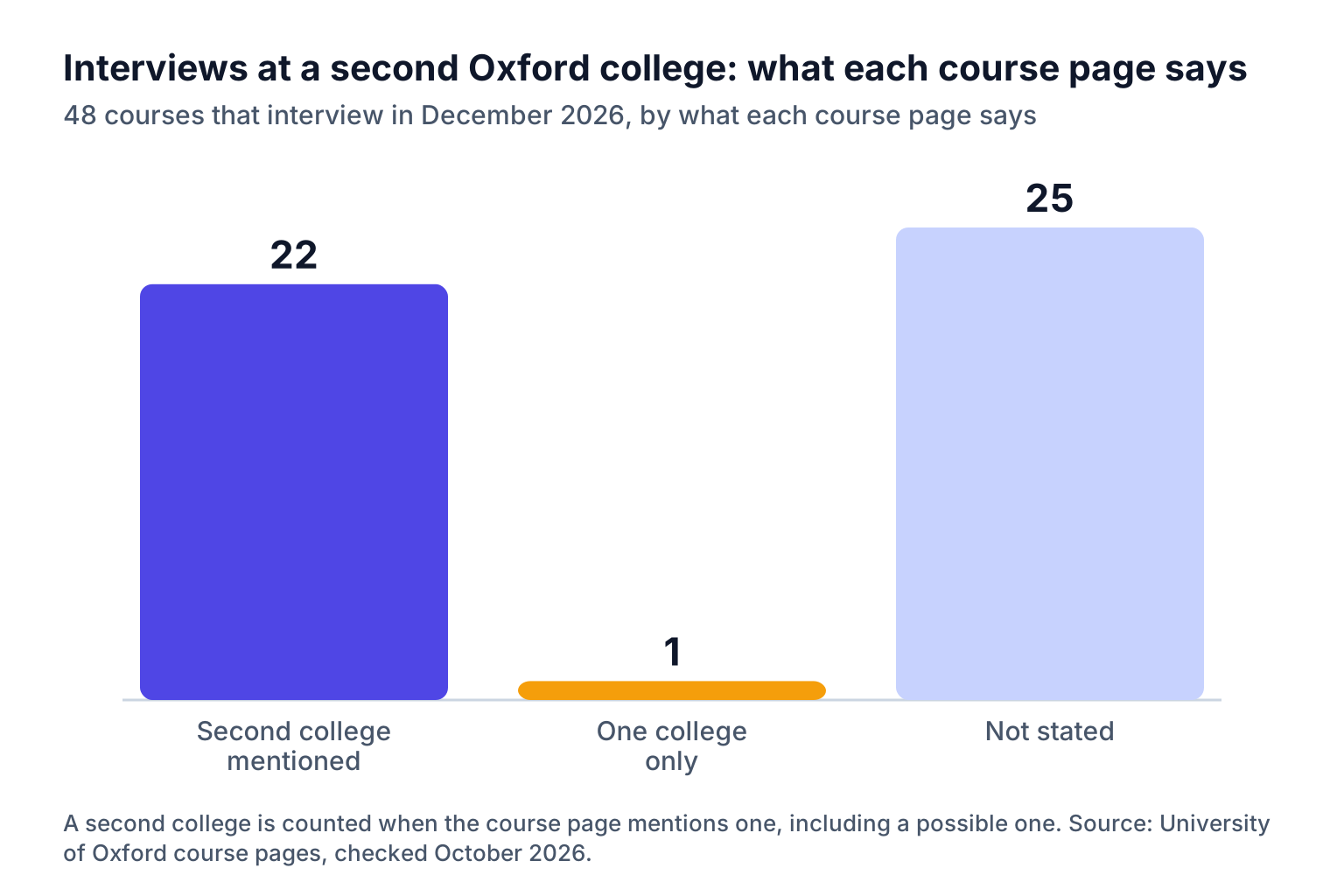
The Oxford interview format varies by course more than by college. Twenty-nine of the 48 courses describe two or more interviews, typically at two different colleges so that two sets of tutors see you, or one for each side of a joint course. The others say at least one, one per language, or a faculty interview plus a college one. On 18 courses the page says simply "Oxford academic tutors; typically two tutors per interview"; the rest name the tutors for each half of a joint course, or the department. The table gives each course's wording.
| Course | Interviews | Interviewers |
|---|---|---|
| Archaeology and Anthropology | at least 2 (college of preference + another college) | Oxford academic tutors; typically two tutors per interview |
| Asian and Middle Eastern Studies | Faculty interview plus college interview(s) | tutors of the Faculty of Asian and Middle Eastern Studies and of the college |
| Biochemistry (Molecular and Cellular) | 2 (two different colleges) | Oxford academic tutors; typically two tutors per interview |
| Biology | 2 (two different colleges) | Oxford academic tutors; typically two tutors per interview |
| Biomedical Sciences | at least 1 | Oxford academic tutors; typically two tutors per interview |
| Chemistry | at least 2 at the first-assigned college; possibly more at other colleges | Oxford academic tutors; typically two tutors per interview |
| Classical Archaeology and Ancient History | at least 1 | Oxford academic tutors; typically two tutors per interview |
| Classics | at least 1 | Oxford academic tutors; typically two tutors per interview |
| Classics and Asian and Middle Eastern Studies | Faculty interview plus college interview(s) | tutors of the Faculty of Asian and Middle Eastern Studies and of the college; tutors from each subject (joint course) |
| Classics and English | at least 1 | tutors from both Classics and English |
| Classics and Modern Languages | typically one per language/subject | Oxford academic tutors; typically two tutors per interview; tutors from each subject (joint course) |
| Computer Science | usually 2 at the first-choice college + at least 1 at another college | usually two interviewers |
| Computer Science and Philosophy | usually 2 at the first-choice college + at least 1 at another college | usually two interviewers; tutors from each subject (joint course) |
| Earth Sciences (Geology) | 2 (one more quantitative, one more qualitative) | two members of academic staff per interview |
| Economics and Management | at least 1 | Oxford academic tutors; typically two tutors per interview |
| Engineering Science | 2 | Oxford academic tutors; typically two tutors per interview |
| English and Modern Languages | typically one per language/subject | tutors from both English and Modern Languages |
| English Language and Literature | usually 2 | at least two English tutors |
| European and Middle Eastern Languages | typically one per language/subject | Oxford academic tutors; typically two tutors per interview; tutors from each subject (joint course) |
| Fine Art | 1-2 (Ruskin panel; some candidates also a college panel) | Ruskin School of Art tutors and college tutors |
| Geography | usually at one college only | Oxford academic tutors; typically two tutors per interview |
| History | standard 1 (some colleges give two interviews of 15 minutes); possible second interview at a different college | two tutors |
| History (Ancient and Modern) | standard 1 (some colleges give two interviews of 15 minutes); possible second interview at a different college | two tutors; tutors from each subject (joint course) |
| History and Economics | 2 (one for each side of the course) | two tutors; tutors from each subject (joint course) |
| History and English | 2 (one for each side of the course) | two tutors; tutors from each subject (joint course) |
| History and Modern Languages | History: 2 (one for each side of the course); Modern Languages: typically one per language/subject | two tutors; tutors from each subject (joint course) |
| History and Politics | 2 (one for each side of the course) | two tutors; tutors from each subject (joint course) |
| History of Art | 2 | college tutors and members of the Department |
| Human Sciences | at least 1 | Oxford academic tutors; typically two tutors per interview |
| Law (Jurisprudence) | at least 2 at the first college | Oxford academic tutors; typically two tutors per interview |
| Materials Science | 2 (college of choice + another college) | Oxford academic tutors; typically two tutors per interview |
| Mathematics / Mathematics and Statistics | 1-2 at the first-choice college + at least 1 at another college | Oxford academic tutors; typically two tutors per interview |
| Mathematics and Computer Science | Mathematics: 1-2 at the first-choice college + at least 1 at another college; Computer Science: usually 2 at the first-choice college + at least 1 at another college | usually two interviewers; tutors from each subject (joint course) |
| Mathematics and Philosophy | 1-2 at the first-choice college + at least 1 at another college | Oxford academic tutors; typically two tutors per interview; tutors from each subject (joint course) |
| Medicine | interviews at two colleges | Oxford academic tutors (may include Fellows, Junior Research Fellows, graduate academics), typically two per interview |
| Medicine (graduate-entry / accelerated) | interviews at two colleges | Oxford academic tutors (may include Fellows, Junior Research Fellows, graduate academics), typically two per interview |
| Modern Languages | typically one per language/subject | Oxford academic tutors; typically two tutors per interview |
| Modern Languages and Linguistics | typically one per language/subject | Oxford academic tutors; typically two tutors per interview; tutors from each subject (joint course) |
| Music | at least 2 (two different colleges); possible third, panel interview | Oxford academic tutors; typically two tutors per interview |
| Philosophy and Modern Languages | typically one per language/subject | Oxford academic tutors; typically two tutors per interview; tutors from each subject (joint course) |
| Philosophy and Theology | Theology: at least 2 (Theology and Religion interviews in at least two colleges); Philosophy: plus a Philosophy interview in at least one college | typically two academics; tutors from each subject (joint course) |
| Philosophy, Politics and Economics (PPE) | at least 1 | Oxford academic tutors; typically two tutors per interview; tutors from each subject (joint course) |
| Physics | normally 2 at the first college (sometimes 1 long or 3 short); + 1 at a randomly assigned second college | Oxford academic tutors; typically two tutors per interview |
| Physics and Philosophy | Physics: normally 2 at the first college (sometimes 1 long or 3 short); + 1 at a randomly assigned second college; Philosophy: + one or more Philosophy interviews | Oxford academic tutors; typically two tutors per interview; tutors from each subject (joint course) |
| Psychology (Experimental) | two colleges by default | Oxford academic tutors; typically two tutors per interview |
| Psychology, Philosophy and Linguistics | two colleges by default | Oxford academic tutors; typically two tutors per interview; tutors from each subject (joint course) |
| Religion and Asian and Middle Eastern Studies | Theology: at least 2 (Theology and Religion interviews in at least two colleges); AMES: plus an interview at the AMES Faculty | Theology: typically two academics; AMES: tutors of the Faculty of Asian and Middle Eastern Studies and of the college; tutors from each subject (joint course) |
| Theology and Religion | at least 2 (Theology and Religion interviews in at least two colleges) | typically two academics |
3. How long an Oxford interview is
Oxford publishes a length for 23 of its 48 courses, and almost all sit between 25 and 45 minutes; the History courses add that some colleges give two interviews of 15 minutes instead.
| Length | Courses |
|---|---|
| approximately 30 minutes | Classics and Modern Languages, English and Modern Languages, European and Middle Eastern Languages, Modern Languages, Modern Languages and Linguistics, Philosophy and Modern Languages |
| 30 minutes (or two interviews of 15 minutes at some colleges) | History, History (Ancient and Modern), History and Economics, History and English, History and Politics |
| around 30 minutes each | Computer Science, Computer Science and Philosophy, Earth Sciences (Geology) |
| about 25-30 minutes | Philosophy and Theology, Religion and Asian and Middle Eastern Studies, Theology and Religion |
| about 25 minutes each | Mathematics / Mathematics and Statistics, Mathematics and Philosophy |
| about 30-45 minutes (first interview); about 30 minutes (second interview, at another college) | Engineering Science |
| History: 30 minutes (or two interviews of 15 minutes at some colleges); Modern Languages: approximately 30 minutes | History and Modern Languages |
| no more than 30 minutes | Law (Jurisprudence) |
| Mathematics: about 25 minutes each; Computer Science: around 30 minutes each | Mathematics and Computer Science |
The other 25 course pages give no length. In practice an interview ends when the tutors have seen enough of your thinking, which is why a short one is not a bad sign.
4. What happens in the interview
Thirty-four course pages describe what you are handed or asked to do:
| Course | At the interview |
|---|---|
| Archaeology and Anthropology | questions on any pre-read passage; no written test at interview |
| Biochemistry (Molecular and Cellular) | working through problems on paper or an interactive whiteboard |
| Biology | questions on the UCAS form; likely discussion of a data figure |
| Classics | Latin/Greek sentences to translate (if studied); otherwise a language-aptitude exercise |
| Classics and Asian and Middle Eastern Studies | Latin/Greek sentences to translate (if studied); otherwise a language-aptitude exercise |
| Classics and English | Latin/Greek sentences to translate (if studied); otherwise a language-aptitude exercise |
| Classics and Modern Languages | discussion of a text, a grammar exercise and personal-statement discussion; part may be conducted in the foreign language; Latin/Greek sentences to translate (if studied); otherwise a language-aptitude exercise; short text to read during the interview; grammar exercise and brief conversation in the target language |
| Computer Science | solving a Computer Science problem, thinking aloud |
| Computer Science and Philosophy | solving a Computer Science problem, thinking aloud |
| Earth Sciences (Geology) | commenting on pictures of geological specimens; mathematical derivations or calculations |
| Engineering Science | maths and physics questions on school topics; explaining the physics of a scenario |
| English and Modern Languages | discussion of a text, a grammar exercise and personal-statement discussion; part may be conducted in the foreign language; short text to read during the interview; grammar exercise and brief conversation in the target language |
| English Language and Literature | discussion of a previously unseen piece of literature |
| European and Middle Eastern Languages | discussion of a text, a grammar exercise and personal-statement discussion; part may be conducted in the foreign language; short text to read during the interview; grammar exercise and brief conversation in the target language |
| Fine Art | discussion of the pre-interview submission |
| History | short passage of historical writing to read just before the interview (some colleges); short passage to read and talk about; discussion of submitted written work and personal statement |
| History (Ancient and Modern) | short passage of historical writing to read just before the interview (some colleges); short passage to read and talk about; discussion of submitted written work and personal statement |
| History and Economics | short passage of historical writing to read just before the interview (some colleges); short passage to read and talk about; discussion of submitted written work and personal statement |
| History and English | short passage of historical writing to read just before the interview (some colleges) |
| History and Modern Languages | History: short passage of historical writing to read just before the interview (some colleges); Modern Languages: discussion of a text, a grammar exercise and personal-statement discussion; Modern Languages: part may be conducted in the foreign language; short text to read during the interview; grammar exercise and brief conversation in the target language; discussion of submitted written work and personal statement |
| History and Politics | short passage of historical writing to read just before the interview (some colleges); short passage to read and talk about; discussion of submitted written work and personal statement |
| History of Art | one interview on submitted work and personal statement; discussing photographs of works of art, buildings or artefacts |
| Law (Jurisprudence) | legally related questions and logical puzzles; possibly a legal extract to discuss |
| Mathematics / Mathematics and Statistics | mathematical problems and definitions worked through aloud |
| Mathematics and Computer Science | Mathematics: mathematical problems and definitions worked through aloud; Computer Science: solving a Computer Science problem, thinking aloud |
| Mathematics and Philosophy | mathematical problems and definitions worked through aloud |
| Modern Languages | discussion of a text, a grammar exercise and personal-statement discussion; part may be conducted in the foreign language; short text to read during the interview; grammar exercise and brief conversation in the target language |
| Modern Languages and Linguistics | discussion of a text, a grammar exercise and personal-statement discussion; part may be conducted in the foreign language; short text to read during the interview; grammar exercise and brief conversation in the target language |
| Philosophy and Modern Languages | discussion of a text, a grammar exercise and personal-statement discussion; part may be conducted in the foreign language; short text to read during the interview; grammar exercise and brief conversation in the target language |
| Philosophy and Theology | stimulus material (a text, object, image or issue) to discuss |
| Physics | mainly maths and physics questions |
| Physics and Philosophy | mainly maths and physics questions |
| Religion and Asian and Middle Eastern Studies | stimulus material (a text, object, image or issue) to discuss |
| Theology and Religion | stimulus material (a text, object, image or issue) to discuss |
5. What the tutors assess
Each course page names what its tutors are looking for. The common thread is how you think about new material in your subject, not what you already know.
| Course | What tutors assess |
|---|---|
| Archaeology and Anthropology | an ability to think independently; potential and motivation for studying archaeology and anthropology; enthusiasm and interest in the combined disciplines |
| Asian and Middle Eastern Studies | intellectual potential |
| Biochemistry (Molecular and Cellular) | an informed interest in the subject (originating from podcasts, videos, books, magazine articles etc) |
| Biology | interest in biology and response to an unfamiliar biological problem |
| Biomedical Sciences | lively, receptive minds with the ability to evaluate evidence critically |
| Chemistry | evidence of academic excellence and motivation, as well as the potential for advanced study, a capacity to analyse, explain and apply current knowledge |
| Classical Archaeology and Ancient History | intellectual potential, the specific visual, textual and reasoning abilities required for this course |
| Classics | analytical and reasoning ability, communication, aptitude for tutorial teaching |
| Classics and Asian and Middle Eastern Studies | Classics: analytical and reasoning ability, communication, aptitude for tutorial teaching; AMES: intellectual potential |
| Classics and English | analytical and reasoning ability, communication, aptitude for tutorial teaching |
| Classics and Modern Languages | Classics: analytical and reasoning ability, communication, aptitude for tutorial teaching; Modern Languages: potential in language and literature, suitability for tutorial teaching |
| Computer Science | "At interview, we explore how you tackle unfamiliar problems and respond to new ideas" |
| Computer Science and Philosophy | independent thinking, following and constructing arguments, thinking on novel topics |
| Earth Sciences (Geology) | approach to scientific problems and flexibility in working through them |
| Economics and Management | an interest in and a motivation for studying the organisation of businesses and the economy; a capacity to construct and critically assess arguments |
| Engineering Science | understanding, developing and explaining new ideas (not a test of knowledge) |
| English and Modern Languages | potential in language and literature, suitability for tutorial teaching |
| English Language and Literature | independent reading, exchanging and building on ideas, clarity, analytical ability, flexibility of thought |
| European and Middle Eastern Languages | at interview, tutors will want to find out as much as possible about your intellectual interests and academic potential |
| Fine Art | work that goes beyond the mere fulfilment of school curricula |
| Geography | an applicant's ability to deploy their knowledge in ways that show initiative and an awareness of the world around them |
| History | motivation, enthusiasm and academic potential in history |
| History (Ancient and Modern) | motivation, enthusiasm and academic potential in history |
| History and Economics | motivation, enthusiasm and academic potential in history |
| History and English | motivation, enthusiasm and academic potential in history |
| History and Modern Languages | History: motivation, enthusiasm and academic potential in history; Modern Languages: potential in language and literature, suitability for tutorial teaching |
| History and Politics | motivation, enthusiasm and academic potential in history |
| History of Art | potential for university study and aptitude for small-group tutorial teaching |
| Human Sciences | keenness; an ability to understand things in context and make connections; readiness to modify ideas in the light of evidence |
| Law (Jurisprudence) | reasoning and analytical ability |
| Materials Science | an ability to apply logical reasoning to problems in physical science, and an enthusiasm for thinking about new concepts in science and engineering |
| Mathematics / Mathematics and Statistics | how you think when doing mathematics |
| Mathematics and Computer Science | "At the interview we will explore how you tackle unfamiliar problems and new ideas" |
| Mathematics and Philosophy | Mathematics: how you think when doing mathematics; Philosophy: independent thinking, following and constructing arguments, thinking on novel topics |
| Medicine | understanding of the science underpinning medicine and skills in scientific enquiry; scientific ability and aptitude for Medicine, a realistic understanding of a medical career, potential to become an effective and caring doctor |
| Medicine (graduate-entry / accelerated) | scientific ability and aptitude for Medicine, a realistic understanding of a medical career, potential to become an effective and caring doctor |
| Modern Languages | potential in language and literature, suitability for tutorial teaching |
| Modern Languages and Linguistics | potential in language and literature, suitability for tutorial teaching |
| Music | potential to engage with the course, an ability to think critically about music, and a keen interest in learning more about this subject |
| Philosophy and Modern Languages | interest in the proposed fields of study, relevant linguistic ability |
| Philosophy and Theology | interest in the proposed fields of study, a critical and analytical approach to abstract questions and the ability to defend a viewpoint by reasoned argument |
| Philosophy, Politics and Economics (PPE) | independent thinking, following and constructing arguments, thinking on novel topics |
| Physics | enthusiastic and highly-motivated students with the ability to apply basic principles to unfamiliar situations |
| Physics and Philosophy | independent thinking, following and constructing arguments, thinking on novel topics |
| Psychology (Experimental) | whether you appreciate the scope of scientific psychology |
| Psychology, Philosophy and Linguistics | independent thinking, following and constructing arguments, thinking on novel topics |
| Religion and Asian and Middle Eastern Studies | intellectual potential |
| Theology and Religion | your ability to think clearly, including understanding complex concepts, forming sound arguments and listening and responding to counterarguments |
6. Before the interview: tests, written work and reading
Courses that set an admissions test use it in shortlisting, and some set a task for the interview itself.
| Course | Admissions test and other steps | Written work or preparation |
|---|---|---|
| Archaeology and Anthropology | - | written work (three pieces of writing); possibly a short passage to read before the interview |
| Asian and Middle Eastern Studies | - | written work (two pieces of writing) |
| Biochemistry (Molecular and Cellular) | - | short article to read beforehand (some interviews) |
| Biomedical Sciences | ESAT admissions test | - |
| Classical Archaeology and Ancient History | - | written work (two pieces of writing) |
| Classics | - | written work (two pieces of writing) |
| Classics and Asian and Middle Eastern Studies | - | written work (two pieces of writing) |
| Classics and English | - | written work (two pieces of writing) |
| Classics and Modern Languages | - | written work (one piece of writing) |
| Computer Science | TMUA admissions test | - |
| Computer Science and Philosophy | TMUA admissions test | - |
| Economics and Management | TARA admissions test | - |
| Engineering Science | ESAT admissions test | - |
| English and Modern Languages | - | written work (one piece of writing) |
| English Language and Literature | - | written work (one piece of writing) |
| Fine Art | - | portfolio (submitted online via SlideRoom); second submission of recent work after shortlisting |
| History | - | written work (one piece of writing) |
| History (Ancient and Modern) | - | written work (one piece of writing) |
| History and Economics | TARA admissions test | written work (one piece of writing) |
| History and English | - | written work (two pieces of writing) |
| History and Modern Languages | - | written work (one piece of writing) |
| History and Politics | TARA admissions test | written work (one piece of writing) |
| History of Art | - | written work (two pieces of writing) |
| Human Sciences | TARA admissions test | - |
| Law (Jurisprudence) | LNAT admissions test | - |
| Mathematics / Mathematics and Statistics | TMUA admissions test | - |
| Mathematics and Computer Science | TMUA admissions test | - |
| Mathematics and Philosophy | TMUA admissions test | - |
| Medicine | UCAT required of all applicants (used in shortlisting); personal statement one component of interview selection, may be used at interview; no written work; offers subject to immunisation, GMC fitness-to-practise and DBS requirements | - |
| Medicine (graduate-entry / accelerated) | 2.1+ in an applied/experimental science degree; UCAT required; UCAS form plus Oxford supplementary application form with two extra references; personal statement one component of interview selection; offers subject to immunisation, GMC fitness-to-practise and DBS requirements | - |
| Music | - | written work (three pieces of writing); performance video (up to five minutes) before interview |
| Philosophy and Theology | - | written work (one piece of writing) |
| Philosophy, Politics and Economics (PPE) | TARA admissions test | - |
| Physics | ESAT admissions test | - |
| Physics and Philosophy | ESAT admissions test | - |
| Psychology (Experimental) | TARA admissions test | - |
| Psychology, Philosophy and Linguistics | TARA admissions test | - |
| Religion and Asian and Middle Eastern Studies | - | written work (one piece of writing) |
| Theology and Religion | - | written work (one piece of writing) |
7. How this page was built
The number and length of interviews, the interviewers, the tasks and the assessment criteria come from each course's page in the University of Oxford's undergraduate course listing. Each page was read on 18 October 2026 and the figures were exported on 21 October 2026; nothing on this page is estimated, and where a university does not publish a figure the page says so. Universities change interview arrangements between cycles, so treat the course page you are applying to as the final word and this page as the way to compare courses side by side.
8. What to do next
Read your course's rows in the tables above and prepare for that format, not for a generic interview: if the page says a problem worked through aloud, practise talking while you think; if it says an unseen text, practise reading one and saying what you notice in the first two minutes. The page on how many applicants Oxford interviews, course by course tells you how many applicants reach this stage. For what to practise and how, see how to prepare for an Oxford interview and the mistakes Oxbridge interviewers see most.
FAQ
How long is an Oxford interview?
Where Oxford states a length it is usually 25 to 45 minutes, for example about 25 minutes for Mathematics, around 30 minutes for Computer Science and 30 to 45 minutes for Engineering Science; some History colleges give two interviews of 15 minutes. The other 25 course pages give no fixed length.
How many interviews do you get at Oxford?
Most courses give two or more, often at two different colleges; some say at least one; the languages courses give one per language. The table on this page lists each course.
Are Oxford interviews online?
Yes, every course in the December 2026 round interviews online.
Who interviews you at Oxford?
Oxford academic tutors; typically two tutors per interview. The Medicine page adds that Fellows, Junior Research Fellows and graduate academics may take part.
What do Oxford tutors assess?
Each course page names its criteria; the common thread is how you think about new material in your subject rather than what you already know. The assessment table on this page gives the wording for each course.
References
- University of Oxford: undergraduate course listing - https://www.ox.ac.uk/admissions/undergraduate/courses/course-listing