UCAS Application Timeline: Every Key Date Explained
By Michael Thompson · Education Specialist; 10 years teaching the IB at Bromsgrove School · Published 21 May 2026 · Updated 4 October 2026
The UCAS application timeline has more moving parts than most students expect, and missing a single internal school deadline can push your application past the point of equal consideration. For 2026 entry, the cycle opens in May 2025 and runs all the way to September 2026 - with several hard cutoffs in between that carry different consequences depending on the course you are applying for. This guide maps every stage in order: when to start drafting, when your school needs your materials, the official UCAS deadlines, and what happens after offers land. Whether you are sitting A-Levels, the IB Diploma Programme, or applying after results day through Clearing, the dates below are the ones that matter.
Key Takeaways
- Two equal-consideration deadlines, not one: 15 October 2025 covers Oxford, Cambridge, medicine, dentistry, and veterinary science; 14 January 2026 covers most other undergraduate courses.
- Your school's internal deadline comes first: Schools typically need your personal statement and course choices several weeks before the UCAS cutoff, so the UCAS date is not your real deadline.
- IB predicted grades arrive later than A-Level mocks: IB Diploma Programme predicted grades are often not confirmed until November or even January, which can affect Oxbridge and medicine applications submitted in October.
- You can apply to up to five courses: Once you hold offers, you designate one as your firm choice and one as your insurance choice - the ordering matters as much as the choices themselves.
- Clearing opens 2 July 2026: Any applicant without a place after the 30 June cut-off enters Clearing automatically, where remaining course spaces are filled before 19 October 2026.
- Applications after the January deadline can still succeed: The late June deadline allows applications to be sent to universities, but these receive no guarantee of equal consideration and compete for fewer remaining places.
In This Article
- How the UCAS Application Process Works
- The Full UCAS Application Timeline for 2026 Entry
- When to Start: Building Your Internal Preparation Timeline
- The October 15 Deadline: Oxford, Cambridge, Medicine, and Vet Science
- The January Equal-Consideration Deadline for Most Undergraduate Courses
- IB Diploma Programme Applicants: How the Timeline Differs
- The 5-Choice Rule: Firm and Insurance Offers Explained
- Applying After the UCAS Deadline: Late Applications and Clearing
- The UCAS Offer Timeline: What Happens After You Submit
- What to Do Next
1. How the UCAS Application Process Works
The ucas application timeline starts earlier than most students expect, and understanding the structure of the application itself is the logical first step. Every UK undergraduate application goes through UCAS online - no paper applications are accepted. You can register with UCAS in the summer before you intend to apply, and the earliest you can submit a completed application is September of the year before your course starts.
The application is divided into seven sections:
- Personal details
- Additional information (UK applicants only)
- Student finance arrangements (UK applicants only)
- Course choices (up to five)
- Education history
- Employment history
- Personal statement and reference
One section that changed significantly for 2025-26 is the personal statement. Instead of one continuous text, UCAS now asks three separate questions: why you want to study the subject, how your qualifications have prepared you, and what you have done outside education to prepare. Each section carries a minimum of 350 characters, so a brief answer to any one question will not pass validation.
The application fee for 2027 entry is £34.50 for up to five choices, paid by card before submission. One non-obvious gotcha: entering invalid payment details five times locks your account and requires a phone call to UCAS to unlock it. Applicants who received free school meals at any point in the last six years of secondary education qualify for a fee waiver.
If you are applying through a school or college, you need a buzzword to register. Independent applicants do not.
2. The Full UCAS Application Timeline for 2026 Entry
The ucas application timeline for 2026 entry spans roughly 17 months from the moment courses appear in search to the final Clearing deadline. Every date below is drawn from the UCAS key dates page.
| Date | Event | What it means in practice |
|---|---|---|
| 13 May 2025 | Applications open | You can start building your application in UCAS Hub |
| 2 Sep 2025 | Earliest submission date | Your reference must be complete before UCAS accepts the form |
| 15 Oct 2025, 18:00 | Oxford, Cambridge, medicine, dentistry, vet science deadline | Miss this by one minute and your application is treated as late |
| 14 Jan 2026, 18:00 | Equal-consideration deadline for most other courses | The main deadline for the majority of applicants |
| 26 Feb 2026 | Extra opens | Available if you used all five choices and hold no offers |
| 30 Jun 2026, 18:00 | Last date applications are sent to universities | After this, any remaining application enters Clearing automatically |
| 2 Jul 2026 | Clearing opens | Unfilled places go live; you can call universities directly |
| 24 Sep 2026, 18:00 | Final deadline for all 2026 entry applications | No applications accepted after this point |
The two equal-consideration deadlines exist because Oxford, Cambridge, and most medical schools run lengthy shortlisting and interview processes that require extra lead time. Grouping competitive applicants under a single earlier cut-off lets those universities assess everyone before making offers, rather than on a rolling first-come basis. The January deadline serves the same guarantee for all other courses: any application received by 14 January 2026 is considered alongside every other, not just those that arrived first.
One non-obvious detail: the 2 September submission date requires a completed referee section, so if your school uploads references in a single batch, your personal statement deadline is set by your school's internal schedule, not by UCAS.
Planning for 2027 entry? The Oxford, Cambridge, and medicine deadline shifts to 15 October 2026, and the equal-consideration date for most courses is 13 January 2027.
3. When to Start: Building Your Internal Preparation Timeline
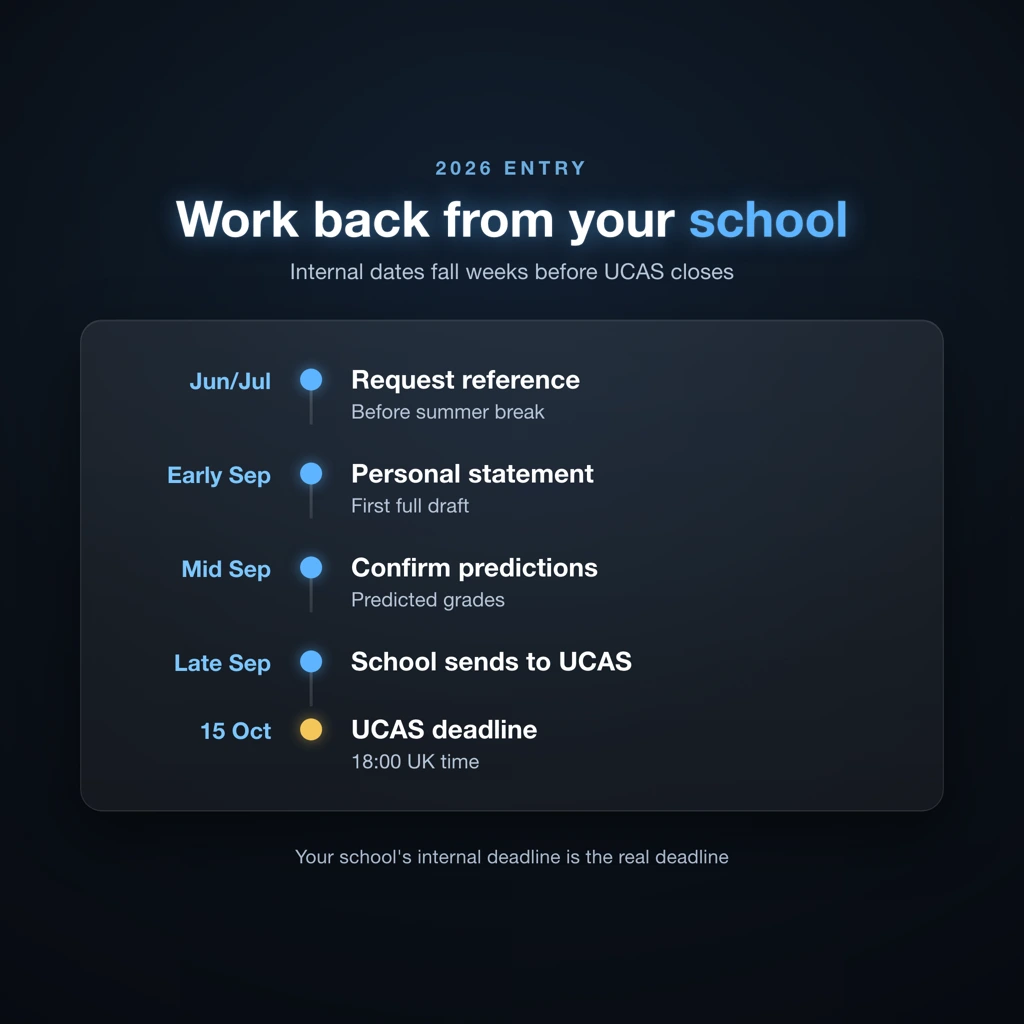
Your school's internal deadline is the real deadline. Most schools and colleges require your personal statement draft, course choices, and supporting materials several weeks before the UCAS cutoff, so that tutors have time to write your reference and the application can be checked. If you miss your school's date, you may miss the UCAS date entirely, regardless of when UCAS itself closes.
Work backwards from your school, not from UCAS. A typical school calendar looks like this:
- Before summer break (June/July): Ask your teachers for a reference in writing. Tutors writing references need time to do them well, and a request dropped on them in September is a request that gets a rushed response.
- Early September: First full draft of your personal statement should be complete. For Oxford, Cambridge, medicine, dentistry, or veterinary science, aim for a near-final draft by this point, not a rough one, because UCAS must receive the completed application before 18:00 UK time on 15 October and your school needs several weeks before that.
- September (mid): Confirm your predicted grades with your school. Competitive courses are assessed partly on predicted grades, and an incorrect or missing prediction can undermine an otherwise strong application.
- Late September: School submits your completed application to UCAS.
One non-obvious gotcha: UCAS notes that school tutors may return applications to students for corrections before forwarding to UCAS. That correction loop can cost several days. Factor it in, especially if your personal statement needs structural reworking.
For January-deadline applicants the same logic applies, just shifted roughly three months later. Build your own backwards calendar the week you return to school in September.
4. The October 15 Deadline: Oxford, Cambridge, Medicine, and Vet Science
If you are applying to Oxford, Cambridge, or most medicine, dentistry, or veterinary medicine/science courses, you are working to an earlier deadline than the rest of the UCAS application timeline. Per UCAS, UCAS must receive your completed application before 18:00 UK time on 15 October 2025. Applications that arrive after that cut-off are not guaranteed equal consideration, though universities may still look at them if places remain.
One thing worth stressing: the UCAS application deadline for Cambridge is not a separate date. It falls on the same 15 October cut-off as Oxford and every other October-deadline course. There is no extra window for Cambridge applicants.
The less obvious pressure point is your reference. Your application cannot be submitted to UCAS without one, and as UCAS notes, school tutors may send it back to you for corrections before forwarding it to UCAS. That back-and-forth takes time that disappears fast in October. What matters for the deadline is when UCAS receives the application, not when your school sends it on.
A practical consequence: most school advisers set an internal October-deadline submission date of late September. If your school sets one, treat it as the real deadline. Missing it by a day can mean missing 15 October entirely.
Key facts at a glance:
- Applies to: all courses at Oxford and Cambridge, plus most medicine, dentistry, and veterinary medicine/science courses
- Hard cut-off: 18:00 UK time, 15 October 2025
- Late applications: may still be considered if places exist, but equal consideration is not guaranteed
- Reference required before UCAS will accept submission, and tutors may return drafts for revision
5. The January Equal-Consideration Deadline for Most Undergraduate Courses
14 January 2026 at 18:00 UK time is the equal-consideration deadline for the majority of undergraduate courses for 2026 entry. Submit by this point and every university on your list is required to consider your application on the same terms as anyone else's. Miss it, and that guarantee evaporates.
Per UCAS, applications received between 15 January and 30 June 2026 can still be forwarded to universities, but universities are under no obligation to look at them equally. In practice, many popular courses fill their places from January-deadline applicants and reject late arrivals outright. The January deadline and the 30 June late deadline are not interchangeable: June is a last resort, not a second window.
One non-obvious gotcha: the 14 January cut-off is the UCAS receipt deadline, not your school's internal submission deadline. Most sixth forms and colleges require completed applications several weeks earlier so tutors have time to write and attach references. If your referee misses your school's internal date, UCAS cannot accept the application in time regardless of when you submitted your personal statement.
For applicants who have used all five choices and hold no offers, UCAS opens Extra on 26 February 2026. Extra lets you add one additional course at a time, one by one, until a place is secured or until June.
The practical takeaway: treat your school's internal deadline as the real deadline, and confirm it with your personal tutor before the end of term.
6. IB Diploma Programme Applicants: How the Timeline Differs
The IB Diploma Programme runs on a different rhythm to A-Levels, and that mismatch creates a specific pressure point for October-deadline applicants.
Predicted grades arrive later. IB coordinators typically confirm formal predicted grades in November or December, after the first assessment period of Year 2. A-Level students often have mock results available by October. This means IB students applying to Oxford, Cambridge, or medicine are frequently submitting their application before their school has run the formal prediction process.
The practical fix is straightforward: contact your IB coordinator in September and ask for an early, informal predicted grade confirmation in writing. UCAS requires the application to be received before 18:00 UK time on 15 October, so "I'll check with my coordinator next month" is not a workable plan.
A non-obvious gotcha: IB coordinators assign predicted grades based on internal assessments, Extended Essay progress, and Theory of Knowledge performance, not just written exam practice. If your EE draft is behind schedule in September, your coordinator may predict lower than your written work warrants. Getting your EE to a strong draft stage before you ask for predictions is worth the effort.
For January-deadline courses, IB students have more room, but the same principle applies: submit with confirmed predicted grades, not placeholder figures you have estimated yourself.
One further note on deferred entry. If you are applying in the current cycle for a 2027 start, conditions such as meeting your grade offer still fall due by the end of August of the entry year, not the application year. Plan your resit options accordingly.
7. The 5-Choice Rule: Firm and Insurance Offers Explained
You can apply to up to five courses through UCAS, but you are not required to use all five slots. Some applicants to Oxford or Cambridge apply to only four choices, keeping the fifth free if they want to add a course after results day.
Once universities have made their decisions, UCAS asks you to reply with two selections:
- Firm choice - your preferred offer, the one you intend to meet.
- Insurance choice - a fallback offer, typically carrying a lower grade condition than your firm.
The non-obvious catch: many students pick an insurance offer only one or two grades below their firm. That gap is rarely enough. If your firm offer requires AAA and your insurance requires ABB, a slip to BBC leaves you without a place. A meaningful safety margin is at least two to three full grade steps below your firm conditions.
You cannot hold more than one firm and one insurance offer at the same time. Any other offers lapse once you reply.
UCAS sets your reply deadline after all your decisions are in, not on a fixed calendar date. Do not treat that deadline as a planning target. Universities can and do withdraw offers if circumstances change, so deciding early protects you.
One overlooked point: an unconditional offer accepted as insurance automatically becomes your firm if you miss your conditional firm offer conditions, so read the terms before accepting.
8. Applying After the UCAS Deadline: Late Applications and Clearing
Missing the January equal-consideration deadline does not close the door, but it does shift the power to universities. Applications submitted between 15 January and 30 June 2026 at 18:00 UK time are still forwarded to universities, which can choose to consider them or not. Most popular courses at selective universities will already have filled their shortlists by this point, so late applications tend to work best for courses with remaining spaces.
The 30 June cutoff is a hard mechanical trigger, not just an advisory date. Any application still unplaced after that deadline automatically enters Clearing, with no action required from you.
Key dates once you are in this part of the process:
- 2 July 2026: Clearing opens, and universities begin listing available spaces
- 4 August 2026: Scottish Qualifications Authority results are published, triggering the first wave of Clearing activity
- 13 August 2026: JCQ A-level results day, the main Clearing peak, when most vacancies are filled quickly
- 19 October 2026: last date to add a Clearing choice
- 24 September 2026: final deadline for all 2026 entry applications
One point many applicants miss: if you are holding a firm or insurance offer, you do not enter Clearing unless you miss the conditions of both and are released by those universities. Clearing is only for applicants with no offer in hand.
The gap between 13 August and 19 October is longer than most people expect. Spaces do reappear after the initial results-day rush as other students decline places or fail to enrol, so checking Clearing vacancies again in late August or September can be worthwhile.
9. The UCAS Offer Timeline: What Happens After You Submit
Submitting your application is not the end of the process - it is the start of a waiting period that has no single fixed length.
Universities respond at their own pace. Some send decisions within days of receiving your application; others, particularly those with interview stages, take several months. Interview invitations for medicine, Oxford, and Cambridge typically arrive between October and December for applicants who submitted by the 15 October 2025 deadline. If you applied to a competitive course and have not heard anything by mid-January, that silence is itself information worth acting on.
Conditional offers are the most common outcome. Each one states the exact grades required, so check the conditions carefully against your predicted grades. A common gotcha: a conditional offer may specify grades in particular subjects, not just an overall tariff total. An A in Chemistry matters more than a spare A elsewhere if the offer names Chemistry explicitly.
You do not reply to offers as they arrive. UCAS waits until all your decisions are in, then sets a personalised reply deadline. That deadline is not a fixed calendar date; it varies per applicant depending on when your final decision lands. Once it appears in UCAS Hub, you choose your firm choice (your top-pick offer) and, if you hold more than one offer, an insurance choice as backup.
Check UCAS Hub regularly once decisions start arriving.
10. What to Do Next
The UCAS dates are fixed. Your school's internal deadlines are not, and they will be earlier than anything on the official calendar. Most sixth forms close their personal statement and reference process several weeks before the UCAS deadline to give tutors time to write and submit.
Do this now:
- Ask your school or sixth-form coordinator this week for their internal cut-off for personal statements and references. This single conversation will give you your real working deadline.
- IB students applying to Oxford, Cambridge, medicine, or veterinary science: contact your IB coordinator now to confirm when your predicted grades will be ready. The 15 October 2026 deadline for 2027 entry waits for no one, and predicted grades must be in your reference before your application is submitted.
- Check the UCAS key dates page for the most current official dates before you plan anything, as dates can shift between cycles.
Book that conversation with your coordinator before the end of this week.
FAQ
When is the UCAS application deadline for 2026 entry?
There are two equal-consideration deadlines: 15 October 2025 at 18:00 for Oxford, Cambridge, medicine, dentistry, and veterinary science, and 14 January 2026 at 18:00 for most other undergraduate courses; a late submission window runs until 30 June 2026.
How long does the UCAS application process take?
The 2026 entry cycle opens 13 May 2025 and runs until 24 September 2026, but most applicants complete and submit their application between September and January, with the bulk of offer-making and decision-making happening between October and May.
What happens if you apply after the UCAS deadline?
Applications submitted after the January equal-consideration deadline can still be sent to universities until 30 June 2026, but universities are not required to consider them equally; after 30 June, applications enter Clearing automatically.
What is the UCAS application deadline for Cambridge?
Cambridge uses the same deadline as all other October-deadline courses: 15 October 2025 at 18:00 UK time for 2026 entry - there is no separate Cambridge-specific deadline.
When does Clearing open in 2026?
Clearing opens 2 July 2026 and runs until 19 October 2026, with the highest volume of activity around A-Level results day on 13 August 2026.
Can the UCAS application timeline change?
UCAS publishes official dates for each entry cycle and these are set well in advance, but applicants should always check the UCAS key dates page directly as specific dates shift slightly year to year - for example, the January deadline is 14 January 2026 for 2026 entry but 13 January 2027 for 2027 entry.
References
- Completing your UCAS application | nidirect - https://www.nidirect.gov.uk/articles/completing-your-ucas-application
- How to apply |
Discover Uni - https://discoveruni.gov.uk/how-apply/
- 15 October deadline: applying on time | UCAS - https://www.ucas.com/connect/blogs/15-october-deadline-applying-time
- Key dates timeline | UCAS - https://www.ucas.com/advisers/help-and-training/key-dates-timeline
- Dates and deadlines for uni applications | UCAS - https://www.ucas.com/applying/applying-to-university/dates-and-deadlines-for-uni-applications
- What is the application fee for the 2027 cycle? | UCAS - https://www.ucas.com/faqs/what-is-the-application-fee-for-the-2027-cycle