IB Mock Exams: Dates, Results and What to Do Next
By Michael Thompson · Education Specialist; 10 years teaching the IB at Bromsgrove School · Published 21 May 2026 · Updated 4 October 2026
IB mock exams are the closest thing to a dress rehearsal for the real Diploma Programme papers, but they carry more weight than most students realise. For the May session, mocks typically run in February; for the November session, they fall in late August or September. Your mock results are the primary evidence your school uses when submitting predicted grades to UCAS - the grades universities actually read when deciding whether to make you an offer. This guide explains how the process works, what a low mock score really means, and the specific steps that tend to move the needle before the real exams.
Key Takeaways
- Timing is fixed by session: May-session mocks usually run in February; November-session mocks fall in late August or September.
- Mock scores drive UCAS predicted grades: Your school submits predicted grades through the UCAS adviser portal, and mock performance is the main quantitative evidence they rely on.
- Most students improve by 2-4 IB points between mocks and the final exams - a low mock score is a data point, not a verdict.
- Diagnose by paper, not headline grade: Breaking your mock result down paper-by-paper reveals exactly which command terms, topic areas, or exam techniques are losing you marks.
- IB Questionbank is the closest resource to real past papers: It is created by the IBO and contains questions aligned to current syllabuses, filterable by paper, level, and exam date.
- Don't let mock revision crowd out IAs and the Extended Essay: Both carry up to 25% of your final score and have earlier deadlines - neglecting them to over-prepare for mocks is a common and costly mistake.
In This Article
- What Are IB Mock Exams and Why Do They Matter
- When Are IB Mock Exams? Typical Schedules by Session
- How Mock Results Feed Into Your UCAS Predicted Grades
- Realistic Mock-to-Final Score Patterns: What the Gap Looks Like
- How to Use Mock Results Diagnostically: Paper-by-Paper Breakdown
- What to Do If You Bomb a Mock: Actions That Move the Needle
- The Risk of Over-Revising for Mocks: IA and Extended Essay Deadlines
- Finding Practice Materials: Past Papers, Questionbank, and Subject-Specific Resources
- Where to Go From Here
1. What Are IB Mock Exams and Why Do They Matter
IB mock exams are school-run practice exams in which students sit papers that closely replicate the real International Baccalaureate Diploma Programme assessments, under timed, exam-hall conditions. The key distinction: mocks are set and marked internally by your school, not by the IBO. Your teachers write or select the papers, apply the markschemes, and record the results. The IBO never sees those scores.
That internal status might suggest mocks are low-stakes. They are not.
Mock results are the main quantitative input teachers use when writing UCAS predicted grades. Those predictions are what UK universities read when they decide whether to extend an offer in Year 13, months before anyone sits a real exam. Per UCAS, advisers enter predicted grades directly in the UCAS adviser portal alongside the reference, and those grades are visible to every university the student applies to.
The non-obvious gotcha: once an application has been sent to UCAS, neither the school nor UCAS can alter the predicted grades. A weak mock performance in October that prompts a cautious teacher to predict a 5 instead of a 6 is locked in from the moment the application is submitted.
That is why mock exams in IB carry consequences well beyond revision practice.
2. When Are IB Mock Exams? Typical Schedules by Session
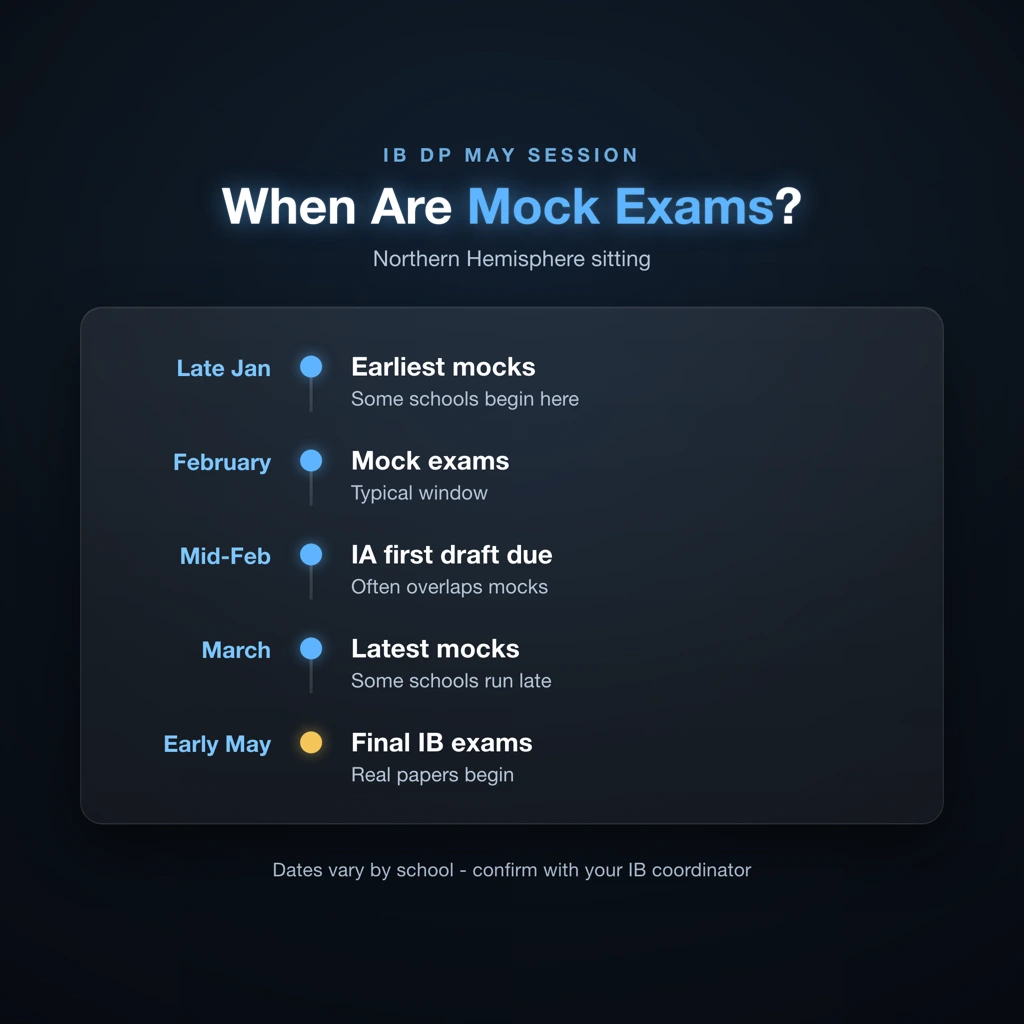
The IBO does not set or publish mock exam dates. Timing is decided entirely by each school, which means there is no universal schedule to bookmark. Two students at different schools sitting the same May session papers could have their IB mock exams a month apart.
That said, there are clear patterns most schools follow:
- May session (the Northern Hemisphere sitting): mocks typically run in February, roughly two to three months before the real papers begin in late April (the May 2027 exams start on 23 April). Some schools push them into late January to leave more revision time; others run them as late as March, which compresses the gap considerably.
- November session (predominantly Southern Hemisphere): mocks usually fall in late August or early September, before the October half-term window that many schools use for catch-up teaching.
One non-obvious quirk worth knowing: schools that run February mocks often schedule them to finish before internal assessment (IA) deadlines land, but the timing is tight. If your school runs mocks in the first two weeks of February and your IA first draft is due mid-February, you are managing both simultaneously. That overlap is not an accident of bad planning - it reflects real timetable constraints - but it catches students off guard every cycle.
Check the specific dates with your IB coordinator well before the autumn term ends. Do not rely on dates from older year groups; schools adjust timing from one cohort to the next.
3. How Mock Results Feed Into Your UCAS Predicted Grades
Your mock results do not go directly to universities, but they shape the predicted grades that do. Understanding the mechanics here matters more than most students realise.
IB students applying through UCAS must mark their Diploma as "pending" in the education section of their application, because results are not yet confirmed. Per UCAS, advisers then assign predicted grades through the adviser portal using either a drop-down menu or a free-text field, depending on the qualification structure. For the IB Diploma, that typically means a predicted total and individual subject scores.
Mock exam performance is the primary quantitative evidence your teacher has when arriving at those numbers. Internal assessments may be partially complete by the mock window, and class tests contribute something, but mocks are the closest available proxy for what you will do in May. A teacher predicting a 6 in IB Chemistry with no mock data is essentially guessing; a mock paper gives them a defensible number.
The less obvious point: once an application is sent to UCAS, the predicted grades cannot be changed, and UCAS cannot amend them on your behalf. If your mock goes badly and your teacher has already submitted a lower prediction, there is no mechanism to revise it upward later, even if your subsequent work is stronger.
One practical quirk worth knowing: if a UCAS application is returned to a student for any edit to the education section, any predicted grades already entered are automatically removed and must be re-entered by the adviser. Timing an edit carelessly around the mock window could create an administrative gap.
Universities read predicted grades when deciding whether to make an offer. A strong set of mock results gives your teacher the evidence to predict higher, which in turn can support an offer from a more selective institution. The mock window is the last point at which that evidence can influence the numbers that go on your application.
4. Realistic Mock-to-Final Score Patterns: What the Gap Looks Like
A low mock score is not a ceiling. Most IB students improve between mocks and final exams, and the gap is often meaningful. Improvements of two to four IB points from mock to final are common, for reasons that are structural rather than exceptional.
Three factors explain why mocks tend to understate a student's final position:
- Mocks fall before peak revision. The bulk of focused, subject-specific revision happens in the weeks after mocks, not before them. Mock season is a diagnostic checkpoint, not a dress rehearsal at full readiness.
- IA marks are unconfirmed. At mock time, many Internal Assessment components are still in progress or unmoderated. The final grade includes those marks, which can shift a student's overall total noticeably upward.
- Exam technique is still developing. Command-term responses, mark-scheme language, and time allocation across papers all tighten with practice. A student who misreads "evaluate" as "describe" in a mock rarely makes the same mistake twice.
The less-discussed risk runs in the opposite direction. Students with strong mock scores sometimes ease off structured revision in the final weeks, assuming the grade is secured. IB final exams are graded against the cohort performance each session, so a plateau in preparation can translate to a grade boundary surprise.
The most honest way to use a mock result is as a directional signal. It tells you which papers need attention and where marks are leaking, not what your final score will be.
5. How to Use Mock Results Diagnostically: Paper-by-Paper Breakdown
The total score is the least useful number on your mock result sheet. A 4 in IB Chemistry could mean you dropped marks evenly across all three papers, or it could mean Paper 1 (multiple choice) is fine while Paper 2 (structured data questions) collapsed entirely. Those two situations need completely different fixes.
Break every subject down to paper level before you plan a single revision session. For each paper, work through the markscheme and note which command terms tripped you up repeatedly:
- Analyse expects a breakdown of component parts with reasoned links between them.
- Evaluate requires a judgement with supporting and opposing evidence.
- Compare demands explicit parallel structure, not two separate descriptions.
IB markschemes are strict about this. A correct idea expressed without the expected language often scores zero. Students who treat a markscheme as optional reading lose marks they already know the content for.
A non-obvious gotcha: some subjects still carry optional topic content that teachers sometimes deprioritise in teaching time (Geography's options, for example; Biology, Chemistry and Physics dropped their options and Paper 3 from May 2025). If your mock included a section you barely revised, the paper-level breakdown will flag the gap clearly rather than letting it blur into a general "this subject is weak" conclusion.
Once you have paper-level data, IB Questionbank is the most targeted practice tool available. Created by the IBO itself, it lets you filter questions by examination paper, level, time zone, and date, so you can isolate exactly the paper-and-topic combinations where your markscheme gap is widest.
Build a priority list from the gap data:
| Subject / Paper | Mark lost | Command-term pattern | Priority |
|---|---|---|---|
| e.g. Chemistry Paper 2 | High | "evaluate" answers too thin | 1 |
| e.g. English Paper 1 | Medium | annotations lack terminology | 2 |
| e.g. Maths AA Paper 1 | Low | arithmetic slips only | 3 |
Work down the list in order. The subjects or papers with the largest markscheme gap get focused time first.
6. What to Do If You Bomb a Mock: Actions That Move the Needle
A poor mock result is diagnostic information. The worst response is to panic-read your entire course notes from the beginning. Here is what actually moves your score.
In the week after results, book a meeting with your subject teacher. Ask specifically which IB assessment objectives you underperformed on, not just which questions you dropped marks on. Assessment objectives map to mark allocations in the markscheme, and knowing you are weak on AO3 (synthesis and evaluation) rather than AO1 (recall) tells you exactly what kind of practice to do next.
Timed past papers beat re-reading. Sit a single paper under exam conditions, mark it yourself against the official markscheme, then review only the questions you got wrong. One marked paper with honest error analysis is worth more than three papers sat without feedback.
For IB Biology and IB Chemistry, the diagnostic split that matters is conceptual versus procedural. Conceptual errors mean you have a topic gap: go back to the syllabus statement and close it. Procedural errors, which are common in data-response questions, mean you understand the biology or chemistry but are not following the command-term conventions that IB markschemes reward. "Explain" requires mechanism, not description. That distinction is not obvious from re-reading a textbook.
For IB English Paper 1, identify whether your marks are leaking on literary terminology, the structure of your response (introduction, developed body paragraphs, a clear line of argument), or the interpretation of an unseen text. Each failure mode has a different fix: terminology is a vocabulary exercise, structure is a planning exercise, and interpretation improves most from reading published literary commentary on unfamiliar texts.
Two to three months of focused, paper-based practice is a realistic window to close a three-to-five point gap on your total IB score.
One situation that changes everything: if illness, bereavement, or another genuine crisis affected your mock performance, speak to your IB coordinator immediately. Schools can include this context in the UCAS reference that accompanies your predicted grades, which gives university admissions teams the framing they need to read your numbers fairly.
7. The Risk of Over-Revising for Mocks: IA and Extended Essay Deadlines
Mock revision has a structural ceiling that most students hit without realising: the Internal Assessment components sitting quietly on their to-do lists. Each IA typically contributes 20-30% of the final grade for that subject. Pouring three weeks into mock prep while your Biology IA data analysis sits unfinished is not a neutral trade-off. You are actively trading away a fifth of one subject's grade for marginal gains on a non-assessed rehearsal.
The Extended Essay compounds this. Combined with Theory of Knowledge, the EE can contribute up to 3 bonus points through the EE/TOK matrix. Those points sit entirely outside the exam hall. Missing your school's internal EE submission deadline means missing moderation cycles, which means your school cannot submit on time, which means a grade of N for the component. The IBO's own published deadlines are irrelevant here. Your school sets an earlier internal cut-off to give coordinators time to process and upload. Check your school's academic calendar specifically, not the IBO's website.
The counter-intuitive trap: students who revise hardest for mocks sometimes see their final scores drop, because the IA and EE grades they sacrificed never come back.
A practical fix is to treat your timetable as two separate columns rather than one rolling list:
- Mock revision windows - scheduled, time-boxed revision sessions by subject and paper
- IA/EE blocks - non-negotiable, protected time that mock prep cannot overrun
If a mock revision session runs long, it eats into the first column, not the second. That single rule prevents the most common planning failure in Year 2 of the IB Diploma Programme.
8. Finding Practice Materials: Past Papers, Questionbank, and Subject-Specific Resources
The most underused official resource for IB mock exam preparation is almost certainly the IB subject report. Published by the IBO after each exam session, these documents describe question by question where candidates lost marks. For IB Biology mock exams, for example, a subject report might flag that students consistently misread the command term "evaluate" in Paper 2 responses, writing descriptions instead of judgements. Your teacher can pull these through the IB Questionbank.
IB Questionbank itself is the IBO's own platform. Teachers build custom practice papers by filtering real past questions by subject, paper number, level, time zone, and question type. Students access it through their school's licence, not independently. The filtering is specific enough to isolate, say, only Paper 3 Higher Level questions from a particular examination year, which is useful when targeting a known weak area rather than grinding through full papers.
One concrete gotcha: several DP subjects ran their final assessment under old syllabuses in 2024, including DP Biology, Chemistry, and Physics, which introduced updated courses with first assessments from 2025 or 2026. Practising from pre-2025 Chemistry or Biology past papers without confirming which syllabus you are sitting can mean drilling content and assessment objectives that no longer apply. Check with your teacher before opening any past paper in these subjects.
For Maths preparation, the same caution applies by course rather than by year. The two current offerings, Analysis and Approaches and Applications and Interpretation, have distinct Paper 1, 2, and 3 structures. A sample IB Maths exam from the wrong course is not useful practice.
A simple checklist before you start any past paper:
- Confirm your syllabus version (pre-2025 or post-2025) with your teacher for Biology, Chemistry, and Physics.
- Identify your exact Maths course before selecting questions.
- Pull the corresponding subject report alongside the markscheme, not just the answers.
9. Where to Go From Here
This week, ask your teachers to return your marked mock scripts, then sit down with the official markscheme for the one paper where you dropped the most marks. Go through every lost point and categorise it: misread command term, missing specific vocabulary, calculation error, or structural problem in your response. That single exercise will tell you more than a colour-coded revision timetable.
One non-obvious gotcha: the markscheme often awards marks for specific IB-approved terminology that a paraphrase will not earn, so the gap between "close enough" and full marks is frequently a vocabulary problem, not a knowledge problem.
When your revised predicted grades are in, check how they convert using the UCAS Tariff points calculator to confirm your offers are within reach. Then cross-reference with our guides to IB predicted grades and UCAS Tariff points for the full picture.
FAQ
Do IB mock exams matter?
Yes - mock results are the primary evidence your school uses when submitting UCAS predicted grades, which universities read when deciding whether to offer you a place.
When are IB mock exams?
For the May session, mocks typically run in February; for the November session, they usually fall in late August or early September - exact dates are set by each school, not the IBO.
Are IB mock exams the same as past papers?
Schools often use genuine past IB papers for mocks, but they may also use questions from IB Questionbank or school-written papers - check with your IB coordinator to know exactly what your school uses.
How important are IB mock exams for UCAS?
Very important: advisers enter predicted grades into the UCAS portal and mock performance is the main quantitative basis for those predictions, which universities see before results day.
Are IB mock exams harder than the real exams?
Not by design, but students often sit mocks before revision peaks and before exam technique is fully developed, which is one reason most students score higher in the final exams than in mocks.
How should I prepare for IB mock exams?
Work paper-by-paper using timed past papers and IBO markschemes, identify which command terms and topic areas cost you the most marks, and prioritise those - avoid re-reading notes as the primary revision method.
References
- Managing references and predicted grades in the adviser portal | UCAS - https://www.ucas.com/advisers/help-and-training/guides-resources-and-training/application-overview/our-adviser-portal/managing-references-and-predicted-grades-adviser-portal
- IB Questionbank - https://questionbank.ibo.org/
- Calculate your UCAS Tariff points | UCAS - https://www.ucas.com/applying/before-you-apply/what-and-where-to-study/entry-requirements/calculate-your-ucas-tariff-points