Unconditional Offers Explained: What They Mean for You
By Michael Thompson · Former IB Diploma Programme coordinator; 10 years at Bromsgrove School · Published 5 July 2026
An unconditional offer is a confirmed university place that does not depend on your final exam results. Unlike a conditional offer, there is no grade threshold to meet - the place is yours if you accept it. That sounds like a straightforward win, but the decision is more complicated than it appears: accepting makes that university your firm choice, which eliminates the option of an insurance place and locks you in before you sit your exams. This guide explains how unconditional offers work, the difference between a fully unconditional offer and a conditional-unconditional offer, and what to think about before you accept.
Key Takeaways
- A confirmed place with no grade strings attached: An unconditional offer means you have already met the entry requirements or the university is waiving them - your place is secure regardless of your final results.
- Accepting removes your insurance choice: Once you accept an unconditional offer as your firm choice, UCAS does not allow you to hold an insurance choice, so you have no safety net if you later want a different course.
- Conditional-unconditional offers come with a catch: Some offers are only unconditional if you make that university your firm choice - a mechanism that has drawn scrutiny from the Office for Students.
- Non-academic conditions can still apply: Even a fully unconditional offer may require a DBS or PVG check, a medical assessment, proof of results, or satisfactory references before enrolment.
- IB students should keep working: An unconditional offer removes the final IB grade condition for that course, but your Diploma results still affect scholarships, other offers you hold, and entry to future professional programmes.
- Grade complacency is a documented risk: UCAS data from the 2018 cycle showed 67% of students holding unconditional offers missed their predicted A-level grades by two or more grades, compared to 56% of those holding conditional offers.
In This Article
- Unconditional offer definition: what it actually means
- Unconditional vs conditional-unconditional offers: a comparison
- How accepting an unconditional offer reshapes your firm and insurance strategy
- The honest catches: complacency, fit, and hidden conditions
- What unconditional offers mean for IB Diploma applicants
- Regulatory scrutiny: what the Office for Students has said
- Can an unconditional offer be withdrawn?
- What to do next
1. Unconditional offer definition: what it actually means
An unconditional offer is a confirmed university place that carries no grade conditions. Per UCAS, it means the applicant has already met the entry requirements and the place is confirmed if accepted. No A-level results, IB scores, or BTEC grades can take it away.
A conditional offer works differently: it sets specific grade thresholds that must be met before the place is confirmed. Miss the grades, and the offer lapses.
The distinction matters because unconditional offers are not always issued to students mid-cycle. Cambridge only issues unconditional offers to applicants who have already completed their qualifications and achieved the required grades. An applicant still sitting A-levels will never receive an unconditional offer from Cambridge, regardless of predicted grades. That is the opposite of how most pre-results unconditional offers work elsewhere, where the offer is made precisely to students whose results are still pending.
One detail that catches applicants off guard: accepting any offer through UCAS is a binding commitment. UCAS is explicit that if you change your mind after accepting an unconditional offer, you must decline the place and apply through Clearing. There is no straightforward way to swap to another university once you have accepted.
2. Unconditional vs conditional-unconditional offers: a comparison
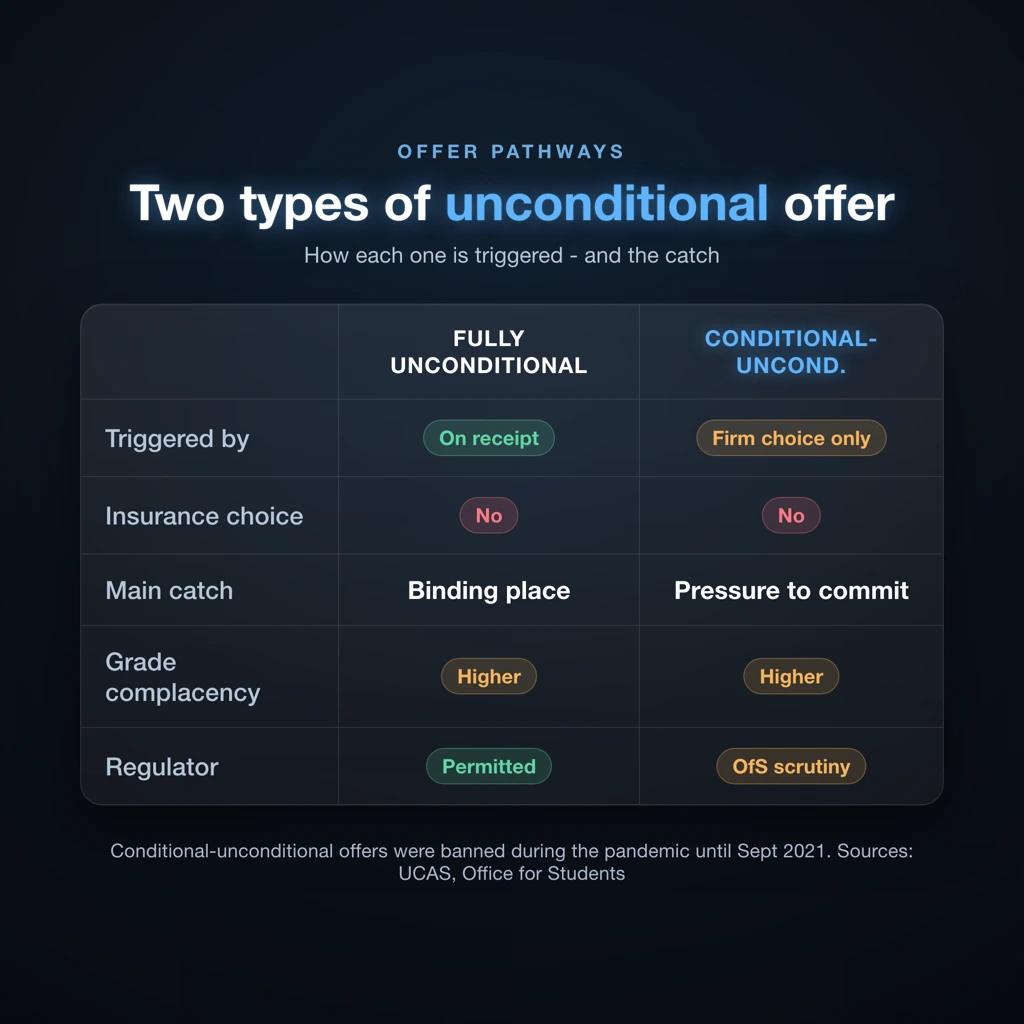
Not all unconditional offers work the same way. There are two distinct types, and confusing them is a common mistake that affects how you use your UCAS choices.
A fully unconditional offer means the university has already decided your place is confirmed. It does not depend on your A-level results, your IB Diploma score, or any other upcoming grades. You can accept it as your firm choice or decline it, but the offer itself does not change based on what you do next.
A conditional-unconditional offer is different. The offer only converts to unconditional if you select that university as your firm choice, per UCAS. In other words, the university is saying: "Make us your first pick, and we'll drop the grade conditions." That distinction matters because it puts pressure on you to commit before you know your results.
| Fully unconditional | Conditional-unconditional | |
|---|---|---|
| How the offer is triggered | Confirmed on receipt, regardless of applicant action | Only activates when applicant selects it as firm choice |
| Insurance choice possible | No - accepting unconditional offer uses your firm slot | No - firm choice is required to trigger the offer |
| Risk to applicant | Low grade risk, but binding commitment to attend | Pressure to commit early; no safety net from insurance |
| Risk of grade complacency | Higher - results have no bearing on the place | Higher - and the OfS found applicants who accepted unconditional offers were more likely to miss predicted grades by two or more |
| Regulatory status | Permitted | Banned during the pandemic until September 2021; subject to ongoing OfS scrutiny |
The counter-intuitive catch with conditional-unconditional offers is that they do not reduce your risk the way a standard unconditional offer does. They remove grade conditions while simultaneously removing your ability to hold a lower insurance offer as a fallback.
The Office for Students prohibited conditional-unconditional offers during the pandemic, with the ban running until September 2021. The OfS also warned that indiscriminate use of unconditional offers could put universities in breach of consumer law, and stated it is prepared to intervene where offers are found to have an obvious negative impact on students' choices or outcomes, per this OfS statement. That regulatory position has not hardened into a permanent ban, but the scrutiny remains live.
If you receive a conditional-unconditional offer, check whether the course is genuinely your first preference before committing. The offer structure is designed to encourage an early firm decision, which benefits the university's recruitment planning, not necessarily yours.
3. How accepting an unconditional offer reshapes your firm and insurance strategy
When you accept an unconditional offer as your firm choice, UCAS rules mean you cannot hold an insurance choice at the same time. The insurance slot simply disappears. That is the counterintuitive mechanic most students miss: the very offer that feels like the safest outcome actually removes your safety net.
The practical consequence is stark. If you change your mind after accepting, there is no fallback university already lined up. Your only route is to decline the place and enter Clearing, competing for whatever vacancies remain at that point.
The conditional-unconditional offer creates a subtler trap. If a university converts your offer to unconditional only when you make it your firm choice, you may end up locked into a university that was never your first preference, because declining the guaranteed place feels too risky while you wait on a preferred conditional offer elsewhere.
One concrete relief valve exists in the 2026 cycle: from 2 July 2026, applicants holding an unconditional firm place can use a 'Decline my place' button in their UCAS application. That button remains available until 2 September 2026. It gives you a window to reconsider once you have your results, without having to contact the university directly first.
Before accepting any unconditional offer as your firm choice, map out exactly what you lose: the insurance place, the motivation to perform in exams, and potentially the university you actually wanted.
4. The honest catches: complacency, fit, and hidden conditions
The grade-drop correlation is the most cited concern. According to UCAS's 2018 analysis, **67% of students holding unconditional offers missed their teacher-predicted A-level grades by two or more grades**, compared to 56% of those holding conditional offers. UCAS is careful not to claim causation: students who receive unconditional offers may have been predicted higher grades relative to their actual ability in the first place, skewing the comparison. But the pattern is consistent enough to take seriously. Removing the grade threshold takes away one reason to keep working hard in Year 13, and for some students that matters.
The more overlooked problem is course fit. An unconditional offer removes exam pressure but not the need to think carefully about whether the subject, institution, and teaching style genuinely suit you. Accepting quickly to secure the place can short-circuit that thinking, particularly with conditional-unconditional offers, which are structured to prompt a fast decision.
Hidden conditions are the practical gotcha most students miss. Even a fully unconditional offer can still require you to satisfy non-academic checks before enrolment confirms. UCAS lists these explicitly and they include:
- DBS or PVG checks (standard for courses involving work with children or vulnerable adults, such as education, social work, and many healthcare programmes)
- Medical or occupational health clearance
- Financial checks or proof of funding
- Satisfactory references
- Proof of qualifications already achieved
Failing any of these can still affect whether you actually start the course, regardless of what the offer letter says.
Finally, UCAS advises that some graduate employers review A-level results when assessing job applications. If your predicted grades were strong and your final results fall well short, that gap can surface years later at the application stage for competitive employers.
5. What unconditional offers mean for IB Diploma applicants
For IB Diploma students, an unconditional offer removes the grade condition for that specific course. When IB results are published on 6 July 2026, your final score will not determine whether that unconditional place is held. The university has already committed to taking you, regardless of what the results say.
That does not mean your final IB session is irrelevant.
The counter-intuitive gotcha: the IB Diploma awards a single certificate score, and that score travels with you. A significant drop below your predicted grades can affect:
- Any conditional offers still in play at other universities, if you are weighing your options before accepting.
- Scholarship eligibility, where minimum point thresholds are typically set independently of admissions decisions.
- Postgraduate and professional entry requirements, particularly for medicine, law, and architecture programmes that ask for full academic transcripts.
UCAS notes that some graduate employers also review A-level and equivalent qualifications when screening applications. The same logic applies to IB scores: a weak final result is on the record permanently, not just for university entry.
Unconditional offers are course-specific. If you hold one alongside a conditional offer at a different institution and have not yet accepted, that conditional offer still depends entirely on your July results. The protection only covers the one place where you accepted the unconditional.
Keep working through Higher Level subjects at full effort. The single unconditional offer is a floor, not a ceiling.
6. Regulatory scrutiny: what the Office for Students has said
The scale of the shift matters here. According to UCAS, unconditional offers to 18-year-olds rose from roughly 3,000 in 2013 to 117,000 in 2018, and 34.4% of 18-year-old applicants from England, Northern Ireland, and Wales received one during that cycle. That growth caught the attention of the Office for Students (OfS), the independent regulator for higher education in England.
The OfS's most direct intervention came during the pandemic. It prohibited conditional-unconditional offers outright until September 2021, with fines of up to or beyond £500,000 per breach possible. The ban was time-limited and targeted specifically at the conditional-unconditional mechanism, not at unconditional offers as a category.
The OfS's broader position, stated before the pandemic ban, was pointed but stopped short of a blanket prohibition. The regulator warned that indiscriminate use of unconditional offers could put universities in breach of consumer law, and said it is prepared to intervene where unconditional offers are found to have an obvious negative impact on students' choices or outcomes.
One counter-intuitive detail worth noting: the OfS explicitly carved out exemptions for portfolio-assessed creative courses, adult learners with relevant prior learning, and applicants who already hold their qualifications. Receiving an unconditional offer in those contexts carries a different regulatory weight than receiving one as a school leaver yet to sit exams.
The regulatory landscape here is not settled. The OfS has signalled willingness to act further, and any university considering indiscriminate use of unconditional offers does so knowing the regulator is watching.
7. Can an unconditional offer be withdrawn?
An unconditional offer is binding on the university, but it is not unconditional in the sense that absolutely nothing can end it. UCAS confirms that additional requirements can still apply after the offer is made, including a DBS or PVG check, proof of identity, or medical and financial clearance. If you fail to satisfy any of those non-academic conditions, the university can withdraw the place.
The other route to withdrawal is misrepresentation. If your application contained false information, the offer can be revoked at any point, including after you have accepted.
Declining is not the same as withdrawal. If you simply change your mind and turn the offer down, that is your decision, not the university's. You are released from the commitment and your other choices remain live as normal.
The counter-intuitive case worth knowing: if you have already accepted an unconditional offer and then want to leave, you cannot simply swap to another course. Per UCAS, you must decline the place through UCAS, which releases you into Clearing. That means competing for remaining vacancies rather than reinstating any previous offers, so the decision carries real cost.
8. What to do next
Before you accept any unconditional offer, check whether the offering university is genuinely your strongest fit across course content, location, and career outcomes, not just the one that removed exam pressure first. Use the UCAS Shortlist Optimiser at /ucas-choices to compare your options side by side.
One non-obvious detail worth knowing: if you accept an unconditional firm place and later have second thoughts, you are not permanently locked in. Per UCAS, a 'Decline my place' button becomes available from 2 July 2026, and you can use it right up until 2 September 2026.
Open the Shortlist Optimiser at /ucas-choices this week and score each offer against your actual priorities. Mark 2 September 2026 in your calendar as the hard deadline to act if anything changes.
FAQ
Can an unconditional offer be withdrawn?
Yes, in limited circumstances - most commonly if a non-academic condition such as a DBS check or medical clearance is not satisfied, or if the application contained misleading information; students who simply change their mind must decline the place themselves via UCAS.
What does unconditional offer accepted mean?
Accepting an unconditional offer via UCAS is a binding commitment to attend that university or college; no insurance choice can be held alongside it, and the only exit route if you later change your mind is to decline the place and enter Clearing.
What if I hold an unconditional uni offer but fail my A levels?
If your firm choice is unconditional, your A-level results do not affect whether you keep that place - the offer stands regardless of your grades, though non-academic conditions such as a DBS check still need to be met.
Is there a cooling-off period for an unconditional offer?
UCAS does not specify a formal cooling-off period for unconditional offers; applicants who hold an unconditional firm place can use the 'Decline my place' button from 2 July 2026 up to 2 September 2026, after which they would need to go through Clearing.
Are unconditional offers still common at UK universities?
Unconditional offers rose sharply from around 3,000 in 2013 to 117,000 in 2018, reaching 34.4% of 18-year-old applicants in England, Northern Ireland, and Wales; since then the Office for Students has increased scrutiny and temporarily banned conditional-unconditional offers, so prevalence has been subject to regulatory pressure.
What does an unconditional offer at college mean?
At a further education college or sixth-form college, an unconditional offer works the same way as at university - your place is confirmed without any grade conditions attached, though the college may still require you to enrol and may have non-academic entry criteria.
References
- University offers - conditional, unconditional, unsuccessful & withdrawn - https://www.ucas.com/applying/after-you-apply/types-of-offers
- Outcome of your application and what to do next | Undergraduate Study - https://www.undergraduate.study.cam.ac.uk/apply/after/application-outcomes
- Universities must avoid using unconditional offers to put pressure on students, says Office for Students - Office for Students - https://www.officeforstudents.org.uk/news-blog-and-events/press-and-media/universities-must-avoid-using-unconditional-offers-to-put-pressure-on-students-says-office-for-students
- Regulator bans controversial ‘conditional unconditional’ offers during pandemic - Office for Students - https://www.officeforstudents.org.uk/news-blog-and-events/press-and-media/regulator-bans-controversial-conditional-unconditional-offers-during-pandemic
- Confirmation and Clearing 2026 key dates | UCAS - https://www.ucas.com/advisers/help-and-training/guides-resources-and-training/supporting-you-through-confirmation-and-clearing/confirmation-and-clearing-key-dates
- Unconditional offers made to a third of young applicants in England, Northern Ireland, and Wales | UCAS - https://www.ucas.com/corporate/news-and-key-documents/news/unconditional-offers-made-third-young-applicants-england-northern-ireland-and-wales