UCAS Tariff Points Explained: A-Level, IB and BTEC
By Michael Thompson · Education Specialist; 10 years teaching the IB at Bromsgrove School · Published 5 July 2026 · Updated 6 October 2026
UCAS tariff points are the numeric values assigned to post-16 qualifications and grades so that universities can compare students holding different types of qualification on a single scale. An A-level A* is worth 56 points, a B is worth 40, and the figures stack up across all your subjects to produce a total. The system covers A-levels, BTECs, T Levels, Scottish Highers, the IB Diploma and dozens of other Level 3 qualifications. Knowing your total matters - but so does understanding when a university cares about the total and when it cares only about named grades.
Key Takeaways
- Points are assigned grade by grade: UCAS calculates your tariff total by adding the points for each individual grade you achieve, not by mapping your results to a single qualification score.
- A-level A* = 56 points, A = 48, B = 40: Under the current tariff (introduced in 2017), three A-levels at AAA total 144 points and three at ABB total 128 points.
- IB HL and SL subjects are weighted differently: Each IB Higher Level grade earns roughly twice the UCAS points of the equivalent Standard Level grade, so your subject choices affect your total as much as your scores.
- Reaching the points total is not always enough: Many selective courses state named grade requirements - for example, HL Maths at grade 6 - and a student who hits the tariff total but misses a named grade still fails the offer condition.
- BTECs accumulate points across all units: A BTEC Level 3 Extended Diploma at DDD is worth 144 points, the same as three A-levels at AAA, but how you mix BTECs with other qualifications changes your running total.
- Apprenticeships are joining the tariff from 2026: UCAS is allocating tariff points to Level 3 and SCQF Level 6 apprenticeships, with values published in May 2025 and applicable from the September 2026 admissions cycle.
In This Article
- What UCAS Tariff Points Mean and Why They Exist
- A-Level Points for University Entry: The Current Conversion Table
- How IB Diploma Points Feed the UCAS Tariff
- How Universities Express IB Offers - Points Total vs Named HL Grades
- BTEC Tariff Points and Mixed Qualification Profiles
- T Levels, Scottish Highers and Other Qualifications on the Tariff
- The Named-Grade Gotcha: When Your Tariff Total Is Not Enough
- How to Work Out Your UCAS Tariff Points
- What to Do Next
1. What UCAS Tariff Points Mean and Why They Exist
UCAS tariff points are the numeric system the Universities and Colleges Admissions Service uses to put different Level 3 qualifications on the same scale, so a university can compare an A-level grade with a BTEC, a T Level, or an IB Higher Level subject without having to treat each as a separate currency.
The current tariff came into effect in 2017, replacing an older system that ran from 2002 to 2016. The numbers shifted dramatically between the two. Under the old tariff, an A-level A was worth 120 points; under the current one, it is worth 48. That gap matters if you are reading older prospectuses or forum posts, because a "AAB = 340 points" entry requirement from 2015 is not the same as 340 points under today's scale.
Across the full framework, the tariff covers a wide range of qualifications, including A-levels, BTECs, T Levels, IB Diploma components, Scottish Highers, the Extended Project Qualification, and many others.
One thing the tariff does not do is guarantee entry. Highly selective courses, including Medicine and Oxbridge programmes, typically specify grades directly rather than accepting a points total, so a candidate cannot, for example, swap a weaker subject for a stronger one and arrive at the same number to meet the offer. The points system is most useful for mid-range and contextual offers, where flexibility between qualifications is genuinely intended.
2. A-Level Points for University Entry: The Current Conversion Table
The current tariff, which replaced the old 2002-2016 system, uses noticeably smaller numbers. Under the previous scheme, an A at A-level was worth 120 points and an A* was 140. Under the current scheme those same grades are worth 48 and 56 respectively. The totals look different but the relative weighting between grades is unchanged, so if a university updated its entry requirements when the new tariff launched, like-for-like comparisons still hold.
Current A-level grade values
| Grade | Points |
|---|---|
| A* | 56 |
| A | 48 |
| B | 40 |
| C | 32 |
| D | 24 |
| E | 16 |
*Source: UCAS Tariff, Wikipedia*
Common three-A-level combinations
| Grades | Total |
|---|---|
| AAA | 144 |
| AAB | 136 |
| ABB | 128 |
| BBB | 120 |
| BBC | 112 |
| BCC | 104 |
| CCC | 96 |
One thing worth noting: a student holding BBC (112 points) and a student holding ABD (48 + 40 + 24 = 112 points) have identical tariff totals. Whether a university treats those profiles as equivalent depends entirely on its offer conditions, which is why section 7 of this guide covers the named-grade gotcha separately.
AS-levels and the EPQ
Standalone AS-levels still carry tariff value: A = 20, B = 16, C = 12, D = 10, E = 6. The Extended Project Qualification (EPQ) contributes A* = 28, A = 24, B = 20, C = 16, D = 12, E = 8. An A-grade EPQ adds 24 points, half the value of an A at A-level, which is why some universities explicitly mention it in conditional offers.
3. How IB Diploma Points Feed the UCAS Tariff
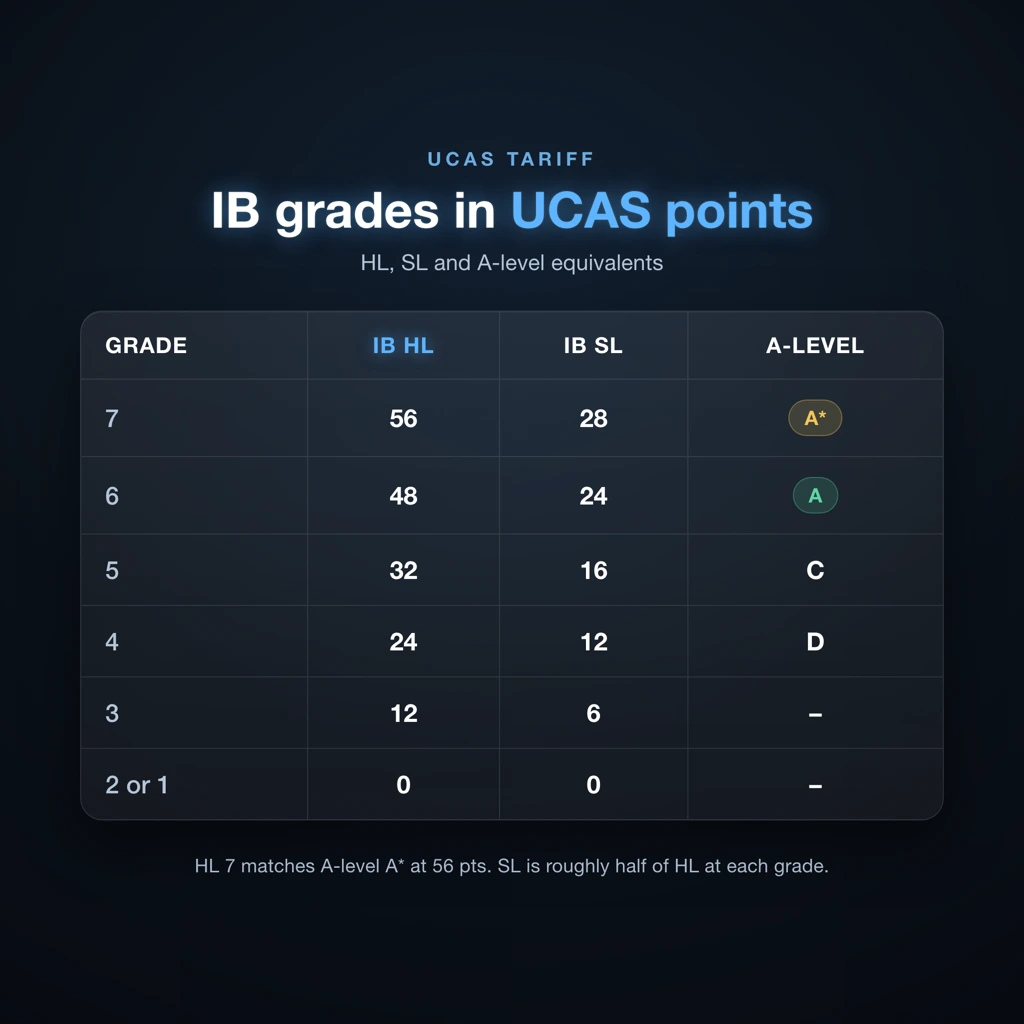
The IB Diploma is not assigned a single UCAS tariff value. Instead, each component is converted separately, and the totals are added together. That matters because two students with the same overall IB score can end up with different UCAS totals depending on how their grades are distributed across HL and SL subjects.
HL subject conversion
| IB HL grade | UCAS points |
|---|---|
| 7 | 56 |
| 6 | 48 |
| 5 | 32 |
| 4 | 24 |
| 3 | 12 |
| 2 or 1 | 0 |
An HL 7 is worth 56 points, the same as an A-level A*. An HL 6 matches an A-level A at 48 points. Source: UCAS Tariff calculator.
SL subject conversion
| IB SL grade | UCAS points |
|---|---|
| 7 | 28 |
| 6 | 24 |
| 5 | 16 |
| 4 | 12 |
| 3 | 6 |
| 2 or 1 | 0 |
SL subjects are worth roughly half their HL equivalents at each grade level.
TOK and the Extended Essay
UCAS gives the Theory of Knowledge (TOK) and Extended Essay (EE) grades separate Tariff values. Each is worth 12 points at grade A, 10 at B, 8 at C, 6 at D and 4 at E, so the two together add up to 24. An E in either, however, means the diploma is not awarded, whatever the subject grades. CAS (Creativity, Activity, Service) contributes nothing to the tariff at all. Source: UCAS Tariff calculator.
Worked example
A student with HL grades 6, 6, 5 and SL grades 7, 6, 5, plus EE grade B and TOK grade A, accumulates the following:
- HL: 48 + 48 + 32 = 128
- SL: 28 + 24 + 16 = 68
- EE (B) and TOK (A): 10 + 12 = 22
- Total: 218 UCAS points
Source: UCAS Tariff calculator.
The non-obvious gotcha here is that SL grade distribution matters more than it looks. Swapping an SL 7 for an SL 4 costs 16 points, which is the same as dropping an A-level grade from B to D. Students who load their effort into HL subjects and neglect SL can lose more points than they expect.
4. How Universities Express IB Offers - Points Total vs Named HL Grades
Not all universities read your IB results the same way, and the difference matters more than most applicants realise.
Many UK universities, mostly post-1992 institutions, make conditional offers expressed in UCAS tariff points. For these universities, your component-by-component total is what counts, and the process is straightforward: add up your HL, SL, and TOK/EE tariff values and check whether you clear the threshold.
Russell Group universities work differently. Oxford, Cambridge, Imperial, UCL, LSE, and Edinburgh typically make offers in IB Diploma points with named HL grade requirements, not in UCAS tariff points at all. A representative Oxford Medicine offer looks like this: "39 points including 7,6,6 at Higher Level." The overall points total and the named HL grades are two separate conditions, both of which must be met.
That independence is the critical gotcha. A student who achieves 39 points overall but scores 5 in one of the named HL subjects has failed the offer condition, even though their UCAS tariff total may be identical to a student who passed. A course-specific HL grade requirement operates entirely independently of the tariff total. An IB 39 with HL Maths 6 does not satisfy a requirement for HL Maths 7.
One historical footnote worth knowing: before 2017, UCAS mapped the whole IB diploma total to a single UCAS points figure, for example IB 45 equalled 720 UCAS points. That system was replaced in 2017 by the current per-subject calculation. Any tariff table showing those whole-diploma figures is out of date.
Before you firm a choice, check whether the offer is expressed in UCAS tariff points or in IB Diploma points with named HL grades. They are not interchangeable.
5. BTEC Tariff Points and Mixed Qualification Profiles
BTEC Level 3 qualifications map onto the tariff in three sizes, each treated as a direct equivalent to a set number of A-levels. Per Wikipedia's UCAS Tariff overview, the Extended Diploma (three A-level equivalent) runs from PPP = 48 points up to DDD = 144 points. The full grade ladder looks like this:
| BTEC Extended Diploma grade | UCAS points | A-level equivalent |
|---|---|---|
| DDD | 144 | AAA |
| DDM | 128 | ABB |
| DMM | 112 | BBC |
| MMM | 96 | CCC |
| MMP | 80 | CDD |
| MPP | 64 | DDE |
| PPP | 48 | EEE |
The Diploma (two A-level equivalent) and the Extended Certificate (one A-level equivalent) scale proportionally from those same grade points.
Where BTEC students often miscalculate is with mixed profiles. Points from different qualifications simply add together. Say you hold a BTEC Extended Certificate at Distinction alongside two A-levels at BB. The Extended Certificate D contributes the same points as a single A-level A*, which is 56 points under the current tariff. Add two B grades at 40 points each and your total is 136 points. Nothing cancels anything out.
The non-obvious gotcha: a number of universities, including Russell Group institutions, set BTEC entry requirements as named grade combinations (DDM, for instance) rather than a tariff number. Reaching 128 points via a different route does not automatically satisfy a DDM condition. Always check the individual course entry requirements, not just the headline points figure.
For any mixed profile, use the UCAS Tariff Calculator on ucas.com to build the exact total rather than estimating by hand. It covers a wide range of qualifications, including combinations that would take several steps to calculate manually.
6. T Levels, Scottish Highers and Other Qualifications on the Tariff
T Levels sit at the top of the current tariff for a single qualification. A Distinction* carries 168 points, making it worth the same as three A* grades combined (3 x 56 = 168). The full T Level scale is:
| T Level grade | UCAS points |
|---|---|
| Distinction* | 168 |
| Distinction | 144 |
| Merit | 120 |
| Pass (C or above on core) | 96 |
| Pass (D or E on core) | 72 |
The non-obvious detail: T Level pass grades split into two bands depending on the core component result, so two students who both "pass" can end up 24 points apart.
Scottish qualifications use the SQA grading structure. Per the UCAS Tariff, Advanced Highers award A = 56, B = 48, C = 40, D = 32. Standard Highers award A = 33, B = 27, C = 21, D = 15. A Scottish applicant taking five Standard Highers at A can accumulate 165 points from that set alone.
Apprenticeships are joining the tariff. UCAS is allocating points to Level 3 and SCQF Level 6 apprenticeships, with values published in May 2025 and applicable from the September 2026 admissions cycle.
The Access to HE Diploma and several other Level 3 qualifications also carry tariff points. Check the full UCAS tariff tables for your specific qualification rather than assuming the table above covers everything.
7. The Named-Grade Gotcha: When Your Tariff Total Is Not Enough
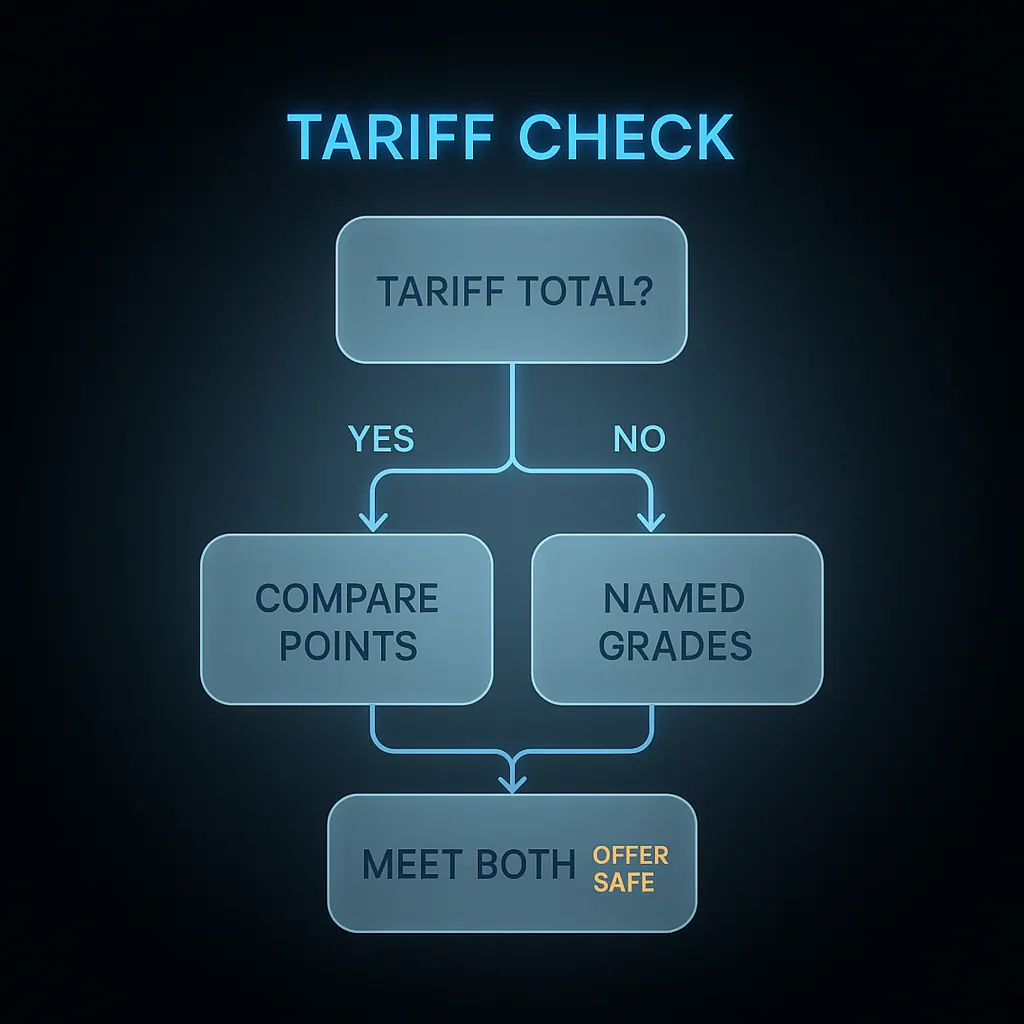
A high tariff total does not automatically satisfy an offer. Most entry requirements are more specific than a single number, and conflating the two is one of the most costly misreads students make during UCAS applications.
The tariff only counts when a course actually asks for it. Consider an A-level student with grades B, B, B, C. Using the current conversions (B = 40, C = 32), that profile generates 152 UCAS points. If the offer reads "128 UCAS points", they are well clear. But if the offer reads "ABB including Chemistry", the C grade is irrelevant. The extra 32 points do not compensate for the missing A, and the offer is not met.
The same logic applies to IB students. Russell Group universities typically make conditional offers in IB diploma points with specific HL grade requirements, such as Oxford Medicine's example offer of "39 points including 7,6,6 at Higher Level." A candidate whose overall tariff total clears the stated threshold but whose HL Maths sits at grade 5 rather than the required 6 will be rejected, regardless of total score. The HL requirement operates independently of the aggregate.
At the most selective end, the tariff is largely beside the point: Medicine, Law, and Oxbridge programmes typically do not use tariff points at all, relying instead on specific grade thresholds, admissions tests, and interviews.
Before applying, check each course entry on the UCAS Course Directory to confirm whether the requirement is a tariff total, a named-grade profile, or both. Those three formats carry very different implications for how you read your predicted grades.
8. How to Work Out Your UCAS Tariff Points
The method is straightforward: list every tariff-bearing qualification you hold (or are predicted), find the current point value for each grade from the UCAS tariff tables, and add them up. That sum is your UCAS tariff points total.
The fastest way to do this accurately is the UCAS Tariff Calculator on ucas.com. It handles mixed profiles, so if you are combining a BTEC Extended Certificate with two A-Levels and an EPQ, it will price each component correctly rather than leaving you to cross-reference multiple tables.
A few things to keep in mind as you run the numbers:
- Predicted vs confirmed totals. Using your predicted grades now gives you a working figure for comparing offers. Your definitive total only exists after results day, when confirmed grades replace predictions.
- Only Level 3 qualifications count. GCSEs sit below the tariff threshold and contribute nothing to your points total, however strong the grades. The equivalent cut-off for Scottish qualifications is SCQF Level 6.
- There is no universal ceiling. The highest single-qualification score currently available is a T Level Distinction*, worth 168 points. Your overall maximum depends on how many tariff-bearing qualifications you sit.
- The EPQ is easy to overlook. An A* EPQ adds 28 points to your total, which is half the value of an A* at A-level.
One non-obvious point worth knowing: the UCAS tariff points framework covers a very wide range of qualifications, so unusual awards from smaller awarding bodies often have an assigned value. Check the calculator before assuming a qualification is excluded.
9. What to Do Next
Before your next predicted-grades meeting with your school or college, open the UCAS Tariff Calculator, enter your current predicted grades, and write down the points gap between your projected total and each of your offer conditions. The non-obvious thing to check: confirm whether each offer is a tariff total, a named-grade condition, or both, because a shortfall on the named-grade side cannot be fixed by adding more qualifications to your points total.
Use our course search tool to filter courses by tariff range and identify realistic alternatives before Clearing opens. Then check each shortlisted course in the course directory to see whether it states a tariff total, named grades, or no points requirement at all.
Act on this now, while predicted grades can still be revised upward.
FAQ
How do UCAS tariff points work?
UCAS assigns a numeric value to each grade in each Level 3 qualification you take - for example, an A-level A = 48 points - and your total is the sum of all those individual values.
How many UCAS tariff points do I need?
Requirements vary widely by course and university: many post-1992 universities accept 96-120 points, while selective courses at Russell Group universities typically specify named grades rather than a tariff total.
What is 112 UCAS tariff points equivalent to in A-level grades?
112 points can be reached by several grade combinations under the current tariff, such as BBC (40+40+32) or ABD (48+40+24), or by combining A-level and BTEC grades - use the UCAS Tariff Calculator to find your specific mix.
What are UCAS tariff points for IB students?
IB Diploma components are converted individually: each Higher Level subject grade earns up to 56 points and each Standard Level grade up to 28 points, with TOK and the Extended Essay each adding up to 12 points (24 combined).
Do UCAS tariff points matter for Oxford and Cambridge?
Oxford and Cambridge do not make tariff-point offers; they specify exact grade requirements or IB Diploma totals with named Higher Level grades, so your tariff total is not relevant for Oxbridge applications.
What gives you the highest UCAS tariff points?
The highest single-qualification tariff score under the current system is a T Level Distinction at 168 points, matching the maximum from three A-levels at AAA (168 points combined), though taking more qualifications can raise your overall total further.
References
- UCAS Tariff - Wikipedia - https://en.wikipedia.org/wiki/UCAS_Tariff
- Calculate your UCAS Tariff points - UCAS - https://www.ucas.com/applying/before-you-apply/what-and-where-to-study/entry-requirements/calculate-your-ucas-tariff-points
- UCAS Tariff points allocated for T Levels | UCAS - https://www.ucas.com/corporate/news-and-key-documents/news/ucas-tariff-points-allocated-t-levels
- Allocating Tariff points to Level 3 and SCQF Level 6 apprenticeships | UCAS - https://www.ucas.com/about-us/news-and-insights/allocating-tariff-points-to-level-3-and-scqf-level-6-apprenticeships