Contextual Offers Explained: How to Get One at UK Universities
By Michael Thompson · Former IB Diploma Programme coordinator; 10 years at Bromsgrove School · Published 5 July 2026
A contextual offer is a lower or adjusted entry requirement made to applicants whose personal or school circumstances are taken into account by a university. Most students who qualify never know the option exists until after they have already applied - or after they have missed it. Universities set their own criteria, so eligibility and grade reductions vary widely from one institution to the next. This guide explains how contextual admissions work, what flags universities look for, and the practical steps to find out whether you are likely to receive a contextual offer before you submit your application.
Key Takeaways
- A contextual offer is a reduced entry requirement: Universities adjust their standard grade conditions for applicants whose circumstances - such as school performance, area of residence, or care experience - are judged to have affected their attainment.
- Each university sets its own criteria: There is no single national standard: eligibility signals, the size of any reduction, and which courses are included all depend on an individual institution's published policy.
- Some flags are applied automatically from UCAS data: Information such as your postcode and school details feeds into universities' systems, but other schemes require you to register separately before your application.
- A contextual offer is not a guarantee of a place: It is a conditional offer at a lower threshold - you still need to meet the reduced grades, and universities are not required to tell UCAS they have made one.
- IB students can qualify too: A reduction may appear as a lower overall Diploma total or a relaxed Higher Level grade requirement, so IB applicants should check whether a university's contextual policy states IB equivalents.
- Comparing universities directly is the most reliable way to find contextual admissions policies: Contextual offers are rarely surfaced in a standard course search, so reading each institution's published admissions policy is the practical approach.
In This Article
- What is a contextual offer
- Why contextual offers exist
- Contextual offer eligibility: criteria universities use
- How contextual offer grades are decided - and how big reductions can be
- How to find universities with contextual admissions and check if you qualify
- Contextual offers for IB Diploma applicants
- What to do next
1. What is a contextual offer
Contextual offers are adjusted entry requirements that some UK universities make to applicants whose personal or school circumstances have affected their education, according to UCAS. Instead of judging every applicant solely against a standard grade threshold, a university looks at the context behind your results and may offer you a place on different terms.
The adjustment does not always mean a simple grade reduction. UCAS identifies several forms a contextual offer can take:
- Reduced grade conditions - typically one or two grades below the advertised requirement
- A foundation year place - entry to a preparatory year rather than the degree directly
- A guaranteed interview - an assured conversation with admissions staff before any offer decision
- **An unconditional offer** - a place regardless of final grades
- Additional support provisions - financial help, dedicated accommodation, mental health support, or study support on arrival
One counter-intuitive point worth knowing: if a university makes you a contextual offer, it will not appear differently in your UCAS Hub - the offer looks identical to a standard one, per UCAS. You may only find out you received contextual consideration if the university contacts you separately.
The system is also not universal. UCAS is clear that not every university or college makes contextual offers, and some that do only apply them to certain courses.
2. Why contextual offers exist
The core problem is an attainment gap that opens early and widens over time. By the end of secondary school, disadvantaged students are on average two years behind more advantaged peers, according to the Office for Students. A-level grades record where a student ends up, not how far they have travelled to get there.
The grade data makes this concrete. Only 4.9% of children eligible for free school meals achieve AAA or better at A-level, compared with 11% of those not eligible, per the Office for Students. Treating those two groups as equivalent on paper overstates the difference in their actual potential.
The knock-on effect at the university end is sharp. The most educationally advantaged students are 5.7 times more likely to attend a higher-tariff provider than the most disadvantaged, according to the OfS insight brief on [contextual admissions](https://www.officeforstudents.org.uk/publications/contextual-admissions-promoting-fairness-and-rethinking-merit).
Contextual offers are the practical response to that gap. The fairness argument is not just theoretical. Research on the University of Bristol's contextual scheme found that students admitted with one grade lower than the standard entry requirements perform as well as, or better than, those admitted on the standard offer. That finding matters: it means a contextual offer holder is not being given a free pass, they are being assessed on a more accurate signal of their ability.
3. Contextual offer eligibility: criteria universities use
No single national standard governs contextual offer eligibility. Each university sets its own criteria, so two applicants with identical backgrounds can receive different treatment depending on where they apply. UCAS lists the most commonly used signals:
- Home postcode in a high-deprivation or low higher-education participation area
- School academic performance below the national average
- Household income below a threshold set by the institution
- Parents with no university education (first-generation applicants)
- Time in local authority care, including those who have left care
- Estrangement from parents
- Unpaid caring responsibilities
- **Disability or mental health conditions**, including dyslexia
Contextual offer criteria for dyslexia, mental health difficulties, and caring responsibilities are recognised factors at many institutions, not edge cases. They matter because these circumstances affect academic output in ways that grades alone do not capture.
One distinction worth understanding: some flags are applied automatically from data UCAS already holds, while others require you to take action. Your postcode and your school's attainment data feed through without any input from you. Eligibility based on caring responsibilities, estrangement, or a disability typically requires active registration with the university's widening participation or disability service, or disclosure on your UCAS application.
Scotland uses a separate framework. UCAS notes that Scottish universities publish two sets of entry requirements, standard and minimum, with minimum requirements reserved for widening access students. The markers used are living in a low-participation postcode measured by the Scottish Index of Multiple Deprivation (SIMD) or attending a school where attainment is typically below average.
The practical takeaway: check the widening access pages of each university you are considering, not just UCAS's general guidance, because the criteria that trigger a contextual offer vary institution by institution.
4. How contextual offer grades are decided - and how big reductions can be
There is no standard reduction. Each university sets its own terms, and the gap between a contextual offer and the advertised entry requirements can be modest or surprisingly large depending on the institution and the course.
The published examples show the range:
- Bristol Scholars programme (University of Bristol): in the pilot year, offers of up to four A-level grades below the standard entry requirements were made to local students. The Office for Students notes that 40% of the 43 pilot-year students had received free school meals.
- York St John University: from 2019, reductions of up to 40 UCAS tariff points were offered, equivalent to entry grades of CDD at A-level, with no conditions attached to the reduced offer.
- **Lady Margaret Hall, University of Oxford**: rather than a direct course offer, eligible applicants receive a foundation year place with lower entry requirements. Completion does not guarantee a place at Oxford.
The foundation year route is worth noting specifically because it changes the shape of the offer entirely. You are not being admitted to a degree on reduced grades; you are being admitted to a preparatory year with its own assessment. That is a different commitment.
One non-obvious point: per UCAS, universities are not required to flag contextual offers in your UCAS Hub, so the offer letter can look identical to a standard one.
For the exact terms that apply to you, check each university's published contextual admissions policy directly. This section illustrates the range; it is not a substitute for the real figures.
5. How to find universities with contextual admissions and check if you qualify
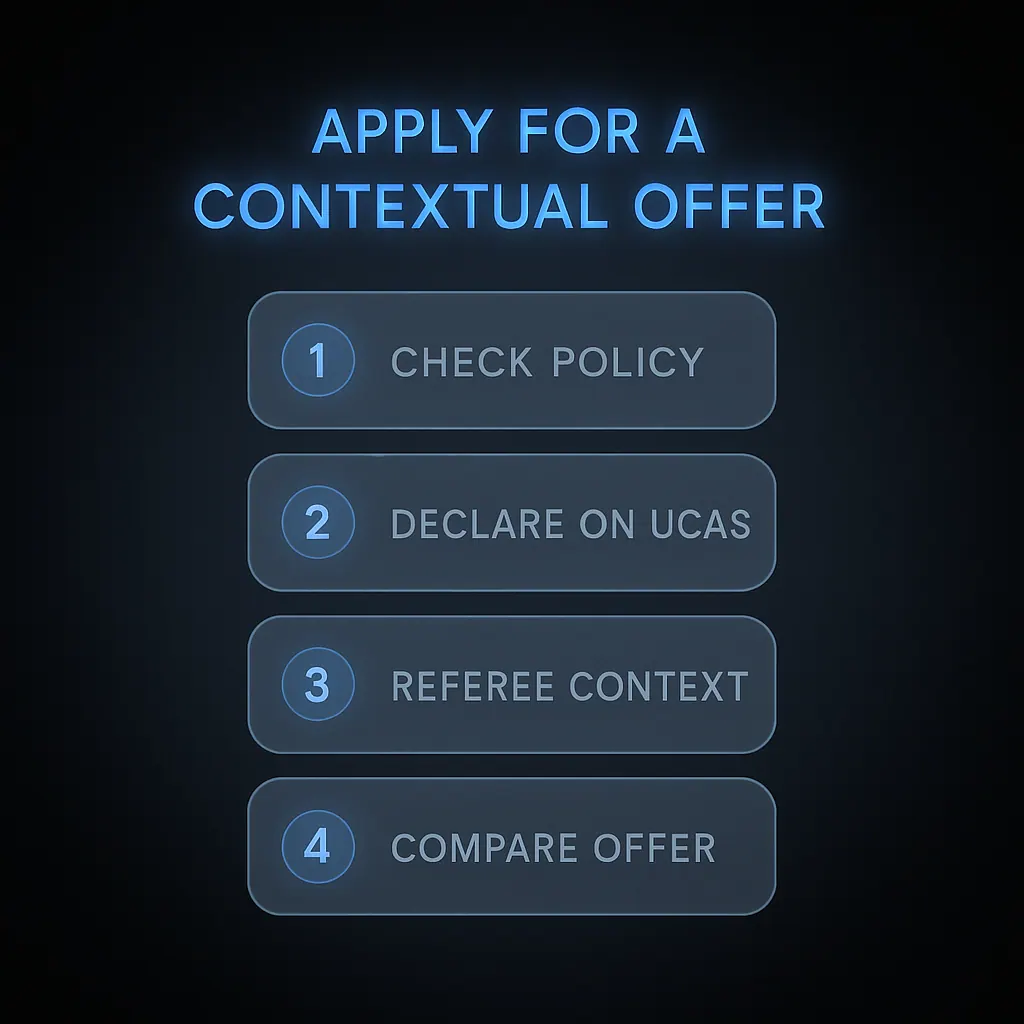
Contextual admissions policies are rarely surfaced in a standard course search. You will not find a "contextual offer" filter on UCAS Course Search, so the practical method is to go directly to each university's admissions pages and compare policies one by one.
Start with the university's own website. Search the institution name plus "contextual admissions" or "contextual offers". Read the published policy carefully, then check the specific course page, because as UCAS notes, some universities only make contextual offers for certain courses, not across the board. A policy that exists for Medicine may not apply to History at the same institution.
Some universities publish a postcode checker or eligibility tool on their admissions pages. These let you enter your postcode and see whether your area meets their low-participation or high-deprivation threshold. Search the admissions section directly rather than relying on a third-party summary.
How to share your circumstances with universities:
- On the UCAS application form itself, including the impairment and care experience fields
- Through direct contact with the university admissions team
- By listing eligible outreach or widening participation programmes you have attended
- Via your referee's written personal statement, where teachers can flag disability, significant school disruption, or caring responsibilities
One gotcha worth knowing: UCAS confirms that universities are not required to tell UCAS when they make a contextual offer. The adjusted offer will not appear differently in your UCAS Hub. It arrives looking identical to a standard offer, so you need to track which universities you flagged circumstances to.
Use our course finder to match your subject interests to universities that run contextual admissions programmes, then work through their published policies from there.
6. Contextual offers for IB Diploma applicants
IB Diploma students can qualify for contextual offers on exactly the same grounds as A-level applicants, including area of deprivation, low household income, school performance, disability, and mental health conditions. The eligibility criteria do not change because of the qualification type.
What does change is how the reduction is expressed. For A-level applicants a contextual offer might mean one or two grades lower than the standard requirement. For IB students, a university might instead reduce the overall Diploma points total, relax the grade requirement at Higher Level (HL), or both. The less obvious problem: most university contextual admissions policies are written with A-level grades as the reference point, and many do not state an IB equivalent at all.
If a policy only lists A-level reductions, do not assume the same proportional reduction applies automatically to your Diploma total. Contact the admissions team directly and ask how their contextual offer translates to IB terms. Put your question in writing so you have a record of the response.
One practical tip worth noting: when you apply through UCAS, you can share your personal circumstances directly on the application form, which gives admissions staff the information they need to flag you as a potential contextual offer candidate regardless of qualification type.
7. What to do next
Start this week: pick two or three universities you are seriously considering, go directly to each admissions page, and search for their published contextual admissions policy. Note any scheme registration deadlines carefully. Some universities run named access programmes, such as foundation pathway schemes, that require a separate application form with a deadline that falls weeks before the main UCAS deadline in January. Missing that internal deadline can mean losing the contextual offer holder status entirely, even if your UCAS application arrives on time.
Use our UK universities directory to compare which institutions publish contextual admissions programmes and what criteria each one uses. Once you have a shortlist, check specific course requirements through the course finder.
Contact each admissions team directly if the policy is unclear. Ask in writing, so you have a record of what you were told.
FAQ
What are contextual offers?
A contextual offer is a lower or adjusted entry requirement that a university may make to an applicant whose personal or school circumstances - such as a low-participation postcode, care experience, or low household income - are judged to have affected their attainment.
Are contextual offers guaranteed?
No - a contextual offer is not a guaranteed place; it is a conditional offer at a lower threshold, and universities set their own criteria, so eligibility and the existence of any reduction depend entirely on the individual institution's published policy.
How do contextual offers work in practice?
Universities use data already present in your UCAS application - such as your postcode and school - alongside any circumstances you or your referee declare, then decide whether to lower the standard grade conditions for your offer; the adjusted offer looks like any other offer in your UCAS Hub.
Do contextual offers apply to international students?
Most contextual admissions schemes are designed for UK-domiciled applicants using UK-specific data such as POLAR or SIMD postcodes, so international students are generally not eligible, though individual universities may have separate access arrangements.
How do I check my postcode for contextual offer eligibility?
Some universities publish a postcode checker on their admissions pages; for others you should search the university's website for its contextual admissions policy and look for the participation area or deprivation criteria it uses.
Do contextual offers take longer to come through?
There is no standard rule - universities are not required to notify UCAS of contextual decisions separately, so the timeline follows the normal UCAS decisions schedule, but if you are uncertain whether your circumstances have been considered it is worth contacting the admissions team directly.
References
- Contextual admissions | UCAS - https://www.ucas.com/applying/applying-university/individual-needs/contextual-admissions
- A new approach to fair access, participation and success - Office for Students - https://www.officeforstudents.org.uk/annual-review-2019/a-new-approach-to-fair-access-participation-and-success
- Contextual admissions: Promoting fairness and rethinking merit - Office for Students - https://www.officeforstudents.org.uk/publications/contextual-admissions-promoting-fairness-and-rethinking-merit
- Widening access and participation | UCAS - https://www.ucas.com/advisers/help-and-training/guides-resources-and-training/tools-and-resources-to-help-you/widening-access-and-participation