How to Reply to UCAS Offers: Firm, Insurance & Deadlines
By Michael Thompson · Former IB Diploma Programme coordinator; 10 years at Bromsgrove School · Published 5 July 2026 · Updated 4 October 2026
Knowing how to reply to UCAS offers correctly can be the difference between securing the right place and losing it by default. You reply through your UCAS application once you have received decisions back from all your choices - or once your personalised deadline arrives. Each reply involves picking one firm acceptance, one insurance acceptance, and declining everything else. Get the logic wrong and you could end up holding two near-identical offers with no real safety net, or miss the deadline and have every offer declined automatically.
Key Takeaways
- Reply only when all decisions are in: UCAS emails you when every university has responded, then you log in to make your choices - you cannot reply to offers piecemeal.
- Firm and insurance serve different functions: Your firm is the course you most want; your insurance should carry a meaningfully lower entry requirement so it acts as a genuine fallback.
- Missing your reply deadline declines your offers automatically: UCAS applies a 'declined by default' rule if you don't respond in time - you then have 14 days to contact UCAS to reverse an automatic decline.
- Holding an unconditional firm removes your insurance slot: If you accept an unconditional offer as your firm choice, you cannot also hold an insurance choice, so weigh that trade-off before committing.
- IB conditional offers come in two forms: Universities express IB conditions either as total diploma points (e.g. 36 points) or as specific Higher Level grades - read yours carefully before deciding whether it's achievable.
- Results day is automatic: Once grades are released, UCAS confirms your firm place, moves you to insurance, or releases you into Clearing - you don't choose between firm and insurance at that point.
In This Article
- When and how you reply to UCAS offers
- UCAS reply dates and deadlines for 2027 entry
- Firm and insurance choices explained
- Conditional vs unconditional offers: what changes when you reply
- Reading IB conditional offers and judging your chances honestly
- What happens at results time: confirmed, insurance, or Clearing
- Where to go from here
1. When and how you reply to UCAS offers
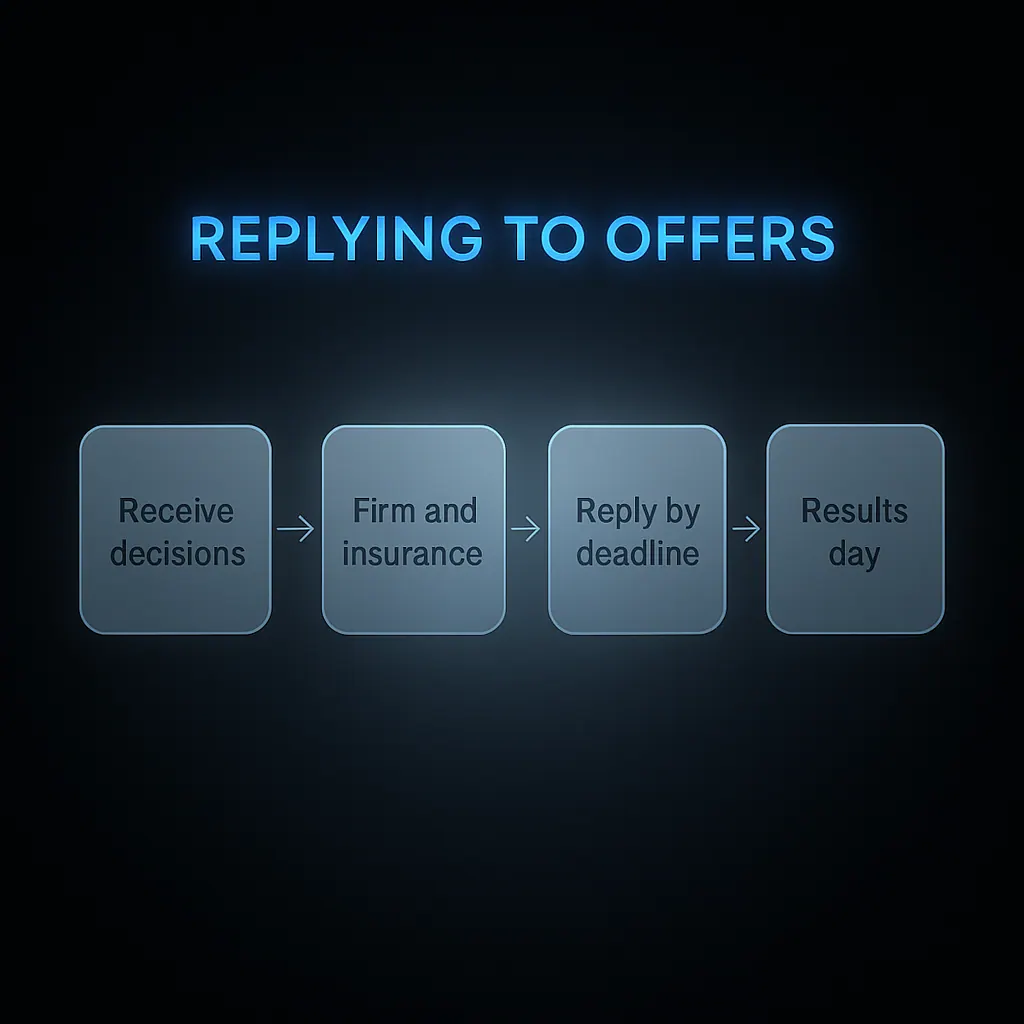
Knowing how to reply to UCAS offers is more mechanical than most applicants expect, but the timing rules catch people out every year. UCAS sends you an email once every university on your application has made a decision. Only then can you log into your application and reply. You cannot accept one offer while others are still pending, unless you permanently withdraw those outstanding choices first. Withdrawn choices cannot be reinstated and the university is notified immediately, so that is a one-way door.
When you do reply, you select one firm acceptance (your first choice) and, if you want a safety net, one insurance acceptance (your backup). Every other offer must be declined.
One detail that surprises many applicants: accepting an offer is a legally binding contract. The university agrees to accept you if you meet any conditions attached, and you agree to attend. Declining later without good reason is not a neutral act, particularly for conditional firm choices where the university has held a place for you.
A further quirk worth knowing: some universities make an offer conditional on you accepting as your firm choice, after which they convert it to unconditional and may add incentives such as guaranteed accommodation. That can feel generous, but it also removes your insurance place entirely. Accepting any unconditional offer as firm means you have no insurance choice, so weigh that trade-off before replying.
2. UCAS reply dates and deadlines for 2027 entry
Your reply deadline is not a fixed date. It depends on when you receive your last university decision. UCAS sets three rolling windows for 2027 entry:
| Last decision received by | Reply deadline |
|---|---|
| 31 March 2027 | 5 May 2027 |
| 12 May 2027 | 2 June 2027 |
| 14 July 2027 | 21 July 2027 |
Most applicants who applied before the January deadline and receive all their decisions in March will fall into the first window, giving them roughly five weeks to decide.
Miss your deadline and every offer is declined automatically. UCAS calls this "declined by default" (DBD). There is no warning email the day before, so set a calendar reminder well ahead of your specific date.
The non-obvious gotcha: if you are declined by default, you do have a short window to recover. Per UCAS, you have 14 days from the recorded decline date to contact UCAS directly and request a swap back. After those 14 days, reversing the decline requires the university's permission, which is not guaranteed. Either way, no swaps of any kind are possible after 22 July 2027, UCAS's cut-off for 2027 entry, so if you are close to that date, treat every deadline as harder than it looks.
Check your UCAS Hub for your personal reply date, as it is displayed there once all decisions are in.
3. Firm and insurance choices explained
Your firm choice is the offer you most want to accept. Your insurance choice is your backup, held in reserve in case you miss the conditions of your firm. Per UCAS, you can hold one of each, and every other offer must be declined.
The four valid combinations are:
- UF - Unconditional Firm (you've met all conditions; place is confirmed)
- CF - Conditional Firm only (no insurance held)
- CF + CI - Conditional Firm with a Conditional Insurance
- CF + UI - Conditional Firm with an Unconditional Insurance
One counter-intuitive detail: if you accept an unconditional offer as your firm, UCAS confirms you cannot hold an insurance choice at all. The unconditional firm settles the matter immediately.
**The [insurance only works as a safety net](/guides/firm-and-insurance-choice) if it genuinely asks for less.** If your firm requires AAA and your insurance also requires AAA, missing your firm grades will almost certainly mean missing the insurance too. The lower the insurance entry conditions relative to your firm, the more protection it actually provides.
The most important thing to understand about how this system works: UCAS is explicit that you cannot choose between your firm and insurance at results time. The outcome is determined automatically. If you meet your firm conditions, you go there. If you miss them but meet your insurance conditions, you go there. There is no moment on results day where you pick between the two.
Choose your insurance offer with that automatic mechanism in mind, not as a course you vaguely like the look of.
4. Conditional vs unconditional offers: what changes when you reply
A conditional offer means your place depends on meeting stated requirements, typically exam results. These can be specified as grades, scores, or subjects - for example, "AAB with A in chemistry" at A-level, "112 UCAS Tariff points", or "36 points from the IB Diploma Programme". Until you meet those conditions, your place is not guaranteed. An unconditional offer means the place is secured, though you may still need to complete a DBS check, provide proof of results, or satisfy financial or medical requirements, per UCAS.
The most consequential trade-off is this: **accepting an unconditional offer as your firm choice removes your insurance slot entirely**. You cannot hold a backup. If you change your mind after accepting, you must decline and apply through Clearing. That is a significant risk to take on voluntarily, particularly before you have sat any exams.
One non-obvious quirk to know: some universities issue a conditional offer that converts to unconditional only once you accept it as firm, sometimes sweetened with incentives such as guaranteed accommodation. This is not the same as receiving an unconditional offer outright. As UCAS notes, accepting it still leaves you without an insurance choice, so the same risk applies.
If any conditions on an offer are unclear, contact the university directly before replying. Do not assume.
5. Reading IB conditional offers and judging your chances honestly
IB conditional offers come in two forms, and confusing them is a common source of misjudgement. UCAS confirms that a conditional offer can be expressed as grades, scores, or subjects - so for IB students this usually means either a **[total diploma points threshold](/guides/ib-predicted-grades) (for example, "36 points from the International Baccalaureate Diploma") or specific Higher Level grade requirements** (for example, HL grades of 6, 6, 5).
How you check each type differs:
- Total points offer: Add your predicted scores for all six subjects, then add your predicted Theory of Knowledge and Extended Essay combined award (up to 3 points). A student predicted 5, 5, 6 at HL and 5, 5, 5 at SL, with a predicted Bilingual Diploma bonus, needs to count everything - the diploma total is not just your HL grades.
- Subject-specific offer: Read each HL grade requirement individually. A prediction of 6 in Chemistry does not offset a predicted 4 in Mathematics if the offer requires both at 6.
The non-obvious gotcha: some universities state a total points requirement and a minimum HL grade in one or more subjects. Missing either condition means missing the offer, even if your overall points look comfortable.
When deciding which offer to hold as insurance, be honest about the gap. Your insurance choice should be one you are confident of meeting even if one exam goes slightly worse than predicted - not merely the lower of two ambitious offers.
6. What happens at results time: confirmed, insurance, or Clearing
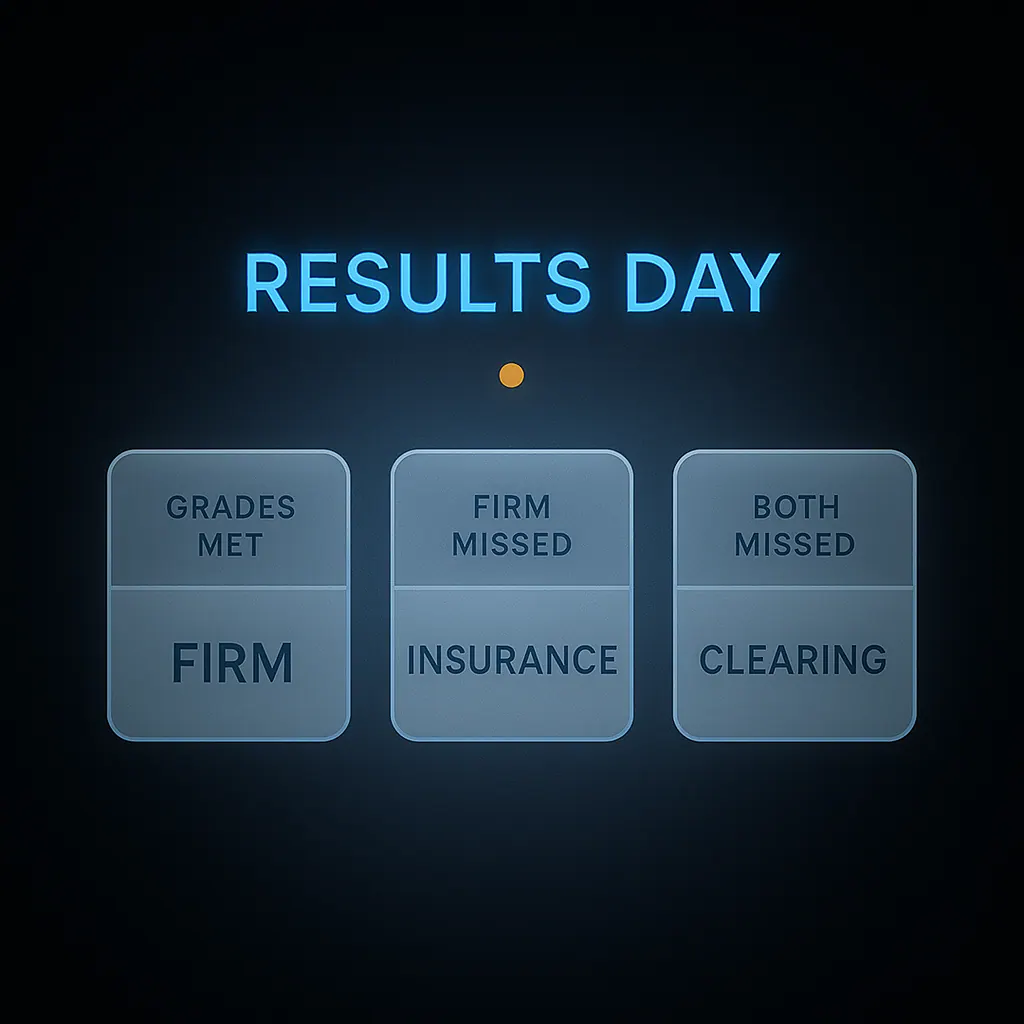
Results day produces one of three outcomes, and UCAS handles the first two automatically.
If you meet your firm conditions, UCAS confirms your place without you doing anything. If you miss your firm but meet your insurance conditions, your application moves to your insurance place instead. Per UCAS, the status message reads: "Congratulations - you've been placed at your insurance choice [University or college] to study [Course]!" If you're happy with that, no action is needed. If you miss both sets of conditions, you enter Clearing automatically.
The counter-intuitive part is what happens when you want to leave a confirmed place. From 2 July, applicants holding an unconditional firm offer can use the 'Decline my place' button to self-release into Clearing. Most applicants assume declining only affects their firm choice. It doesn't: UCAS confirms it also cancels your insurance place, voids any accommodation arrangements, and terminates scholarship contracts with the university.
A few important specifics:
- Swapping courses at the same university means contacting that institution directly, not pressing the decline button, which would release you into Clearing entirely.
- Accidental declines require an immediate phone call to the university. UCAS warns the place may already have been offered to another applicant by the time you call.
- Insurance place you don't want can also be declined using the same button, which then makes you eligible for Clearing.
If your firm place is still conditional on results and you want to apply elsewhere, you can contact UCAS between 08:00 on Thursday 14 August and 2 September to request Clearing release, but doing so forfeits both your firm and insurance choices.
7. Where to go from here
Before you reply, do one specific check that many applicants skip: confirm that your insurance offer carries a **genuinely lower grade requirement** than your firm, not just a different course name. An insurance offer at the same tariff points as your firm gives you no safety net at all.
This week, log into your UCAS application, find the "Your choices" tab, and note which decisions are still outstanding. Your personal reply deadline is shown there, and it is almost certainly earlier than the main UCAS reply date for your application round.
Then use the UCAS choices shortlist optimiser to check your combinations before you reply to confirm the gap between your firm and insurance requirements is wide enough to be meaningful.
Check your UCAS hub today and write your personal deadline on your calendar before anything else.
FAQ
How long do I have to reply to my UCAS offers?
Your deadline depends on when you received your last decision: for 2027 entry, decisions received by 31 March 2027 give you until 5 May 2027, decisions by 12 May give you until 2 June, and decisions by 14 July give you until 21 July.
What is the difference between a firm and insurance choice on UCAS?
Your firm choice is the offer you most want to accept; your insurance is a backup that should carry a lower entry requirement so that if you narrowly miss your firm conditions, you still have a confirmed place.
Can I change my UCAS choices after accepting an offer?
You can swap an automatically declined choice within 14 days by contacting UCAS, but after that you need the university's permission, and no swaps are possible after 22 July 2027, UCAS's cut-off for 2027 entry.
What happens if I don't reply to my UCAS offers by the deadline?
UCAS applies a 'declined by default' rule - all your offers are automatically declined - but you have 14 days from that date to contact UCAS to request a reversal.
Can I hold an insurance choice if I accept an unconditional offer?
No - accepting an unconditional offer as your firm choice means you cannot hold an insurance choice; if you change your mind later, you would need to go through Clearing.
How do I accept a UCAS offer on results day?
On results day, UCAS confirms your place automatically based on whether you met your firm or insurance conditions - you do not need to actively choose between them, though you can decline your insurance place if you want to enter Clearing instead.
References
- How To Accept Or Decline University Offers & Deadlines For Your Replies - https://www.ucas.com/applying/after-you-apply/types-of-offers/replying-to-your-offers
- Think carefully when you reply to your offers | UCAS - https://www.ucas.com/connect/blogs/think-carefully-when-you-reply-your-offers
- Key dates timeline | UCAS - https://www.ucas.com/advisers/help-and-training/key-dates-timeline
- University offers - conditional, unconditional, unsuccessful & withdrawn - https://www.ucas.com/applying/after-you-apply/types-of-offers
- Your insurance choice: What are your options? | UCAS - https://www.ucas.com/applying/after-you-apply/clearing-and-results-day/results-day/your-insurance-choice
- Declining your firm place | UCAS - https://www.ucas.com/applying/after-you-apply/clearing-and-results-day/results-day/declining-your-firm-place