Firm and Insurance Choice: What They Mean and How to Pick
By Michael Thompson · Former IB Diploma Programme coordinator; 10 years at Bromsgrove School · Published 5 July 2026
Your firm and insurance choice are the two decisions that determine where you go to university after results day. The firm is the offer you commit to attending if you meet its conditions; the insurance only activates if you fall short of the firm but meet a lower set of grades at your backup university. Most applicants treat this as a formality, but the choice you make - and the grade gap between the two offers - matters more than it looks. Get it wrong and you could end up with no safe fallback, or locked into a place you never wanted.
Key Takeaways
- Firm choice is a conditional contract: if you meet its entry requirements, you are placed there automatically - you cannot switch to your insurance at that point.
- Insurance only activates on a miss: if you fall short of your firm offer's grades but satisfy your insurance conditions, UCAS places you at the insurance university.
- The insurance must have genuinely lower entry requirements: an insurance set at the same grades as the firm offers no safety net - there is no meaningful fallback if you miss by one grade.
- Missing the reply deadline means all offers are declined: UCAS withdraws any outstanding offers automatically if you do not reply in time.
- IB applicants must check the points gap, not just the subject grades: a one-point overall IB Diploma difference may not be enough of a buffer if higher-level subject conditions overlap.
- Accepting an unconditional offer as your firm removes your insurance slot: you cannot hold an insurance place alongside an unconditional firm choice.
In This Article
- What firm and insurance choice mean on UCAS
- Firm vs insurance choice: a side-by-side comparison
- Why your insurance must have lower entry requirements than your firm
- UCAS firm and insurance choice deadline and what happens if you miss it
- Can you change your firm and insurance choices after submitting?
- Common mistakes when choosing firm and insurance
- What to do before you submit your choices
1. What firm and insurance choice mean on UCAS
Your firm and insurance choice are the two decisions that turn a set of university offers into a firm commitment. You make both via UCAS Track once all your university decisions have come in, not before.
Firm choice is the offer you rank as your first preference. If you meet its conditions on results day, you are placed there automatically. No further action needed, no room to reconsider at that point.
Insurance choice is a backup. It only activates if you miss the conditions attached to your firm offer but satisfy the (typically lower) conditions the insurance university set. As UCAS makes clear, if that happens you are allocated to the insurance university and cannot choose between the two at results stage. The decision is made for you.
One detail that catches students out: accepting an offer is a legally binding contract. The university agrees to take you if you meet the conditions; you agree to attend the course. This matters more than it might seem, given that you are committing to spending at least three years there.
The practical implication is worth stating plainly. Your insurance offer must carry lower entry requirements than your firm, not equal ones. An insurance offer with identical grade conditions gives you no safety net at all.
2. Firm vs insurance choice: a side-by-side comparison
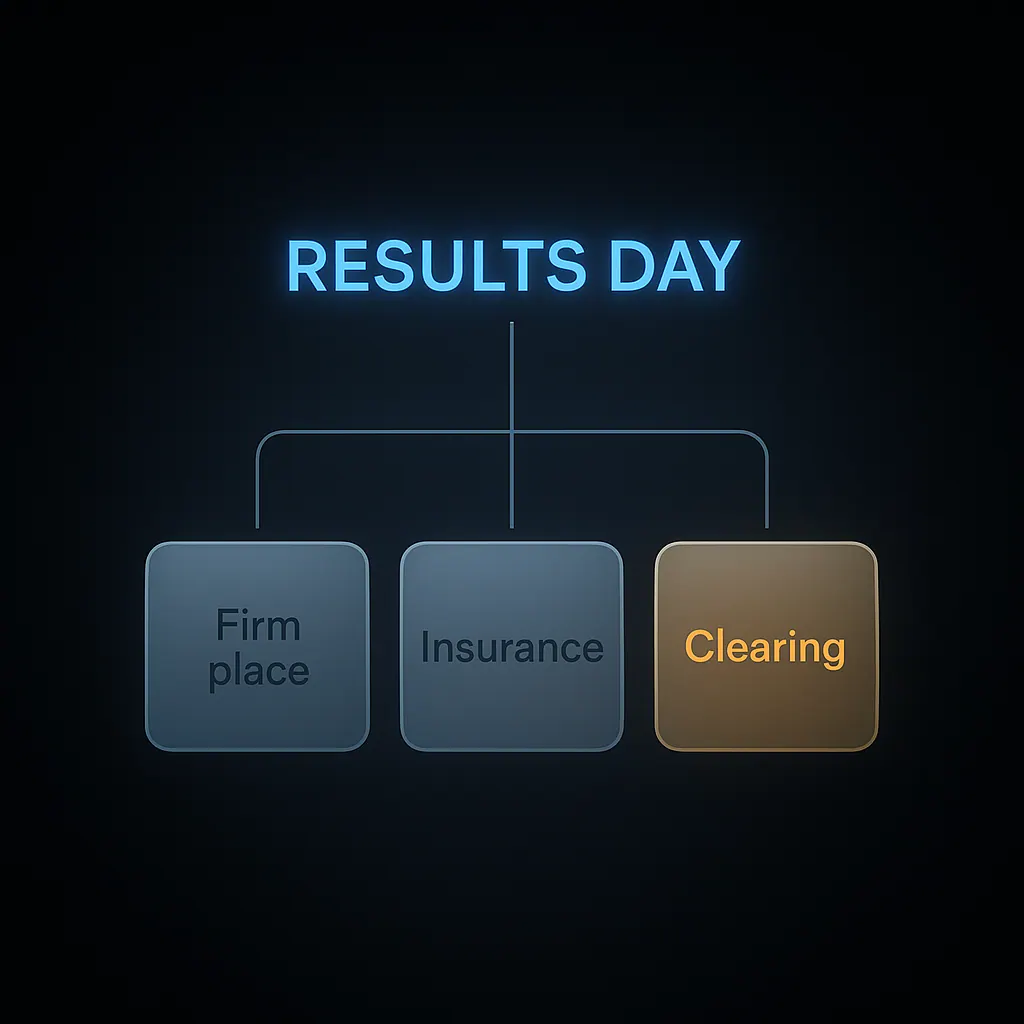
| Firm choice | Insurance choice | |
|---|---|---|
| What it is | Your first-preference offer, the one you most want to attend | Your backup offer, held in reserve if the firm falls through |
| Typical entry requirement level | Higher, matching your predicted grades | Lower, so you can realistically still meet it if results disappoint |
| You meet the firm's conditions | You are placed there automatically | Automatically declined, with no action required from you |
| You miss the firm's conditions | You are released from that offer | If you meet its conditions, UCAS places you there automatically |
| You miss both sets of conditions | N/a | You enter Clearing |
The automatic nature of results day is worth sitting with. Per UCAS, if you meet your firm offer conditions, your status becomes "placed at firm choice" and the insurance offer is dropped without any input from you. There is no moment where you can compare the two and pick.
The same logic runs in reverse. If you miss your firm but satisfy your insurance conditions, UCAS places you at the insurance university and you cannot then choose between them. The only remaining option at that point is to decline your insurance place and enter Clearing instead.
The non-obvious gotcha: some universities make their offer unconditional only if you name them as your firm choice. Accept that offer as insurance and the unconditional status may not apply.
3. Why your insurance must have lower entry requirements than your firm
The logic here is simple but easy to overlook. If you miss your firm offer's grades, you almost certainly missed them because results day was harder than expected. An insurance set at the same grade threshold gives you no extra room: you would fail both simultaneously, leaving you with no accepted place and heading straight to Clearing.
StudentStream states this directly: your insurance choice must have entry requirements lower than your firm, not equal to or higher. An insurance at identical grades is not a real backup; it is a false safety net.
Birmingham City University puts it plainly as a general rule: place the university with higher entry requirements as your firm and the one with lower requirements as your insurance, unless personal preference gives you a strong reason to do otherwise.
The IB-specific gotcha
A-level applicants can compare offers in a single number (UCAS Tariff points or grade strings), but IB Diploma applicants need to read two separate conditions:
- Overall points total. An offer of 32 points is genuinely lower than one of 35 points, and that three-point gap is meaningful.
- Higher Level subject conditions. One university might ask for 35 points with 6,6,5 at Higher Level; another might ask for 33 points with 6,5,5. Even if the overall points look close, the Higher Level conditions can be the tighter constraint.
The non-obvious trap: an insurance offer with a lower overall points total but identical Higher Level grade conditions to your firm is not much protection. If you drop a grade in one Higher Level subject, you may breach both conditions at once. When comparing two IB offers, check the Higher Level string carefully, not just the headline number.
As a practical step, write both offers side by side, list the overall totals and the Higher Level conditions separately, and confirm that the insurance is genuinely easier to meet on both dimensions before you submit.
4. UCAS firm and insurance choice deadline and what happens if you miss it
You do not get to choose when your firm and insurance choice deadline falls. Once all your university decisions are in, UCAS sets a reply deadline and notifies you through your UCAS Hub. That window is typically a few weeks, but the exact date shifts between cycles.
The consequence of missing the deadline is automatic, not manual. If you do not reply in time, UCAS withdraws all your remaining offers without further warning. You are not chased for a second chance; the offers simply lapse. At that point, your only route back into the process is Clearing, which opens much later in the year.
The non-obvious gotcha here involves unconditional offers. If a university makes your offer unconditional specifically on the condition that you accept it as your firm choice, accepting it removes your insurance slot entirely. You hold one place, not two. That can feel like a good deal, but it leaves no safety net if your circumstances change before September.
A separate quirk: once you have submitted your firm and insurance choice via UCAS, you cannot change them before results day, so the deadline is not just about replying, it is about replying correctly.
Check your own UCAS Hub now for the 2025 or 2026 cycle deadline. The date is personalised to your application and will differ slightly depending on when your last university decision arrived.
5. Can you change your firm and insurance choices after submitting?
**Once you submit your firm and insurance choice through UCAS Track, you cannot change them before results day.** That is the default rule, with no exceptions for second thoughts or changed circumstances, per StudentStream.
The one route out involves Clearing, and it only works in a specific direction. If on results day you would rather attend your insurance university than your firm, you cannot simply swap. You must first ask your firm-choice university to release you. If they agree, you enter Clearing. Only at that point can you contact your preferred university to confirm the course still has a place and that they will accept you. Crucially, StudentStream is explicit: you need that confirmation before accepting anything in Clearing. Do not release yourself and assume the place will be waiting.
The less obvious scenario involves changed course offers. If your firm choice issues a changed course offer (a different course, start date, or entry point from what you applied for), your options depend on where your insurance choice is in the process, per UCAS:
- Insurance has made an unconditional offer: you can accept the changed course or decline it and take the insurance place.
- Insurance has not yet decided: you can accept, decline, or wait before acting.
- Both choices issue changed course offers: you choose which one to accept.
The non-obvious gotcha with firm and insurance choice changes: releasing yourself into Clearing is irreversible. Once your firm-choice university lets you go, that offer is gone, even if the Clearing conversation with your preferred university then falls through.
6. Common mistakes when choosing firm and insurance
Four errors come up repeatedly, and each one has a consequence worth understanding before you submit.
Naming an insurance you would not actually attend. Accepting an offer is a legally binding contract: the university agrees to take you if you meet the conditions, and you agree to attend the course (UCAS). If you miss your firm grades but meet your insurance conditions, you are allocated to the insurance university automatically. You cannot choose between the two at results stage. You will spend at least three years there (UCAS), so "I'll just pick somewhere as a backup" is not a safe strategy.
Setting the insurance at the same grade requirement as your firm. This is not a real fallback. Your insurance must have lower entry requirements than your firm choice (StudentStream). If the two offers sit at identical conditions, missing your firm grades almost certainly means missing your insurance too.
**Leaving the insurance slot empty.** You lose the safety net entirely. If you do not meet your firm conditions with no insurance in place, you go straight into Clearing with no guaranteed option waiting.
Accepting an unconditional offer without realising it removes the insurance option. Some universities only make an offer unconditional once you set them as your firm choice (Loughborough University). The moment you accept an unconditional offer as firm, you cannot hold an insurance choice alongside it (StudentStream). That trade-off catches students who accept quickly without reading the small print.
7. What to do before you submit your choices
Before you reply, run through this checklist. Missing one step here can mean spending three or more years at a university you never properly evaluated, so the time is worth it.
- **Compare your offers side by side.** Use the UCAS Shortlist Optimiser at /ucas-choices to lay both offers next to each other and confirm a genuine grade gap exists between firm and insurance. If the entry requirements are identical, your insurance provides no real safety net.
- Read the conditions of both offers in full. If anything is unclear, contact the university directly for clarification before you reply, not after.
- Check you would genuinely attend your insurance university. Visit it, look at accommodation availability, and review the course content. Accepting an offer is a legally binding contract.
- IB applicants: write out both offers in full. Note the overall points requirement and every HL subject grade condition separately. One overall point of buffer means nothing if both offers demand identical HL grades.
- Check your reply deadline in the UCAS Hub now. Calendar it with a buffer day or two. Open the Hub this week, confirm the exact date, and set the reminder before you close the tab.
FAQ
What is a firm and insurance choice on UCAS?
Your firm choice is the offer you commit to as your first preference; your insurance is a backup offer with lower entry requirements that activates only if you miss the firm's conditions on results day.
What is the deadline for firm and insurance choices on UCAS?
UCAS sets a reply deadline once all your university decisions are in; the exact date appears in your UCAS Hub and missing it causes all remaining offers to be automatically declined.
Can you change your firm and insurance choice on UCAS after submitting?
Once submitted, firm and insurance choices cannot normally be changed; if you later prefer your insurance university, you must ask your firm-choice university to release you into Clearing first.
Can your insurance choice have the same grades as your firm?
It can technically, but it gives you no real safety net - if you miss the firm's conditions, you will almost certainly miss an equally demanding insurance too.
What happens if you miss your firm offer but meet your insurance conditions?
UCAS automatically places you at your insurance university; you cannot switch back to the firm at that point, though you can decline the insurance place and enter Clearing instead.
Can you choose your insurance offer over your firm on results day?
No - if you meet your firm offer's conditions, you are placed there automatically and the insurance is declined; to attend the insurance university instead you would need to be released into Clearing by the firm.
References
- Think carefully when you reply to your offers | UCAS - https://www.ucas.com/connect/blogs/think-carefully-when-you-reply-your-offers
- What Are Firm And Insurance Choices? - StudentStream - https://www.studentstream.co.uk/blog/what-are-firm-and-insurance-choices
- Understand Your Exam Results & UCAS Application Status | Clearing - https://www.ucas.com/applying/after-you-apply/clearing-and-results-day/results-day/what-your-application-status-means
- Choosing a firm and insurance choice | Birmingham City University - https://www.bcu.ac.uk/student-info/how-to-apply/after-you-apply/choosing-firm-and-insurance
- Six firm and insurance do's and don'ts | LUDUS | Loughborough University - https://www.lboro.ac.uk/study/ludus/students/applying/firm-and-insurance-dos-and-donts