How to Write a UCAS Personal Statement 2026
By Michael Thompson · Former IB Diploma Programme coordinator; 10 years at Bromsgrove School · Published 4 July 2026 · Updated 5 July 2026
How to write a UCAS personal statement has changed fundamentally for 2026 entry: the old single free-form essay is gone, replaced by three separate structured questions with a shared 4,000-character limit. The shift matters because admissions tutors now read your answers as a scored whole, which means a list of achievements spread across 47 lines no longer works the way it used to. This guide walks through every question, explains what tutors are actually assessing in each, and gives you a planning method that works whether you are studying A-levels, the IB Diploma, or a mix of qualifications. One statement still covers all five of your UCAS choices, so the approach here is built around writing to the common ground between your courses rather than flattering a single university.
Key Takeaways
- Three questions, one shared budget: The 2026 format replaces the single essay with three separate questions, all drawing from a single 4,000-character (including spaces) limit, with a minimum of 350 characters per question.
- Admissions tutors read all three answers together: UCAS explicitly warns against repeating information across questions - each answer should carry different evidence.
- Plan before you draft: Map your specific evidence - modules, wider reading, work experience, projects - to whichever of the three questions it best answers before writing a single sentence.
- IB students have ready-made material: Your Extended Essay, Theory of Knowledge, CAS programme, and HL subject choices directly supply the evidence that questions two and three ask for.
- One statement serves all five choices: Write to the common ground between your courses rather than naming a specific university, because every admissions tutor on your list reads the same text.
- The old 'achievement list' approach no longer fits: The structured format rewards explained, evidenced motivation - not a chronological list of things you have done.
In This Article
- What Changed for 2026 Entry - and Why It Matters
- The 4,000-Character Limit: One Budget, Three Questions
- Question 1: Why Do You Want to Study This Course?
- Question 2: How Have Your Qualifications and Studies Prepared You?
- Question 3: What Else Have You Done to Prepare Outside Education?
- A Compact Map of the Three Questions
- How to Plan Before You Draft: Mapping Evidence to Questions
- IB Students: Using Your Diploma as Evidence Across All Three Questions
- Personal Statement Opening Lines: What Actually Works
- Where to Go from Here
1. What Changed for 2026 Entry - and Why It Matters
Knowing how to write a UCAS personal statement has always been stressful. For 2026 entry, the format changed fundamentally: the single free-form essay is gone, replaced by three separate structured questions, each with its own answer box and a minimum of 350 characters. The total budget stays at 4,000 characters including spaces, so the constraint is familiar, but the shape of the task is not.
The change came after UCAS consulted over 1,200 students, over 200 teachers and advisers, and over 100 universities and colleges. The motivation is visible in the data: a survey of 2022 cycle applicants found 83% said the process was stressful, even though the same survey found the majority understood what the personal statement was for.
One concrete consequence is that extenuating circumstances no longer belong in the personal statement at all. UCAS has moved them to a dedicated section within the reference, written by your teacher or adviser. That is worth knowing early: do not use your 4,000 characters to explain illness, bereavement, or disrupted schooling.
The less obvious implication is that a chronological list of activities, the approach many students defaulted to under the old format, no longer fits. Admissions staff review all three answers as a single whole, and the structure is specifically designed to surface motivated, evidenced reasoning. What you did matters less than why it prepared you for this course.
2. The 4,000-Character Limit: One Budget, Three Questions
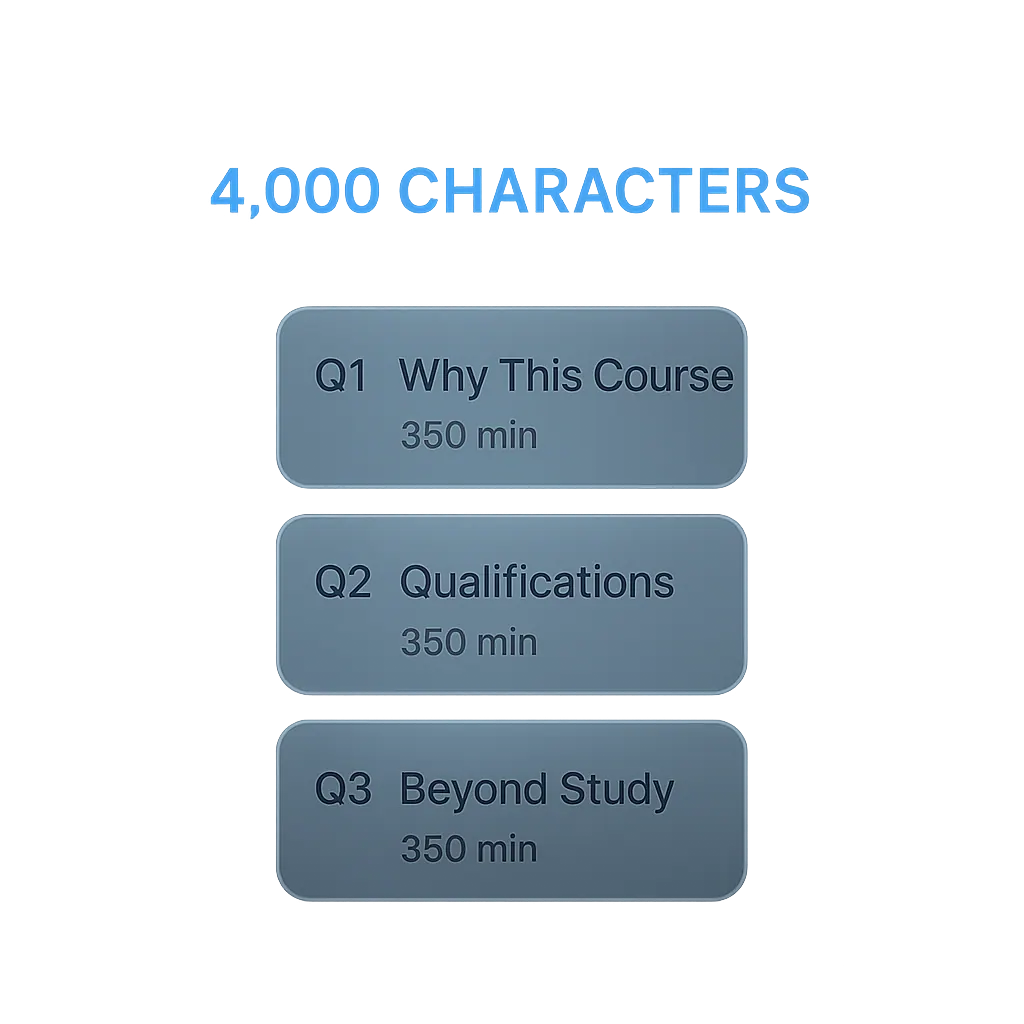
The UCAS personal statement for 2026 entry gives you **4,000 characters including spaces** as a single shared budget across all three questions. That is not 4,000 per question. Spend 3,800 on Question 1 and you have almost nothing left for the other two.
Each question box shows its own character counter alongside the overall one, and UCAS requires a minimum of 350 characters per question. That floor exists to stop applicants leaving a question effectively blank.
There is no fixed upper limit per question beyond the 4,000-character total, so you can distribute the budget unevenly. A sensible starting point is roughly equal thirds, then shift weight toward whichever question your strongest evidence answers. If your super-curricular reading list and academic competitions are your real differentiators, Question 1 can reasonably absorb more characters than Questions 2 or 3.
One practical gotcha: the limit counts characters, not words. A word-count tool will mislead you. Draft in a character-counting tool, such as the one built into the UCAS application itself, or a free online character counter. Spaces between words count toward your total, so a sentence that looks short in a word processor can be longer than you expect.
3. Question 1: Why Do You Want to Study This Course?
UCAS phrases this question as: "Why do you want to study this course or subject?"
Admissions tutors are looking at four things here: genuine motivation, subject knowledge, super-curricular engagement, and future plans. The question is deliberately broad, but that breadth is a trap. Vague statements about lifelong passion take up characters without telling a tutor anything they can evaluate.
Anchor your motivation to a specific intellectual encounter. That might be a named book that shifted how you think about a problem, a public lecture, a piece of published research you followed up independently, or a competition such as the UKMT Mathematical Challenge. The specificity signals that your interest is real and that you can engage with material beyond the A-level syllabus.
One structural quirk catches many applicants off guard: your statement goes to all five of your UCAS choices simultaneously. You cannot name individual universities, and you should not try to write motivation that only fits one course. Focus on the subject itself and the intellectual common ground across your shortlisted courses. If your choices span, say, Economics and Philosophy, identify what draws you to both rather than hedging.
Future plans do not need to be specific career commitments. A sentence explaining how the subject connects to a broader intellectual direction is enough. Tutors are assessing whether your motivation has any depth, not whether you have already planned your career.
Keep this question tightly focused. Resist the urge to mention extracurricular activities here: UCAS explicitly places those in Question 3, and repeating material across answers wastes your 4,000-character budget.
4. Question 2: How Have Your Qualifications and Studies Prepared You?
UCAS phrases this question as: "How have your qualifications and studies helped you to prepare for this course or subject?"
The scope is wider than it sounds. Admissions tutors use this answer to assess formal education, transferable skills, and educational achievements. Grades are listed separately on your application, so do not waste characters restating them here. The question is about what you did with the content of your studies, not what grade you received for doing it.
UCAS names specific evidence types that belong in this question:
- Extended Project Qualification (EPQ)
- UKMT (UK Mathematics Trust) competitions
- Private music or sports qualifications
- Online courses
- Tutoring or mentoring experience
The non-obvious pitfall here is treating this as a list. An EPQ title dropped in without context tells a tutor almost nothing. What they want to see is the connection: which skill or body of knowledge did that project develop, and why does the course you are applying for require it? A student applying to study Law who mentored younger pupils in essay writing has a stronger answer than one who simply states they hold a Grade 8 in violin, unless they can explain what sustained, self-directed practice taught them about structured argument or performance under pressure.
Aim for specificity over coverage. Pick two or three pieces of evidence and connect each one directly to a skill or concept the course demands, rather than listing every qualification you hold.
5. Question 3: What Else Have You Done to Prepare Outside Education?
UCAS words this question precisely: "What else have you done to prepare outside of education, and why are these experiences useful?" The second clause is the one most applicants underwrite. Listing what you did is not enough. The question asks why it is useful, which means connecting each activity directly to the course you are applying for.
Admissions tutors use this section to assess a range of evidence:
- Work experience (paid or unpaid) relevant to the subject
- Extracurricular activities that demonstrate relevant skills or interests
- Volunteering that shows engagement with a field or community
- Personal projects such as independent reading, podcasts, a coding portfolio, or self-directed research
The non-obvious trap: students who have done impressive things often spend their character budget on description and run out of space before reaching the reflection. A week of work shadowing at a law firm earns nothing if you do not explain what it revealed about legal reasoning or the realities of practice.
If your formal work experience is limited, UCAS recommends subject tasters and virtual work experience as legitimate ways to generate evidence. A virtual placement or an online subject taster course can be cited here, provided you reflect on what you took from it.
The test for every activity you include: can you finish the sentence "this is useful because..."? If not, either find the reflection or cut the activity.
6. A Compact Map of the Three Questions
UCAS instructs admissions staff to read all three answers as a single whole, which means repeating a piece of evidence across two questions actively wastes your 4,000-character budget. The counter-intuitive implication: a strong answer to Question 2 can weaken your overall statement if it bleeds into territory you covered in Question 1.
| Question | What admissions tutors assess | Example evidence types | Common pitfall |
|---|---|---|---|
| Q1: Why this course? | Genuine motivation, subject knowledge, awareness of the discipline | Super-curricular reading, lectures attended, podcasts, relevant work shadowing | Vague "passion" statements with no specific subject content |
| Q2: How have your studies prepared you? | Transferable academic skills, formal qualifications beyond grades | EPQ, UKMT competitions, A-level modules, online courses, tutoring others | Listing grade predictions (they appear elsewhere on the application already) |
| Q3: What else have you done outside education? | Independent initiative, relevant extracurricular activities, personal qualities | Part-time work, volunteering, sports leadership, Duke of Edinburgh | Repeating super-curricular activities already used in Q1 |
The no-repetition rule is stricter than it looks. Super-curricular activities for the personal statement belong in Q1; extracurricular activities belong in Q3. Crossing that boundary is the most common structural error in the 2026 format.
7. How to Plan Before You Draft: Mapping Evidence to Questions
Before you write a single sentence, build an inventory. List every piece of evidence available to you: A-level or IB modules, wider reading, online courses, work experience, competitions such as UKMT or Biology Olympiad, the EPQ, private qualifications, tutoring, projects. Get it all on one page first.
Then assign each item to the question it fits best:
- Question 1 (why this subject): reading beyond the syllabus, subject-specific competitions, future plans.
- Question 2 (how your studies prepared you): modules, EPQ, formal qualifications, transferable academic skills.
- Question 3 (what else you have done): work experience, volunteering, extracurricular projects.
This step matters because UCAS explicitly warns against repeating information across the three answers. The [most common planning failure](/guides/personal-statement-mistakes) is not repetition, though - it is front-loading. Students dump almost everything into Question 1 and leave Questions 2 and 3 thin. The inventory forces you to distribute deliberately before habit takes over.
**Identify the common ground across all five of your UCAS choices before you assign anything.** If you are applying to courses ranging from straight Economics to PPE, the shared thread might be quantitative reasoning, policy analysis, and independent research - not macroeconomics specifically. Build your plan around those two or three overlapping skills, and every answer will read coherently to admissions tutors across all five universities.
Once assigned, draft each question independently without worrying about length. Then read all three together. Check for overlap, check the balance feels proportionate, and only then edit down to fit within the 4,000-character budget. Editing a balanced draft is much faster than trying to redistribute evidence mid-sentence.
8. IB Students: Using Your Diploma as Evidence Across All Three Questions
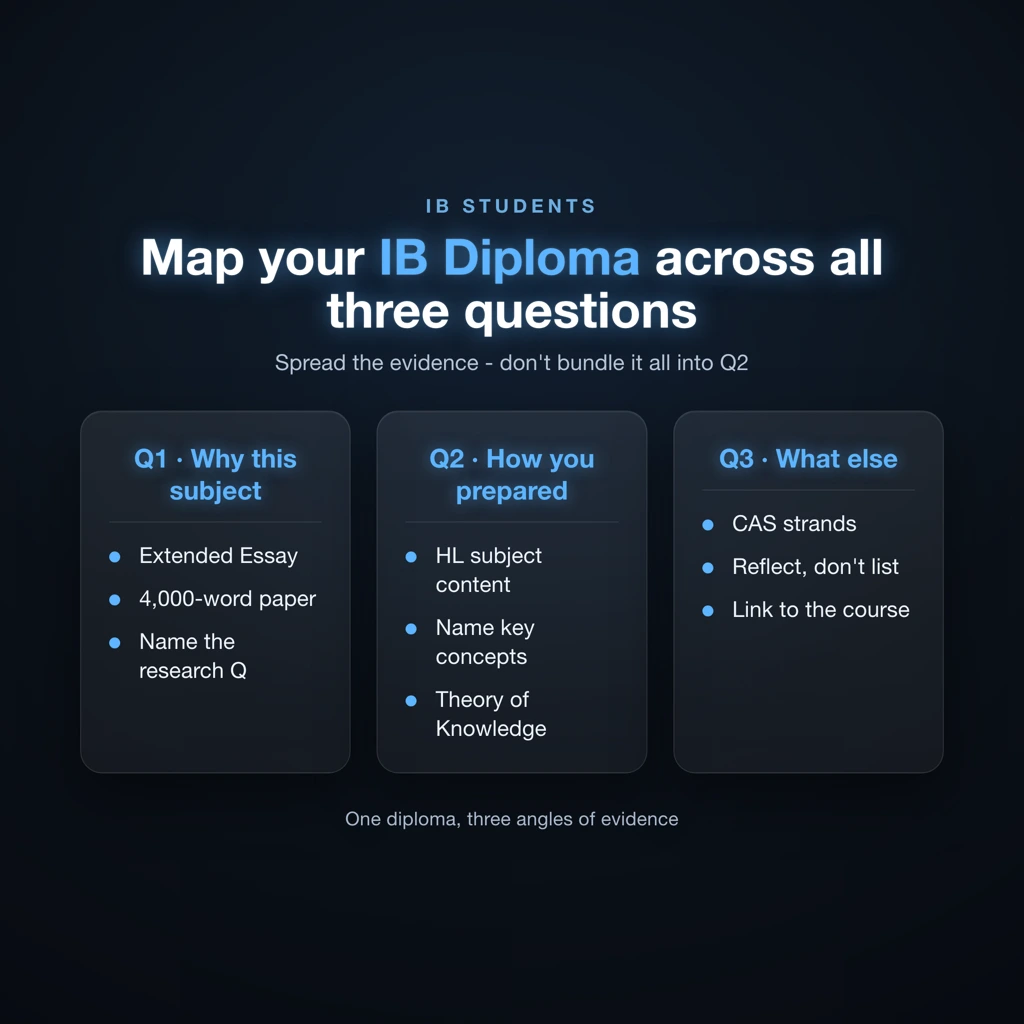
The IB Diploma is unusually well-matched to the new three-question format - but only if you distribute its components deliberately rather than bundling everything into question 2 by default.
Question 1 (why this subject): The Extended Essay is your strongest asset here. A 4,000-word independent research paper on a focused question demonstrates sustained intellectual curiosity in a specific field, not just general interest. If your EE topic overlaps with your intended course, name the research question and say what it showed you about the discipline. That is concrete evidence of motivation, not a claim about it.
Question 2 (how your studies prepared you): Two IB-specific sources of evidence work well.
- HL subject content: Name the specific concepts, not just the subject. A student applying for Economics who studied price discrimination and market failure at HL is saying something more precise than "I studied Economics." Precision matters because admissions tutors read thousands of statements.
- Theory of Knowledge: TOK is frequently underused. It trains cross-disciplinary epistemological reasoning and requires you to write a structured essay under academic constraints. If you are applying for Philosophy, Law, or any course that rewards analytical writing, TOK essay experience belongs in question 2.
Question 3 (what else have you done): CAS is the non-obvious source. The mistake IB students make is treating CAS as a checklist: "I volunteered at a food bank, played in an orchestra, and ran a 10k." That tells an admissions tutor nothing useful. Instead, reflect on what each strand showed you. Service that involved communicating with people under pressure is relevant to Medicine. A Creativity project that required iterative problem-solving is relevant to Engineering. The UCAS guidance explicitly asks what you have done to prepare outside education, not simply what you have done.
The counter-intuitive point: IB students often have richer question 3 material than A-level applicants, because CAS is structured and documented. The problem is not a shortage of evidence, it is a failure to connect that evidence to the course.
9. Personal Statement Opening Lines: What Actually Works
Under the new three-question format, the opening of Question 1 is your first line. Admissions readers see it before anything else, so it carries the same weight the old single-essay opener did.
The one thing that sinks most openings is abstraction. "I have always been passionate about economics" tells a reader nothing. A named idea does: opening with a specific concept you encountered, a named text that shifted how you think, or a real event that posed a question you couldn't answer, signals intellectual engagement rather than just enthusiasm. Specificity is the mechanism, not decoration.
The counter-intuitive trade-off in the new format: you now have three openings, not one. Question 1 should orient the reader to your intellectual pull toward the subject. Question 2's opening should pivot clearly to formal preparation. Question 3's opening should signal the strand of evidence that sits outside the classroom. Each one needs to do its own orienting work. Students who treat Question 2 and 3 as continuations of Question 1 waste that reorientation signal.
On AI tools: UCAS publishes specific guidance on using AI with personal statements, covering both recommended uses and practices to avoid. Read it before you draft anything, not after, because the guidance covers authorship expectations that affect every line you submit.
10. Where to Go from Here
Before you write a single sentence, build an evidence inventory. Open a spreadsheet and list every module you have studied, every qualification you are taking (A-Level, IB Higher Level, BTEC, SQA Higher, EPQ), every super-curricular activity, every relevant work or volunteering experience, and every independent project. Then assign each item to one of the three 2026 questions. The counter-intuitive gotcha: most students discover they have almost nothing mapped to Question 2, because they assume qualifications "speak for themselves." They do not. An examiner reading your statement needs you to name the specific content and explain what it revealed.
Once the inventory is complete, the gaps are obvious before you waste words on a draft.
If you want a second pair of eyes on your answers before the UCAS deadline, book a personal statement review to get structured feedback on all three questions.
FAQ
What is the UCAS personal statement word limit for 2026?
The 2026 UCAS personal statement has a 4,000-character limit (including spaces) shared across all three questions, not a word limit - each question also has a minimum of 350 characters.
How many questions are in the 2026 UCAS personal statement?
There are three separate questions for 2026 entry onwards, covering: why you want to study the course, how your qualifications have prepared you, and what you have done outside education to prepare.
Can I write the same thing in more than one question?
No - UCAS explicitly advises against repeating information across the three answers because admissions staff read all three as a single whole.
How long does it take to write a UCAS personal statement?
Most applicants spend several weeks on their personal statement across multiple drafts; the planning stage - mapping evidence to questions before drafting - typically saves the most time overall.
How should I divide the 4,000 characters between the three questions?
There is no fixed per-question allocation beyond the 350-character minimum; a practical starting point is to divide the budget roughly evenly, then shift more characters toward whichever question your strongest evidence answers.
How do I write a UCAS personal statement if I am applying to different subjects?
Identify the two or three subject-level themes or skills that all your chosen courses share and build each answer around that common ground, since every admissions tutor on your UCAS list reads the same statement.
References
- Reforming admissions | UCAS - https://www.ucas.com/about-us/news-and-insights/reforming-admissions
- How to write your personal statement: 2026 entry onwards | UCAS - https://www.ucas.com/applying/applying-to-university/writing-your-personal-statement/how-to-write-your-personal-statement-for-2026-entry-onwards
- Writing your personal statement | UCAS - https://www.ucas.com/undergraduate/applying-university/writing-personal-statement