UCAS Reference: What It Is and How It Works
By Michael Thompson · Former IB Diploma Programme coordinator; 10 years at Bromsgrove School · Published 5 July 2026
A UCAS reference is a confidential statement written on your behalf by a teacher, tutor, or other authorised referee - not by you - and submitted as part of your undergraduate application. It is attached to your application before it is sent, so universities see it alongside your personal statement and predicted grades. The reference follows a structured format introduced by UCAS, with set sections covering your school or college context, any extenuating circumstances, and information specific to you as an applicant. Understanding how the reference works, and what you can do to help your referee, makes a real difference to how specific and useful the final statement is.
Key Takeaways
- You never see or write your own UCAS reference: It is confidential and submitted directly by your referee through the UCAS system.
- The reference follows a structured three-section format: Each section covers a distinct area: school context, extenuating circumstances, and applicant-specific information.
- Your referee must submit the reference before your application is sent: This means your school's internal deadline will fall weeks before the official UCAS deadline of 14 January 2026.
- IB students' predicted grades are carried within the reference: The Diploma Programme coordinator supplies these predictions, so they must be agreed before the reference is finalised.
- Sharing your achievements and context with your referee early: gives them the material to write something concrete rather than a generic character endorsement.
- Extenuating circumstances have a dedicated section in the reference: If personal or medical factors have affected your studies, your referee can flag them here without mixing them into the general academic commentary.
In This Article
- What Is a UCAS Reference?
- The Structured Reference Format: What Each Section Covers
- Who Provides the UCAS Reference and How It Is Attached
- How to Help Your Referee Write a Specific Reference
- UCAS References and Predicted Grades: The IB Connection
- UCAS Referee Deadlines: When the Reference Must Be Ready
- What If You Have No School Reference or Are a Mature Student?
- What to Do Next
1. What Is a UCAS Reference?
A UCAS reference is a confidential written assessment submitted by a teacher, tutor, or adviser as part of a student's university application through UCAS. It is written by the referee, not the applicant, and the student cannot read, edit, or approve it before it reaches universities.
That confidentiality is worth noting: even if your referee mentions a difficult year or a subject you nearly dropped, you will not know unless they tell you. Universities receive it as an independent voice, which is precisely why admissions tutors treat it differently from the personal statement.
UCAS has moved away from the old free-form letter format. As part of a phased admissions reform programme, UCAS introduced a structured reference format in 2023, replacing the open-ended letter with a set of defined sections that referees complete in sequence. This sits alongside other reforms introduced across the same period, including new widening participation questions in 2022 and changes to historical grade data in 2024, all described by UCAS in its admissions reform overview.
The practical consequence: a referee can no longer simply paste a letter they wrote last year. Each section now requires a targeted response, which changes how teachers need to prepare.
2. The Structured Reference Format: What Each Section Covers
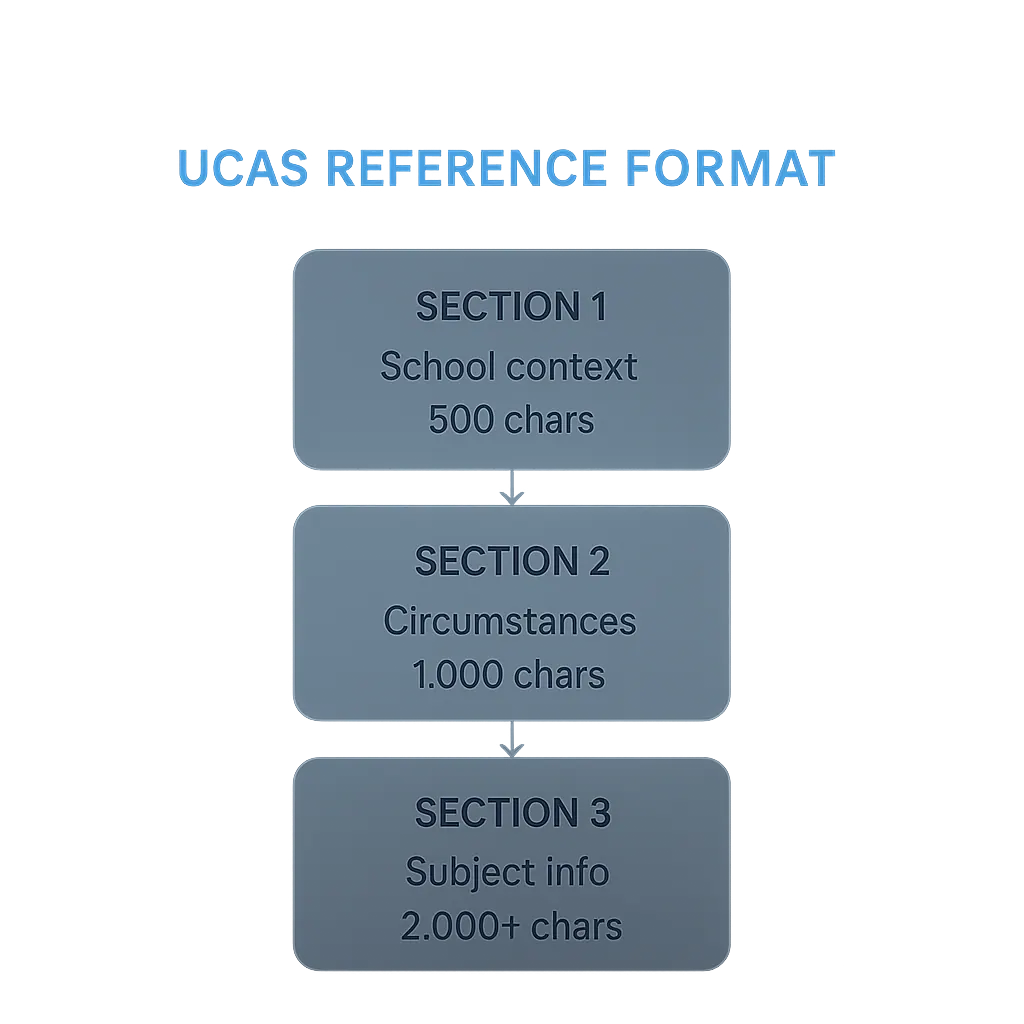
The UCAS reference is no longer a single free-text box. As part of UCAS's admissions reform programme, the reference was restructured into three distinct sections, each with a specific purpose. The extenuating circumstances section was introduced deliberately to separate sensitive personal or medical context from academic commentary, so that readers making academic judgements are not inadvertently influenced by personal detail that is not relevant to their decision.
The three sections are:
- Section 1: School or college context. A general statement about the institution. Cambridge's guidance to referees suggests using no more than 500 characters here. For non-UK schools this section carries more weight, since admissions tutors may be unfamiliar with the institution's curriculum or attainment profile.
- Section 2: Extenuating or personal circumstances. Space to flag mitigating factors such as illness, bereavement, or disrupted schooling. Cambridge advises a limit of around 1,000 characters; anything more detailed should go through a separate extenuating circumstances process so that only relevant staff see it. Referees must obtain the applicant's consent before disclosing any health or personal details in this section.
- Section 3: Supportive information about the applicant. The academic and subject-specific commentary. Cambridge's guidance sets a floor of at least 2,000 characters here, not a ceiling.
The counter-intuitive gotcha: because Section 2 exists, referees who bury a student's difficult circumstances inside Section 3 (the old habit) may actually reduce how carefully that context is weighed, since reviewers now expect sensitive information in a specific place.
3. Who Provides the UCAS Reference and How It Is Attached
For most school leavers, the referee is linked through their school or college. The role typically falls to a subject teacher, form tutor, or head of year. The key requirement is that the person knows the student academically, not just personally, and per Cambridge's guidance on UCAS references, the reference must be provided free of charge.
Students applying independently, such as mature applicants not attached to a school, add their referee's details directly to the application themselves. The referee then receives a link to complete the reference online.
**The reference must be attached before the application can be submitted.** This is the detail that catches students out: you cannot send your application and add the reference later. Your referee needs to be briefed, willing, and ready well before your target submission date. If you are applying by the January equal consideration deadline, that means your referee needs to be in a position to submit their section by then.
One notable change affects music and performing arts applicants. UCAS Conservatoires has moved away from requiring two full references. Applicants now submit contact details for a single referee, who is only contacted if a conservatoire needs further information. This is a significant reduction in upfront burden compared with the previous process.
For the standard UCAS reference, the application is not yours alone to submit: it is a shared document, and that dependency is worth planning around early.
4. How to Help Your Referee Write a Specific Reference
You never write your own UCAS reference, and you will not see it before it is submitted. That means the only way to influence its quality is to give your referee good material before they sit down to write.
The counter-intuitive point most students miss: Section 3 of the reference, the applicant and subject-specific section, should use at least 2,000 characters. A referee who knows nothing beyond your predicted grades will fill that space with vague praise. A referee who has your competition results, EPQ title, or the essay you wrote on a specific topic can fill it with concrete evidence. The difference is visible to admissions staff.
Give your referee a written briefing document. Include:
- Specific academic achievements - named essays, project titles, class debate wins, marks that surprised even you
- Relevant extracurricular activities - with dates, roles, and outcomes, not just activity names
- Context for any grade dips - illness, family disruption, a topic you found harder than expected
- Personal circumstances you are comfortable disclosing - note that referees must obtain your consent before including health or personal information, so this is a conversation to have explicitly, not an assumption
Do this several weeks before your school's internal deadline, not the week before. Referees juggling multiple students will write more substantively when they have time to reflect rather than rushing to meet a close deadline.
One specific gotcha: if you are completing an EPQ or an IB Extended Essay, name it clearly in your briefing document with the research question. These are exactly the subject-specific details that sit in Section 3, and referees often do not realise a student has done this work unless told directly.
5. UCAS References and Predicted Grades: The IB Connection
For IB Diploma Programme students, predicted grades do not sit in a separate UCAS field. They are carried inside the UCAS reference itself, written by the DP coordinator. This is the opposite of how A-level predictions work, where grades are entered in a dedicated section of the application form. The structural difference is easy to miss, and missing it causes real problems.
Universities use predicted grades to decide whether to make a conditional offer and at what level. If the DP coordinator submits the UCAS reference before predicted grades have been properly agreed, those figures may be conservative, aspirational, or simply unconfirmed. An underestimate can trigger a lower offer or a rejection that a stronger prediction would have avoided.
The practical consequence is an extra preparatory step that A-level applicants do not face: **IB students and their DP coordinator must agree predicted grades before the reference is finalised**, not after. Build that conversation into your timeline well ahead of the school's internal submission deadline.
There is also a less obvious complication for IB students applying to highly selective universities. Cambridge's guidance for referees specifies that the school context section of the reference should include how long the school has been teaching the applicant's qualifications. For IB schools that adopted the Diploma Programme relatively recently, the coordinator needs to address this directly. Admissions readers will notice if it is absent.
6. UCAS Referee Deadlines: When the Reference Must Be Ready
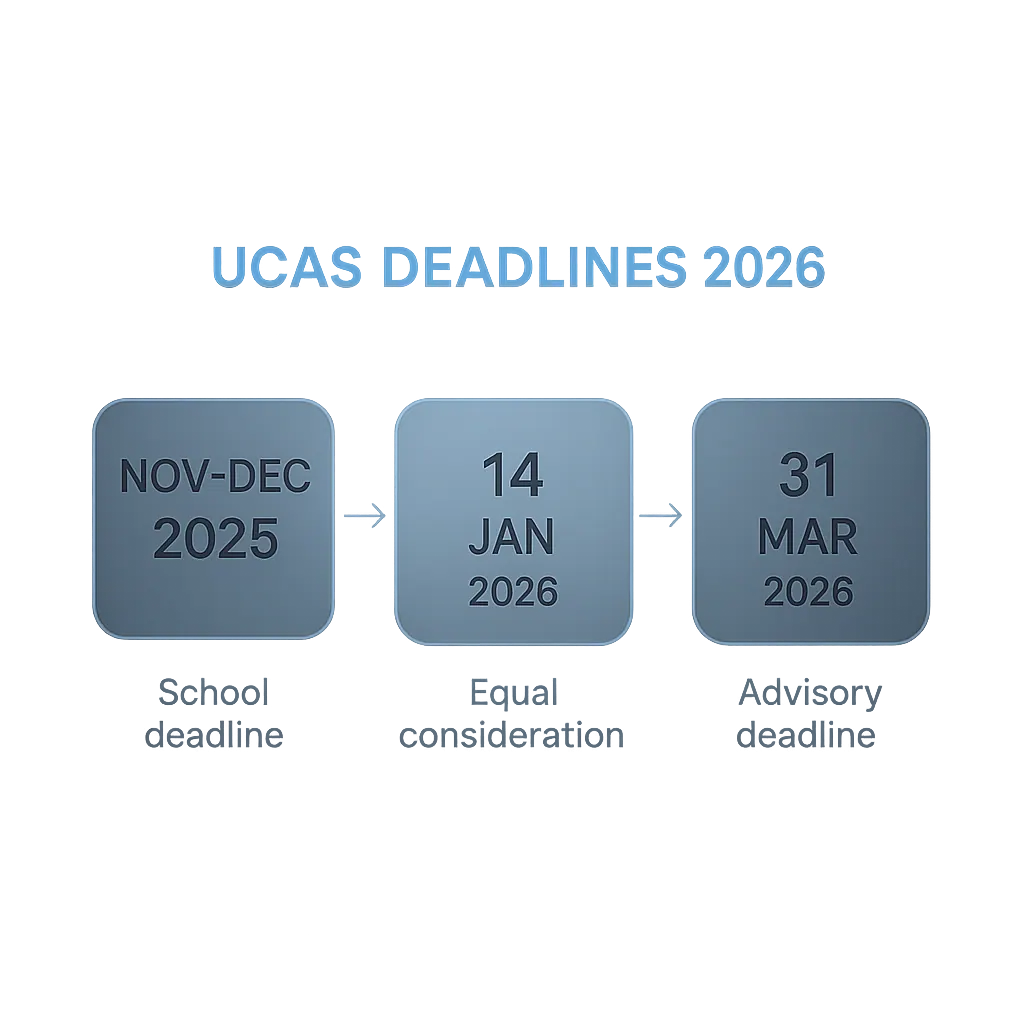
The equal consideration deadline for 2026 entry is 14 January 2026. Miss it and universities are under no obligation to treat your application the same as those submitted on time.
The less obvious point: the reference must be attached before you submit your application, not after. UCAS does not accept applications without a reference, so if your referee has not completed their section, the submit button will not work. You cannot fire off your form and expect your teacher to catch up later.
This means your real deadline is your school's internal deadline, which will fall several weeks before 14 January 2026. Schools stagger submissions across a large cohort, and many set internal cutoffs in late November or early December. Ask your form tutor or UCAS coordinator for the exact date now, not in January.
The key dates for the full 2026 cycle:
- 14 January 2026 - equal consideration deadline for most undergraduate courses
- 31 March 2026 - advisory deadline for late and Extra applications
- 2 July 2026 - Clearing opens
One gotcha worth knowing: if your school submits applications in batches, your referee may complete your reference on time but your application could still miss a batch upload window. Confirm with your school how and when they transmit applications to UCAS.
7. What If You Have No School Reference or Are a Mature Student?
Not every applicant goes through a registered school or college. Gap-year students, mature applicants, and career changers all apply as independent applicants, which means they add their referee directly in their UCAS account rather than through an institutional centre.
The key difference is practical: there is no admissions administrator to chase the reference on your behalf, so the entire process sits with you and your chosen referee.
Who can referee you? The short answer is anyone who can speak to your academic potential or relevant experience. In practice, the strongest options are:
- A former college or sixth-form tutor who taught you recently
- A previous teacher, particularly one whose subject connects to your chosen course
- A line manager who can speak to skills directly relevant to the degree, such as research, analysis, or clinical exposure for medicine
A personal friend or family member is not acceptable. An employer reference is permitted, but Cambridge's guidance notes that the referee should be someone who knows the applicant academically, and admissions staff will notice if the reference lacks any comment on academic ability.
The non-obvious gotcha: some selective universities treat a purely professional reference with scepticism even when the applicant's work history is impressive. If you have any route to a former teacher, use it.
If you are unsure whether your proposed referee meets UCAS referee requirements, contact UCAS or the admissions offices at your chosen universities before submitting. Do not assume.
8. What to Do Next
The equal consideration deadline is 14 January 2026, but your school's internal reference deadline will sit several weeks before that. Many schools close their referencing window in late November or early December to give teachers time to draft, review, and submit. If you miss that internal cutoff, your application cannot go in on time regardless of what UCAS allows.
This week, find out your school's exact internal deadline and confirm it directly with your referee or form tutor. Do not assume it matches the UCAS date. Put it in your calendar with a two-week buffer and give your referee any supporting notes, context, or subject examples they asked for before then.
For everything else around your application, check our UCAS application guide for step-by-step coverage of the full process.
FAQ
Can a UCAS reference be from an employer?
Yes - for applicants not in school or college, such as mature students or those applying after a gap year, an employer can act as referee, though the reference should ideally speak to academic potential or relevant skills.
Can I see my UCAS reference?
No - the UCAS reference is confidential; it is submitted directly by your referee and you do not have access to read or edit it before or after submission.
How long can a UCAS reference be?
The reference is structured into three sections; Cambridge's guidance to referees suggests Section 1 use up to ~500 characters, Section 2 up to ~1,000 characters, and Section 3 at least ~2,000 characters, though UCAS sets the overall format.
Does the UCAS reference have to be academic?
It should come from someone who can comment on your academic ability or potential - typically a teacher or tutor - though for mature or independent applicants a professional who can speak to relevant skills may be acceptable.
How many UCAS references do I need?
One reference is required for a standard undergraduate UCAS application; UCAS Conservatoires applicants now only need to provide contact details for one referee, who is contacted only if a conservatoire requires further information.
Does the UCAS reference matter?
Yes - universities use the reference alongside your personal statement and predicted grades; for competitive courses like medicine and Oxbridge applications, the academic detail in Section 3 and any contextual information carry real weight in the decision.
References
- Reforming admissions | UCAS - https://www.ucas.com/about-us/news-and-insights/reforming-admissions
- Writing a UCAS reference for undergraduate applicants | Undergraduate Study - https://www.undergraduate.study.cam.ac.uk/find-out-more/teachers-and-advisers/ucas-reference
- 2026 cycle toolkit | UCAS - https://www.ucas.com/advisers/help-and-training/toolkits/2026-cycle-toolkit