Engineering Personal Statement Example (2026 UCAS Format)
By Michael Thompson · Education Specialist; 10 years teaching the IB at Bromsgrove School · Published 4 September 2026 · Updated 6 October 2026
An engineering personal statement example can show you the gap between a vague draft and one that an admissions tutor actually notices - but the 2026 UCAS format means you are no longer writing a single essay. For 2026 entry, UCAS replaced the open-format statement with three structured questions, each requiring a minimum of 350 characters, within a total cap of 4,000 characters. This guide walks through a complete example statement written for this guide, split across all three questions, with annotation explaining what each paragraph is doing and where a weaker version would fall flat. If you want the broader how-to strategy before reading the example, start with the engineering personal statement guide and come back here for the annotated walkthrough.
Key Takeaways
- Three questions, not one essay: The 2026 UCAS personal statement is divided into three separate questions with a combined limit of 4,000 characters and a minimum of 350 characters per answer.
- Question 1 is about motivation, not biography: Admissions tutors want to see why you are drawn to this specific discipline - backed by reading, projects, or media you engaged with - not a timeline of when you first liked science.
- Question 2 covers formal study without listing grades: UCAS explicitly instructs applicants not to repeat grades, since universities see these elsewhere; focus instead on skills, relevant modules, EPQ work, or competitions.
- Question 3 needs a 'so what': Every extracurricular experience - work shadowing, fixing a bike's wheel alignment, a STEM club - must be connected to a transferable skill or insight relevant to engineering.
- Physics and maths need a discipline-specific anchor: Naming a subject like 'forces' or 'calculus' is weaker than linking it to a specific application - how a stress calculation informed a bridge model, for instance.
- Admissions tutors read all three answers as a whole: UCAS advises against repeating information across questions, so plan your evidence across all three before you start writing.
In This Article
- The 2026 UCAS personal statement format for engineering
- How to budget your 4,000 characters across the three questions
- Full engineering personal statement example (annotated)
- Adapting the example for mechanical, aerospace, chemical, and electrical engineering
- Personal statement examples for engineering apprenticeships
- Engineering personal statement checklist
- What to do next
1. The 2026 UCAS personal statement format for engineering
If you're searching for an engineering personal statement example to guide your 2026 application, the first thing to know is that the format has changed significantly. UCAS has replaced the traditional single free-text essay with three separate, structured questions. The overall character limit stays at 4,000 characters including spaces, but each question carries a minimum of 350 characters.
The three questions, verbatim, are:
- Question 1: "Why do you want to study this course or subject?"
- Question 2: "How have your qualifications and studies helped you to prepare for this course or subject?"
- Question 3: "What have you done outside of your education that has helped prepare you for this course or subject?"
The 4,000-character cap is a shared pool. UCAS confirms you can distribute it unevenly across the three questions, so a student who has extensive engineering project experience might allocate more space to Question 3 than to Question 2. The only hard constraint is the 350-character floor on each.
One point worth noting: do not list your grades or subjects anywhere in your answers. Universities already see those on the rest of your application, and UCAS explicitly advises against repeating them. Filling space with "I am studying A-level Maths, Physics, and Further Maths" wastes characters that could carry genuine argument.
Admissions staff read all three answers together as a single picture of you, and UCAS warns against repeating the same information across questions. The practical implication: if you mention your EPQ in Question 2, don't restate it in Question 3. Use each question to add something new.
2. How to budget your 4,000 characters across the three questions
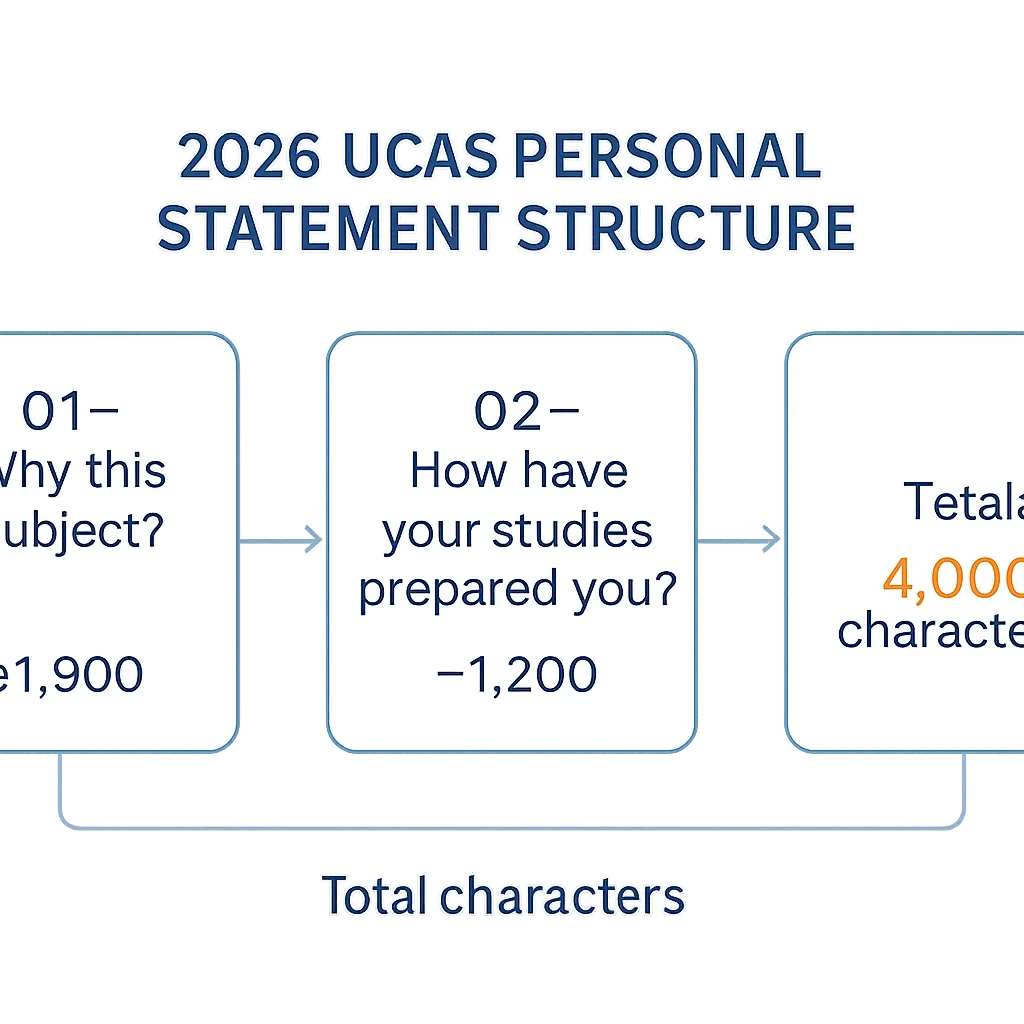
UCAS sets no per-question character limit beyond a 350-character minimum for each answer, so the split is entirely your call. That flexibility is worth using deliberately.
For an engineering applicant, a practical starting budget looks like this:
| Question | Focus | Suggested budget |
|---|---|---|
| Q1 - Why this subject? | Motivation, subject curiosity, super-curricular reading | ~1,800 characters |
| Q2 - Qualifications and studies | Relevant modules, EPQ, competitions such as UKMT | ~1,200 characters |
| Q3 - Everything else | Work experience, projects, skills outside education | ~1,000 characters |
Q1 earns the most space because it is where admissions tutors form their first impression of whether you genuinely understand what engineering involves. A stronger case for subject passion is harder to make in Q2 or Q3, so front-loading here reduces the risk of your application reading as competent-but-generic.
The counter-intuitive gotcha: UCAS advises against repeating information across the three questions, so if you use an EPQ on structural load distribution to illustrate curiosity in Q1, you cannot lean on it again in Q2 to demonstrate independent study skills. Each piece of evidence can only do one job. Plan which question owns each example before you start drafting.
3. Full engineering personal statement example (annotated)
This engineering personal statement example is written for this guide to show the 2026 UCAS three-question format in practice. It is not a real applicant's work. The subject focus is civil and structural engineering, which means it can also serve as one of the more grounded civil engineering personal statement examples you will find, with specific academic and extracurricular evidence throughout.
One non-obvious point worth flagging before you read: admissions tutors read Q1 first, and a Southampton civil engineering admissions tutor quoted by UCAS says they want candidates who "show a bit of spark." That spark needs to arrive in Q1, not Q3. If your most compelling evidence sits in the extracurricular section, you have the structure the wrong way round.
Q1: Why do you want to study this course? (~1,800 characters)
> Watching the Extreme Engineering documentary series shift my thinking from "how big is that?" to "how does that stay up?" was the moment I understood what civil engineering actually asks of its practitioners. The question is not scale, it is load path. That shift made A-level physics click in a different way. When we covered forces and moments in the mechanics unit, I went back and applied the principle of moments to a cable-stayed bridge I had seen on the programme, sketching out where compression and tension would concentrate in the deck. > > That sketch became a project. Working with a partner in my school's STEM club, I designed a 60-centimetre balsa-wood bridge using a Pratt truss configuration, then load-tested it incrementally using calibrated weights. The beam failed at the joint between the vertical and diagonal members, exactly where the shear force diagram, calculated using integration from our A-level calculus unit, predicted the highest internal stress. Tracing the failure back to the mathematics was genuinely satisfying in a way that finishing an exam paper is not. > > My interest in how structures interact with their environment drew me to read about the Restoring Your Railway initiative, which focuses on reactivating disused rail routes. The engineering challenge of adapting Victorian-era earthworks to modern load standards made me want to understand ground behaviour and geotechnical principles at degree level. Civil engineering is where physics, mathematics, and the built environment meet, and that intersection is where I want to work.
Annotation - Q1
- What it is doing: It opens with named external inspiration, the Extreme Engineering programme cited by UCAS, then traces a clear chain from curiosity to specific academic content (forces and moments, integration) to a practical test. The Restoring Your Railway reference, named directly in UCAS's civil engineering guide, signals subject knowledge without namedropping for its own sake.
- Line an admissions tutor would notice: "The beam failed at the joint... exactly where the shear force diagram predicted." This is specific enough to be verifiable and shows the applicant can connect theory to physical outcome.
- What a weaker version looks like: "I have always been fascinated by buildings and bridges. Physics and maths are my strongest subjects and I believe they will help me succeed in engineering." No mechanism, no evidence, no spark.
Q2: How have your qualifications prepared you? (~1,200 characters)
> A-level physics gave me a working vocabulary for structural behaviour: free-body diagrams, stress and strain, material properties under load. A-level mathematics extended that vocabulary into calculus, which I used practically in the bridge project to calculate bending moments rather than relying on tables. Design Technology introduced me to the iterative process of making a design decision, testing it, and revising, a discipline that feels closer to professional engineering practice than any purely written exam. > > My EPQ examined whether sustainable construction methods, specifically cross-laminated timber versus reinforced concrete for low-rise commercial buildings, could meet current UK structural performance standards without significant cost premium. Completing it required me to read technical guidance documents, structure an argument across 5,000 words, and present findings to a panel. The research process developed skills in selecting credible sources and communicating technical conclusions to a non-specialist audience, both of which the civil engineering admissions process, and the profession itself, reward.
Annotation - Q2
- What it is doing: Rather than listing subjects and grades (which UCAS explicitly advises against), it explains the mechanism of each subject's contribution. The EPQ is used as UCAS recommends to demonstrate project management and communication skills, not just as a credential.
- Line an admissions tutor would notice: The EPQ topic is a real engineering trade-off (CLT vs concrete), which signals that the applicant did not pick a question at random.
- What a weaker version looks like: "I am studying A-level physics (predicted A), mathematics (predicted A*), and design technology. I have also completed an EPQ." This tells the reader nothing about what the applicant can do with that knowledge.
Q3: What have you done outside education to prepare? (~1,000 characters)
> A two-week work shadowing placement at a regional civil engineering consultancy gave me sight of how projects move from site survey to planning submission. I attended a team meeting where the structural engineer and the project manager disagreed about foundation depth on a brownfield site, and watched them resolve it by commissioning an additional soil investigation rather than cutting the programme. That decision-making process, weighing cost against risk under time pressure, was more instructive than any textbook chapter on project management. > > In my school's STEM club I took on the role of coordinating the bridge-build competition entry, which meant allocating tasks across a group of six, managing the material budget, and presenting our results to the judging panel. I also volunteer weekly at a community repair cafe, where I help residents fix household electronics and appliances. The diagnostic process, working backwards from a symptom to a root cause, is the same logical structure that engineering problem-solving requires.
Annotation - Q3
- What it is doing: Each activity is linked to a named transferable skill, which mirrors the UCAS guidance on outside-education evidence listing teamworking, problem-solving, and project management as the skills worth surfacing. The repair cafe reference also reflects the UCAS suggestion that dismantling and rebuilding household items counts as relevant preparation.
- Line an admissions tutor would notice: The foundation-depth disagreement resolved by additional
4. Adapting the example for mechanical, aerospace, chemical, and electrical engineering
The civil/structural example in section 3 follows a fixed three-question structure: Q1 sets a discipline-specific anchor (a moment or project that made the subject click), Q2 maps your academic preparation to engineering thinking, and Q3 brings in evidence from outside the classroom. That structure transfers directly to any engineering discipline. The only thing you swap is the Q1 anchor.
| Discipline | Swap Q1 anchor to... | Relevant Q2 subjects |
|---|---|---|
| Mechanical | Fixing wheel alignment on a bike, or experimenting with materials for moisture-wicking during sport (UCAS mechanical guide) | Physics, maths, design technology |
| Aerospace | A model aircraft build or aeronautics competition, linking to forces and fluid dynamics from A-level physics | Physics, further maths |
| Chemical | A chemistry lab investigation or an EPQ on materials science (UCAS engineering guide) | Chemistry, maths |
| Electrical | A circuits or electronics project, or an after-school coding club (UCAS engineering guide) | Physics, maths |
One non-obvious point: the UCAS mechanical engineering guide specifically names aerospace and nuclear engineering as acceptable degree-level ambitions to reference in Q1. That means a student applying to mechanical engineering can legitimately frame their motivation around an aerospace interest without applying to an aerospace programme, which matters if your chosen university offers mechanical with an aerospace pathway rather than a standalone course.
For Oxbridge engineering applications, the same three-question format applies. The difference is that admissions tutors at Oxford and Cambridge weight the academic depth of Q1 and Q2 more heavily. A vague reference to "finding physics interesting" will not do the work that a specific engagement with a mechanism or physical principle will. Name the concept, name the project, and explain what the result made you think.
5. Personal statement examples for engineering apprenticeships
Apprenticeship personal statements follow a different logic from UCAS university applications. Employers design their own application forms, and the format is typically closer to a cover letter: shorter, more explicitly skills-focused, and written with workplace readiness in mind rather than academic curiosity.
The UCAS three-question format applies only to university routes. If you are applying to a degree apprenticeship that runs through UCAS (some Level 6 programmes do), you will complete the standard three questions. If you apply directly to an employer, such as a Rolls-Royce or Atkins graduate scheme, you will face a bespoke form, often with word-limited competency questions instead.
The non-obvious gotcha: many degree apprenticeship routes do both. You submit through UCAS and then complete a separate employer application. Check the provider's entry requirements page before you draft anything.
What transfers across both contexts:
- Problem-solving evidence from a specific project, not a general claim about enjoying challenges
- Teamwork illustrated by a named activity (D of E, robotics club, part-time work)
- Time management shown through balancing school commitments alongside practical experience
6. Engineering personal statement checklist
Run through these before you submit. Each item maps to a specific requirement from UCAS's 2026 format.
Question 1
- [ ] Your 'why this discipline' answer names a specific moment, text, project, or programme, not a general interest in "how things work"
- [ ] Any practical project (a build, a competition, a teardown) names at least one concrete skill or insight you took from it
- [ ] Physics or maths is connected explicitly to your chosen discipline, not left as a vague academic interest
Question 2
- [ ] No grades are mentioned (they appear elsewhere on the UCAS application)
- [ ] Every qualification or module is linked to a skill the course requires, such as problem-solving, data analysis, or design iteration
- [ ] Relevant extras such as an EPQ or UKMT competition are included if you completed them
Question 3
- [ ] Every activity has a 'so what': the transferable skill it built is named, whether teamworking, project management, or communication
- [ ] No activity from Q1 or Q2 is repeated
Whole statement
- [ ] Total character count is under 4,000 (including spaces)
- [ ] No single answer is below 350 characters
One non-obvious check: admissions tutors read all three answers together, so a skill mentioned briefly in Q2 that reappears in Q3 as a headline point will read as padding even if the contexts differ slightly. If two answers overlap in theme, cut one.
7. What to do next
Open the UCAS personal statement builder in the UCAS Hub right now. Paste your existing Q1 draft, or write a first attempt directly in the tool. The builder includes a character counter for each question, so you can see immediately whether your Q1 is taking up a fair share of the 4,000 total characters or crowding out Q2 and Q3.
One counter-intuitive point worth flagging: many applicants finish Q1 and then copy grades into Q2, but the builder guidance is explicit that grades appear elsewhere in your application. Q2 is for accomplishments, not transcripts. Catching that before you write Q2 saves a full redraft.
This page is the annotated example companion. For the underlying strategy, read the main engineering personal statement how-to guide before drafting.
Check your Q1 draft against the section 6 checklist before writing a single word of Q2.
FAQ
When should you write your personal statement for engineering?
Most students start drafting in the summer before Year 13, aiming to have a complete version by mid-September so school deadlines and the October UCAS deadline for Oxford and Cambridge are not a problem.
Can I use the same engineering personal statement example for different universities?
Yes - the UCAS personal statement is a single set of three answers submitted to all your choices simultaneously, so you write one statement for all five universities, which is why it must not favour any one institution.
Do engineering personal statement examples work for Oxbridge applications?
The same UCAS three-question format applies for Oxford and Cambridge engineering, but both universities typically expect deeper academic engagement in Q1 and Q2 - specific reading, independent investigation, or competition results rather than general interest.
Should I include my A-level grades in my engineering personal statement?
No - UCAS explicitly instructs applicants not to list grades in the personal statement because universities see them elsewhere in the application; use the space to describe skills and achievements instead.
Where do I write my personal statement for a 2026 UCAS application?
You write it inside the UCAS Hub personal statement builder, which provides a character counter for each of the three questions and an overall counter, and allows you to export a PDF draft.
Do personal statement examples for engineering apprenticeships follow the same format?
No - apprenticeship providers set their own application requirements, and the UCAS three-question format only applies to university applications; degree apprenticeships that route through UCAS are the exception where the format does apply.
References
- How to write your personal statement: 2026 entry onwards | UCAS - https://www.ucas.com/applying/applying-to-university/writing-your-personal-statement/how-to-write-your-personal-statement-for-2026-entry-onwards
- Engineering and technology personal statement guide | UCAS - https://www.ucas.com/applying/applying-to-university/writing-your-personal-statement/personal-statement-guides/engineering-and-technology-personal-statement-guide
- Civil engineering personal statement guide | UCAS - https://www.ucas.com/applying/applying-to-university/writing-your-personal-statement/2026-personal-statement-guides/civil-engineering-personal-statement-guide
- Mechanical engineering personal statement guide | UCAS - https://www.ucas.com/applying/applying-to-university/writing-your-personal-statement/2026-personal-statement-guides/mechanical-engineering-personal-statement-guide
- The personal statement builder | UCAS - https://www.ucas.com/applying/applying-to-university/writing-personal-statement/personal-statement-builder