Computer Science Personal Statement Example (2026 Entry)
By Michael Thompson · Education Specialist; 10 years teaching the IB at Bromsgrove School · Published 4 September 2026
A computer science personal statement example only helps if you know exactly what it is supposed to answer - and for 2026 entry, the format has changed. UCAS now splits the statement into three structured questions with a combined 4,000-character limit, replacing the old single free-text essay. This guide gives you a complete example written for this format, labelled clearly as a guide example, then annotates each question so you can see what the answer is doing and where weaker versions go wrong. By the end, you will have a checklist you can apply to your own draft before submission.
Key Takeaways
- Three questions, not one essay: From 2026 entry, UCAS personal statements are split across three separate questions with a minimum of 350 characters each and a 4,000-character total.
- Question 1 is your intellectual argument: Admissions tutors want to know why you find computing compelling now - not that you got your first computer as a child.
- Question 2 covers formal study, not grades: Describe what specific topics, modules, or qualifications taught you to think like a computer scientist; UCAS and universities already see your grades elsewhere.
- Question 3 rewards concrete projects: Name what you built, what broke, what you learned - a vague reference to 'personal projects' is weaker than one well-described example.
- Cambridge and Oxford weight super-curricular work heavily: Relevant reading, competitions, and subject-linked work experience count; sports and musical instruments do not affect academic admissions assessment at Cambridge.
- Clichés are noticed and remembered badly: Phrases like 'computing is the future' are flagged by admissions tutors at multiple universities as negative signals.
In This Article
- The 2026 UCAS Personal Statement Format for Computer Science
- Full Computer Science Personal Statement Example (Guide Example)
- Annotation: What Each Question Is Doing (and Where Weaker Versions Go Wrong)
- How to Describe Personal Projects, Competitions and Open-Source Work
- Oxford and Cambridge Computer Science Personal Statement Considerations
- Computer Science Personal Statement Checklist
- What to Do Next
1. The 2026 UCAS Personal Statement Format for Computer Science
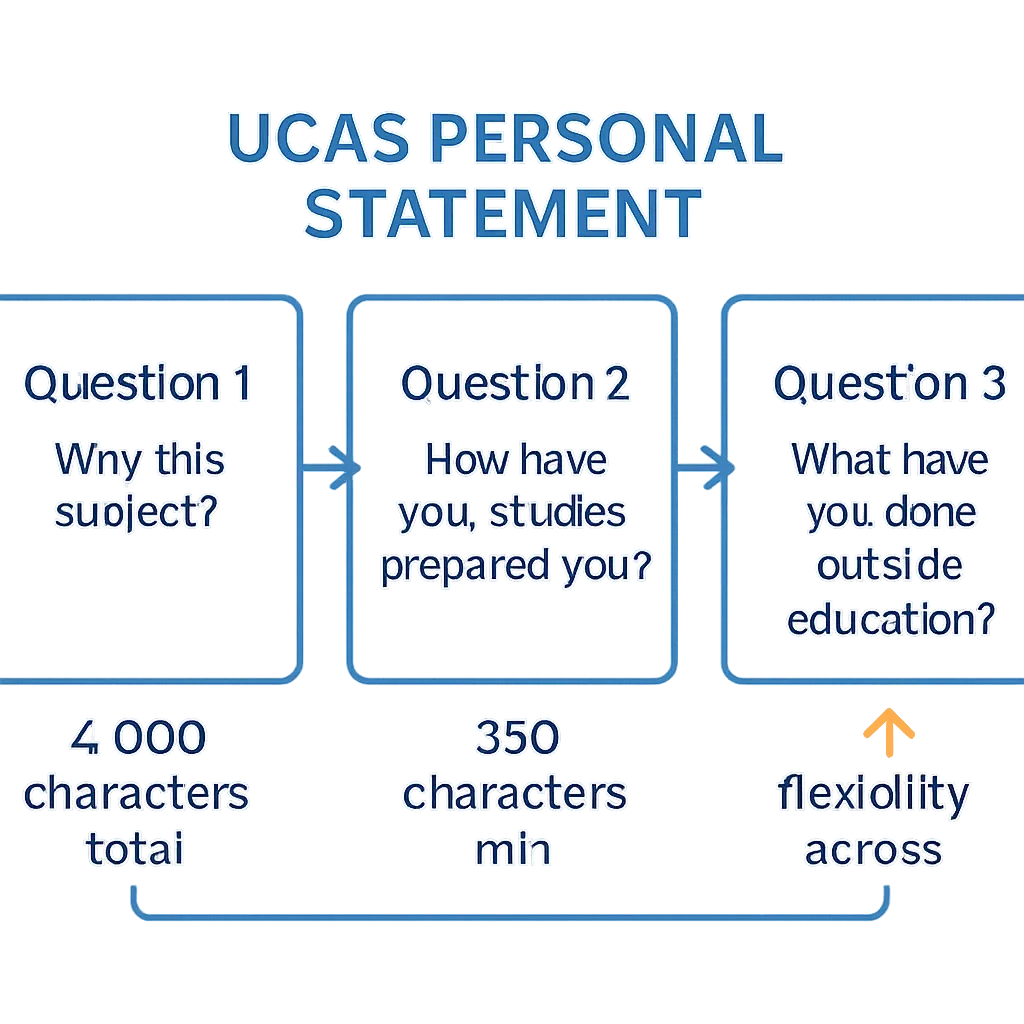
If you are looking at a computer science personal statement example to guide your 2026 application, the first thing to know is that the format has changed significantly. UCAS replaced the traditional single essay with three structured questions, effective for September 2025 applications onward. The total character limit stays at 4,000 characters (including spaces), but you now answer three distinct prompts rather than writing one continuous piece.
The three questions, verbatim, are:
- Question 1: "Why do you want to study this course or subject?"
- Question 2: "How have your qualifications and studies helped you to prepare for this course or subject?"
- Question 3: "What else have you done to prepare outside of education, and why are these experiences useful?"
Each answer must be at least 350 characters, but beyond that floor you can distribute the remaining characters in any proportion. A common trap for computer science applicants is front-loading Question 1 with motivation and leaving Question 3 thin, when in practice admissions readers review all three answers as a whole.
One counter-intuitive rule: do not mention your grades. Universities already see them elsewhere in your application, and repeating them wastes characters you could spend on substance.
The sections that follow include a full worked example and annotation showing how each question functions in practice.
2. Full Computer Science Personal Statement Example (Guide Example)
This is a constructed guide example, written to demonstrate strong technique across all three UCAS questions. It is not a real applicant's work. Each answer stays within the character distribution that UCAS permits for 2026 entry, and the three answers are read together as a whole, not scored separately.
One non-obvious point worth flagging: many applicants front-load Question 1 and leave Questions 2 and 3 thin. Because admissions staff assess all three answers together, a weak Question 3 undercuts a strong Question 1. Distribute your characters with intention.
Question 1: Why do you want to study this subject? (~1,400 characters)
> The moment I understood why quicksort has an average-case complexity of O(n log n) but a worst-case of O(n²), I stopped thinking of algorithms as recipes and started thinking of them as arguments. That shift is why I want to study computer science rather than mathematics or engineering. Maths gave me the language; CS gave me a question worth answering with it: how do we build systems that are correct, efficient, and verifiable when the input space is effectively infinite? > > That question became concrete when I read about the Therac-25 radiation machine failures. A race condition in the software killed patients. The bug was not exotic; it was a failure to reason carefully about concurrent state. I found myself reading backwards through the literature on formal verification and Dijkstra's concept of the program as a mathematical object. Engineering asks what works under load; mathematics asks what is true; computer science, at its core, asks both at once. That conjunction is where I want to spend the next three years.
Character count: approx. 1,390
Notice what this answer does not do: it does not open with a childhood memory or the phrase "computing is the future", both of which admissions tutors at the University of Portsmouth and the University of Warwick have identified as clichés to avoid. The hook is a named concept (quicksort worst-case complexity), and the reflection is specific enough that a tutor reading a hundred personal statements would notice it.
Question 2: How have your qualifications and studies prepared you? (~1,300 characters)
> Studying A-level Computer Science with OCR introduced me to the theory of computation unit, where I worked through Turing machines, regular languages, and the limits of what is decidable. Alongside that, A-level Mathematics (Edexcel) trained me to construct proofs rather than accept results on trust. The two subjects reinforced each other in a way that neither syllabus explicitly signals: formal proof and computational thinking share the same underlying logic. > > My EPQ asked whether P equals NP is genuinely undecidable or simply unsolved, which required me to read primary material rather than rely on secondary sources. Separating a claim from its evidence, and assessing the strength of a reduction argument, became skills I now apply in every technical context. I also competed in the UKMT Senior Mathematical Challenge, which reinforced comfort with problems that resist standard methods. That competition specifically taught me to sit with uncertainty rather than reach for a formula.
Character count: approx. 1,290
As UCAS notes, Question 2 should not repeat grade information because grades appear elsewhere in the application. The example above names qualifications and boards (OCR, Edexcel) and explains what each developed analytically, without listing predicted grades.
Question 3: What have you done outside your studies to prepare? (~1,300 characters)
> Over six months I built a static site generator in Python. The brief version: it worked until I added incremental builds, at which point the dependency graph became cyclic and the output was silently wrong for two weeks before I noticed. Debugging that taught me more about directed acyclic graphs and topological sort than any textbook had, because the failure was mine and the stakes were real (a friend's portfolio site was rendering incorrectly). I refactored the dependency resolution using Kahn's algorithm, added a test suite with pytest, and published the project on GitHub under an MIT licence. > > I have also followed the "Unconfuse Me with Bill Gates" podcast, which has episodes on AI alignment and the limits of large language models. One episode prompted me to read the original attention mechanism paper, which I only partially understood but which clarified why transformer architectures are not magic: they are matrix multiplications with learned weights. That gap between the hype and the mechanism is exactly the kind of thing I want to close through formal study.
Character count: approx. 1,295
The UCAS computer science personal statement guide specifically names "Unconfuse Me with Bill Gates" as an example of relevant external engagement. Naming it here is not padding; it signals that the applicant is engaging with primary sources rather than stopping at the podcast itself.
Total across all three answers: approx. 3,975 characters. That leaves a small buffer without triggering the 350-character minimum on any individual answer.
A good computer science personal statement example at this level is identifiable by one quality: every sentence earns its place by telling the admissions tutor something the rest of the application cannot.
3. Annotation: What Each Question Is Doing (and Where Weaker Versions Go Wrong)
Question 1: Why do you want to study this subject?
The goal here is a specific intellectual hook, not a biographical timeline. Admissions tutors at the University of Portsmouth and University of Warwick have flagged lines like "I have always loved computers" and "computing is the future" as clichés that immediately date a statement, and UCAS's computer science guide names both as negatives to avoid. Robert Zimmer, Head of Computing at Goldsmiths University of London, advises applicants to explain why they are passionate about computing now, not when they were eight.
Stronger opening: "Reading about the Church-Turing thesis made me question whether there are problems no algorithm can ever solve, which led me to Turing's 1936 paper on computable numbers."
Weaker version: "I have always loved computers and knew from a young age that I wanted to study computing."
The stronger version gives the reader something to ask about at interview. The weaker version gives them nothing.
Professor Lowe from the University of Oxford has noted that many personal statements he reviews "are similar, bland, impersonal and don't stand out", which means the specific intellectual hook is also your main differentiator.
Question 2: How have your qualifications prepared you?
Naming a concept beats listing a subject. Compare:
| Version | Example |
|---|---|
| Weaker | "My A-level Maths and Computer Science have prepared me well for university study." |
| Stronger | "Studying graph traversal algorithms in A-level Computer Science made me curious about why BFS guarantees shortest path in unweighted graphs but DFS does not." |
The weaker version restates information already visible elsewhere in the UCAS form. The UCAS guide explicitly notes that current grades and subjects appear elsewhere in the application, so listing them in the personal statement wastes space that should carry analytical weight.
Question 3: What have you done outside education to prepare?
The counter-intuitive point here is that failure often makes stronger material than success. "I built a Python web scraper that failed to handle rate-limiting, which taught me about HTTP request headers and exponential backoff" demonstrates problem-solving instinct. "I have done personal projects in Python" demonstrates nothing except familiarity with a bullet point.
Cambridge's undergraduate guidance states directly that reflections and experience of activities matter more than the number of activities pursued. One project described with precision and honest analysis of what went wrong carries more weight than a list of six tools you have "explored."
4. How to Describe Personal Projects, Competitions and Open-Source Work
The most common mistake here is treating a project entry as a CV line. Listing "Python, Flask, PostgreSQL, REST API" tells an admissions reader nothing about your thinking. The what-why-learned structure fixes this: name what you built or contributed, explain why that specific problem was worth solving, then state what you now understand that you didn't before you started.
Weak version: > "I built a pathfinding visualiser using JavaScript and React."
Stronger version: > "I built a pathfinding visualiser to test why Dijkstra's algorithm consistently outperformed A* on my randomly generated grids. Debugging the heuristic taught me that an admissible heuristic can still produce suboptimal routes when edge weights vary dynamically, something the textbook derivation had obscured."
The second version names the problem, the obstacle, and the insight. An admissions tutor reading a good personal statement example for computer science can see exactly where the applicant's thinking moved forward.
Where each activity belongs in the UCAS format:
- UCAS explicitly lists UKMT competitions and EPQ as valid Question 2 material, because both are formally assessed qualifications or recognised achievements within your studies.
- Personal projects and open-source contributions sit in Question 3, which asks what you have done outside formal education to prepare.
Mixing these up wastes character budget in the wrong answer box.
For Oxbridge applicants specifically: Cambridge states directly that reflections on activities matter more than the number of activities. One project described with precision, including what you got wrong and why it changed your understanding, carries more weight than five GitHub repositories mentioned by name only.
The non-obvious implication: if you contributed a single bug fix to an open-source project but spent three weeks understanding the codebase to do it safely, write about those three weeks.
5. Oxford and Cambridge Computer Science Personal Statement Considerations
One thing that surprises many applicants: the UCAS personal statement is the same document sent to every university you apply to, including Oxford and Cambridge. There is no separate Oxford-specific version submitted through UCAS. All five of your chosen institutions read identical answers to the same three questions.
The Cambridge-specific addition
Cambridge offers one genuine extra route. After submitting your UCAS application, you receive access to My Cambridge Application, a mandatory supplementary form. Within it sits an optional additional statement capped at 1,200 characters, separate from UCAS entirely. The guidance is explicit: do not repeat what you wrote in your UCAS answers, and do not use the space to explain why you chose a particular college. Use it to add something new, such as a recent paper you read or a project outcome you did not have room to mention elsewhere.
What Oxford and Cambridge actually assess
Christ's College Cambridge states plainly that it assesses applicants on academic criteria only. Activities like sport, music, or holding a school leadership role are not evaluated. The boundary they draw is between super-curricular and extra-curricular:
- Super-curricular (relevant): reading specialist texts, attending lectures, relevant work experience, academic competitions, science Olympiads
- Extra-curricular (not assessed): football, knitting, being head girl
The Cambridge undergraduate guidance also notes that your reflections on activities matter more than the number you list.
From the Oxford side, Professor Lowe has said that many statements he reads "are similar, bland, impersonal and don't stand out." The fix is not stylistic polish; it is subject-specific intellectual engagement that shows you have thought carefully about computer science beyond the classroom.
6. Computer Science Personal Statement Checklist
Run through each item before you submit. Every "no" is a revision task.
- [ ] Character budget. Total across all three questions is 4,000 characters or fewer, and each individual answer is at least 350 characters (UCAS).
- [ ] No grades in Question 2. Predicted grades appear elsewhere in your application; repeating them here wastes characters and signals you haven't read the guidance (UCAS).
- [ ] Question 1 opens with a specific intellectual hook. A childhood memory of playing video games is not an intellectual hook. A named concept, paper, or problem is.
- [ ] Question 2 names specific topics and skills. "I studied maths" is not enough. Name the module, the technique (e.g. proof by induction, Boolean algebra), or the qualification (AQA, OCR, IB Diploma, EPQ).
- [ ] Question 3 includes one project with three elements. What you built, what failed, and what you learned. All three. Missing any one of them makes the project feel padded.
- [ ] No clichés. Search your draft for "computing is the future", "passionate about technology", and "ever-changing world". Delete every instance.
- [ ] Oxbridge applicants: super-curricular, not just extra-curricular. Section 5 of this guide covers the distinction. A school coding club is extra-curricular. Reading a textbook beyond your syllabus and engaging with its ideas is super-curricular.
- [ ] No copied content. UCAS uses anti-plagiarism software to detect personal statements copied from other applications. Use the example in this guide as a structural model only, not as text to reproduce.
- [ ] Read all three answers together. Admissions staff review them as a whole (UCAS). A point made in Question 1 should not be repeated word-for-word in Question 3.
- [ ] Get a second reader who doesn't know your subject. If they can't follow the project you described in Question 3, the explanation needs work, not more jargon.
7. What to Do Next
The checklist, the annotations, the example: none of it matters until you have words on a page. The most common mistake is waiting until you feel ready before starting a first draft. First drafts are supposed to be bad. Their job is to give you something to cut.
This week, open a blank document and paste in the three UCAS question headings as a scaffold. Then write a rough answer to Question 1 only, even if it is a single paragraph. Do not edit as you go. A clunky, honest first attempt is more useful than a polished sentence you spent three hours on, because it shows you what you actually think.
Expect to write at least three to four full versions before anything feels settled. That is not a sign of weakness in your application. It is how the process works.
Start the document today. Come back to Question 2 next week.
FAQ
Can I use a computer science personal statement example as my own?
No - UCAS uses anti-plagiarism software that detects copied personal statement content, so examples should be used as structural models only, never copied directly.
Do personal statement examples have to follow the three-question format for 2026 entry?
Yes - from 2026 entry, all UCAS personal statements are structured as three separate questions with a 4,000-character total and a minimum of 350 characters per answer.
Does a computer science personal statement need to mention programming languages?
Only if you can say something specific about what you learned by using them; a list of languages without context is weaker than one well-described project that explains a concrete technical insight.
Should a computer science personal statement example for Cambridge look different from a standard UCAS one?
The UCAS statement itself is identical for all universities, but Cambridge applicants can submit an optional additional statement of up to 1,200 characters through My Cambridge Application, which should not repeat UCAS content.
Where should personal projects go in the new UCAS personal statement structure?
Personal projects, open-source contributions, and self-directed learning sit in Question 3, which asks what you have done outside formal education to prepare for the course.
What do admissions tutors consider a good personal statement example for computer science?
Tutors at universities including Oxford have noted that strong statements are specific, personal, and intellectually engaged - avoiding clichés like 'computing is the future' and instead showing genuine subject-level curiosity.
References
- How to write your personal statement: 2026 entry onwards | UCAS - https://www.ucas.com/applying/applying-to-university/writing-your-personal-statement/how-to-write-your-personal-statement-for-2026-entry-onwards
- Personal statement tips for international students: 2026 entry | UCAS - https://www.ucas.com/applying/applying-university/writing-your-personal-statement/personal-statement-tips-international-students-2026-entry
- Computer science personal statement guide | UCAS - https://www.ucas.com/applying/applying-to-university/writing-your-personal-statement/personal-statement-guides/computer-science-personal-statement-guide
- Improve your application to Cambridge | Undergraduate Study - https://www.undergraduate.study.cam.ac.uk/apply/before/improve-application
- Completing My Cambridge Application | Undergraduate Study - https://www.undergraduate.study.cam.ac.uk/apply/how/cambridge-application
- UCAS personal statement | Christs College Cambridge - https://www.christs.cam.ac.uk/international-students/apply/statement
- University applications: 'The most stressful experience' - BBC News - https://www.bbc.co.uk/news/education-30815105