Psychology Personal Statement Example: Annotated for 2026 Entry
By Michael Thompson · Education Specialist; 10 years teaching the IB at Bromsgrove School · Published 4 September 2026 · Updated 6 October 2026
A psychology personal statement example can only do its job if you know what the example is actually answering - and for 2026 entry, that structure has changed significantly. UCAS now asks three separate questions within a single 4,000-character allowance, replacing the old open-essay format. This guide sets out a complete, purpose-written example statement split across all three questions, then annotates each section so you can see exactly what works, what a weaker version looks like, and how to apply the same logic to your own draft. By the end, you will have a practical checklist you can run against your writing before you submit.
Key Takeaways
- Three questions, not one essay: The 2026 UCAS format divides the personal statement into three structured questions with a combined 4,000-character limit and a minimum of 350 characters per answer.
- Question 1 is about intellectual motivation: Admissions tutors want specific scientific curiosity, not a general statement that you find people interesting - show what you have read, studied, or questioned.
- Question 2 covers formal study, not grades: Use this section to show how subjects like IB Psychology, A-level Biology, or an EPQ have built skills such as statistical analysis and critical thinking.
- Question 3 captures everything outside the classroom: Work experience, part-time jobs, relevant reading, and online courses all belong here - this is also where international applicants can explain why they want to study in the UK.
- Avoid quoting Freud as a shortcut: UCAS-quoted admissions tutors say personal insight and out-of-classroom curiosity impress more than name-dropping famous psychologists.
- The example in this guide is purpose-written: It is not a real applicant's statement - it is annotated specifically to show the reasoning behind every paragraph.
In This Article
- The 2026 UCAS Personal Statement Format for Psychology
- How to Allocate the 4,000 Characters Across the Three Questions
- Complete Psychology Personal Statement Example (Purpose-Written for This Guide)
- Annotation: What Each Question Is Doing (and What a Weaker Version Looks Like)
- Adapting the Example for Specialist Pathways: Clinical, Forensic, Child, and Educational Psychology
- Psychology Personal Statement Checklist: Apply This to Your Own Draft
- What to Do Next
1. The 2026 UCAS Personal Statement Format for Psychology
Finding a strong psychology personal statement example matters more than ever now that UCAS has scrapped the single-essay format. For 2026 entry onwards, applicants answer three separate questions rather than writing one continuous piece of text. The combined limit across all three answers is 4,000 characters (including spaces), with a minimum of 350 characters per question, and you can split the budget across the three questions in any proportion you choose - UCAS confirms there is no fixed allocation.
The three questions are:
- Question 1: "Why do you want to study this course or subject?"
- Question 2: "How have your qualifications and studies helped you to prepare for this course or subject?"
- Question 3: "What else have you done to prepare outside of education, and why are these experiences useful?"
For psychology applicants, this structure creates a specific split to think about. Question 1 is where you make the intellectual case for your interest in the discipline. Question 2 covers formal study, including relevant A-Level units, an EPQ, or online courses, but explicitly excludes grades, which admissions staff see elsewhere on your application. Question 3 is the place for voluntary work, relevant reading, work shadowing, or any other preparation outside the classroom.
One non-obvious consequence of the format: repeating the same point across two questions is actively discouraged by UCAS, since all three answers are read as a whole. Psychology applicants who discuss a book in Question 1 and then mention the same book again in Question 3 will waste characters and signal that they have not read the guidance carefully.
2. How to Allocate the 4,000 Characters Across the Three Questions
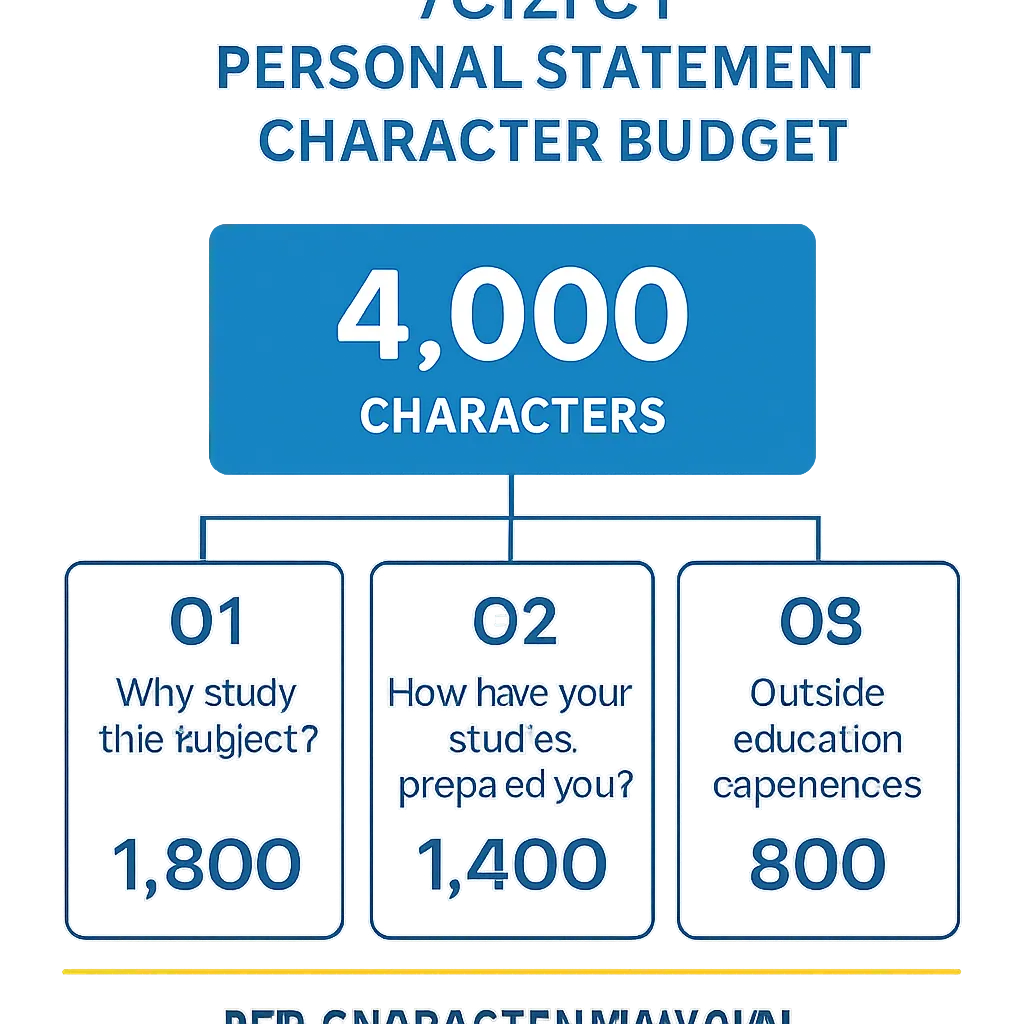
Do this before you write a single sentence. UCAS confirms the 4,000 characters can be split across the three questions in any proportion, with a minimum of 350 characters per answer. That flexibility is a planning decision, not a drafting one.
A workable split for most psychology applicants looks like this:
| Question | Focus | Suggested characters |
|---|---|---|
| Q1 - Why psychology? | Intellectual motivation, subject knowledge, future direction | ~1,800 |
| Q2 - Qualifications and studies | A-levels, EPQ, relevant courses | ~1,400 |
| Q3 - Beyond your studies | Work experience, activities, skills | ~800 |
Question 1 earns the biggest allocation because intellectual motivation is the hardest thing to demonstrate, and the hardest for an admissions tutor to infer from the rest of your application. Grades appear elsewhere; Q1 is your only dedicated space to show you understand what psychology actually involves as an academic discipline.
The counter-intuitive gotcha: UCAS explicitly discourages repeating information across answers, and tutors read all three as a whole. If your work-experience placement appears in Q1 as a motivation and again in Q3 as an activity, you have wasted roughly 150-200 characters and signalled poor planning. Each answer should introduce new evidence.
3. Complete Psychology Personal Statement Example (Purpose-Written for This Guide)
The example below is purpose-written for this guide and does not represent a real applicant's statement. It is structured around the three-question format introduced by UCAS for 2026 entry. Use it as a worked template, not a draft to copy: admissions software flags recycled text, and every university can see whether your answer reflects genuine engagement with the subject.
One non-obvious quirk of the new format: because admissions staff read all three answers as a whole, repeating the same experience across two questions actively weakens the application. The example below treats each answer as a distinct window into the applicant.
Question 1: Why do you want to study this course or subject?
Approximate character count: 1,800
> During a work placement at a primary school, I watched a child freeze completely when asked to read aloud, despite having no difficulty reading alone. That gap between private ability and public performance stayed with me. It pointed directly to something I later found named and examined in Daniel Kahneman's Thinking, Fast and Slow: the way automatic, System 1 processes can override deliberate intention under social pressure. Reading Kahneman made me realise I had been observing psychological phenomena without the vocabulary to describe them. > > That realisation pushed me further. Bessel van der Kolk's The Body Keeps the Score shifted my understanding of how trauma is not stored as a narrative memory but as a physical state, with measurable consequences for behaviour and cognition. The contrast between Kahneman's cognitive framing and van der Kolk's somatic one raised a question I want to pursue at university: to what extent do the two frameworks overlap in explaining the same behaviour, and where do they genuinely conflict? > > Psychology interests me precisely because it sits at the intersection of the scientific and the interpretive. I am drawn to research methodology as much as to theory: I want to understand how claims are tested, not just what the claims are. The University of Bristol's admissions guidance describes wanting applicants who see psychological research as an academic focus, and that description fits my own direction. I am particularly interested in developmental and cognitive psychology, and I would like to move towards research into how early educational environments shape attentional control in children.
Question 2: How have your qualifications and studies helped you to prepare for this course or subject?
Approximate character count: 1,400
> Studying IB Psychology at Higher Level gave me direct experience of the empirical cycle: forming a hypothesis, selecting an appropriate research design, collecting data, and evaluating findings against the original claim. For my internal assessment, I replicated an experiment examining the effect of leading questions on recall, which required me to apply inferential statistics and write up results in APA format. Working through the analysis made the gap between a significant result and a meaningful result concrete in a way that reading about it does not. > > IB Mathematics at Standard Level reinforced that foundation. Calculating confidence intervals and interpreting standard deviation in a psychology context felt different once I had worked through the underlying mechanics in a mathematics class. > > My Extended Project Qualification focused on whether cognitive behavioural models adequately account for the role of social context in adolescent anxiety. Writing a 5,000-word independent research paper required me to evaluate primary sources critically rather than summarise them, a skill UCAS notes is directly relevant to psychology training. I also completed a Springpod Subject Spotlight in Psychology, which introduced me to current debates in replication and open science that sit outside the standard sixth-form syllabus.
Question 3: What outside-education experiences are relevant to your application?
Approximate character count: 800
> For eight months I volunteered as a reading mentor at a local primary school, working one-to-one with children identified as having reading difficulties. The role required me to adjust my communication style session by session depending on the child's confidence and attention that day, which developed a practical awareness of how emotional state affects learning that no textbook had made as clear. > > I also work part-time in a cafe on weekends. That setting demands attention to non-verbal cues, de-escalation when customers are frustrated, and quick decisions about how to respond to unpredictable behaviour. UCAS guidance on psychology applications identifies part-time roles in customer-facing environments as valid evidence of the interpersonal and communication skills psychology programmes expect. Both experiences have reinforced that I want to work in a field where understanding human behaviour is the central task, not an incidental one.
This psychology personal statement example is intentionally varied in sentence rhythm and specificity across the three answers. Section 4 annotates each question in detail, identifying exactly what is working and what a weaker version of the same content would look like.
4. Annotation: What Each Question Is Doing (and What a Weaker Version Looks Like)
Question 1: Why psychology?
The opening sentence does the most work. Admissions tutors told UCAS that personal insight and outside-classroom pursuit of interest impress more than quoting Freud or Jung. That one fact rules out an entire category of openings.
Before: "I have always been interested in why people behave the way they do."
After: "Reading Kahneman's account of anchoring effects made me question whether the estimates I form in everyday decisions are ever truly my own."
The difference is not style. The "before" version signals that the applicant has a general curiosity. The "after" version signals that they have read something specific, processed it, and arrived at a question. That question is the intellectual curiosity signal admissions tutors are looking for. Every paragraph in Question 1 should carry at least one of: a named text, a named concept, or a named question the applicant is still trying to resolve.
A non-obvious gotcha: naming Thinking, Fast and Slow alone is no longer distinctive because UCAS guidance lists it as an obvious reading choice. The stronger move is to reference a specific idea from it and push back, agree, or extend it.
Question 2: How do your qualifications prepare you?
The weak version lists subjects. "I study Biology, Maths, and Psychology, which have given me research and analytical skills" is a summary an admissions tutor can already read elsewhere in the application. UCAS notes that current subjects and grades appear elsewhere and should not simply be restated.
The stronger version connects a specific module to a specific intellectual problem. For IB Psychology candidates sitting from May 2027, describing how the internal assessment required designing a research proposal, choosing a method and a sample and creating a data-collection tool, shows research competence rather than asserting it. (The sample statement above was written on the previous course, whose IA was a replication experiment.) That moves the reader from "this student takes relevant subjects" to "this student can already do the thing the degree demands."
Question 3: What outside-education experience is relevant?
"Working with people" is the vague version. "Supporting a non-verbal child during a six-week holiday play scheme by adapting visual communication prompts" is the specific version. The difference is a concrete outcome attached to a named role. UCAS guidance explicitly includes part-time work in cafes and shops as valid experience if the interpersonal skill is described precisely. The principle holds: what did you do, with whom, and what changed as a result?
5. Adapting the Example for Specialist Pathways: Clinical, Forensic, Child, and Educational Psychology
The three-question structure described by UCAS applies across every psychology pathway. What changes is the emphasis within each question, not the framework itself.
Here is how to adjust your focus by pathway:
Clinical psychology
- Question 1: Ground your interest in psychological distress and evidence-based therapies. A reference to The Body Keeps the Score (cited by the UCAS psychology guide as a relevant reading choice) works naturally here.
- Question 3: Prioritise NHS-adjacent or caring roles. Volunteering with a crisis line or a mental health charity carries more weight than generic work experience.
Forensic psychology
- Question 1: Connect your interest to criminology, judicial decision-making, or cognitive bias research rather than crime drama. Admissions tutors distinguish clearly between applied forensic work and academic psychology, so name the academic angle explicitly.
Child psychology
- Question 1: Reference developmental psychology literature specifically.
- Question 3: Child-facing roles, such as a teaching assistant or a play scheme, are the most relevant evidence to cite.
Educational psychology
- A non-obvious gotcha here: most BPS-accredited doctorate routes require a psychology undergraduate degree first. Keep Question 1 focused on undergraduate motivation, not postgraduate goals.
For detailed pathway advice, the main psychology personal statement how-to guide covers each route in full so this section does not need to repeat it.
6. Psychology Personal Statement Checklist: Apply This to Your Own Draft
Run through this before you submit. Each item is a pass/fail check, not a vague aspiration.
- Q1 opens with something specific. Your first sentence names a concrete observation, question, or moment, not a broad claim about human behaviour.
- Q1 names at least one real source you have engaged with. A book (Thinking, Fast and Slow, The Body Keeps the Score), a named study, or a researcher, something you could discuss at interview, as UCAS's psychology guide specifically flags.
- Q2 explains skill-building, not subject-listing. Describe how your A-levels, EPQ, or an online course developed analytical or research ability. Listing subjects without mechanism tells admissions tutors nothing.
- Grades do not appear anywhere. UCAS confirms they appear elsewhere on the application. Mentioning them wastes characters.
- Q3 names a real, specific experience. A volunteering role, part-time job, or placement, linked explicitly to a psychology-relevant skill such as empathy, attention to detail, or communication.
- No point is repeated across two questions. UCAS advises admissions staff read all three answers as a whole, so duplication is noticed.
- Every claim is interview-proof. If you cannot speak for five minutes on something you mention, cut it.
- Each answer clears 350 characters. This is the UCAS minimum per question. Falling short flags an incomplete application.
- Total character count is at or below 4,000. Include spaces in your count.
7. What to Do Next
Open your current draft and re-read just the first two sentences of your Q1 response. Ask yourself: do those sentences answer "what specifically about psychology do you want to study, and why now?" If the answer is even slightly ambiguous, that is the paragraph to rewrite before anything else. Admissions readers form an impression fast, and a vague opener rarely recovers in later sentences.
A non-obvious trap: students often write a strong specific claim in sentence three, then bury it because sentence one was a scene-setter. Cut the scene-setter. Move the specific claim to the front.
For broader drafting strategy, the main psychology personal statement guide covers structure, evidence, and word allocation in full detail. Check your Q1 opener this week and rewrite it before you touch anything else in the draft.
FAQ
Can I use a psychology personal statement example as a template for my own?
Examples are useful for understanding structure and tone, but copying or closely adapting any example risks plagiarism detection; use them to identify what strong answers look like, then write entirely in your own words about your own experiences.
Do psychology personal statement examples work for Cambridge applications?
Cambridge's Psychological and Behavioural Sciences course uses the standard UCAS personal statement, so the three-question format applies, but Cambridge also considers the written work submitted at interview - the personal statement should signal serious academic engagement rather than general enthusiasm.
Should I mention Freud or Jung in my psychology personal statement?
UCAS-quoted admissions tutors say that personal insight and out-of-classroom curiosity impress more than quoting Freud or Jung, so references to more recent empirical research or specific books you have genuinely read will carry more weight.
Does the psychology personal statement format differ for a master's or conversion course?
The UCAS three-question format applies to undergraduate entry; psychology conversion and master's programmes typically use their own application systems with different prompts, so check each institution's requirements directly.
Will my psychology personal statement example work if I am applying from an IB Diploma Programme?
Yes - IB Psychology is strong evidence for Question 2, and you can reference Internal Assessment research design, Theory of Knowledge links to cognitive science, and your Extended Essay if it covered a relevant topic.
How long should each answer be in a psychology personal statement?
UCAS sets a combined limit of 4,000 characters with a minimum of 350 per question; psychology applicants often find that allocating roughly half the budget to Question 1, a third to Question 2, and the remainder to Question 3 reflects the relative weight admissions tutors place on each area.
References
- How to write your personal statement: 2026 entry onwards | UCAS - https://www.ucas.com/applying/applying-to-university/writing-your-personal-statement/how-to-write-your-personal-statement-for-2026-entry-onwards
- Personal statement tips for international students: 2026 entry | UCAS - https://www.ucas.com/applying/applying-university/writing-your-personal-statement/personal-statement-tips-international-students-2026-entry
- Psychology personal statement guide | UCAS - https://www.ucas.com/applying/applying-to-university/writing-your-personal-statement/personal-statement-guides/psychology-personal-statement-guide