UCAS Personal Statement Questions 2026: The Three-Question Format Explained
By Michael Thompson · Education Specialist; 10 years teaching the IB at Bromsgrove School · Published 4 September 2026 · Updated 6 October 2026
The personal statement questions 2026 applicants face are a significant departure from the old single-essay format: UCAS now asks three separate, structured questions within a shared 4,000-character limit. The change took effect for applications opening in September 2025, covering entry in 2026. Each question has a distinct focus, and admissions staff read all three answers together as a whole. Understanding what each question is actually asking - and how to divide your character budget - is the practical challenge this guide addresses.
Key Takeaways
- Three questions, one 4,000-character limit: The total character count (including spaces) stays the same as the old format; the difference is that characters are now split across three separate answer boxes, each with a 350-character minimum.
- Question 1 is about motivation and subject knowledge: Why you want to study this subject - your genuine interest, what you know about it, any super-curricular reading or activities, and where you want it to take you.
- Question 2 covers formal study and academic achievements: Your qualifications, courses, and educational accomplishments - but not your predicted grades, which universities already see elsewhere on the application.
- Question 3 is not optional or minor: It asks what you have done outside education to prepare - work experience, volunteering, hobbies, personal responsibilities - and why those experiences are relevant.
- Admissions tutors read all three answers together: There is no prescribed correct split, but repeating the same content across questions, or leaving Question 3 thin, are the most common mistakes with the new format.
- The format change was designed to reduce coaching advantage: UCAS restructured the statement after research found 79% of students said writing it was difficult without support, and the open-ended essay favoured those with access to paid help.
In This Article
- What changed for 2026 entry - and what stayed the same
- The three personal statement questions for 2026 entry - quoted exactly
- Question 1: why do you want to study this subject?
- Question 2: how your qualifications and studies prepared you
- Question 3: what you have done to prepare outside education
- How to split the 4,000-character budget across the three answers
- Common mistakes with the new UCAS personal statement format
- What to do next
1. What changed for 2026 entry - and what stayed the same
The personal statement questions 2026 applicants face look nothing like what previous cohorts submitted. From September 2025, UCAS replaced the old single free-text essay with three separate structured questions, each with its own prompt and a minimum of 350 characters. The format change applies to anyone applying for 2026 university entry.
The one thing that did not change is the budget. The 4,000-character limit, including spaces, carries over unchanged from the old format. That is worth emphasising: you are not getting more space. The same 4,000 characters are now split across three boxes rather than one. Each box shows its own counter, and a separate overall counter tracks your total progress toward 4,000. Our UCAS personal statement character limit guide covers how to spend every one of them.
The counterintuitive catch is the 350-character minimum per question. That floor eats roughly 1,050 characters before you have written a single sentence of substance, which compresses your effective room for detail more than the headline limit suggests.
UCAS's own research explains the rationale. 89% of students surveyed said the purpose of the personal statement was clear, but 79% said writing it was difficult without support. Put plainly: students understood what they were supposed to do but struggled to do it on a blank page. More than three-quarters of prospective applicants preferred the three-question format when shown it during consultation.
One point UCAS makes explicit: admissions staff review all three answers as a whole, not in isolation. Writing each question as a self-contained mini-essay without considering how they connect to each other is a structural mistake to avoid from the first draft.
2. The three personal statement questions for 2026 entry - quoted exactly
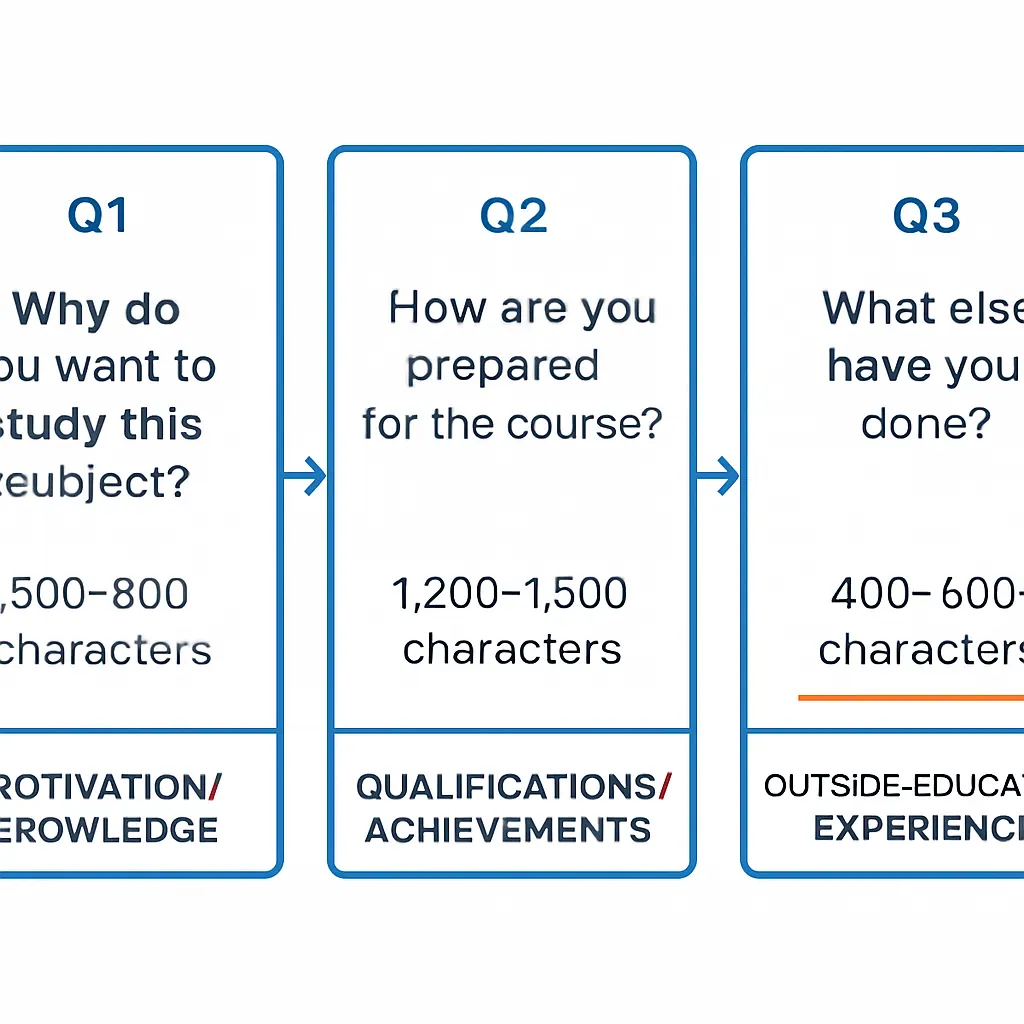
UCAS publishes three fixed questions that every 2026 entry applicant answers in place of the old open-text statement:
- "Why do you want to study this course or subject?"
- "How have your qualifications and studies helped you to prepare for this course or subject?"
- "What else have you done to prepare outside of education, and why are these experiences useful?"
These are the exact prompts - word for word. Each answer sits in its own box inside the UCAS Hub personal statement builder, with a per-question character counter and a combined counter tracking your progress toward the 4,000-character total.
One detail worth noting: the questions look sequential, but UCAS is explicit that admissions staff read all three answers as a whole, not as three independent mini-essays. That means repetition across answers costs you character budget without adding anything.
3. Question 1: why do you want to study this subject?
UCAS describes this question as covering your motivations, subject knowledge, super-curricular activities, and future plans. In practice, it is asking for evidence that your interest exists independently of what a teacher put in front of you.
What admissions tutors are looking for is engagement outside the classroom: books you sought out, podcasts you followed up on, online courses you completed, competitions you entered. Cambridge is explicit that it wants to see reading, videos, and podcasts rather than a recap of school lessons, and it specifically flags the phrase "I have always wanted to study this subject" as an example of what not to write. That warning applies well beyond Cambridge. A declaration of lifelong passion, unsupported by anything concrete, tells an admissions tutor very little.
The counter-intuitive point many students miss: you do not need to have wanted this subject since childhood. A moment of genuine intellectual surprise, a specific argument in a book that changed how you understood something, a competition result that made you think differently, these are more persuasive than a longer timeline.
A practical approach:
- Open with one specific moment, idea, or piece of reading that crystallised your interest in the subject.
- Name the source precisely (author, title, or named event) rather than referencing "a book I read".
- Connect that moment to a broader question or area you want to explore at degree level.
- Keep future plans brief unless they are directly relevant to your course choice.
For most academic subjects, this question warrants the largest share of the 4,000-character budget. Save the specifics of your A-level or IB coursework for Question 2.
4. Question 2: how your qualifications and studies prepared you
Question 2 asks how your qualifications and studies have helped you prepare for your chosen course. Per UCAS, formal education here covers school, college, training providers, and short online university courses that lead to a qualification.
Do not list your predicted or actual grades. Admissions staff already see your grades elsewhere on the application, and UCAS guidance is explicit that repeating them wastes character budget. What universities cannot see from your grades alone is what you did within your education beyond the syllabus.
Focus instead on specific achievements and what each one developed. Examples named by UCAS include:
- EPQ (Extended Project Qualification) - describe your research question, the method you used, and the analytical habits it built, not just that you completed it.
- UKMT competitions - name the competition tier (Junior, Intermediate, or Senior Mathematical Challenge) and explain what problem-solving approach it pushed you to develop.
- Private music or sports qualifications (for example, ABRSM Grade 8 or a coaching award) - relevant where the discipline connects directly to your subject.
- Student ambassador or mentoring roles - communication and leadership within a formal educational setting.
- Lead roles in school productions or national competitions - where the skill is directly transferable to the course.
The non-obvious trade-off worth knowing: some activities sit ambiguously between Questions 2 and 3. A school-run work-shadowing placement organised through your sixth form, for example, has no prescribed correct home. UCAS states there is no correct placement for these edge cases, so use your own judgment based on whether the institution formally arranged or accredited the experience.
For each achievement you include, the structure is simple: what you did, what it required you to do differently, and what that means for your readiness for the course. One sentence for each step is enough.
5. Question 3: what you have done to prepare outside education
Question 3 asks: "What else have you done to prepare outside of education, and why are these experiences useful?" The scope is broad: paid work, voluntary roles, hobbies, caring responsibilities, extracurricular achievements, and virtual programmes. UCAS names Springpod as an example virtual work experience platform, which is useful if you have limited access to in-person shadowing.
The clause most applicants ignore is "why are these experiences useful." A list of activities without a direct link to the course or the skills it demands tells an admissions tutor nothing. Work shadowing in a pharmacy matters for a Chemistry application only if you explain what you observed and what it confirmed or complicated about your subject interest. A part-time retail job matters for Business Economics only if you connect it to something concrete, a pricing decision you noticed, a supply problem you watched play out.
Experiences that fit well here include:
- Work shadowing or clinical observation
- Part-time employment where a transferable skill developed (data handling, client communication, stock management)
- Caring responsibilities, which signal maturity, reliability, and time management
- Virtual work experience programmes
- Sustained hobbies with measurable progression, such as a music grade or a sports coaching award
One useful ceiling: Cambridge advises that non-academic activities should not exceed 20% of the section in which they appear. Even if you are not applying to Cambridge, that ratio is a reasonable guide. Question 3 is not an invitation to write a CV narrative. It is an evidence section, and the evidence it wants is self-direction and real-world engagement with ideas or environments relevant to your course.
Treat it as a full section, not an afterthought written in the last 200 characters.
6. How to split the 4,000-character budget across the three answers
UCAS confirms that the 4,000-character total can be distributed unevenly across the three questions, with the only hard floor being 350 characters per question. Everything above that minimum is yours to allocate.
A sensible default for most school-leaver applicants applying to academic subjects:
| Question | Default split | Vocational-heavy split (nursing, teaching, sports science) |
|---|---|---|
| Q1 - Why this subject? | ~1,600 characters | ~1,400 characters |
| Q2 - Qualifications and studies | ~1,200 characters | ~900 characters |
| Q3 - Preparation outside education | ~1,200 characters | ~1,700 characters |
| Total | 4,000 | 4,000 |
These are starting points, not targets. The counter-intuitive mistake is treating them as minimums for each question and padding thin material to fill a quota. Admissions tutors reading a Q3 answer of fewer than 400 characters will reasonably infer that preparation outside education has been minimal, regardless of how strong Q1 is. The questions are reviewed as a whole, but a very short answer still signals a gap.
The practical approach: draft each answer freely without a character target, then assess which sections carry the strongest material. The UCAS Hub's character counter tracks your combined total in real time as you work in the builder, so you can trim or expand based on actual content strength rather than an arbitrary split.
Applicants with substantial work experience, such as healthcare assistants applying to nursing or coaches applying to sports science, should weight Q3 accordingly. Applicants applying straight from sixth form with limited outside experience should resist padding Q3 to match the default split. A focused 800-character Q3 grounded in real examples outperforms a stretched 1,200-character answer built on thin observations.
7. Common mistakes with the new UCAS personal statement format
The three-question structure should make the personal statement easier to organise. In practice, it introduces a new failure mode: applicants treat the questions as one essay broken into arbitrary chunks rather than three distinct answers, so the same ideas wash across all three boxes.
The most common mistakes:
- Repeating motivation across all three answers. Question 1 is the place to explain why you want to study the subject. If your answer to Question 2 or Question 3 also circles back to passion for the subject, you have wasted characters explaining what you already told them. UCAS is explicit that admissions staff review all three answers as a whole, which means overlap is immediately visible.
- Listing predicted grades in Question 2. UCAS advises directly against this: universities already see your grades elsewhere in the application. The question is asking about accomplishments and skills, not numbers. Use that space for things like an EPQ, a UKMT result, or a tutoring role.
- Describing the school syllabus as evidence of engagement. Cambridge's guidance is blunt on this: applicants must not write at length about classroom-based learning and should instead demonstrate engagement outside school, through reading, videos, or podcasts. The same principle applies across selective universities.
- Treating Question 3 as an afterthought. A thin final answer signals that your preparation ended at the classroom door.
- Applying to different subjects without adapting the thread. One personal statement covers all five UCAS choices. If your choices span two significantly different subjects, every question needs to carry a coherent connection, or each set of admissions tutors will feel the statement was written for someone else. A counter-intuitive option worth knowing: Cambridge allows a separate shorter statement via My Cambridge Application if your Cambridge course differs from your other choices, which can relieve some of that tension.
8. What to do next
Open the UCAS personal statement builder in the UCAS Hub this week and write a rough first draft of Question 1. Two hundred words of unpolished thinking about why you want to study your subject is a more useful starting point than a blank page you keep intending to fill.
One counter-intuitive detail worth knowing: the builder shows a character counter per answer, not just a combined total. That means you can see immediately if you are crowding Question 1 at the expense of the other two, before you have committed to a final structure.
Write the draft now, while your reasoning is fresh. Tighten the character split later.
FAQ
What are the UCAS personal statement questions for 2026 entry?
The three questions are: (1) Why do you want to study this course or subject? (2) How have your qualifications and studies helped you to prepare for this course or subject? (3) What else have you done to prepare outside of education, and why are these experiences useful? - all within a shared 4,000-character limit.
How long is the UCAS personal statement for 2026 entry?
The total character limit is 4,000 characters including spaces, the same as the old single-essay format; each of the three questions has a 350-character minimum, but the remaining characters can be distributed unevenly across the three answers.
How do I write a personal statement for 2026 using the new format?
Answer each question with distinct content - your motivation and subject knowledge in Q1, educational achievements (not grades) in Q2, and outside-education preparation with a clear explanation of relevance in Q3 - then check that no content is duplicated across the three answers.
How long does it take to write a personal statement?
There is no fixed timeframe, but the process typically spans several weeks: drafting each question separately, reviewing for duplication, cutting to fit the 4,000-character limit, and seeking feedback from a teacher or adviser before the UCAS deadline.
Can I include the same experience in more than one question?
UCAS states there is no prescribed boundary between Questions 2 and 3, so some overlap in the underlying experience is acceptable, but you should not describe the same activity in identical terms in two answers - each reference should serve a different angle or demonstrate a different skill.
References
- How to write your personal statement: 2026 entry onwards | UCAS - https://www.ucas.com/applying/applying-to-university/writing-your-personal-statement/how-to-write-your-personal-statement-for-2026-entry-onwards
- New personal statement to help level the playing field for disadvantaged students | UCAS - https://www.ucas.com/corporate/news-and-key-documents/news/new-personal-statement-to-help-level-the-playing-field-for-disadvantaged-students
- Reforming admissions | UCAS - https://www.ucas.com/about-us/news-and-insights/reforming-admissions
- The personal statement builder | UCAS - https://www.ucas.com/applying/applying-to-university/writing-personal-statement/personal-statement-builder
- Writing your personal statement | Undergraduate Study - https://www.undergraduate.study.cam.ac.uk/apply/how/ucas-personal-statement
- Personal statement tips for international students: 2026 entry | UCAS - https://www.ucas.com/applying/applying-university/writing-your-personal-statement/personal-statement-tips-international-students-2026-entry
- Personal statement toolkit | UCAS - https://www.ucas.com/advisers/help-and-training/toolkits/personal-statement-toolkit