Best UK Universities for Economics: A Course Finder
By Michael Thompson · Former IB Diploma Programme coordinator; 10 years at Bromsgrove School · Published 5 July 2026
Choosing the best UK universities for economics is harder than it looks because the subject splits into two quite different intellectual traditions: highly mathematical courses built around econometrics and formal theory, and more applied, essay-driven programmes that blend economics with politics, history or management. The gap between those two tracks shapes everything from the A-level maths grade you need to the kind of career you end up in. This guide groups universities by that mathematical intensity, flags the entry-requirement spread, and covers joint-honours combinations - economics with finance, politics, management or data science - so you can match a shortlist to how you actually want to study the subject.
Key Takeaways
- Mathematical intensity is the key fit decision: courses range from highly formal and quantitative (where Further Maths is strongly preferred) to essay-heavy and interdisciplinary - picking the wrong track is the most common reason students feel out of place.
- A-level Maths is effectively a gate: most competitive economics courses require it at A-level, and some specify A or A* in Maths; always check the individual course page for the current offer.
- Oxford's PPE, Economics & Management, and Economics & History: all contributed to the university being ranked No. 1 in the UK for Economics in the Guardian University Guide 2026.
- LSE was named University of the Year: by The Times and Sunday Times Good University Guide 2025, reflecting its position as the UK's leading specialist social-science institution.
- Placement years vary widely by programme: whether a sandwich year is available affects both skills development and graduate outcomes - check individual course structures rather than assuming.
- The IB route is well-established: most competitive economics departments specify a total-points threshold and require Higher Level Maths, with HL Mathematics Analysis and Approaches often preferred over HL Mathematics Applications and Interpretation.
In This Article
- What Makes an Economics Course Right for You
- The Maths Gate: Entry Requirements Across the Spread
- Highly Quantitative Economics: Oxford, Cambridge, LSE, UCL and Warwick
- Applied and Interdisciplinary Economics: PPE, History and Politics Combinations
- Best UK Universities for Maths and Economics, Finance, and Data-Science Combinations
- Best UK Universities for Business Economics and Economics with Management
- Placement Years, Graduate Outcomes, and How to Compare Them
- Postgraduate Economics: Masters and PhD Routes
- University Comparison Table: Mathematical Intensity, Joint Honours and Entry Bands
- What to Do Next
1. What Makes an Economics Course Right for You
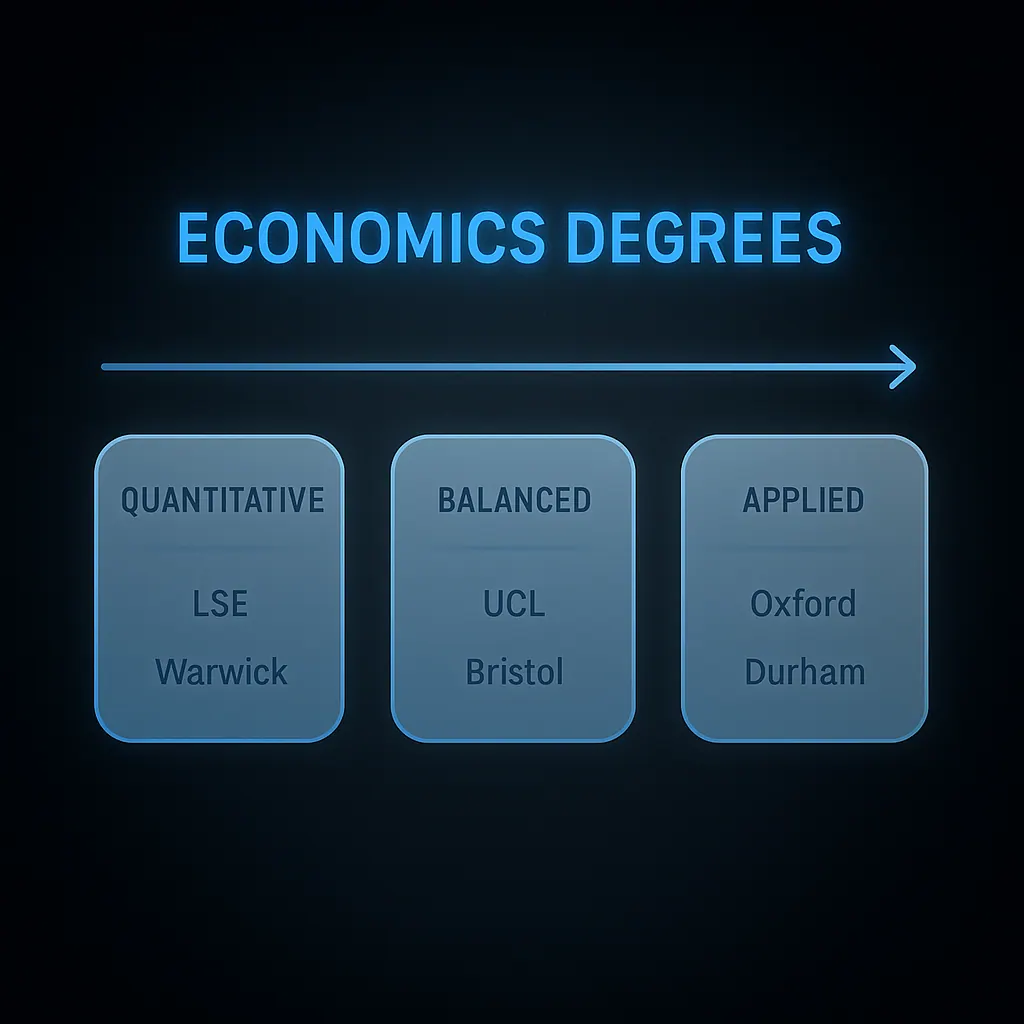
Choosing from the best UK universities for economics is less about league-table position and more about which version of economics you actually want to study. The subject splits into two broad traditions, and picking the wrong one is a more common mistake than picking the wrong institution.
The first tradition is formal and technical: microeconomic theory built from axioms, macroeconomic models using differential equations, econometrics heavy on linear algebra, and in the most demanding programmes, real analysis at the level you would encounter in a mathematics degree. Oxford, Cambridge, LSE, UCL, and Warwick sit firmly here. The counterintuitive thing is that a student with A* Mathematics who dislikes abstract proof-writing can find these courses deeply frustrating, even at a Russell Group institution ranked below those five.
The second tradition is political-economy and interdisciplinary: courses that treat economic questions alongside history, sociology, philosophy, or public policy. These are not easier programmes. They are differently demanding, rewarding breadth of argument over technical precision.
The distinction shapes your shortlist in a practical way:
- A student targeting a quantitative research career or a competitive graduate economics programme needs to prioritise the first tradition.
- A student drawn to policy, journalism, international development, or law benefits from the second.
- Joint honours such as PPE, History and Economics, or Economics with Politics are not compromises. They are coherent intellectual choices with their own graduate outcomes.
Decide which tradition fits you before you rank universities by reputation.
2. The Maths Gate: Entry Requirements Across the Spread

A-level Mathematics is effectively a prerequisite for economics at every competitive UK university. Most departments will not consider an application without it, and several of the most selective institutions specify an A or A* in Maths as a hard condition of the offer, not a preference.
Further Mathematics sits in a grey zone that catches many applicants off guard. Departments at the most quantitative end of the spectrum, including those that run heavily theoretical first-year courses built around real analysis and linear algebra, strongly prefer Further Maths even when their published entry requirements do not formally list it. Applying without it to those programmes puts you at a structural disadvantage in a competitive pool, regardless of your other grades.
For IB students, the picture is similar. Universities making economics offers typically want Higher Level Mathematics, and most specify a preference for HL Mathematics Analysis and Approaches (AA) over HL Mathematics Applications and Interpretation (AI). The distinction matters because AA covers proof, calculus, and abstract reasoning in a way that maps more directly onto first-year university economics. AI is designed around applied statistical contexts and is widely considered less preparation for a theoretical economics degree. Some departments will accept AI at HL but may view it less favourably at offer stage.
One practical caution: published entry requirements shift year to year as applicant volumes and cohort profiles change. Always check the individual course page on the university's own website before assuming any summary table, including this one, reflects the current cycle's offer.
3. Highly Quantitative Economics: Oxford, Cambridge, LSE, UCL and Warwick
If you want the most mathematically demanding undergraduate economics in the UK, the field narrows quickly to five institutions: Oxford, Cambridge, LSE, UCL, and Warwick, all Russell Group members and all operating at a level where A-level Maths at the highest grade is a baseline, not a differentiator.
Oxford topped the Guardian University Guide 2026 for Economics, published in September 2025. The ranking covers three undergraduate programmes: Philosophy, Politics and Economics (PPE), Economics and Management, and Economics and History. All three are taught through Oxford's tutorial system, where small groups meet weekly with a specialist tutor. That format rewards students who can prepare and defend written arguments under direct questioning, which is different from large-lecture learning and worth considering before you apply.
The Economics and Management programme is the standout by one specific measure: it has held first place in the Complete University Guide for five consecutive years, most recently in the 2026 edition published June 2025, and was ranked best for graduate prospects in the same table. It is taught jointly by Oxford Saïd Business School and the Department of Economics, which gives it a different character from a pure economics degree.
LSE is the one institution in this group that is entirely focused on social science. That specialism shows in the curriculum: economics sits alongside statistics, methodology, and policy in a way that generalist universities cannot fully replicate. LSE was named University of the Year by The Times and Sunday Times Good University Guide 2025.
Cambridge, UCL, and Warwick round out this tier. Each runs heavily mathematical first years, and Warwick in particular is known among applicants for treating its economics degree almost as an applied mathematics course from the outset. If your strongest subject is Further Maths rather than essay-writing, that structure may suit you better than the Oxford tutorial model.
The non-obvious point: applying to two or more of these five in the same UCAS cycle is common and broadly fine, except for Oxford and Cambridge, where you must choose one.
4. Applied and Interdisciplinary Economics: PPE, History and Politics Combinations
PPE (Philosophy, Politics and Economics) is one of the most distinctive undergraduate degrees in the UK, and it started at a single college. Balliol College Oxford originated the PPE degree in the 1920s, and the programme has been running long enough that more than 16,000 students have graduated in PPE at Oxford over the last five decades. The degree celebrated its centenary in 2020. Today, Balliol offers 12 undergraduate places per year, making it one of the more competitive single-college allocations in Oxford.
The non-obvious thing about PPE is how differently its economics content sits from single-honours economics. Oxford PPE bridges three departments: Politics and International Relations, Philosophy, and Economics. Students split their time across all three in the first year, then specialise in two. That means an Oxford PPE student may drop economics entirely after Part 1. If your priority is quantitative depth, PPE is not a substitute for an economics degree. If your priority is analytical breadth across institutions, argument, and political economy, it is a genuinely different intellectual experience.
Economics with History and Economics with Politics combinations follow a similar logic. These joint honours degrees reward students who want to understand why economic systems behave as they do, not just model how they behave. The reading lists, the essay conventions, and the assessment styles are closer to humanities than to applied mathematics.
Several Russell Group universities offer economics in these applied and joint-honours forms, including Manchester, Edinburgh, Bristol, Exeter, Nottingham, and York. The best universities for PPE and for history and economics are a different shortlist from the best for maths and economics: the selection criteria shift from mathematical intensity toward tutorial quality, department breadth, and access to politics or history faculty.
If you are choosing between a joint-honours and single-honours economics degree, be clear on which discipline you would drop first. Most joint degrees require genuine commitment to both halves, not economics with a minor attached.
5. Best UK Universities for Maths and Economics, Finance, and Data-Science Combinations
Joint degrees pairing economics with mathematics, statistics, or data science attract students who want rigorous quantitative training but with economic applications built in from day one, rather than the abstraction of pure mathematics. The practical appeal is straightforward: you graduate able to build econometric models and interpret them in a policy or market context, which pure maths rarely teaches directly.
The gotcha most applicants miss is that a strong economics department and a strong mathematics or statistics department do not automatically combine into a strong joint degree. The two departments have to co-design the curriculum, share teaching resources, and agree on progression rules. At some universities the joint honours is essentially two half-degrees bolted together; at others it is genuinely integrated. Checking module lists and reading the programme specification matters more here than consulting a league table.
Warwick, UCL, Edinburgh, Bristol, and Bath are among the institutions with established reputations in quantitative economics tracks and economics-with-finance combinations. All five appear on the Commonwealth Scholarship Commission's MOU partner list, which signals a minimum level of postgraduate research infrastructure that tends to feed back into the quality of undergraduate teaching in technical subjects.
Economics with Finance deserves a separate look. Many finance programmes sit inside business schools rather than economics departments, and the teaching philosophy differs. Business-school finance tends to focus on valuation, markets, and accounting logic. Economics-department finance draws more heavily on game theory, contract theory, and empirical methods. Neither is better, but they lead to different graduate profiles, so it is worth confirming which department owns the degree before applying.
Choosing a joint programme effectively narrows your shortlist, because you are looking for institutional strength in two disciplines simultaneously, not one.
6. Best UK Universities for Business Economics and Economics with Management
Business economics degrees sit within a business school rather than an economics department. The intellectual centre of gravity shifts: less time on pure theory and general equilibrium, more on firm behaviour, strategy, organisational decision-making, and how markets affect business practice. That is a genuine trade-off, not a hierarchy. Students who want to work in consulting or corporate finance often find the blend more directly applicable; students aiming for economic research or central banking usually find mainstream academic economics a better fit.
Oxford's Economics and Management programme is the benchmark. Taught jointly by Oxford Saïd Business School and the University of Oxford Department of Economics, it has been ranked 1st in the UK by the Complete University Guide for five consecutive years, most recently in the 2026 edition. The same ranking named it best for graduate prospects. Times Higher Education places it 2nd in the world, behind MIT.
Other universities with well-regarded programmes in this space include Durham, Bath, Leeds, Exeter, and Manchester, each offering variants under names like Business Economics or Economics with Management.
One non-obvious gotcha: the economics component of a business economics degree varies considerably in mathematical depth. Some programmes require little beyond A-level Maths; others match the quantitative rigour of a standalone economics degree in years two and three. Check the module list, not just the title.
Before accepting an offer, confirm three things:
- Whether the degree carries professional body accreditation (AACSB, AMBA, or EQUIS for the business school element).
- Whether it grants exemptions from CIMA, ACCA, or ICAEW exams.
- How the economics teaching is weighted against management modules across all three years.
7. Placement Years, Graduate Outcomes, and How to Compare Them
A sandwich or placement year typically adds a third year of paid work experience between your second and final year, extending a three-year degree to four. How it appears on your course page matters: some programmes embed it as a standard feature with dedicated careers support, some list it as an optional "with placement year" variant, and others offer no structured placement at all. That distinction sits at course level, not institution level. A university can have a strong placement record in business economics and none at all in its straight economics route. Always check the specific course structure page, not the department homepage.
For comparing graduate earnings and employment rates, the most reliable public source is the Longitudinal Educational Outcomes (LEO) dataset, published via gov.uk, which links HMRC earnings records to degree subject and institution. You can filter by subject area and provider to compare trajectories over one, three, and five years after graduation. HESA's Graduate Outcomes survey covers broader employment categories including further study.
The counter-intuitive finding that surfaces repeatedly in LEO analysis: **subject choice and mathematical intensity tend to predict earnings more strongly than institution alone**, particularly across mid-tier universities. A quantitative economics degree from a less-famous university often produces better early-career earnings than a qualitative social-science-adjacent course from a more prestigious one. That is worth weighing before you prioritise brand over course structure.
8. Postgraduate Economics: Masters and PhD Routes
For postgraduate study, the names that appear most consistently across research and taught programme rankings are LSE, Oxford, Cambridge, UCL, and Warwick. All five offer both MSc Economics routes and research-track MRes or PhD programmes, and all five are well-established for producing economists who go on to central banks, international institutions, and academic posts.
The standard PhD pathway runs: strong undergraduate degree, then a one-year MSc Economics or two-year MRes (Master of Research), then doctoral application. The MRes is worth noting specifically because many departments use it as a filter: students who perform well in the MRes are invited to continue to the PhD, rather than applying separately. Mathematical preparation matters more here than at undergraduate level. Measure theory, real analysis, and matrix algebra feature in first-year PhD coursework at the leading departments, so candidates who coasted through A-level Maths will find the step up significant.
Funding is a real constraint, but one practical option for eligible students is a Commonwealth Scholarship. The Commonwealth Scholarship Commission has signed MOU agreements with over 100 UK universities, and the economics-relevant institutions on that list cover a wide spread. Per the Commonwealth Scholarship Commission, MOU partners include LSE, Oxford, Cambridge, Warwick, UCL, Edinburgh, Manchester, Bristol, Bath, York, Exeter, Nottingham, and King's College London. Commonwealth Master's Scholarships, PhD Scholarships (for least developed countries and fragile states), and Split-Site Scholarships are only placed at MOU-signatory universities, so checking that list before applying is a concrete first step.
9. University Comparison Table: Mathematical Intensity, Joint Honours and Entry Bands
Column definitions before you read the table:
- High mathematical intensity means the course includes formal proofs, real analysis, and econometrics from year one. Expect epsilon-delta proofs, measure theory in later years, and problem sets closer to a mathematics degree than a social-science one.
- Medium means calculus and statistics are core, but proof-writing is limited. Quantitative methods build progressively rather than front-loaded.
- Applied means the emphasis is on using mathematical tools in policy or business contexts, with less formal theory.
| University | Mathematical Intensity | Representative Joint-Honours Options | Placement Year | A-level Maths Required | Entry Band |
|---|---|---|---|---|---|
| Oxford | High | PPE, Economics and Management, Economics and History | No | Yes | Highest |
| Cambridge | High | Economics (standalone), Land Economy | No | Yes | Highest |
| LSE | High | Economics and Statistics, PPE, Mathematics and Economics | Optional | Yes | Highest |
| UCL | High | Economics and Statistics, Economics and Business | Optional | Yes | High |
| Warwick | High | Maths and Economics, Economics and Industrial Organisation | Optional | Yes | High |
| Edinburgh | Medium | Economics and Politics, Economics and Finance | Optional | Yes (or equivalent) | High |
| Manchester | Medium | PPE, Economics and Finance, Business Economics | Yes | Yes | Competitive |
| Bristol | Medium | Economics and Mathematics, Economics and Accounting | Optional | Yes | High |
| Exeter | Applied | Business Economics, Economics and Finance | Yes | Yes | Competitive |
| Durham | Medium | PPE, Economics and Politics, Business Economics | Optional | Yes | High |
A non-obvious quirk worth knowing: Oxford offers no standalone Economics BA. Every undergraduate economics degree at Oxford is a joint-honours programme, as confirmed by the Oxford Economics department. If you want pure economics, Oxford is not the route, regardless of its No. 1 ranking in the Guardian University Guide 2026.
All ten universities listed are Russell Group members, which matters for some graduate employer shortlisting criteria, but mathematical intensity and course structure vary considerably within that group.
> Note: Entry offer grades change each admissions cycle. Treat the bands above as a rough guide only. Always check the current course page on UCAS before applying.
10. What to Do Next
This week, open the comparison table in section 9 and find the mathematical-intensity column. Check it against your current A-level or IB Maths qualification: if you are taking IB Maths Applications and Interpretation rather than IB Maths Analysis and Approaches, several of the most quantitative programmes listed will not accept you at the standard offer level, regardless of your overall points. That is the one detail many applicants miss until it is too late to change course options.
Once you have confirmed your maths qualification fits each target department, open the UCAS course search pages for your three top universities and verify that the current advertised offer matches what you hold or are predicted.
For further depth, browse our Economics subject guide. You can also read about individual departments on the University of Warwick, LSE, and UCL pages. Check UCAS this week before your predicted grades are submitted.
FAQ
What are the best UK universities for economics?
Oxford, Cambridge, LSE, UCL, and Warwick are consistently ranked at the top, but the best fit depends on whether you want a highly mathematical programme or a more applied, interdisciplinary course - the mathematical intensity of the course matters as much as the institutional name.
Do I need Further Maths to study economics at a top UK university?
Further Maths is not always a formal requirement, but it is strongly preferred at the most quantitative departments, such as those at Oxford, Cambridge, LSE, and Warwick; always check the individual course page for the current entry requirements.
Which UK universities are best for PPE (Philosophy, Politics and Economics)?
Oxford is the originator of the PPE degree and ranks No. 1 in the UK for Politics according to the Guardian; other strong options for interdisciplinary economics-politics combinations include LSE, UCL, Edinburgh, Manchester, and Durham.
What is the best UK university for economics and finance?
LSE, UCL, Warwick, Edinburgh, and Bath are widely regarded for economics-and-finance combinations, though the distinction between an academic economics programme with a finance track and a business-school finance degree is worth understanding before you apply.
Which UK universities offer the best masters in economics?
LSE, Oxford, Cambridge, UCL, and Warwick are the most established destinations for taught MSc Economics and MRes programmes, with research-focused PhDs typically requiring a masters as a prerequisite.
Can I study economics at a top UK university with IB qualifications?
Yes - all the major economics departments accept the IB Diploma; most specify a total-points threshold and require Higher Level Maths, with HL Mathematics Analysis and Approaches (AA) often preferred over HL Mathematics Applications and Interpretation (AI).
References
- Our universities | Russell Group - https://www.russellgroup.ac.uk/our-universities
- Oxford ranked No. 1 in the UK for Economics | Department of Economics - https://www.economics.ox.ac.uk/article/oxford-ranked-no.-1-in-the-uk-for-economics
- Economics & Management Programme Ranked Best in UK for Fifth Consecutive Year | Department of Economics - https://www.economics.ox.ac.uk/article/economics-management-programme-ranked-best-in-uk-for-fifth-consecutive-year
- London School of Economics | Russell Group - https://www.russellgroup.ac.uk/our-universities/london-school-economics
- Philosophy, Politics and Economics (PPE) | Balliol College - https://www.balliol.ox.ac.uk/courses/undergraduate/ppe
- Philosophy, Politics and Economics (PPE) BA | DPIR - https://www.politics.ox.ac.uk/course/philosophy-politics-and-economics-ppe-ba
- UK universities - Commonwealth Scholarship Commission in the UK - https://cscuk.fcdo.gov.uk/uk-universities