Engineering Personal Statement: Complete Guide for 2026
By Michael Thompson · Former IB Diploma Programme coordinator; 10 years at Bromsgrove School · Published 5 July 2026
Your engineering personal statement needs to do one thing clearly: show that you think like an engineer. The 2026 UCAS format splits the old single essay into three separate questions, each with a minimum of 350 characters within a shared 4,000-character limit - so you cannot bury a vague opening under a word count. Admissions tutors at engineering departments, from Imperial to Cambridge, want evidence of mathematical and physical reasoning, hands-on making, and applied problem-solving - not a general enthusiasm for how things work. This guide maps every part of the new format to what engineering courses actually reward, with worked examples, subject-specific super-curriculars, and an IB-specific section for students whose evidence sits in internal assessments and extended essays.
Key Takeaways
- Three questions, one 4,000-character limit: The 2026 UCAS personal statement uses three separate questions you can weight unevenly, but each needs at least 350 characters.
- Tutors want applied problem-solving, not general interest: Concrete accounts of a design constraint, an iteration, and a failure are more persuasive than 'I have always loved building things'.
- Maths and physics grounding is the baseline: Engineering courses - especially at Cambridge and Imperial - expect evidence of higher-level mathematical and physical reasoning, not just good grades.
- Super-curriculars should be technical and specific: Robotics competitions, personal build projects, and relevant work experience carry weight when described with engineering specifics, not vague enthusiasm.
- IB students have strong built-in evidence sources: Design Technology or Physics internal assessments and an Extended Essay in a relevant subject map directly onto the three UCAS questions.
- Cambridge treats non-academic activities strictly: Cambridge states that extra-curricular activities unrelated to your subject are not taken into consideration - focus on super-curriculars in depth.
In This Article
- What Engineering Admissions Tutors Actually Look For
- How the 2026 UCAS Personal Statement Format Works for Engineering
- Question 1: Showing Motivation Through a Specific Engineering Problem
- Question 2: Evidencing Maths, Physics, and Technical Preparation
- Question 3: Super-Curriculars That Carry Weight in Engineering
- Engineering Books and Reading for Your Personal Statement
- IB Students: Using Internal Assessments and the Extended Essay
- Mechanical Engineering Personal Statement: Cambridge and Other Selective Courses
- Common Mistakes That Weaken Engineering Personal Statements
- What to Do Next
1. What Engineering Admissions Tutors Actually Look For
A strong engineering personal statement does not open with a childhood memory of taking apart a toaster. Admissions tutors at selective departments read statements to find evidence of one specific thing: that you can think about engineering problems analytically, not just that you find engineering interesting.
The difference matters. General enthusiasm is easy to perform. Applied problem-solving leaves a different trace: you identify a specific problem, you reason about constraints, you reference the mathematics or physics that governs the system. That is what separates a competitive statement from a forgettable one.
Most engineering tutors are looking for three core signals:
- Mathematical and physical grounding - can you handle the rigour of a demanding technical degree?
- Hands-on design or build experience - have you engaged with engineering as a practice, not just a subject?
- Readiness to think beyond the syllabus - does your curiosity extend past A-level or IB content?
The third point has a counter-intuitive consequence at Cambridge specifically. Cambridge advises against discussing school curriculum content at length and states that classroom-based learning should not dominate the statement. Many applicants do the opposite, using A-level topics as their main evidence of interest. That approach misreads what the statement is for.
Cambridge also distinguishes sharply between super-curricular and extra-curricular activity, and explicitly states that extra-curricular activities are not taken into consideration. Depth of engagement with a few subject-related activities counts for more than a long list.
2. How the 2026 UCAS Personal Statement Format Works for Engineering
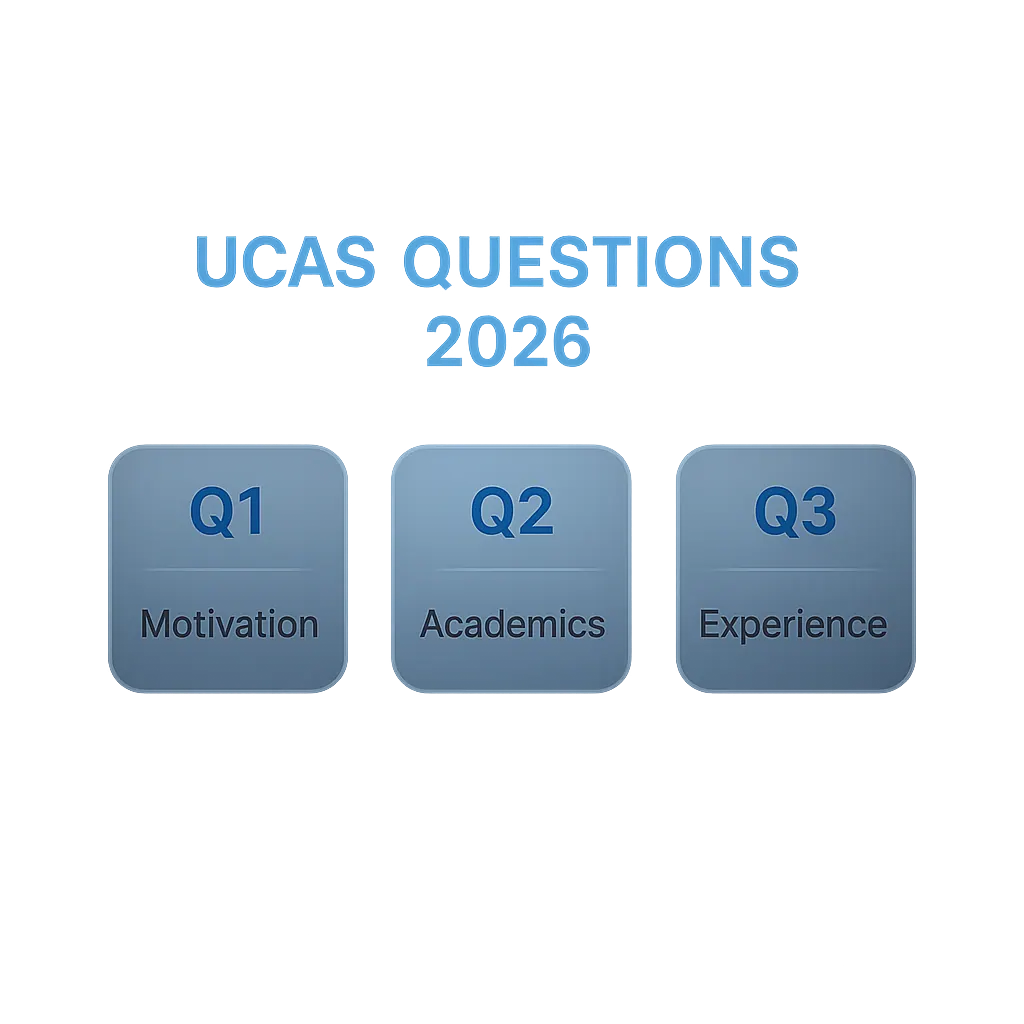
From 2026 entry onwards, UCAS replaced the single free-text personal statement with three separate questions. The overall character limit stays at 4,000 characters (including spaces), and each question carries a minimum of 350 characters. You can distribute the remaining space unevenly, which matters for engineering: most applicants will want to weight Q1 and Q2 more heavily than Q3.
Admissions staff review all three answers as a whole, not individually in isolation, so a thin answer to one question cannot be rescued by a strong answer to another.
Here is how the three questions map onto engineering applications:
| Question | What UCAS asks | What this means for engineering |
|---|---|---|
| Q1 | Why do you want to study this course or subject? | Motivation grounded in a specific problem, project, or engineering challenge |
| Q2 | How have your qualifications and studies helped you to prepare? | Maths and physics skills, specific modules, EPQ, UKMT, online courses |
| Q3 | What else have you done to prepare outside of education? | Work experience, making projects, design competitions, industry visits |
One counter-intuitive point about Q2: UCAS explicitly states that grades appear elsewhere on the application, so repeating them here wastes characters. Use the space to name specific modules (fluid mechanics, further mechanics, differential equations) and explain what you can do with that knowledge, not what grade you achieved doing it.
The 350-character floor per question is a harder constraint than it looks. At average typing density, 350 characters is roughly three short sentences. Treat it as a signal that UCAS expects a substantive answer to every question, not a placeholder.
3. Question 1: Showing Motivation Through a Specific Engineering Problem
UCAS Question 1 asks "Why do you want to study this course or subject?" The word "why" is doing serious work here. Admissions tutors read it as: what specific problem pulled you toward engineering, and what did you do about it?
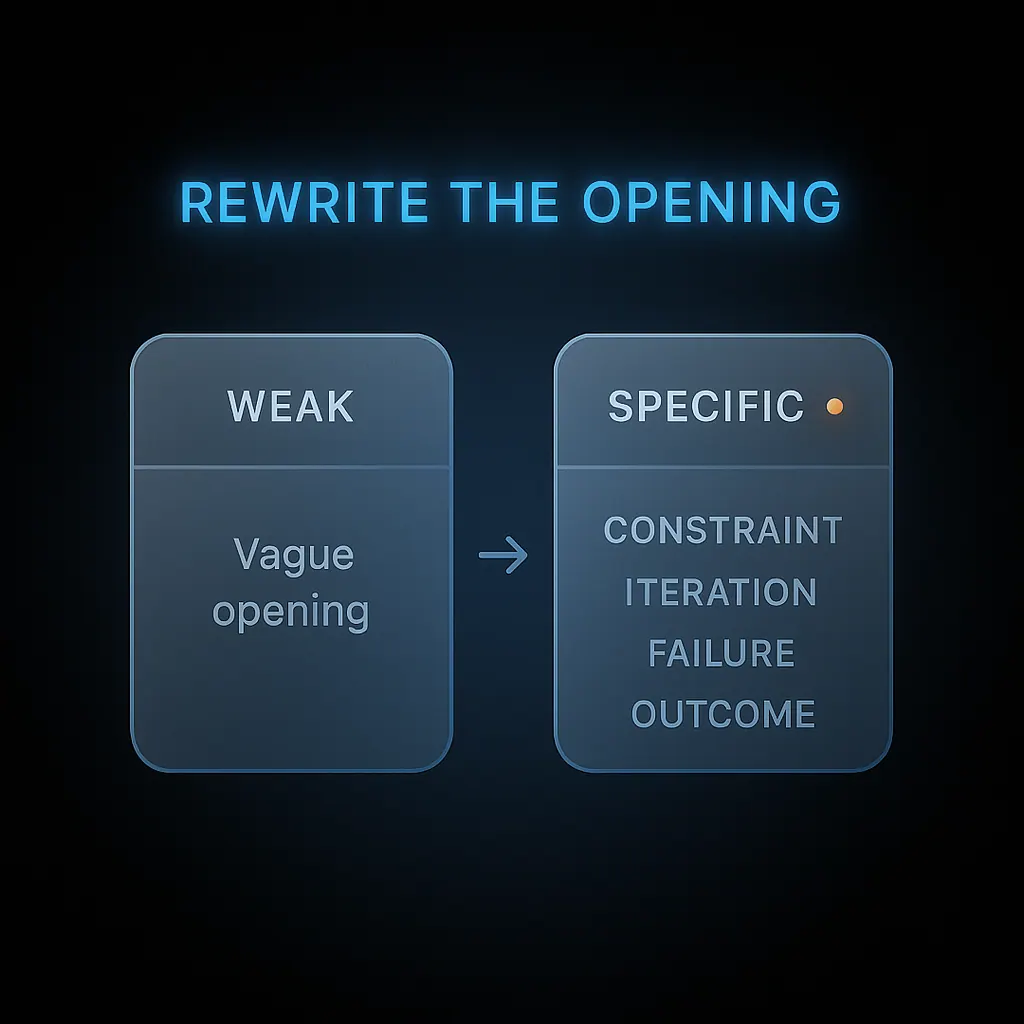
Anchor your answer to a problem, not a feeling. "I have always loved building things" tells a tutor nothing they can evaluate. It signals enthusiasm without evidence of engineering thinking. The fix is to replace the sentiment with a constraint, an attempt, a failure, and a lesson.
Here is the same idea rewritten:
| Version | What it says |
|---|---|
| Before | "I have always loved building things and find engineering fascinating." |
| After | "When I built a small balsa-wood bridge for a school competition, my first design failed under a load of 4 kg because I had placed the central support too close to one end. I rebuilt it with the load transferred symmetrically across three nodes, and it held 11 kg. That gap between my prediction and the result is what I want to understand formally." |
The "after" version names a constraint (asymmetric load), an iteration (repositioning nodes), a failure (collapse at 4 kg), and a question the applicant cannot yet answer without a degree. That is the structure tutors are looking for.
The same logic works across sub-disciplines:
- Civil engineering: describe a moment noticing deflection in a footbridge, and the question it raised about load distribution and material choice.
- Aerospace engineering: describe a model rocket or wing section where a materials failure (skin buckling, adhesive shear) prompted you to read about fatigue limits.
- Electronic engineering: describe a circuit fault where a component failed unexpectedly, leading you to investigate the difference between theoretical and real-world resistance tolerances.
One counter-intuitive point worth knowing: tutors report that applicants often write about the most impressive-sounding project rather than the one that generated the sharpest question. A modest failure that produced genuine curiosity reads better than a polished success story that produced none.
4. Question 2: Evidencing Maths, Physics, and Technical Preparation
Question 2 asks how your qualifications and studies have prepared you for your chosen course. UCAS guidance is explicit: grades appear elsewhere on the application, so this question is for skills, achievements, and specific modules - not a transcript summary.
For engineering, that means demonstrating mathematical and physical reasoning, not just listing subjects you took.
What to include:
- Specific modules that developed relevant thinking: mechanics in A-Level Maths, further calculus, AQA Physics Unit 5 (fields and nuclear), or the IB Higher Level Physics option on engineering physics
- An EPQ with an engineering or scientific focus - UCAS explicitly names EPQ as recognised Q2 evidence
- UKMT competitions (Junior, Intermediate, or Senior Mathematical Challenge), which UCAS also names as valid evidence here
- Relevant online courses, such as MIT OpenCourseWare modules or Coursera's engineering mathematics content
The counter-intuitive point most applicants miss: a UKMT Gold certificate carries more weight than a generic claim about "loving problem-solving" because it gives an admissions tutor a calibrated, external benchmark. Describing what you found difficult in the competition is even better - it signals genuine engagement rather than a line on a list.
Transferable signals admissions tutors look for include analysing and interpreting data, and structured problem-solving - skills built directly through maths and physics study. Show where you applied those skills, not just that you have them.
5. Question 3: Super-Curriculars That Carry Weight in Engineering
Super-curriculars are activities directly related to engineering. Extra-curriculars are everything else: sport, music, volunteering for a food bank. Cambridge is explicit that extra-curricular activities are not taken into consideration during assessment. That is not a soft preference. It means space spent listing your Duke of Edinburgh Award in Q3 is space wasted.
Per UCAS guidance, Question 3 asks: "What else have you done to prepare outside of education, and why are these experiences useful?" Work experience sourced through Springpod is named explicitly as an acceptable Q3 example.
What counts as a high-value engineering super-curricular
- Personal build or design projects. Name the system and the constraint, not just the outcome. "I built a line-following robot" is thin. "I designed a PID controller for a two-wheeled balancing robot, then traded off sensor sampling rate against battery life" signals engineering thinking.
- Competitions. The Engineering Education Scheme, First Lego League, or IMechE's Formula Student give you a defined brief and real constraints to reflect on.
- Work experience or shadowing. A week at a civil or chemical engineering consultancy through Springpod or direct contact counts here. The reflection matters more than the prestige of the firm.
- Reading around a specific branch. Books and journals that connect to your motivation belong in Q3 if they shaped how you think. Section 6 of this guide covers specific titles.
The Cambridge depth-over-breadth rule
Cambridge weighs reflections on super-curricular activities more heavily than the total number undertaken. One well-analysed project where you explain what you learned, what failed, and what you would change next time is worth more than five bullet points listing activities. If you are applying to Cambridge Engineering, resist the instinct to stack activities. Pick two or three and go deep.
The counter-intuitive implication: a student who built one microcontroller circuit and can articulate the trade-off between clock speed and power consumption will read as a stronger candidate than one who completed six taster courses without reflecting on any of them.
6. Engineering Books and Reading for Your Personal Statement
Reading around your subject does more than fill time before term starts. It demonstrates intellectual curiosity that extends beyond the A-level or IB syllabus, and that is exactly what UCAS Questions 1 and 3 need to show. Cambridge explicitly weights reflections on super-curricular activity more heavily than the sheer volume of activities listed, which means one book you can discuss in depth beats five titles you have dropped into a list.
The key is specificity about sub-discipline. A biomedical engineering applicant gains little from a book on bridge design. Pick reading that maps to your stated interest: materials science and thermodynamics texts for mechanical engineering, process chemistry or reaction kinetics for chemical engineering, structural analysis or geotechnics for civil, aerodynamics or flight mechanics for aerospace.
When you write about a book, name the argument or idea that challenged or extended your thinking, not just the title. Tutors who interview hundreds of applicants each cycle can tell immediately whether a candidate read something or simply added it to a list.
Cambridge publishes subject-specific suggested reading lists on its undergraduate study pages. Check the Engineering entry directly, as recommended texts change and some course pages carry more detail than others.
One non-obvious point: peer-reviewed journal articles, even abstracts from IEEE or Nature Engineering, carry as much weight as popular-science books and signal that you understand how engineering knowledge is actually produced.
7. IB Students: Using Internal Assessments and the Extended Essay
IB students have richer material to draw on than they often realise. The challenge is knowing which piece of evidence maps to which UCAS question.
**Check entry requirements before anything else.** Most engineering courses at UK universities specify Higher Level Mathematics and often HL Physics. The non-obvious gotcha: several courses, including some at Imperial and UCL, explicitly require Maths AA (Analysis and Approaches) rather than Maths AI (Applications and Interpretation). Maths AI is accepted for some programmes but not others, so check each course's official requirements page individually.
Mapping your IB work to the three UCAS questions
UCAS asks three separate questions for 2026 entry, and your IB portfolio fits differently into each:
| IB work | Best question | What to highlight |
|---|---|---|
| Physics or Design Technology IA | Q2 (formal preparation) | Experimental design, data analysis method, specific finding |
| Extended Essay in maths or science | Q2 or Q3 | Research question, analytical approach, or how it deepened your curiosity |
| TOK connections to engineering ethics or design | Q3 (super-curriculars and wider engagement) | A specific claim or discussion prompt, not a general summary |
A concrete tip: if your Physics IA involved structural load testing or fluid dynamics, that belongs squarely in Q2 as evidence of technical preparation, not in Q3 as a reading recommendation.
Cambridge applicants: the additional statement
If Cambridge appears on your list, My Cambridge Application includes an optional 1,200-character statement separate from your UCAS answers. Cambridge's guidance states it should not repeat your UCAS content. Use it to address anything specific to Cambridge's engineering course that differs from your other choices, for instance a particular research group or the integrated MEng structure.
One rule applies everywhere: UCAS states that grades appear elsewhere on the application, so do not list your IB predicted scores in any of the three questions. Write about what you did with your studies, not the number you expect to receive for them.
8. Mechanical Engineering Personal Statement: Cambridge and Other Selective Courses
Cambridge reads every engineering personal statement in full, but does not formally score it. Tutors are looking for signs of academic potential and critical thinking, not a polished CV summary. That distinction matters: a statement dense with club memberships and sporting achievements will not help, because extra-curricular activities unrelated to the subject are explicitly not taken into consideration. Cambridge is direct about this.
The practical constraint for a mechanical engineering personal statement Cambridge applicants should note: non-academic activities must not occupy more than 20% of whichever section they appear in. If you spend a paragraph on sport, you have probably already used up that allowance.
What Cambridge engineering tutors do want to see is mathematical reasoning, physical modelling, and hands-on design experience, described with enough depth to show you understand why something worked or failed. One specific example of iterating a design under a constraint, such as a material limitation or a load calculation that forced a change, tells a tutor more than three generic paragraphs about passion for machines.
The same evidence structure applies across disciplines:
- Chemical engineering personal statement: the constraint is usually thermodynamic or yield-based; show you followed the logic of the trade-off.
- Civil engineering personal statement: focus on structural or materials reasoning, not admiration for famous bridges.
- **Biomedical engineering personal statement:** the mechanism is biological, but the engineering framing (constraint, iteration, outcome) still drives the argument.
- Aerospace and design engineering personal statements: aerodynamic or manufacturing constraints work the same way.
Cambridge also recommends a separate, shorter statement via My Cambridge Application if your Cambridge course differs from your other UCAS choices. Use it.
9. Common Mistakes That Weaken Engineering Personal Statements
Five patterns consistently weaken an engineering personal statement, and most are easy to fix once you know what to look for.
- Opening with vague motivation. "I have always been fascinated by engineering" tells an admissions tutor nothing. Start with a specific problem, project, or moment instead. The question is why this discipline, not that you find it interesting.
- Repeating your grades. UCAS explicitly states that grades appear elsewhere in your application. Restating them in Question 2 wastes characters you could use to discuss a specific module, competition, or skill.
- Listing activities without reflection. Cambridge weights depth over volume, explicitly stating that reflections on super-curricular activities matter more than the total number you can name. Five activities with no analysis lose to two activities examined properly.
- Over-indexing on extra-curricular activities. Sport and music are not irrelevant to your life, but Cambridge states they are not taken into consideration in admissions decisions, and non-academic content should not exceed 20% of whichever section it appears in. A biomedical engineering personal statement dominated by rowing results will not perform well.
- **Using one statement for very different courses.** If your UCAS choices span general engineering and, say, chemical engineering or design engineering, the same text will feel generic to every reader. Cambridge specifically recommends its optional supplementary personal statement, available via My Cambridge Application, for applicants whose Cambridge course differs significantly from their other choices. That extra 1,200 characters is worth using.
10. What to Do Next
Before you write a single sentence, check the specific entry requirements for each course you are targeting. This matters more than most applicants realise: some universities accept IB Maths Applications and Interpretation at Higher Level for engineering, while others, including several Russell Group departments, require Maths Analysis and Approaches HL. Getting this wrong at the drafting stage wastes time on a statement aimed at a course you cannot enter. Compare engineering course entry requirements and Maths and Physics prerequisites across UK universities before you commit to a structure.
Once you have confirmed your targets, draft your three UCAS questions and submit them to the Personal Statement Review this week. Send your draft before you have over-edited it. Fresh drafts reveal the gaps that matter most.
FAQ
How do I start an engineering personal statement?
Start Question 1 with a specific problem, project, or moment that required engineering thinking - not a general statement about loving the subject - so the reader immediately sees applied reasoning rather than motivation.
Do engineering personal statements matter?
Yes - Cambridge, for example, reads personal statements in full to identify academic potential and critical thinking, and uses them alongside other application materials to decide who to interview.
How long is the engineering personal statement for 2026 entry?
The 2026 UCAS personal statement has a shared limit of 4,000 characters across three questions, each with a minimum of 350 characters, which you can distribute unevenly according to how much you have to say for each question.
What should I write in an engineering personal statement for Cambridge?
Cambridge wants evidence of academic potential and critical thinking, advises keeping non-academic content to under 20% of any section, and recommends going deep on a few subject-relevant super-curriculars rather than listing many activities.
Can IB students use their internal assessments in their engineering personal statement?
Yes - a Physics or Design Technology IA is strong evidence for Question 2, while an Extended Essay in a science or maths subject can support either Question 2 or Question 3, depending on whether it reflects formal study or independent preparation.
What super-curriculars are most useful for an engineering personal statement?
Personal build or design projects (described with specific constraints and iterations), robotics or engineering competitions, relevant work experience, and reading around your target branch of engineering all carry weight when you reflect on them concretely.
References
- Writing your personal statement | Undergraduate Study - https://www.undergraduate.study.cam.ac.uk/apply/how/ucas-personal-statement
- Improve your application to Cambridge | Undergraduate Study - https://www.undergraduate.study.cam.ac.uk/apply/before/improve-application
- How to write your personal statement: 2026 entry onwards | UCAS - https://www.ucas.com/applying/applying-to-university/writing-your-personal-statement/how-to-write-your-personal-statement-for-2026-entry-onwards
- Personal statement tips for international students: 2026 entry | UCAS - https://www.ucas.com/applying/applying-university/writing-your-personal-statement/personal-statement-tips-international-students-2026-entry
- Software engineering personal statement guide | UCAS - https://www.ucas.com/applying/applying-to-university/writing-your-personal-statement/2026-personal-statement-guides/software-engineering-personal-statement-guide
- Completing My Cambridge Application | Undergraduate Study - https://www.undergraduate.study.cam.ac.uk/apply/how/cambridge-application