Computer Science Personal Statement: What Actually Works
By Michael Thompson · Former IB Diploma Programme coordinator; 10 years at Bromsgrove School · Published 5 July 2026
A computer science personal statement lives or dies on specificity: admissions tutors at universities including Oxford, Warwick, and Goldsmiths have said publicly that clichés like 'I've loved computers since I was three' are an immediate turn-off. The 2026 UCAS format replaces the old free-form essay with three structured questions, each asking something distinct about your motivation, preparation, and outside-education activity - all within a shared 4,000-character limit. What tutors want to see is not a love of technology stated in the abstract, but evidence of mathematical thinking, genuine building, and intellectual curiosity that goes beyond the classroom. This guide maps each question to what a computer science applicant should actually put there, with before-and-after phrasing and subject-specific super-curricular ideas.
Key Takeaways
- Three questions, one limit: From 2026, UCAS splits the personal statement into three separate questions sharing a 4,000-character total, with a minimum of 350 characters per answer.
- Show building, not enthusiasm: Tutors at multiple universities have flagged generic passion statements as a turn-off - a concrete project with a specific problem and a debugging story is far more compelling.
- Mathematical maturity matters more than tools: Computer science degrees are maths-heavy; demonstrating you can reason formally - through proofs, competitions, or self-study - signals readiness more clearly than listing programming languages.
- IB applicants need to check maths requirements carefully: Many UK computer science courses specify Maths AA at Higher Level; some accept Maths AI, but you must verify this on each university's official course page before you apply.
- Oxford and Cambridge have distinct emphases: Oxford explicitly states it selects on academic potential alone and does not require specific computing knowledge; Cambridge expects evidence of subject exploration outside school discussed in depth.
- Super-curriculars need specifics, not names: Naming a competition or open-source project is less useful than describing what you built, what broke, and what you concluded - the mechanism matters more than the credential.
In This Article
- What Computer Science Admissions Tutors Actually Reward
- How the 2026 UCAS Personal Statement Format Works
- Mapping the Three Questions to Computer Science
- Before and After: Replacing Buzzwords with Project Evidence
- Super-Curriculars That Carry Weight for Computer Science
- Books, Podcasts, and Reading for Your Computer Science Personal Statement
- Oxford and Cambridge Computer Science Personal Statement Requirements
- Mathematics and Computer Science Personal Statement: IB and Joint Degrees
- Common Mistakes to Avoid in a Computer Science Personal Statement
- What to Do Next
1. What Computer Science Admissions Tutors Actually Reward
A computer science personal statement lives or dies on one thing: evidence that you think like a computer scientist, not just that you like computers. Most statements fail that test before the end of the first sentence.
Professor Lowe at the University of Oxford is direct about it: many of the statements he reads "are similar, bland, impersonal and don't stand out." Robert Zimmer, Head of Computing at Goldsmiths University of London, identifies the same pattern, noting that a remarkable number begin "Ever since I was five years old I have been interested in computing." Admissions tutors at Portsmouth and Warwick flag a related cliche - phrases like "I want to do computing because it's the future" - as a "big turn-off."
Three things cut through that noise:
- **[Evidence of genuine building or investigation](/guides/engineering-personal-statement)** - a project you made decisions on, not a course you completed.
- Mathematical maturity - showing you are comfortable with abstraction and formal reasoning, not just computation.
- Structured problem-solving - describing how you approached a hard problem, including where you got stuck.
The counter-intuitive part: listing languages ("I know Python, Java, and C++") fails for exactly the same reason as enthusiasm cliches. Neither tells a tutor how you think. A sentence about why you chose a recursive solution over an iterative one, and what the trade-off cost you, says more than a paragraph of tool names.
Tutors are reading for thinking. Give them evidence of it.
2. How the 2026 UCAS Personal Statement Format Works
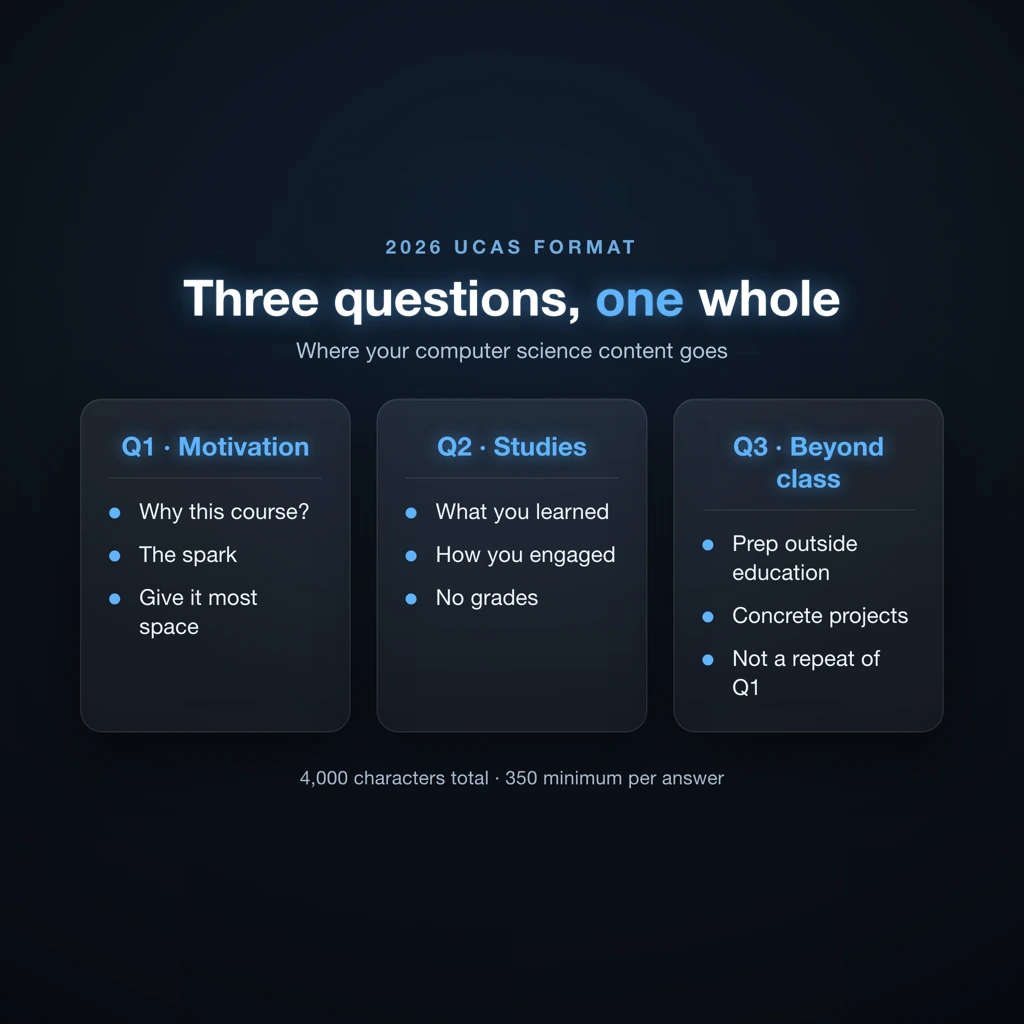
For 2026 entry, UCAS replaced the old free-form essay with three structured questions. The overall character limit stays at 4,000 characters (including spaces), and each answer has a minimum of 350 characters. How you split the remaining characters across the three questions is your choice.
The three questions, verbatim:
- Question 1: "Why do you want to study this course or subject?"
- Question 2: "How have your qualifications and studies helped you to prepare for this course or subject?"
- Question 3: "What else have you done to prepare outside of education, and why are these experiences useful?"
One important constraint on Q2: UCAS explicitly says not to discuss grades, because universities already see them elsewhere in the application. Write about what you learned and how you engaged with the material, not what you scored.
Admissions staff read all three answers as a single whole, so the questions are not isolated boxes. The non-obvious implication for computer science applicants is that Q1 and Q3 can easily overlap if you are not careful. A personal project that sparked your interest belongs in Q1; the same project as evidence of independent preparation belongs in Q3. Splitting a single piece of evidence deliberately across two questions, rather than repeating it, is a more efficient use of your character budget.
A rough starting point for proportions: Q1 deserves the most space because motivation is what admissions tutors weigh first, Q2 is constrained by the no-grades rule, and Q3 rewards specific, concrete experience over volume.
3. Mapping the Three Questions to Computer Science
The three-question format gives you a structure, but it also removes a common hiding place. In the old continuous essay, you could bury a weak motivation paragraph between stronger material. Now Question 1 sits alone, and admissions tutors read it first.
Question 1: Why do you want to study this?
Anchor your answer in a specific intellectual encounter, not a general enthusiasm for technology. Tutors at the University of Warwick and the University of Portsmouth have flagged phrases like "I want to do computing because it's the future" as an immediate turn-off. The fix is precision: name the algorithm you traced by hand, the paper that confused you, or the thing you built that stopped working in a way you had to explain. The problem or the puzzle is the motivation, not the field.
Question 2: How have your qualifications prepared you?
This question is explicitly not about grades. UCAS confirms that universities already see your grades elsewhere, so listing them wastes characters. Instead, show how a specific topic opened something up. A UKMT challenge that made you think carefully about proof structure, an EPQ on cryptography, or an online course that led to a formal qualification are all cited by UCAS as eligible material. The counter-intuitive move here: a single A-level topic explored deeply beats a list of every module you studied.
Question 3: What have you done outside formal education?
This is a reflective account, not a CV. Admissions tutors are not counting projects. They want to know what you now understand differently because you built or read something on your own. An open-source contribution, a self-taught language, or a personal project matters most when you explain the decision you had to make or the concept you had to revise your thinking about.
4. Before and After: Replacing Buzzwords with Project Evidence
The opening sentence admissions tutors see most often looks something like this:
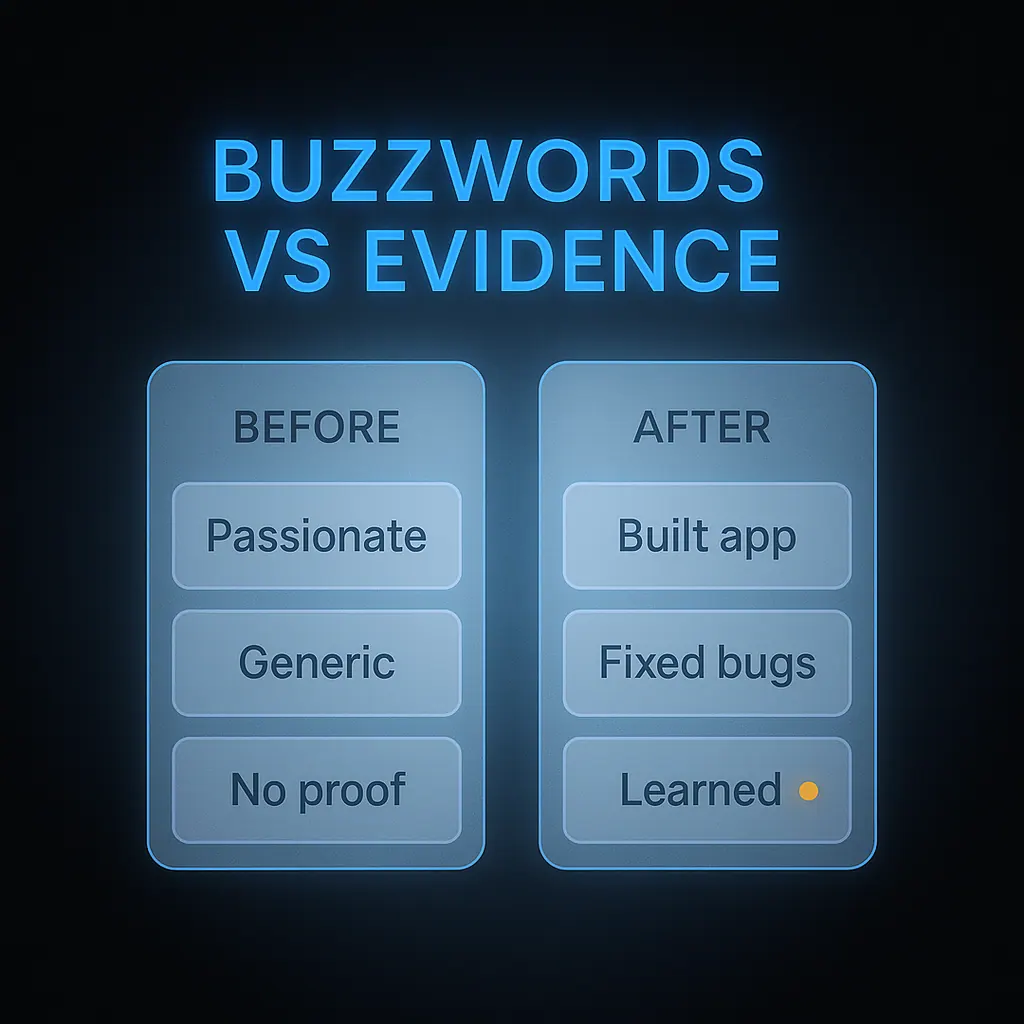
> "I am passionate about coding and have always been fascinated by how computers work."
UCAS notes that Robert Zimmer, Head of Computing at Goldsmiths, sees statements beginning "Ever since I was five years old I have been interested in computing" so frequently they have become a cliché. The problem with the sentence above is not the sentiment. It is the absence of anything verifiable: no problem, no attempt, no result. A reader cannot distinguish it from a sentence written by someone who has never opened a terminal.
**Here is the same idea rewritten with project evidence:**
> "I built a Python script to scrape local bus timetable data and feed it into a journey planner. The first version returned wildly wrong arrival times because I had not accounted for daylight saving time in the Unix timestamps. Fixing it meant reading the Python `datetime` documentation properly for the first time, and I realised the bug had existed silently for two weeks before I noticed. That gap between 'the program runs' and 'the program is correct' is what pushed me toward studying formal verification."
The before version makes a claim. The after version shows the claim being earned: a specific problem (wrong arrival times), a specific failure (silent timestamp bug), and a conclusion drawn from fixing it (the gap between running and correct). Admissions tutors at the University of Portsmouth and University of Warwick explicitly flag "I want to do computing because it's the future" as a "big turn-off", and the underlying reason is the same: the sentence tells tutors nothing about how you think.
The generalised pattern:
- Replace every claim of interest with a specific moment.
- That moment needs three parts: a problem you set out to solve, something that went wrong or surprised you, and what you concluded.
- The conclusion does not have to be profound. "I realised I needed to learn more about X" is honest and useful. "I am passionate about X" is neither.
The counter-intuitive point worth noting: a modest project described precisely reads better than an impressive project described vaguely. An admissions tutor can assess reasoning from a timestamp bug. They cannot assess anything from "I built several complex applications."
5. Super-Curriculars That Carry Weight for Computer Science
The counter-intuitive point here: a project built in Python is not more impressive than one built in Scratch if you can explain why you chose the architecture, what broke, and what you would do differently. Admissions tutors are reading for evidence of thinking, not a technology inventory.
Personal projects
Describe the problem you were solving before you name any tools. A script that scraped local bus timetables to cut your commute time tells a better story than "I built a Python web scraper." Focus on:
- the constraint that made the problem interesting
- one specific decision you got wrong the first time
- what that failure changed about how you approach a new problem
Hardware builds (Raspberry Pi environmental monitors, custom keyboard firmware) work well here because the physical constraints force genuine trade-offs that are easy to write about concisely.
Competitions and olympiads
UCAS names UKMT competitions as an eligible achievement for Question 2 of the new personal statement format. The British Informatics Olympiad and UKIEPC sit in the same category. The gotcha: a bare result ("I reached Round 2") reads as a transcript entry. What reads as genuine engagement is one sentence on a specific problem type that exposed a gap in your reasoning, and one sentence on how you filled it. Participation with honest reflection is more convincing than a medal with no commentary.
Open-source contributions and self-taught topics
Teaching yourself algorithms beyond the A-level or IB syllabus (Dijkstra's, dynamic programming), discrete mathematics, or introductory theory of computation is worth including only if you can say what specifically shifted in your thinking. "I read about P vs NP" is filler. "Working through the halting problem made me realise that some questions about programs cannot be answered by any program, which changed how I think about what software can guarantee" is a claim an admissions tutor can evaluate.
If you have made even a small open-source contribution, name the repository and describe the review process. Seeing a maintainer reject your first pull request and explain why is concrete evidence of feedback-driven learning.
6. Books, Podcasts, and Reading for Your Computer Science Personal Statement
The medium you cite in your computer science personal statement matters far less than what you did with it. UCAS explicitly lists books, news articles, blogs, YouTube videos, podcasts, and subject tasters as acceptable inspiration sources for Question 1 - the one asking why you want to study the subject. A podcast episode is as valid as a textbook chapter, provided you show intellectual follow-through.
The counter-intuitive gotcha: **naming a source without discussing an idea from it reads as padding, not evidence.* An admissions tutor seeing "I listened to Unconfuse Me with Bill Gates*" gains nothing. An admissions tutor seeing "an episode of Unconfuse Me with Bill Gates raised questions about AI interpretability that led me to build a small decision-tree classifier and test where it failed" has something to discuss at interview. The podcast is the prompt. What you did next is the evidence.
Apply the same logic to books. Mentioning a title signals you can read. Explaining one specific claim from it, then connecting that claim to a project, a problem, or a question you then pursued, signals you can think.
A practical test before you include any source in your personal statement: can you write two sentences describing a concrete thing you did or investigated because of it? If not, cut the reference and keep the activity.
7. Oxford and Cambridge Computer Science Personal Statement Requirements
Oxford and Cambridge each have distinct expectations, but you submit the same single UCAS computer science personal statement to every university on your list simultaneously. The statement must work for all five choices at once, not just the most competitive.
Oxford: academic potential, not activities
Oxford's Computer Science department makes one thing explicit: admissions decisions are based on academic abilities and potential alone. Extra-curricular activities such as sport, music, or volunteering do not form part of the selection criteria. What does count are super-curricular activities, meaning subject-related work including competitions, background reading, and programming experience. Oxford also states it is not looking for any specific computing knowledge, so a lack of formal languages or frameworks is not a disqualifier.
The less obvious implication: because other universities on your list may place considerably more weight on broader activities, Oxford's position can actually constrain how you write the statement. If you fill space with non-academic content to satisfy a less selective choice, you dilute the academic signal Oxford is reading for.
Joint degree applicants, for example those applying for Computer Science and Philosophy, must address both subjects with equal seriousness. A statement that reads as primarily a CS pitch, with philosophy mentioned briefly at the end, will not serve that application.
Cambridge: depth over breadth, and a second statement option
Cambridge does not formally score personal statements but reads them in full. The key requirement is evidence of subject exploration outside school, discussed in depth rather than listed. Non-academic activities must not exceed 20% of whichever section they appear in.
If your Cambridge course differs significantly from your other UCAS choices, you can add a Cambridge-specific statement through My Cambridge Application, a separate platform from UCAS. This is worth using if, for instance, you are applying to Cambridge for Computer Science but to other universities for a broader joint or conversion programme.
8. Mathematics and Computer Science Personal Statement: IB and Joint Degrees
IB applicants face one specific gotcha that A-level students don't: not all Higher Level maths qualifications are treated equally. Most UK computer science degrees expect **Maths Analysis and Approaches HL (Maths AA HL)**, not Maths Applications and Interpretation HL (Maths AI HL). The two share a grade band but cover different content, and some courses explicitly name which they require. Check the official course page before applying, not after. This is not a minor formatting detail, it is an eligibility question.
Once that is resolved, the IB offers two pieces of assessed work that map directly onto a computer science personal statement:
- The Computer Science Internal Assessment is a client-driven software product with documented design, development, and evaluation stages. Describe the design trade-offs you made, not just that you built something.
- The Extended Essay in mathematics, computer science, or physics is a 4,000-word independently researched piece. A well-chosen EE question, one that connects an algorithm or mathematical structure to a real problem, gives you research evidence that few A-level candidates can match.
Both map onto Questions 2 and 3 of the 2026 UCAS format, which ask about skills and knowledge gained outside the core curriculum.
Joint degrees: treating both disciplines as primary
For Mathematics and Computer Science, or Computer Science and Philosophy, the computer science personal statement cannot treat one subject as a footnote. Oxford's admissions guidance states explicitly that applicants for joint programmes must explain their interest in both aspects of the programme. A statement that devotes three paragraphs to algorithms and one sentence to philosophy will not satisfy that requirement. Allocate genuine intellectual engagement to each discipline, with separate examples of reading, projects, or reasoning that motivated the combination.
9. Common Mistakes to Avoid in a Computer Science Personal Statement
Three errors appear often enough in computer science personal statements that admissions staff have named them publicly.
Opening with a childhood computing memory. Robert Zimmer, Head of Computing at Goldsmiths University of London, observed that many statements begin "Ever since I was five years old I have been interested in computing." Admissions tutors at the University of Portsmouth and University of Warwick separately identified lines like "I want to do computing because it's the future" as a "big turn-off," per the UCAS computer science personal statement guide. The counterintuitive fix: start with the specific problem or idea that created a genuine question in your mind, not with the moment you first touched a keyboard.
Listing qualifications and grades. The 2026 UCAS format explicitly tells applicants not to discuss grades in Question 2, because universities already see them elsewhere in the application. Reproducing your A-level subjects wastes characters that could carry real analytical weight.
Treating Question 3 as a bare CV. A list of activities with no follow-through reads as padding. Each item in your computer science personal statement needs at least one sentence explaining what it changed in your thinking or which specific skill it developed. "I attended a Springpod Virtual Work Experience" tells an admissions tutor nothing. "The Springpod placement showed me how version control decisions affect team coordination, which reframed how I approached my own group project" does.
10. What to Do Next
The most common mistake at this stage is waiting until you have a "finished" draft before asking for feedback. A rough outline with one concrete project description and a clear thread across the three UCAS questions is already reviewable, and early feedback saves far more time than late-stage rewrites.
This week, write one paragraph about a project you built or a problem you worked through independently. Keep it specific: what the problem was, what you tried, what you learned when it didn't work. That single paragraph is the core of a strong computer science personal statement. Everything else builds around it.
Once you have a first draft, submit it for a personal statement review from an editor who works with CS applicants.
Before you finalise your university choices, compare computer science courses and their maths requirements across UK universities so your personal statement reflects the right emphasis for each programme you are targeting.
FAQ
How do you write a computer science personal statement for 2026 UCAS entry?
From 2026, you answer three separate questions within a shared 4,000-character limit: why you want to study the subject, how your qualifications have prepared you, and what you have done outside education - each requiring specific evidence rather than general enthusiasm.
What should I include in a computer science personal statement?
Include a specific project or intellectual encounter that shows how you think about problems, evidence of mathematical maturity, any relevant competitions or self-study, and reflection on what each experience changed in your understanding.
What do Oxford and Cambridge look for in a computer science personal statement?
Oxford selects on academic potential alone and values super-curricular activity related to the subject; Cambridge expects depth of subject exploration outside school, with non-academic content limited to around 20% of whichever section it appears in.
Can I mention books in my computer science personal statement?
Yes - UCAS lists books, podcasts, articles, and videos as acceptable inspiration sources for Question 1, but you should discuss a specific idea from the book and explain what you did or investigated as a result, not just name the title.
Does my IB maths level matter for a computer science personal statement?
It matters for the application: most UK computer science courses require or strongly prefer Higher Level mathematics, and some specify Maths AA rather than Maths AI - check each course's official entry requirements before applying.
What is the character limit for the 2026 UCAS personal statement?
The overall limit is 4,000 characters including spaces, split across three questions with a minimum of 350 characters each; you decide how to distribute the remaining characters across the three answers.
References
- Computer science personal statement guide | UCAS - https://www.ucas.com/applying/applying-to-university/writing-your-personal-statement/personal-statement-guides/computer-science-personal-statement-guide
- How to write your personal statement: 2026 entry onwards | UCAS - https://www.ucas.com/applying/applying-to-university/writing-your-personal-statement/how-to-write-your-personal-statement-for-2026-entry-onwards
- Personal statement tips for international students: 2026 entry | UCAS - https://www.ucas.com/applying/applying-university/writing-your-personal-statement/personal-statement-tips-international-students-2026-entry
- Department of Computer Science - Undergraduate Admission - https://www.cs.ox.ac.uk/admissions/undergraduate/how_to_apply/personal-statement.html
- Writing your personal statement | Undergraduate Study - https://www.undergraduate.study.cam.ac.uk/apply/how/ucas-personal-statement