Best UK Universities for Engineering (2026 Guide)
By Michael Thompson · Former IB Diploma Programme coordinator; 10 years at Bromsgrove School · Published 5 July 2026
Choosing among the best UK universities for engineering is harder than picking the highest name on a league table, because the decision that actually shapes your career is whether the specific course you accept is accredited by the right professional institution. Accreditation by bodies such as IMechE, IET or ICE is what counts toward Chartered Engineer status - and it varies course by course, not university by university. Alongside that, you face a structural fork: a three-year BEng or a four-year MEng, a broad first year or a named discipline from day one, and whether a placement year is built in. This guide maps those choices clearly so you can compare universities on the things that matter.
Key Takeaways
- Accreditation is course-level, not university-level: Always check that the specific degree you are applying to carries accreditation from the relevant professional body - IMechE for mechanical, IET for electrical, ICE for civil - because two courses at the same university can differ.
- The MEng satisfies more of the academic requirement for Chartered Engineer status: A four-year MEng is accredited as meeting the full academic requirement for CEng, whereas a three-year BEng typically meets it only partially and may require additional postgraduate study.
- The extra MEng year has funding implications: Student loan entitlement extends to cover an additional year for an integrated MEng, but the rules depend on whether you have studied at degree level before - check the gov.uk student finance pages before you apply.
- Most courses require A-level maths and physics: Maths is a near-universal gate; physics is required by the majority of programmes, though some chemical and civil engineering courses accept chemistry instead.
- IB students need strong HL maths and usually HL physics: Universities typically state IB offers as a total-point band with Higher Level conditions, and most engineering departments require HL Mathematics: Analysis and Approaches alongside HL Physics or HL Chemistry.
- Oxford and Cambridge both offer a broad first-two-years model: Oxford's MEng Engineering Science and Cambridge's BA/MEng Engineering both cover fundamentals in years one and two before allowing specialisation, which suits students who are not yet set on a single discipline.
In This Article
- Why Accreditation Matters More Than a League Table Position
- MEng vs BEng: Structure, Chartership, and Funding
- Broad First Year vs Named Discipline from Day One
- Entry Requirements: The Maths and Physics Gate
- Featured Universities for Engineering in the UK
- University Comparison Table: Engineering Degrees at a Glance
- Specialist Disciplines: Aerospace, Civil, Chemical, and Beyond
- How to Compare Universities for Your Engineering Degree
- Where to Go from Here
1. Why Accreditation Matters More Than a League Table Position
Choosing from the best UK universities for engineering involves more than sorting a spreadsheet by ranking. The detail that catches students out most often is accreditation, and it operates at the course level, not the university level. Two degrees at the same institution can carry different accreditation status, so checking your university's general engineering page is not enough.
Professional accreditation means that a recognised engineering body has reviewed a specific course and confirmed it meets the academic threshold for progression toward Chartered Engineer (CEng) status. The Engineering Council oversees the framework that professional bodies operate within. Those bodies include:
- IMechE (Institution of Mechanical Engineers) for mechanical engineering
- IET (Institution of Engineering and Technology) for electrical and electronic engineering
- ICE (Institution of Civil Engineers) for civil engineering
- IStructE (Institution of Structural Engineers) for structural engineering
- RAeS (Royal Aeronautical Society) for aerospace and aeronautical engineering
- IChemE (Institution of Chemical Engineers) for chemical engineering
Cambridge's MEng, for instance, is accredited by multiple bodies including IMechE, IET, ICE, IStructE, and the Royal Aeronautical Society within a single four-year course.
The practical consequence: an unaccredited degree can still lead to CEng, but it requires additional evidence and scrutiny during professional review. That is a friction cost worth avoiding if accreditation is available.
Before applying anywhere, check the relevant professional body's accredited-course search tool and the individual course page directly.
2. MEng vs BEng: Structure, Chartership, and Funding
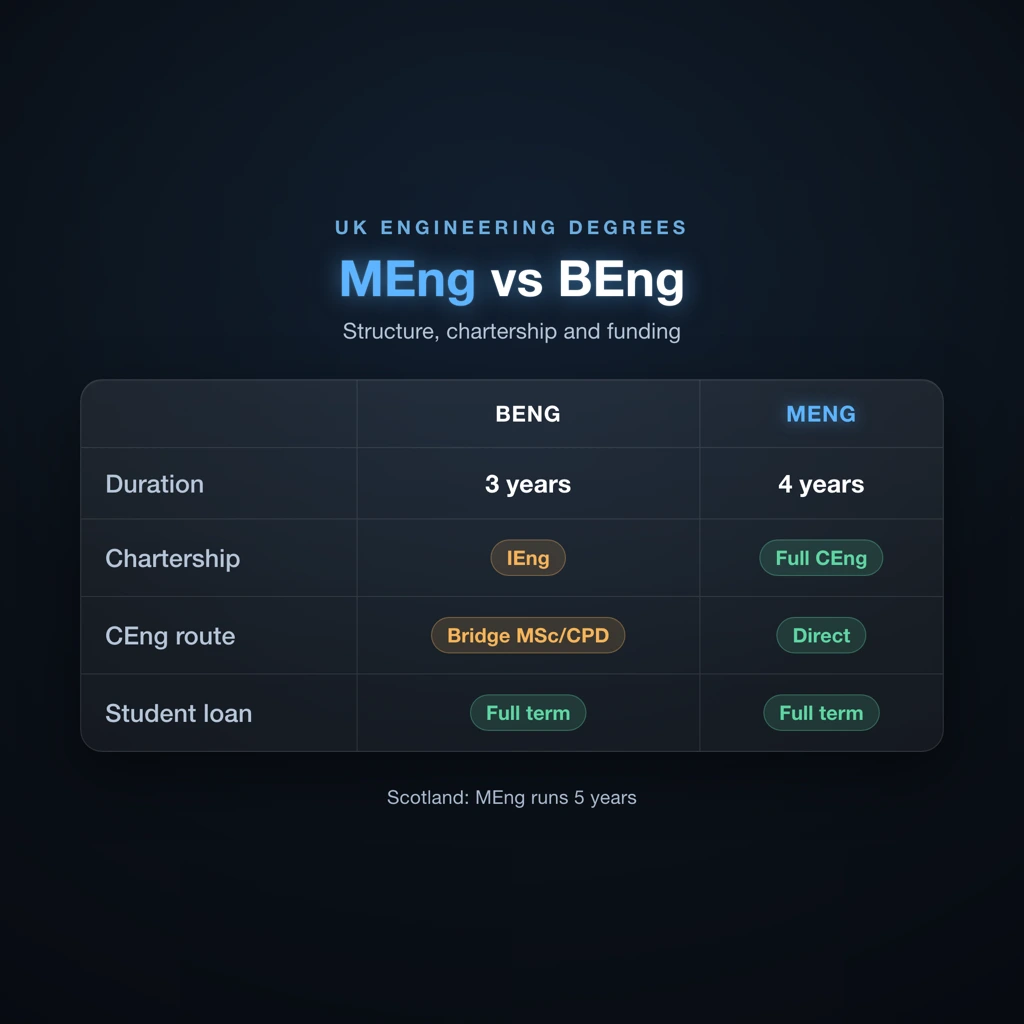
The degree you choose now affects your professional registration decades later, so the MEng vs BEng decision deserves more than a cursory read of the course page.
Chartership is the sticking point. The Engineering Council recognises two tiers of professional engineer: Chartered Engineer (CEng) and Incorporated Engineer (IEng). A BEng (typically three years in England and Wales) meets the academic requirement for IEng, and only the partial requirement for CEng. An MEng (typically four years in England, five in Scotland) is accredited as meeting the full academic requirement for CEng. BEng graduates who later want CEng status must bridge the gap through a further MSc or a sustained programme of self-directed CPD, adding both time and cost after graduation. That extra year on an MEng looks less expensive when you factor in the alternative.
The counter-intuitive wrinkle is that at Oxford and Cambridge the MEng is fully integrated from day one, not bolted on. Oxford's MEng in Engineering Science runs across four years, with students spending the first two on core topics before specialising in one of six branches. Cambridge's four-year BA/MEng is accredited by the Engineering Council alongside multiple professional bodies including IMechE, IET, ICE, IStructE, and the Royal Aeronautical Society. Neither programme lets you leave after year three with an MEng, because the qualification only exists as the full four-year award.
Scotland adds another variable. Scottish MEng programmes run for five years. Scottish-domiciled students studying at Scottish universities may have different fee arrangements compared to students from elsewhere in the UK.
On student finance, the standard undergraduate loan covers tuition fees for the full duration of an MEng, including the additional year beyond a BEng. Eligibility depends on your prior study history, so check the current rules on the GOV.UK student finance pages before assuming you qualify for the extra year of funding.
If CEng is your target registration, applying directly to an accredited MEng is the cleaner, lower-cost route.
3. Broad First Year vs Named Discipline from Day One
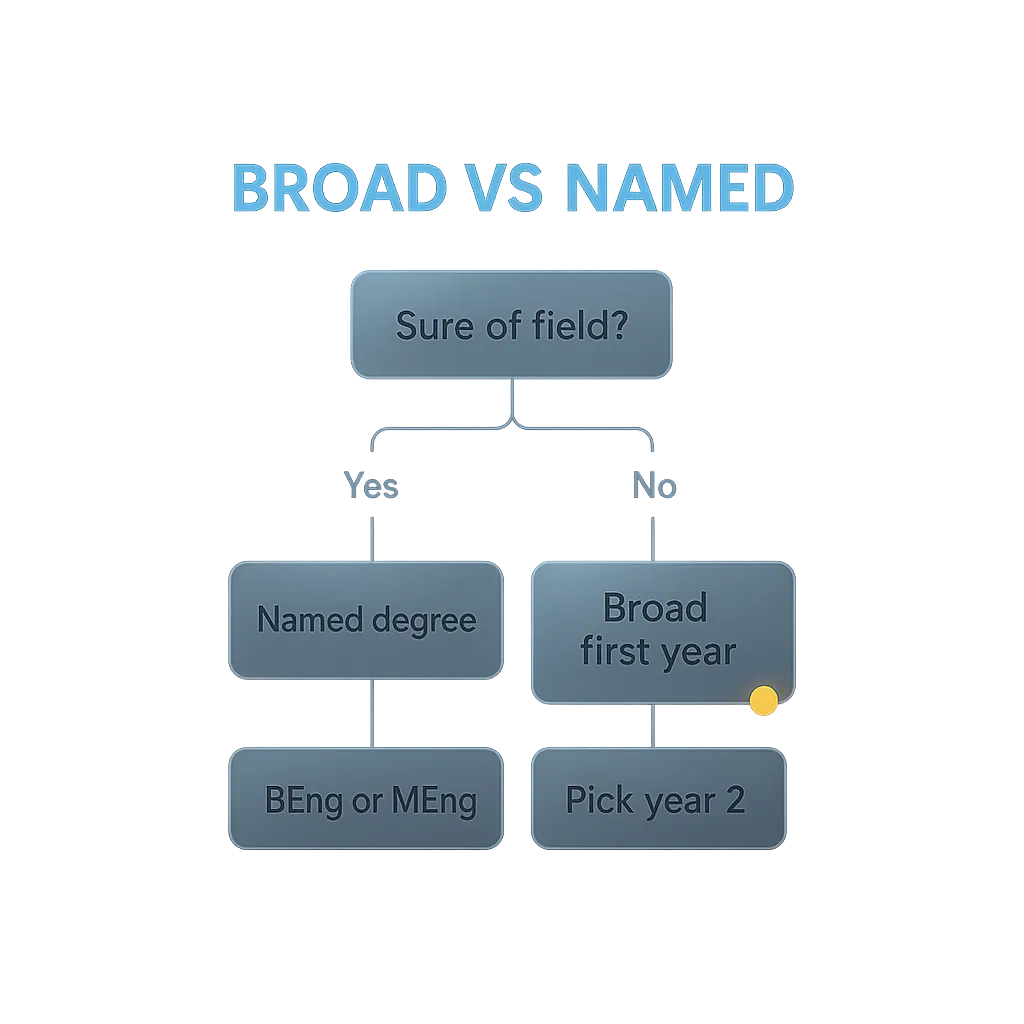
UK engineering degrees split into two structural models, and the difference shapes your entire undergraduate experience.
The broad first-year model keeps all students on common ground before any branching. Oxford's MEng Engineering Science runs two years of core engineering fundamentals, then lets students specialise in years three and four across six branches: Biomedical; Chemical and Process; Civil and Offshore; Control, Electrical and Opto-electronic; Information, Solid Materials and Mechanics; and Thermofluids and Turbomachinery. Cambridge's BA/MEng Engineering follows a similar pattern, with years one and two covering broad fundamentals and specialisation beginning only in year three. The non-obvious consequence: at both institutions, you apply to read Engineering, not Mechanical Engineering or Aerospace Engineering. Your UCAS application says nothing about your eventual specialism.
**The named-discipline model** is more common across the wider UK sector. A student applies directly to BEng Mechanical Engineering, MEng Aerospace Engineering, or BEng Civil Engineering, and the programme is discipline-specific from day one. This suits anyone who already knows their direction.
Which model fits you depends on how certain you are. If you are weighing aeronautical engineering against civil, a broad first year buys genuine decision time. If you have wanted to work in automotive engineering since you were fifteen, the named route gets you to specialism faster.
Sandwich placements are a separate consideration entirely. Many UK universities offer a year in industry, typically in the penultimate year, which extends the degree by one year. This is distinct from the MEng extra year, which is academic, not industrial. Both can appear on the same programme.
4. Entry Requirements: The Maths and Physics Gate
A-level Mathematics is a near-universal requirement across UK engineering degrees. A-level Physics is required by the majority of programmes, and is almost always mandatory for aerospace, mechanical, electrical, and civil engineering. The concrete quirk worth knowing: chemical engineering is the main exception, where many departments will accept A-level Chemistry in place of, or alongside, Physics. If you are sitting Edexcel, AQA, or OCR, the specific board rarely matters to admissions teams, but the subject choice does.
Entry-requirement bands vary considerably across universities. UCAS lists over 3,800 engineering courses in the UK, ranging from degree-level programmes down to HNCs. Rather than relying on aggregated summaries, check each individual UCAS course page for the current conditional offer attached to that specific programme and intake year.
**IB applicants** face an additional layer of specificity. Departments typically express offers as a total-point band with Higher Level conditions attached. Most engineering departments require:
- HL Mathematics: Analysis and Approaches (not Applications and Interpretation, which most departments explicitly reject)
- HL Physics, or HL Chemistry for chemical and process engineering routes
- Some departments also accept HL Further Mathematics in place of standard HL Maths
Beyond grades, some universities require admissions tests. Cambridge Engineering runs a four-year integrated degree and requires applicants to sit the Engineering Admissions Assessment (ENGAA), meaning strong predicted grades alone are not sufficient to secure an offer.
For students who do not meet standard entry conditions, a small number of universities offer foundation year routes, which bridge the gap into first-year undergraduate entry the following year.
5. Featured Universities for Engineering in the UK
Oxford: Engineering Science
Oxford's Department of Engineering Science was founded in 1908 and is structured as a single unified department covering most branches of the subject. That structure matters in practice: there is no BEng option. Every undergraduate graduates with an MEng in Engineering Science, which means Oxford suits students who are certain they want the integrated master's route.
The degree is broad for the first two years, then splits into six specialisation branches in years three and four: Biomedical; Chemical and Process; Civil and Offshore; Control, Electrical and Opto-electronic; Information, Solid Materials and Mechanics; and Thermofluids and Turbomachinery. Industry partners include Rolls-Royce and Jaguar Land Rover.
Explore Oxford's Engineering Science department for full module and specialisation details.
Cambridge: Engineering BA/MEng
Cambridge's four-year course leads to both a BA (Hons) and an MEng, and is ranked 2nd in the UK by The Complete University Guide 2026. Like Oxford, the first two years cover broad fundamentals. Specialisation begins in year three across eight streams including Aerospace and Aerothermal Engineering, Civil/Structural/Environmental Engineering, Electrical and Electronic Engineering, and Mechanical Engineering.
One non-obvious requirement: students must complete a minimum of six weeks of industrial experience by June of year three. That is a condition of the course, not optional work experience. Plan for it early. The four-year course is accredited by the Engineering Council, IMechE, IET, ICE, IStructE, and the Royal Aeronautical Society.
Compare Cambridge's engineering specialisations to see how the eight streams are structured across years three and four.
Other Well-Regarded UK Universities for Engineering
Beyond Oxford and Cambridge, several universities are consistently well regarded for specific disciplines:
- Imperial College London - strong reputation in aerospace, mechanical, and chemical engineering, and often cited among the best UK universities for aerospace engineering.
- UCL - recognised for civil, mechanical, and chemical engineering programmes.
- University of Manchester - known for mechanical, aerospace, and chemical engineering, with research-active departments.
- University of Sheffield - well regarded for aerospace and mechanical engineering, and notable for placement year availability.
- **University of Bath** - a strong option for mechanical and automotive engineering, with structured placement years built into many programmes.
- Loughborough University - frequently mentioned for automotive and mechanical engineering, with close industry ties.
Most of these universities offer named-discipline degrees from year one rather than the broad-first model used at Oxford and Cambridge. Placement year availability varies by programme, so check individual course pages directly.
6. University Comparison Table: Engineering Degrees at a Glance
The table below gives a side-by-side view of seven universities that regularly appear in shortlists for the best UK universities for engineering. One counter-intuitive detail worth flagging: both Oxford and Cambridge award an integrated MEng as the standard undergraduate degree, meaning there is no separate BEng exit route at either institution.
| University | Accrediting bodies | MEng / BEng | Discipline structure | Placement year available | Entry requirement band |
|---|---|---|---|---|---|
| University of Oxford | Engineering Council and professional body accreditation | MEng only (Engineering Science) | Broad for years 1-2, then one of six specialisms from year 3 | Not standard | High (A-level, competitive interview) |
| University of Cambridge | Engineering Council, IMechE, IET, ICE, IStructE, Royal Aeronautical Society | MEng only (BA + MEng awarded) | Broad for years 1-2, specialisation from year 3 | Minimum 6 weeks industrial experience required | High (A-level, competitive interview) |
| Imperial College London | Multiple professional bodies | Both MEng and BEng | Named discipline from year one | Available on selected programmes | High |
| University of Manchester | Multiple professional bodies | Both MEng and BEng | Named discipline from year one | Sandwich placement available | High-medium |
| University of Bath | Multiple professional bodies | Both MEng and BEng | Named discipline from year one | Sandwich placement available (Bath is well known for it) | High-medium |
| Loughborough University | Multiple professional bodies | Both MEng and BEng | Named discipline from year one | Sandwich placement available | Medium-high |
| University of Sheffield | Multiple professional bodies | Both MEng and BEng | Named discipline from year one | Available on selected programmes | Medium-high |
Disciplines covered across these seven universities include aerospace, aeronautical, mechanical, civil, chemical, electrical, and architectural engineering, among others.
> Note on accreditation: Accreditation status changes between cohorts. Always verify on the individual course page and cross-check against the relevant professional body's accredited-course register (for example, IMechE, IET, or ICE) before applying.
7. Specialist Disciplines: Aerospace, Civil, Chemical, and Beyond
Different engineering disciplines have different accrediting bodies, different entry requirement quirks, and different concentrations of strong programmes. Here is what to know before you apply.
Aerospace and aeronautical engineering
Most UK aerospace degrees are named-discipline programmes from year one rather than broad-first courses. The relevant accreditation mark to check is from the Royal Aeronautical Society (RAeS). Universities with established aerospace programmes include Imperial College London, the University of Manchester, the University of Bath, and Loughborough University. One non-obvious point: "aerospace" and "aeronautical" often describe the same degree under different names, so check the module list rather than the title.
Civil and architectural engineering
The Institution of Civil Engineers (ICE) and the Institution of Structural Engineers (IStructE) are the two accrediting bodies to look for. Architectural engineering sits at the intersection of structural engineering and building design. It is offered by far fewer institutions than civil engineering, so your shortlist will be shorter by default.
Chemical and biochemical engineering
The Institution of Chemical Engineers (IChemE) accredits these degrees. A useful quirk: entry requirements for chemical engineering often accept A-level Chemistry in place of Physics, which opens the route to students whose strengths lean more towards chemistry.
Automotive and biomedical engineering
Automotive engineering is offered as a named degree at institutions including Loughborough, with IMechE as the relevant accrediting body. Biomedical engineering, offered as a distinct programme at universities including UCL and Imperial, is accredited by IMechE alongside the Institute of Physics and Engineering in Medicine (IPEM).
Engineering management
Engineering management degrees combine core engineering modules with business, finance, and operations content. They are most commonly available at MEng or MSc level and suit students who want to move into technical leadership or project roles rather than purely design or research positions.
8. How to Compare Universities for Your Engineering Degree
UCAS lists 3,866 engineering courses across UK institutions. Starting with a league table and working backwards is the least efficient way to shortlist. Start with discipline, then accreditation, then course structure.
A practical five-point checklist:
- Accreditation first. Confirm the specific course, not just the university, is accredited by the relevant professional body (IMechE, IET, RAEng, ICE, depending on your discipline). Accreditation status can differ between BEng and MEng routes at the same institution.
- MEng or BEng. Decide based on your Chartered Engineer ambition and whether you can fund a fourth or fifth year. Aberdeen's MEng runs to five years full-time; most others are four.
- Course structure. Broad first year versus named discipline from day one. Match this to how certain you are about your specialism before you apply.
- Placement year. Check whether an industrial placement is available, optional, or compulsory. An optional placement adds a year but significantly changes your timetable and student finance position.
- Entry requirements. Check both UCAS and the university course page. IB conditions are often listed separately, if at all.
Two things admissions pages often miss. If you hold a BTEC or other vocational qualification, contact admissions directly. Entry-requirement pages rarely cover these routes fully, and requirements vary by department, not just institution.
Book Open Days as soon as dates are published. Places fill quickly, and an Open Day is the one opportunity to ask an admissions tutor directly whether a course's accreditation is current and which placement partners the department actually uses.
9. Where to Go from Here
Your shortlist is only as solid as the accreditation check behind it. This week, pull up the accredited-degrees register for the professional body covering your chosen discipline, for example the IMechE list for mechanical engineering or the RAeS list for aerospace and aeronautical engineering, and cross-reference each course against the relevant UCAS course pages. One non-obvious gotcha: some universities offer two versions of the same course, one accredited and one not, with near-identical titles. The UCAS page alone will not flag the difference.
For a wider starting point, browse the Engineering subject hub to compare disciplines, typical offers, and course structures side by side.
Check the accredited-course register for your discipline before you submit your UCAS application.
FAQ
Which UK universities are best for engineering?
Oxford and Cambridge are consistently ranked among the top globally, but the right choice depends on your discipline, whether you want a broad or named-discipline degree, and whether the specific course is accredited by the relevant professional body - IMechE, IET, ICE, or another.
What is the difference between a BEng and an MEng?
A BEng is typically three years and meets the academic requirement for Incorporated Engineer (IEng) status or part of the CEng requirement; an MEng is typically four years and is accredited as meeting the full academic requirement for Chartered Engineer (CEng) status.
Do all engineering degrees in the UK require A-level Physics?
A-level Mathematics is a near-universal requirement; Physics is required by most programmes, particularly mechanical, aerospace, electrical, and civil engineering, though some chemical engineering courses accept Chemistry instead - check the individual course page on UCAS.
Can I study engineering in the UK with the International Baccalaureate?
Yes - universities express IB offers as a total-point band with Higher Level conditions, and most engineering departments require HL Mathematics: Analysis and Approaches alongside HL Physics or HL Chemistry; the exact points band varies by institution and should be checked on each university's course page.
What is the best UK university for aerospace engineering?
Imperial College London, the University of Manchester, the University of Bath, and Loughborough University are among those well regarded for aerospace and aeronautical engineering; check that the course carries Royal Aeronautical Society (RAeS) accreditation before applying.
How many engineering courses are available at UK universities?
UCAS lists over 3,800 engineering courses across UK institutions, so narrowing by discipline and then checking accreditation status is a more practical starting point than working from a single league table.
References
- Engineering, BA (Hons) and MEng | Undergraduate Study - https://www.undergraduate.study.cam.ac.uk/courses/engineering-ba-hons-meng
- Department of Engineering Science | University of Oxford - https://eng.ox.ac.uk
- Search | All results | "engineering" | UCAS - https://www.ucas.com/explore/search/all?query=engineering
- Oxford Tops Times Higher Education Engineering Rankings, Ranked First in the World - https://eng.ox.ac.uk/news/oxford-ranked-first-in-world-for-engineering