Personal Statement Multiple Courses: How to Write One That Works
By Michael Thompson · Former IB Diploma Programme coordinator; 10 years at Bromsgrove School · Published 5 July 2026
A personal statement for multiple courses is harder than it looks, because UCAS gives you exactly one statement to cover all five of your choices simultaneously. There is no per-course version, no way to tailor what Birmingham sees versus what Leeds sees, and no option to send different answers to different admissions teams - at least not through the standard application. The practical question is how to build a shortlist that a single honest statement can defend, and how to write that statement so it holds together whether your five choices are near-identical or spread across related disciplines. Get this right and every offer counts; get it wrong and some universities may not make an offer at all.
Key Takeaways
- One statement, all five choices.: UCAS allows only one personal statement per application, and universities cannot see which other courses you have applied to, so the statement must be coherent across your entire list.
- The 2026 format uses three questions.: From 2026 entry, the personal statement splits into three separate answers within a shared 4,000-character limit - but the single-statement constraint across all five choices does not change.
- Cluster your choices around a common thread.: A shared subject family, overlapping skill set, or a joint-honours bridge gives admissions staff a clear reason why your five picks belong together.
- Scattered choices signal a scattergun approach.: Some universities will withhold an offer if the personal statement lacks focus, so a very mixed shortlist is often a signal to narrow down before writing.
- IB Higher Level subjects can do some of the coherence work.: For IB applicants, the combination of HL subjects naturally maps onto related course families and gives concrete evidence for the 'why this subject' question.
- One genuinely different course may be handled separately.: If one choice differs significantly from the others, you can contact that university directly - some admissions teams will accept a supplementary statement sent outside UCAS.
In This Article
- The Core Constraint: One Statement for All Five Choices
- How the 2026 Three-Question Format Changes Things
- Building a Shortlist One Honest Statement Can Cover
- Applying to Different Courses: Finding the Genuine Overlap
- IB Applicants: Using HL Subjects to Signal Coherence Across Courses
- Writing the Statement: Practical Structure Across Three Questions
- What to Do Next
1. The Core Constraint: One Statement for All Five Choices
Writing a personal statement multiple courses creates one immediate problem: UCAS gives every applicant a single statement, used unchanged across all five course choices. There is no per-course version. Every word you write goes to every university on your list simultaneously.
The hidden detail that catches applicants out: universities cannot see which other courses you have applied to, unless you have applied to more than one course at the same institution. So a Bristol admissions tutor reading your statement for Economics has no idea you also applied for Computer Science at Manchester. What they do see is whether your statement makes sense for Economics. If it reads like a Computer Science pitch, that is a problem you cannot explain away after the fact.
In practice, this means every sentence must be defensible to every admissions reader at the same time. A line that impresses one department and alienates another is a net loss. Some universities will not make an offer if a personal statement lacks focus when applying to multiple subjects, which makes course selection and statement drafting decisions that need to happen together, not one after the other.
2. How the 2026 Three-Question Format Changes Things
For 2026 entry, UCAS is replacing the single continuous personal statement with three separate questions. The overall character limit stays at 4,000 characters including spaces, but each answer must reach a minimum of 350 characters.
The three questions are:
- Why do you want to study this course or subject?
- How have your qualifications and studies helped you to prepare for this course or subject?
- What else have you done to prepare outside of education, and why are these experiences useful?
You can distribute the 4,000 characters across the three answers in any proportion you choose, which creates a genuine strategic decision: a student applying to courses that share a clear academic thread might weight Question 1 heavily, while someone whose strongest evidence sits in work experience or an EPQ will want to protect characters for Question 3.
The non-obvious gotcha is this: admissions staff read all three answers as a whole, and UCAS explicitly flags repeating information across answers as something to avoid. That means the three questions are still one submission, seen by every university on your list. The structure is new; the single-statement constraint across all five choices is not.
If you are writing a personal statement for multiple courses, the format shift does not solve the core problem. It just reframes where that problem sits.
3. Building a Shortlist One Honest Statement Can Cover
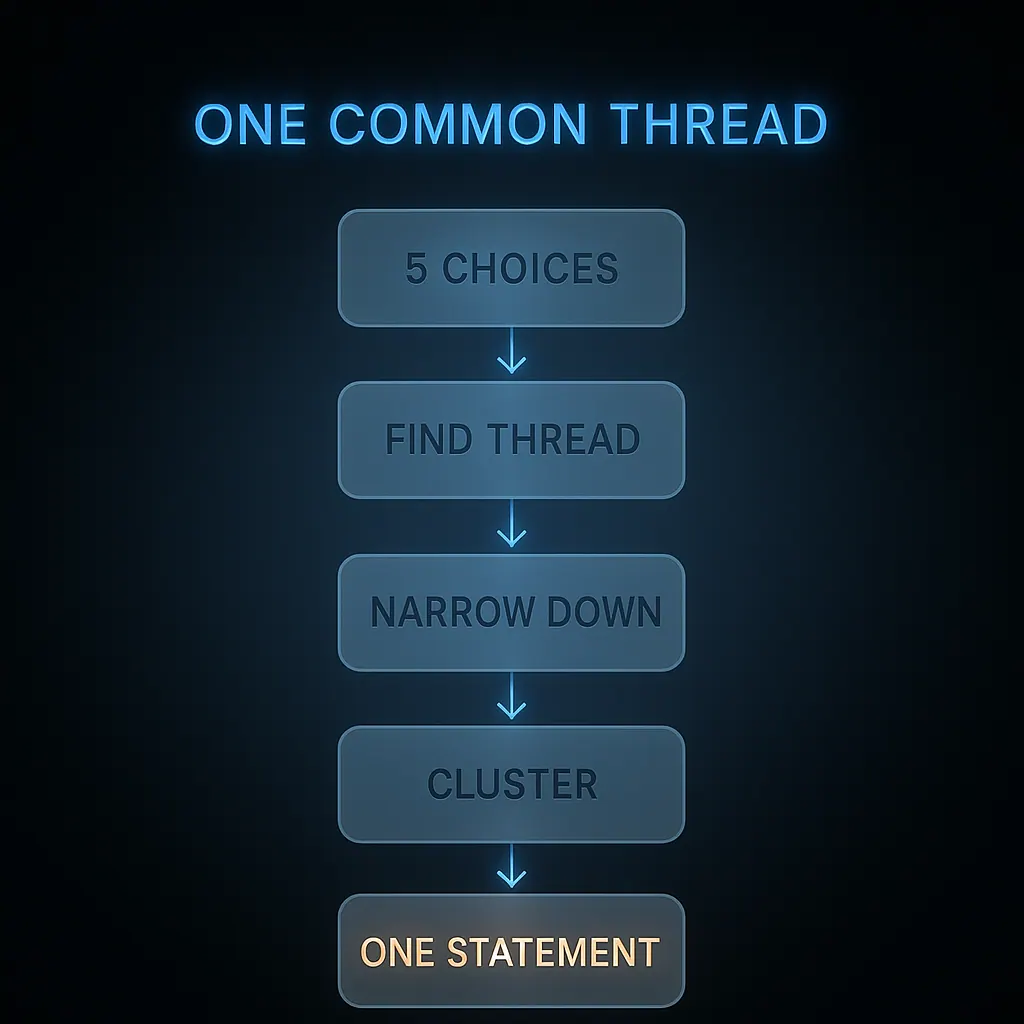
The clustering exercise belongs at the start of your course selection, not as a fix applied after a weak draft. If you cannot name the thread connecting your five choices in a single sentence, the statement will not hold together, and UCAS warns that some universities will not make an offer if a personal statement lacks focus when applying to multiple subjects.
Three clustering approaches tend to work:
- Subject family. All five choices sit within one broad discipline: Geography, Environmental Science, Earth Sciences, Geology, and Planning share enough intellectual ground that a statement about spatial thinking and physical systems covers all of them.
- Shared skill set. The courses are different labels for the same underlying competency. Economics, Mathematics, Statistics, and Actuarial Science all reward quantitative reasoning and formal modelling. A statement built around that skill set reads coherently to every admissions tutor.
- Joint-honours bridge. A History and Politics degree can anchor a shortlist that also includes straight History at one institution and straight Politics at another. The combined course becomes the argument that both disciplines belong together.
The counter-intuitive gotcha: a joint-honours choice can actually make a mixed shortlist easier to defend, not harder, because it signals that the overlap is itself a recognised field of study.
If one choice genuinely sits outside your cluster, UCAS recommends contacting universities directly, by website, email, phone, or at an open day, before submitting an application that spans very different courses. Some admissions teams will accept a supplementary statement sent directly to them for that course. Sort this out before you write a single word of your main statement.
4. Applying to Different Courses: Finding the Genuine Overlap
The mixed-subject dilemma is real. Applying to Psychology at one university and Sociology at another is manageable because both disciplines share a core concern with human behaviour, social structures, and research methods. [Computer Science and Mathematics overlap](/guides/computer-science-personal-statement) more obviously still. The question to ask before writing a single word is: what intellectual thread connects these courses? If you cannot name it in one sentence, that is a signal to revisit your shortlist, not to write a longer statement.
UCAS advises that Sara Harker-Bettridge, Admissions Manager at Birmingham City University, recommends focusing on transferable skills and personal attributes rather than anchoring your statement to one specific course when applying across different subjects. That framing matters practically. A statement built around "I want to study X" collapses the moment an admissions reader for course Y opens it. A statement built around analytical thinking, or quantitative reasoning, or the ability to work with populations data, holds up across a wider range.
There is a counter-intuitive gotcha here: some universities will not make an offer at all if the statement reads as a scattered list of unrelated interests. Trying to cover every course by mentioning each one briefly is worse than choosing a clean through-line and sticking to it. Breadth signals indecision; coherence signals readiness.
If one course genuinely differs from the other four and you cannot reconcile the gap, there is a route worth knowing. UCAS confirms that some admissions teams will accept a supplementary statement sent directly to them for that specific course, outside the main UCAS application. Contact the admissions office before you submit, not after.
5. IB Applicants: Using HL Subjects to Signal Coherence Across Courses
For IB Diploma Programme students, the HL subject combination does work that A-level applicants have to do with words. Three HL subjects chosen from different groups already signals intellectual focus. If you are taking HL Biology, Chemistry, and Mathematics, your shortlist of Biochemistry, Biology, and Natural Sciences at Oxford sits on an obvious foundation. The courses look different on paper but share the same subject core, and your HL choices demonstrate that before you have written a single sentence.
The less obvious point: IB students sometimes undersell the Extended Essay and Theory of Knowledge because they assume admissions tutors will discount them as compulsory. They will not. An Extended Essay in Chemistry is a 4,000-word independent investigation in the discipline. A TOK presentation built around epistemic uncertainty in scientific models shows exactly the kind of reflective thinking that Natural Sciences programmes want to see. These are specific, assessable pieces of work, not generic enrichment.
When mapping your content across the new three-question format, the structure falls naturally:
- Question 2 (qualifications and studies) is where HL subject content belongs. Explain what you did in HL, not just that you took it.
- Question 3 (outside education) suits the Extended Essay, CAS projects with subject relevance, and any super-curriculars that cross course boundaries.
UCAS confirms there is no designated "wrong" question for any specific information, so treat this as a default layout rather than a rule. The priority is that each piece of evidence appears once and earns its place.
6. Writing the Statement: Practical Structure Across Three Questions
Per UCAS, admissions staff review all three answers as a whole, so the biggest structural mistake is treating each question as a separate mini-essay. The three answers should advance different dimensions of one argument, not restate the same points in different words.
A useful way to divide the work:
- Question 1 (why this subject): State the subject-level motivation that applies across every course on your list. Avoid naming modules, year-abroad schemes, or facilities that only one university offers. If you are applying to both Economics and Philosophy, for example, describe what draws you to the analytical overlap, not why you want LSE's specific degree structure.
- Question 2 (qualifications and studies): Highlight transferable academic evidence. Relevant A-level modules, an EPQ, a BTEC specialism, or a short online university course all work here. UCAS explicitly advises against restating grades in this answer because universities see them elsewhere in the application. Use the space for achievements: a competition, a student ambassador role, or a research project.
- Question 3 (outside education): Use super-curriculars, reading, and work experience that reinforce the common thread identified in Question 1. This is where the argument becomes personal rather than academic.
The non-obvious trade-off: the 4,000 characters can be distributed across the three answers in any proportion, with a minimum of 350 characters per answer. If Question 1 carries the heaviest argumentative load for a personal statement covering multiple courses, it is worth allocating it more space rather than dividing the budget equally.
For drafting, the UCAS personal statement builder in the UCAS Hub includes a character counter that shows when each answer has cleared its 350-character minimum, plus the option to export a completed draft as a PDF. That PDF is genuinely useful for sharing with a teacher or adviser before submitting.
Once you have a draft, get your single statement reviewed against your chosen courses to check whether the overlap argument holds for every course on your list.
7. What to Do Next
Before you write a single word of your personal statement, sit down this week and list your five intended UCAS choices side by side. Then write one sentence that connects all of them. Not a vague "I enjoy science" sentence, a precise one that a admissions tutor at each of those five departments would read and nod at. If that sentence will not come, your shortlist needs rethinking before any drafting begins. This is the step most applicants skip, and it is why statements for mixed shortlists often feel pulled in two directions.
The non-obvious gotcha: courses that sound similar, such as Economics and Business Management, can have genuinely different intellectual priorities, and a sentence that satisfies one department may actively concern the other.
Check whether your five choices are coherent enough for one statement using the Shortlist Optimiser, then write that connecting sentence before you open a blank document.
FAQ
How does a personal statement work when applying to multiple courses on UCAS?
UCAS allows only one personal statement per application, and that same text is seen by every university on your list of up to five choices - there is no option to send different versions to different institutions through the standard application.
Can I apply to completely different courses on UCAS with one personal statement?
You can, but some universities will not make an offer if the statement lacks focus across very different subjects - UCAS recommends contacting universities directly before submitting an application that spans significantly different course areas.
Is the personal statement the same for all five UCAS choices?
Yes - every university and college on your UCAS application receives the same personal statement; they cannot see where else you have applied, unless you have made more than one application to the same institution.
How do the three new UCAS personal statement questions work for multiple courses?
From 2026 entry, the personal statement becomes three separate answers within a shared 4,000-character limit, but the text is still one submission sent identically to all five choices - the three-question structure does not allow per-course tailoring.
What should I write in Question 1 when applying to different but related courses?
Focus on your motivation for the subject area that links your choices rather than features specific to one course or university - this keeps your answer defensible to every admissions team reading it.
Can I send a separate personal statement to one university if my fifth choice is very different?
Possibly - UCAS notes that if one course choice differs significantly from the others, some admissions teams may agree to accept a supplementary statement sent directly to them outside the UCAS application, but you should contact the university first to ask.
References
- How to write a personal statement that works for multiple courses | UCAS - https://www.ucas.com/applying/applying-to-university/writing-your-personal-statement/how-to-write-a-personal-statement-that-works-for-multiple-courses-0
- Reforming admissions | UCAS - https://www.ucas.com/about-us/news-and-insights/reforming-admissions
- How to write your personal statement: 2026 entry onwards | UCAS - https://www.ucas.com/applying/applying-to-university/writing-your-personal-statement/how-to-write-your-personal-statement-for-2026-entry-onwards
- The personal statement builder | UCAS - https://www.ucas.com/applying/applying-to-university/writing-personal-statement/personal-statement-builder