Personal Statement Mistakes to Avoid in 2026
By Michael Thompson · Former IB Diploma Programme coordinator; 10 years at Bromsgrove School · Published 5 July 2026
Personal statement mistakes rarely look like disasters until an admissions tutor has already moved on. The 2026 UCAS format asks three structured questions within a 4,000-character limit, and the errors that sink applications are mostly predictable: clichéd opening lines, evidence listed without reflection, and a budget skewed so heavily toward question one that questions two and three barely get answered. This guide names the specific mistakes, maps each to the question it damages most, and shows what a stronger version looks like.
Key Takeaways
- Tired opening lines: Quotations, 'from a young age', and dictionary definitions are flagged by admissions tutors as generic - replace them with a specific observation or experience that anchors your why.
- Listing without reflection: Naming a book, activity, or qualification scores nothing unless you explain what you understood differently because of it.
- The 4,000-character budget matters across all three questions: Spending the majority of your allowance on question one leaves question two (qualifications) and question three (outside preparation) too thin to persuade.
- Unverifiable superlatives undermine credibility: Claims like 'I am passionate about' or 'I have always excelled' are ignored by tutors; concrete, checkable evidence carries the argument instead.
- IB-specific evidence is under-used: CAS, Theory of Knowledge, and the Extended Essay are substantive academic experiences - treating them as box-ticking rather than as evidence wastes the strongest material IB students have.
- Repeating the same evidence across questions: Each of the three questions calls for different evidence; recycling the same example signals you have not read the prompts carefully.
In This Article
- How the 2026 UCAS Personal Statement Format Works
- Tired Opening Lines and Common Personal Statement Mistakes in Question One
- The Listing-Without-Reflection Trap: Show Don't Tell in Your Personal Statement
- Over-Claiming and Unverifiable Statements
- Structural Mistakes Unique to the Three-Question Format
- IB-Specific Personal Statement Mistakes
- Medical School and Law Personal Statement Mistakes
- Where to Go From Here
1. How the 2026 UCAS Personal Statement Format Works
The biggest personal statement mistakes in 2026 stem from a misunderstanding of the format itself. Since UCAS replaced the open-ended essay with a structured three-question layout, applicants no longer write a single continuous piece. Each question has a fixed job to do, and confusing them is an easy way to waste characters.
The three questions, per the UCAS personal statement toolkit, are:
- Question 1: "Why do you want to study this course or subject?"
- Question 2: "How have your qualifications and studies helped you to prepare for this course or subject?"
- Question 3: "What else have you done to prepare outside of education, and why are these experiences useful?"
The total limit is 4,000 characters across all three answers, with a minimum of 350 characters per question. That minimum matters: you cannot front-load Question 1 and leave the others thin.
One non-obvious gotcha: Question 2 guidance explicitly says not to discuss your grades, because universities already see them elsewhere in your application. Writing "I achieved an A in Chemistry" in Question 2 wastes characters and signals you have not read the brief.
UCAS also provides a personal statement builder tool and subject-specific guides with examples. Use them before you write a single word.
2. Tired Opening Lines and Common Personal Statement Mistakes in Question One
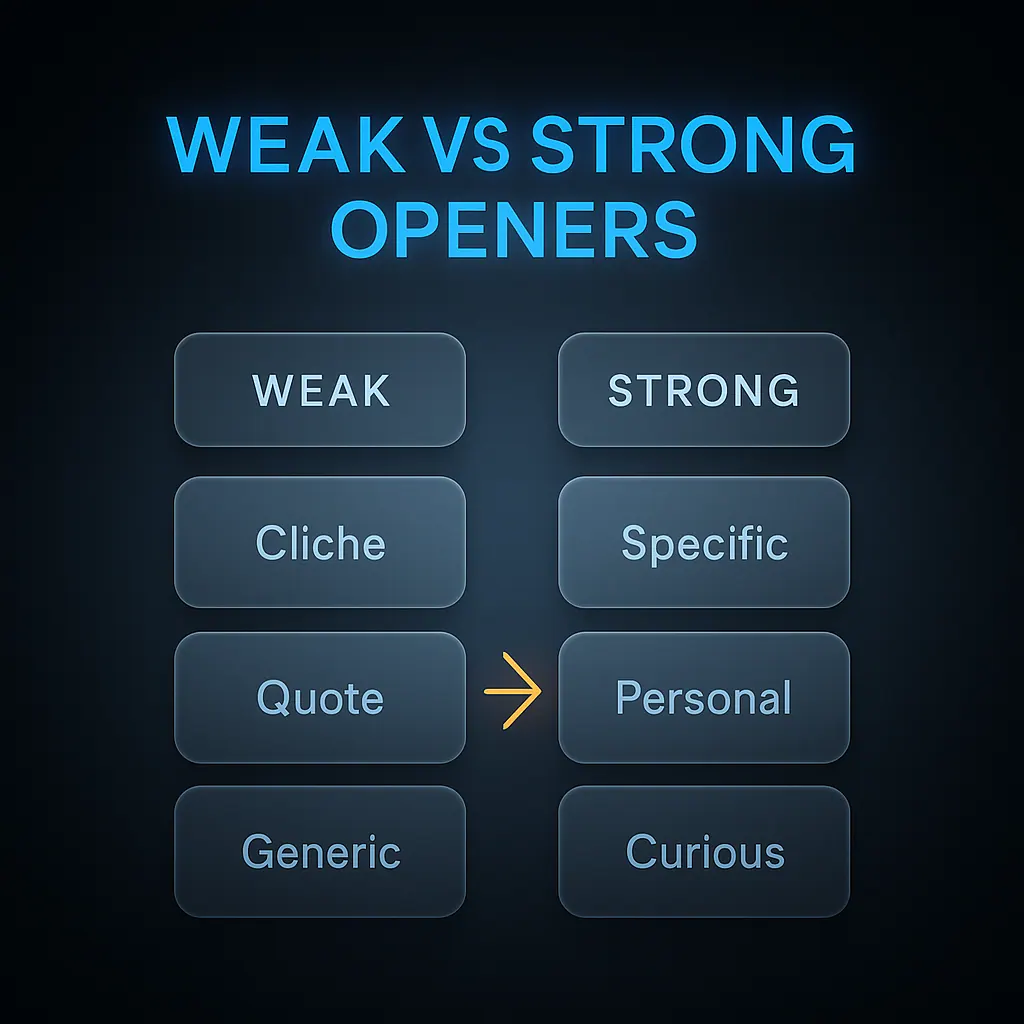
Question One asks why you want to study this course. It is the first thing an admissions tutor reads, and it is where the most predictable personal statement mistakes land.
Three opener types get flagged most often:
- The floating quotation. A line from Einstein, Aristotle, or a novelist, dropped in without follow-up. Jane Marshall, Widening Participation Manager at Imperial College London, describes opening quotes as a "common mistake" when they are "never mentioned anywhere else in the rest of the text." A quote that disappears after the first sentence signals the student picked it from a list rather than actually engaging with the idea.
- "From a young age I have always wanted to..." This tells the reader nothing about your thinking. Every applicant can claim long-standing interest. None of it is verifiable, and none of it answers the actual question.
- The dictionary definition. "The Oxford English Dictionary defines law as..." is a structural crutch. UCAS explicitly flags generic statements as one of the five things to avoid in a personal statement.
Marshall also singles out the word "passion" as "an overused and usually, misused word" that "shouldn't really feature in a serious academic application." The word is so common it has stopped carrying meaning.
The counter-intuitive fix: stronger [personal statement opening lines examples](/guides/personal-statement-examples) are almost always smaller, not grander. Instead of a sweeping quote, open with a specific observation from a book you read, a problem you could not stop thinking about, or the moment a topic contradicted something you assumed. That specificity is what Marshall describes as evidence of "outside reading, extra project work and attended lectures" - the markers that distinguish a strong application.
A concrete swap:
| Weak opener | Stronger alternative |
|---|---|
| Einstein quote on curiosity | One sentence on a claim in a paper you read that you initially disagreed with |
| "From a young age I have always loved biology" | A specific experiment result that raised a question you went away to research |
| Dictionary definition of economics | A pricing anomaly you noticed and could not explain with intuition alone |
For law personal statement opening lines in particular, the dictionary-definition opener is almost a cliche of its own - admissions tutors at law schools see hundreds of statements beginning with Merriam-Webster or Black's. Opening with a specific case outcome or a legal contradiction you found genuinely puzzling is a more direct answer to Question One.
3. The Listing-Without-Reflection Trap: Show Don't Tell in Your Personal Statement
A list of books, competitions, and qualifications tells an admissions tutor what you encountered. It does not tell them what happened to your thinking as a result. Those are different things, and only the second one is evidence.
UCAS explicitly warns against overloading a statement with skills without depth, and Jane Marshall, Widening Participation Manager at Imperial College London, defines the strongest statements as those demonstrating "outside reading, extra project work and attended lectures" in the subject. The word "demonstrating" is doing real work there. A name-drop is not a demonstration.
The contrast is stark in practice:
- Weak: "I have read Thinking, Fast and Slow, The Selfish Gene, and The Man Who Mistook His Wife for a Hat." An admissions tutor cannot infer intellectual development from three titles.
- Stronger: "Kahneman's distinction between System 1 and System 2 thinking made me question whether behavioural economics offers a better predictive model for consumer choice than classical theory, which I want to explore further in the microeconomics modules at this course."
One book. One specific idea it shifted. One direct link to the degree. That is the show-don't-tell principle applied.
The counter-intuitive trap here is that more titles can actually weaken a statement. Three books listed superficially signals wide reading but shallow engagement. One book treated rigorously signals the intellectual habit universities are selecting for.
Where this mistake concentrates in the 2026 format:
- Question 2 (how your qualifications have prepared you) - students list A-level subjects or an IB Diploma without explaining which content from those courses connects to the degree.
- Question 3 (what else you have done to prepare) - students list a lecture, a podcast series, and a summer school without saying what any of them changed or challenged in their thinking.
Both questions carry an expectation of substantiated evidence. If you name it, you must say what you did with it.
4. Over-Claiming and Unverifiable Statements
Admissions tutors read hundreds of statements. Superlatives about passion, dedication, and innate talent get filtered out quickly, not because tutors are cynical, but because they cannot verify them. An opinion about yourself substitutes for evidence, and evidence is what decides offers.
The specific example that Jane Marshall, Widening Participation Manager at Imperial College London, flags is a student who wrote: "I have been told I'm the best student the school has ever had." Marshall is direct: that claim belongs in a teacher's reference, not the statement. A tutor can write it about you with authority. You writing it about yourself carries no weight at all.
The same source notes that "passion" is "an overused and usually, misused word" that "shouldn't really feature in a serious academic application." If you have to tell a reader you are passionate, the evidence is not doing its job.
UCAS explicitly flags generic statements and irrelevant information as errors to avoid, both of which overlap directly with over-claiming.
The concrete alternative is specific and checkable:
- A named competition entered (the Biology Olympiad, the UK Chemistry Olympiad)
- A paper or book read independently, with a named argument you engaged with
- A short course or lecture attended, with what it changed in your thinking
- A question you pursued outside lessons, with what you found
Marshall describes the best statements as those demonstrating "outside reading, extra project work and attended lectures" in the subject area. None of those things require you to claim you are exceptional. They simply show what you did.
5. Structural Mistakes Unique to the Three-Question Format
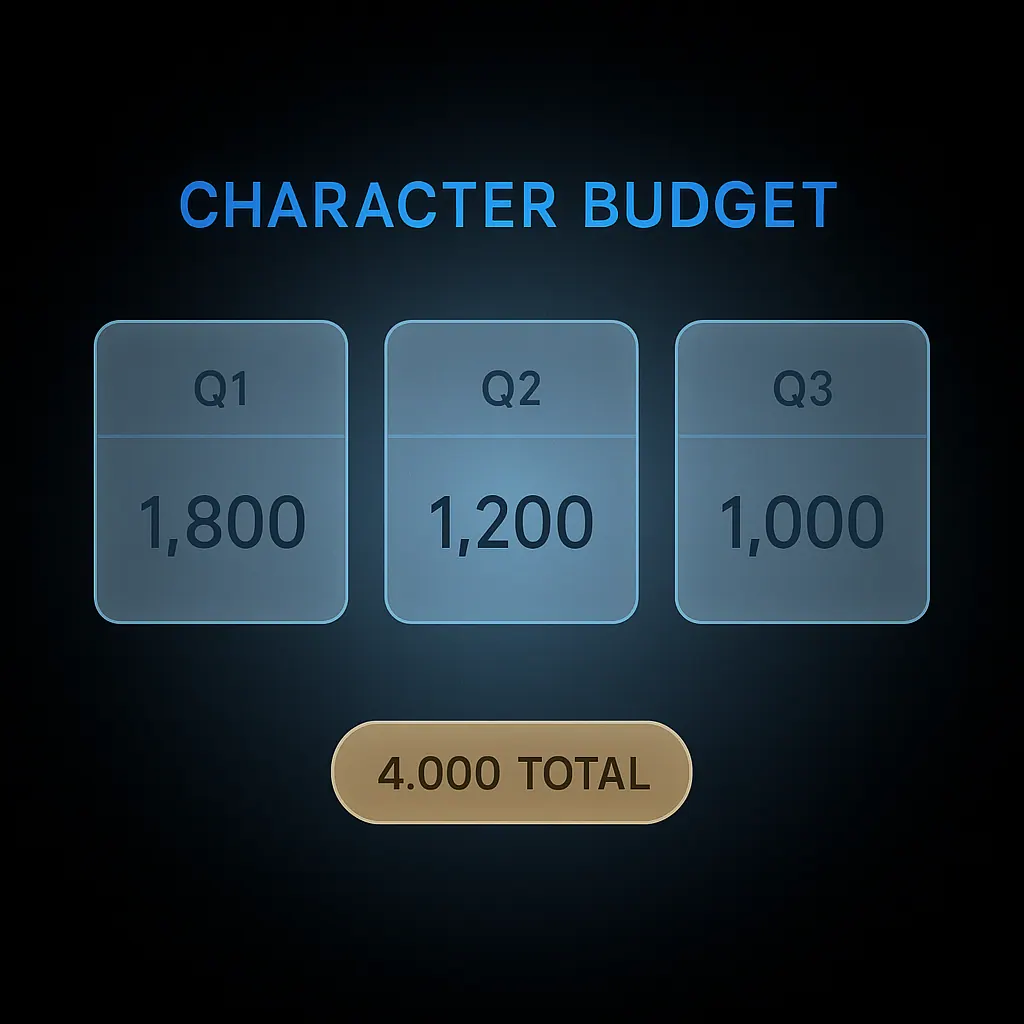
The three-question format creates structural traps that didn't exist with the old single free-text box. The three most common are: recycling the same evidence across multiple answers, neglecting one question almost entirely, and burning so much of the character budget on Question 1 that Questions 2 and 3 end up thin.
Character budget is the most fixable problem. The total allowance is 4,000 characters across all three questions, with each answer requiring a minimum of 350 characters, per Christ's College Cambridge. A rough working split that keeps all three answers substantive:
| Question | Focus | Suggested characters |
|---|---|---|
| Q1: Why this course? | Intellectual motivation | ~1,500 |
| Q2: Qualifications and studies | Coursework, EPQ, competitions | ~1,200 |
| Q3: Outside education | Work experience, reading, projects | ~1,000 |
Adjust based on your circumstances. If you have an Extended Project Qualification or a UKMT competition result to discuss, Q2 may need more room.
The Question 2 quirk most students miss: UCAS guidance explicitly states that students should not discuss their grades in Question 2, because universities see those elsewhere on the application. Q2 is about what your studies have taught you, not how well you performed in them. Writing "I achieved a strong grade in A-Level Chemistry" wastes characters on information that is redundant to every admissions reader.
On recycling evidence: if you mention a particular book or work placement in Q1 as evidence of motivation, do not re-cite it in Q3 as outside-education preparation. Each piece of evidence should earn its place in one answer only.
Finally, Christ's College notes that the statement is read by all UK universities you apply to, not just Cambridge. Writing Q1 as though it addresses a single institution's course structure will read as off-topic to every other admissions team seeing the same document.
6. IB-Specific Personal Statement Mistakes
IB students often hold stronger academic evidence than they realise, then fail to use it. The personal statement mistakes that follow are specific to the Diploma Programme structure.
The CAS, TOK, and Extended Essay box-tick. The most common IB error is treating these as credentials to name-drop rather than intellectual experiences to analyse. Writing "I completed Theory of Knowledge, which deepened my critical thinking" tells admissions readers nothing. What was the knowledge question you genuinely struggled with? What did the essay force you to change your mind about? The same applies to CAS: if a project connects to your degree subject, explain the connection. If it does not, leave it out.
Wasted Higher Level depth. Your HL subjects are the strongest academic evidence you hold for Question 2 ("How have your qualifications and studies helped you to prepare for this course?"). An HL Biology student applying to Biochemistry who mentions only that they "enjoyed the subject" has discarded their best material. Name the specific topics, the methods, the ideas that connect to undergraduate content.
The Extended Essay as a missed opportunity. UCAS lists the EPQ as a direct example of relevant educational achievement for Question 2. The Extended Essay carries the same weight. Name your research question, state the argument you made, and explain how it connects to the degree. "I wrote an EE on climate modelling" is not enough. "My EE examined whether CMIP6 models underestimate Arctic sea-ice loss, which led me to read the primary literature on feedback mechanisms" is.
Extracurricular lists won't compensate. Christ's College Cambridge states it assesses applicants only on academic criteria. If substantive academic content from your IB qualifications is thin, a long list of activities outside education will not fill the gap.
7. Medical School and Law Personal Statement Mistakes
Medicine and law attract some of the most competitive applicant pools in the UK, which means the personal statement mistakes that might slide elsewhere become disqualifying here.
Medicine
The most common medical school personal statement mistake is leading with vocation rather than intellect. Phrases like "I have always wanted to help people" tell an admissions tutor nothing that distinguishes you from thousands of other applicants. What separates a strong medical statement is demonstrated engagement with the science: what did you observe during work experience that connected to a biological mechanism you had read about, and what did you make of it?
A week of clinical shadowing listed without reflection carries no more weight than a bullet point on a CV. The question is what it changed or confirmed in your thinking about the discipline.
Law
Law personal statement opening lines that invoke justice, a famous trial, or a newspaper headline are a similar trap. Admissions tutors are assessing legal reasoning ability, not enthusiasm for high-profile cases. Analytical engagement with a legal concept, a moot, or an essay competition is far stronger evidence. Christ's College Cambridge explicitly names mooting and essay competitions as examples of relevant super-curricular activity, while football and head girl roles are listed as non-relevant.
The relevance test for both subjects
UCAS identifies irrelevant information as a specific mistake to avoid. For competitive courses, relevance is judged against the intellectual demands of the discipline, not general academic ability. If an activity or experience does not connect directly to medicine or law as fields of study, cut it.
8. Where to Go From Here
Print your current draft and read each answer against the corresponding UCAS question in order. Question one should show genuine engagement with your subject, not a list of achievements. Question two should reflect on skills developed, not just describe activities. Question three should connect your preparation directly to the demands of your chosen course. If any answer drifts from its question, that is the sentence to rewrite first.
One non-obvious check: admissions readers often read question three before question two, looking for evidence that your work experience actually connects to academic readiness. Make sure that link is explicit, not implied.
Do that read-through this week, then submit your revised draft to the Personal Statement Review for structured feedback. Book your review slot before your school's internal deadline, which will almost certainly fall earlier than the UCAS deadline itself.
FAQ
What should I say in my personal statement?
Answer each of the three UCAS questions directly: why you want to study the course, how your qualifications have prepared you, and what you have done outside education to prepare - every sentence should connect back to one of these three prompts.
Do personal statement mistakes actually affect my offer?
Yes - admissions tutors use the personal statement to assess academic readiness and genuine subject interest, so weak evidence, generic claims, or structural imbalance across the three questions can make an otherwise strong application look unprepared.
What are the most common personal statement mistakes?
UCAS identifies five key errors to avoid: generic statements, repetition, overloading with skills without depth, clichéd quotes, and including irrelevant information - all of which waste the limited 4,000-character budget.
Can I use the same personal statement for medicine and another course?
The UCAS personal statement is a single document sent to all your chosen universities, so if you apply to more than one type of course you must decide how to balance the content - UCAS provides specific guidance on applying to two or more different courses with one statement.
How should IB students use the Extended Essay in their personal statement?
Treat the Extended Essay the same way UCAS treats the EPQ - name the research question, summarise the argument you developed, and explain what that process showed you about the subject you plan to study at university.
Is it a mistake to discuss grades in my personal statement?
Yes - UCAS guidance for Question 2 explicitly states that students should not discuss their grades, because universities and colleges can already see these elsewhere in the application; use that space for subject-specific content instead.
References
- Personal statement toolkit | UCAS - https://www.ucas.com/advisers/help-and-training/toolkits/personal-statement-toolkit
- UCAS personal statement | Christs College Cambridge - https://www.christs.cam.ac.uk/international-students/apply/statement
- Writing your personal statement | UCAS - https://www.ucas.com/undergraduate/applying-university/writing-personal-statement
- How not to completely bomb your UCAS personal statement - BBC Three - https://www.bbc.co.uk/bbcthree/article/17870fea-11f1-4975-b526-7aa0ffd1dcb2
- Supporting your child with writing their personal statement | UCAS - https://www.ucas.com/discover/advice-for-parents-guardians-and-carers/helping-your-child-write-a-great-personal-statement/supporting-your-child-with-writing-their-personal-statement