IB Predicted Grades: How They Work for UCAS Applications
By Michael Thompson · Former IB Diploma Programme coordinator; 10 years at Bromsgrove School · Published 5 July 2026
IB predicted grades are the subject-by-subject and overall Diploma scores your teachers and school coordinator submit to UCAS on your behalf, before you sit a single May exam. UK universities read these predictions - not your final results - when deciding whether to make you a conditional offer. That means the number your school puts on your UCAS form shapes which courses are realistic to apply for, and which are out of reach. Understanding how predictions are set, when they land in the cycle, and what the risks look like gives you a much clearer run at the process.
Key Takeaways
- Teachers and your diploma coordinator set predictions: Your school submits one predicted grade per subject plus a predicted total to UCAS - these are not set by the IBO and are not your final results.
- Conditional offers are made against your predicted total and HL grades: A typical UK offer specifies a minimum IB Diploma total alongside minimum grades in one or two Higher Level subjects, so your predictions directly determine which offers arrive.
- Mock exams carry the most weight in shaping your prediction: According to Lanterna Education, mocks are the single most controllable factor teachers draw on, alongside Internal Assessment quality and consistent class performance.
- Over-optimistic predictions create dangerous gaps: If your firm and insurance choices both require totals close to your predicted grade, a small shortfall on results day can leave you without a confirmed place.
- Final results trigger confirmation, near-miss consideration, or Clearing: If your May results miss a conditional offer, the university reviews your application - but no specific outcome is guaranteed.
- You can use predicted grades right now to find matching courses: Entering your subject predictions into the Course Finder at /course-finder shows you realistic, matched, and aspirational choices before results day.
In This Article
- What are IB predicted grades and who sets them
- How IB predicted grades are determined
- UCAS timing: when IB predicted grades enter the cycle
- How universities use IB diploma predicted grades to make conditional offers
- The honest risks: what happens if your final IB results miss the offer
- Can IB predicted grades change before submission
- Using your predicted grades to find the right UK courses now
- What to do next
1. What are IB predicted grades and who sets them
IB predicted grades are your subject teachers' formal estimates of the grade you are expected to achieve in each IB Diploma subject before you sit your final exams. The IB defines a predicted grade as "the teacher's prediction of the grade the candidate is expected to achieve in the subject, based on all the evidence of the candidate's work and the teacher's knowledge of IB standards," as documented on College Confidential's IB forum. That definition matters because it is not a guess or a target: it is a considered professional judgement grounded in real assessment evidence.
Your school's IB Diploma coordinator and individual subject teachers set the predictions, not the IBO itself. Predictions cover each subject grade on the familiar 1-7 scale, plus a predicted overall Diploma total out of 45 (which includes points for Theory of Knowledge and the Extended Essay). Schools typically draw on between three and six pieces of assessment data from Year 12 to arrive at these numbers.
The key distinction for UCAS purposes: **the predicted grade is what appears on your UCAS application**, submitted at the start of Year 13. Your final IB result, released after the May exam session, comes later. Universities make conditional offers based entirely on the predicted figure, so the two numbers are doing very different jobs. One notable quirk: the IBO monitors schools that consistently over- or under-predict, and if an Internal Assessment prediction deviates by more than two score bands, the whole class's grades can be adjusted, per College Confidential.
2. How IB predicted grades are determined
Your IB predicted grades are not a teacher's gut feeling. They follow a structured process, drawing on several distinct evidence sources, and the IBO monitors schools that get it systematically wrong.
Lanterna identifies four evidence sources teachers use:
- Mock exam results - the single most influential factor you can control. A strong mock in DP2 can shift a prediction upward; a poor one is hard to argue away.
- Internal Assessment quality - the only component a teacher directly marks that feeds into your final IB grade, which gives it outsized weight relative to its percentage of the total score.
- Consistent performance across class tests and assignments throughout DP1 and DP2 - a single strong result impresses less than a sustained pattern.
- Classroom engagement - less quantifiable, but teachers factor in how actively a student participates and responds to feedback.
One non-obvious implication: because the IA is the one piece of work a teacher has actually graded to IB standard, a weak IA can depress a prediction even when exam performance looks solid.
According to Nord Anglia Education, schools use between three and six pieces of assessment data, typically drawn from Year 12 performance, to generate each prediction.
The process has external oversight. Per College Confidential, the IBO monitors schools that consistently over- or under-predict and works with them to improve accuracy, so [teachers cannot simply](/guides/applying-to-university-without-predicted-grades) inflate grades without consequence.
3. UCAS timing: when IB predicted grades enter the cycle
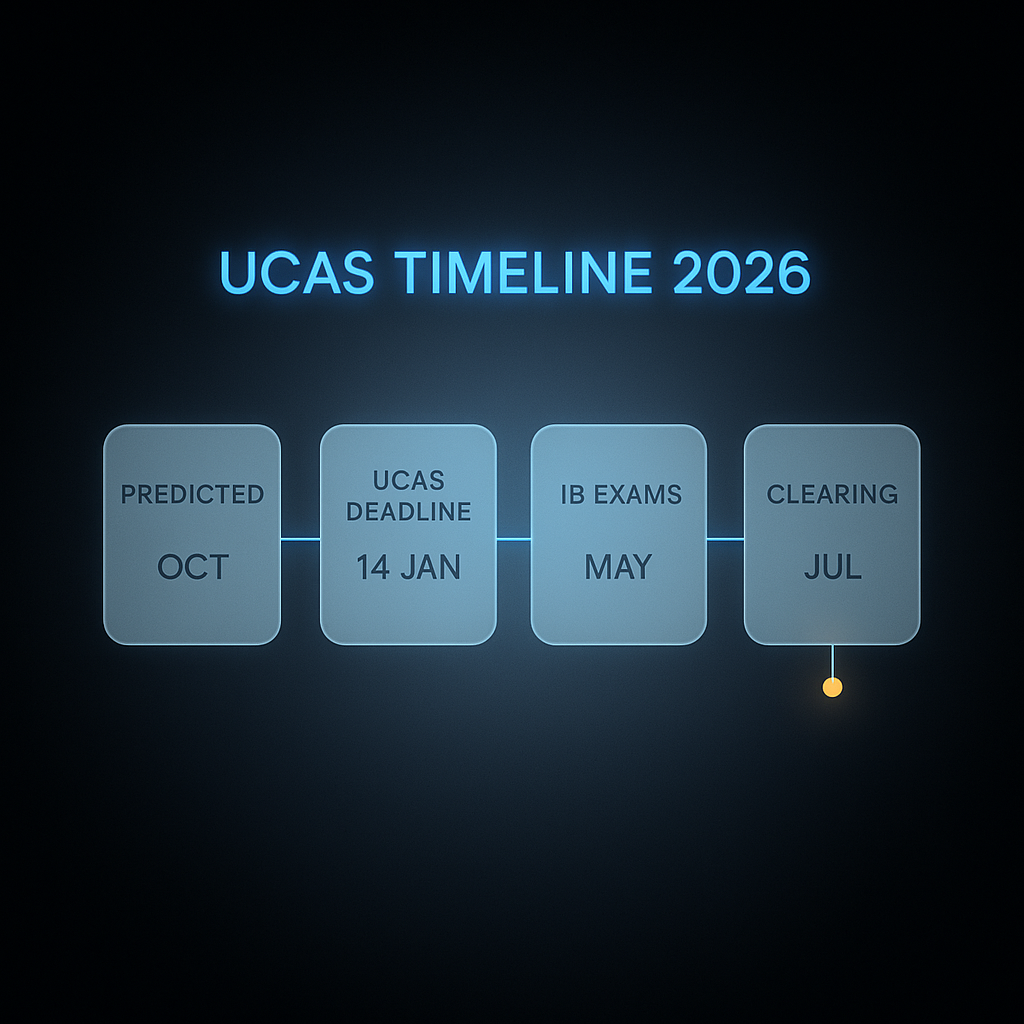
IB students apply to university at the beginning of Year 13, before sitting their final exams, which means IB predicted grades are the primary academic data on the UCAS form at the point of application, as Nord Anglia Education notes. Final IB results simply do not exist yet. Universities have nothing else to go on.
The two dates that shape everything are set by UCAS via MyRevisionAgent:
- **15 October 2025 at 18:00** - Oxford, Cambridge, medicine, dentistry, and veterinary science.
- 14 January 2026 at 18:00 - most other undergraduate courses.
The awkward tension for IB students is that predicted grades are often not confirmed until November or even January, well after the October deadline has passed, according to MyRevisionAgent. An IB student applying to medicine or Oxbridge may therefore be submitting a UCAS form before their school has formally signed off the predictions those universities will rely on. In practice, teachers produce working predictions ahead of the October cut-off, but those figures can shift.
The pressure is compounded by school internal deadlines. Most schools require personal statements and course choices several weeks before the UCAS cut-off, meaning the real deadline for students is earlier than the published date, MyRevisionAgent confirms. If your school deadline is early October, your predicted grades need to be in place by late September.
Finally, UCAS is clear that predicted grades must be finalised by application submission. Providers may not be able to accommodate errors after the form is sent, and that risk is highest for selective courses where every point in a prediction matters.
4. How universities use IB diploma predicted grades to make conditional offers
UK universities issue conditional offers based on two separate targets drawn from your predicted grades: the overall Diploma total and the grades achieved in specific Higher Level subjects. According to Nord Anglia Education, students who do not meet predicted or specified grade requirements are unlikely to be accepted, so both targets carry real weight.
A typical offer reads something like: **38 points overall, including 6, 6, 6 at Higher Level**. That means even if you hit 38 points, falling short of a single HL grade can cost you the place. The HL component is an independent condition, not a footnote.
For the most selective institutions, the bar is higher. Lanterna Education notes that Oxford and Cambridge require predictions in the 38-45 point range, with 7s in specific Higher Level subjects. A prediction of 36 with a 6 in your relevant HL will not ordinarily meet their threshold, regardless of how strong the rest of your application is.
Predictions are also systematically optimistic. UCAS data from 2024 shows that around half of UK 18-year-olds were predicted AAA and above, yet only 26% of accepted applicants actually achieved those grades. The same inflationary pressure applies to IB Diploma predicted grades: your predicted total may reflect optimism as much as evidence.
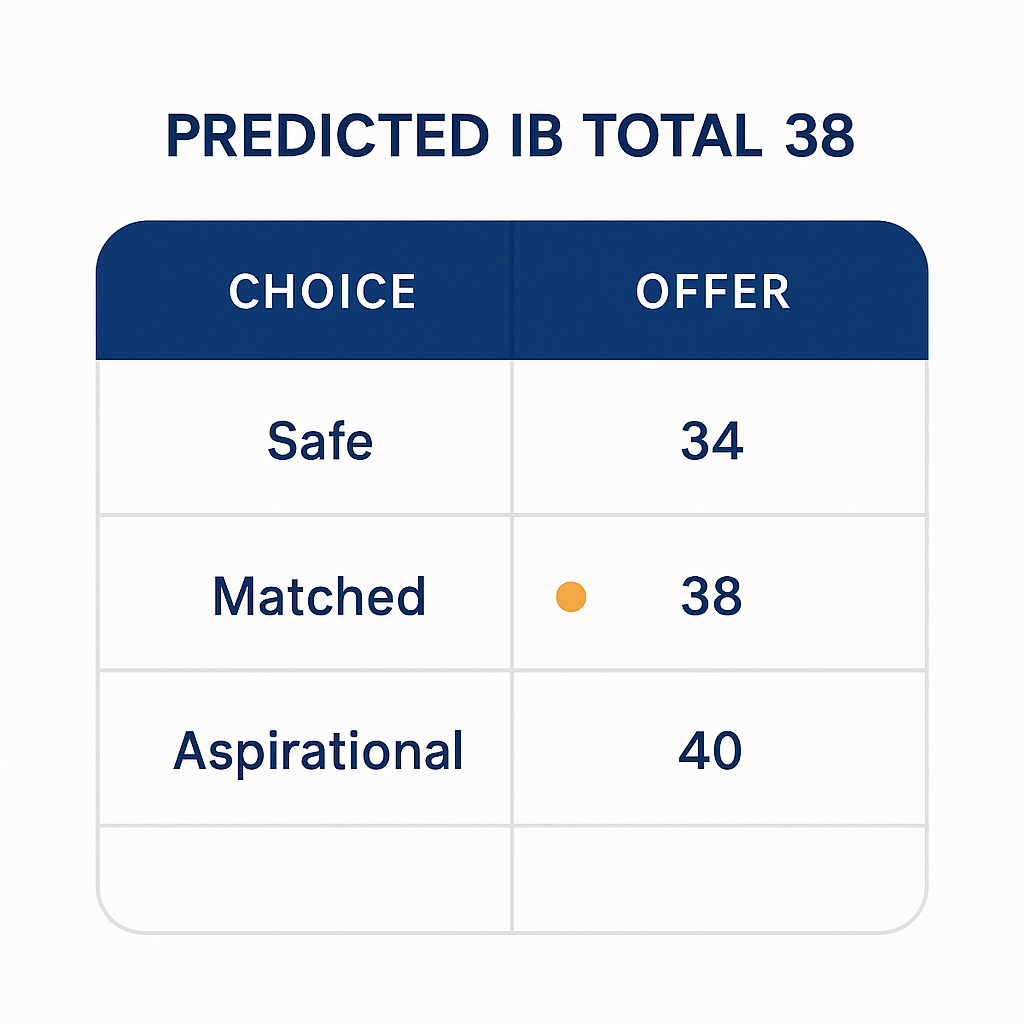
That gap matters when you are choosing where to apply. Use your predicted total to sort courses into three bands:
- Safe choice: the course entry requirement sits meaningfully below your predicted total, giving you a buffer if results day brings a surprise.
- Matched choice: the entry requirement aligns closely with your prediction, which is where most firm and insurance offers sit.
- Aspirational choice: the requirement stretches above your prediction, meaning you are relying on a strong performance to close the gap.
The non-obvious gotcha: if your HL subjects do not match the specific subjects named in a course offer, the points total becomes irrelevant. A student predicted 40 points who has not taken HL Chemistry cannot meet a Biochemistry offer requiring 6 in HL Chemistry, however strong the overall score.
5. The honest risks: what happens if your final IB results miss the offer
Predicted grades are estimates, and the gap between prediction and reality is wider than most students expect. UCAS data shows that around half of UK 18-year-olds were predicted AAA or above in 2024, yet only 26% of accepted applicants actually achieved that. The IB's 45-point scale doesn't insulate you from the same pattern: a prediction of 38 or 40 points is common; hitting it in May is another matter.
The counter-intuitive gotcha is that the problem isn't usually missing by a lot. It's missing by two or three points when both your firm and insurance offers are set near your predicted total. If your firm wants 38 and your insurance wants 37, a final score of 35 leaves you without either.
After May results, three outcomes are possible:
- Confirmation. You met the conditions. Your place is secured automatically through UCAS Track.
- Near-miss review. The university looks at your full application and decides whether to accept you anyway. This is at the university's sole discretion, and no outcome is guaranteed. Some departments do it routinely; others do not.
- Clearing. Your place is released. You search for available courses on the UCAS Clearing tool. Clearing opens 2 July 2026 and the final deadline is 24 September 2026, so there is a process, but it requires fast, deliberate action.
The practical fix is straightforward: choose an insurance course whose standard offer is genuinely lower than your firm's, not just a different subject at an identical points threshold. A real gap of three to four IB points gives you an actual safety net. Dressing up two 37-point offers as "firm" and "insurance" defeats the purpose entirely.
Treat your IB predicted grades as a working estimate, not a floor. Build your choices around what you can confidently achieve, not what a generous teacher thinks is possible on a good day.
6. Can IB predicted grades change before submission
IB predicted grades can be revised by your teacher right up until your UCAS application is submitted. Once it goes in, UCAS warns that providers may not be able to accommodate corrections, particularly for highly selective courses. A prediction is effectively locked the moment you click submit.
Before that point, movement in either direction is possible:
- Upward revision: A strong performance in early DP2 internal assessments, or a mock that comes in well above a teacher's initial estimate, can prompt them to raise a prediction.
- Downward revision: A weaker-than-expected mock or a poor set of IA drafts can have the opposite effect. Teachers are under professional pressure to predict accurately, not generously.
One non-obvious gotcha: subject teachers set individual subject predictions, but the diploma coordinator is usually the gatekeeper who reviews the full profile before submission. If your ib predicted grades look inconsistent across subjects, the coordinator may query or adjust them at that stage.
Talk to your subject teacher and diploma coordinator before your school's internal deadline, not after. Internal deadlines typically fall weeks before the UCAS deadline, so leaving the conversation late removes any meaningful window to address a discrepancy.
7. Using your predicted grades to find the right UK courses now
Your IB predicted grades are not just a number the school sends to UCAS. Before results day, they are your most precise planning instrument, and how you use them now directly shapes the quality of your five UCAS choices.
Build a balanced list across three tiers. Map your predicted Higher Level and Standard Level grades against courses in this shape:
- **[Aspirational (1-2 choices)](/guides/aspirational-university-choices):** courses whose typical entry grades sit at or just above your predictions. Worth including if you have a strong Personal Statement and school reference to support the stretch.
- Matched (2-3 choices): courses where your predictions align closely with the grades held by previously accepted applicants. This is the core of a sensible list.
- Safe (1-2 choices): courses where your predictions comfortably exceed the standard offer. These protect you if final IB results dip slightly.
One counter-intuitive point: a "safe" choice at a well-regarded university in your subject often serves you better than a matched choice at a university whose IB offer is poorly calibrated to the Diploma's actual grade boundaries. Some admissions teams still weight total points heavily over HL profile, so a course with a lower points threshold is not automatically the weaker option.
**Use the Course Finder at /course-finder before you start shortlisting.** It runs on predicted grades, so you can enter your current IB DP predicted grades and see matching UK courses now, not just as a results-day fallback. Treat it as your first filter, not a last resort.
Cross-check with UCAS's historical entry grades data, which shows the actual grades held by students who were accepted onto a course in previous cycles. This tells you what the real intake looked like, not just what the published offer says. The two numbers are often different, and that gap is worth knowing before you commit a choice.
8. What to do next
Open the Course Finder now, enter your current predicted Diploma total and your HL subject grades, and check which courses fall into your safe, matched, and aspirational bands. Do this before your school's internal application deadline, not after.
Here is the non-obvious gotcha: most schools set their internal UCAS deadline several weeks ahead of the official UCAS date, because teachers need time to write references and verify predicted grades with the IB coordinator. Missing the internal date can mean your application goes in late or with placeholder grades your school has not formally signed off. Ask your IB coordinator this week what that internal date is, and write it down somewhere you will actually see it.
Check the Course Finder, confirm your internal deadline with your coordinator, and act on both before the end of this week.
FAQ
What are IB predicted grades?
IB predicted grades are subject-by-subject and overall Diploma score estimates submitted by your school's teachers and diploma coordinator to UCAS before your May exams, based on your mock results, Internal Assessments, and class performance.
How are IB predicted grades calculated?
Teachers draw on mock exam results, Internal Assessment quality, consistent performance across DP1 and DP2 assessments, and classroom engagement - schools typically use between three and six pieces of data - and the IBO monitors schools that regularly over- or under-predict.
When are IB predicted grades due for UCAS?
Predicted grades must be finalised and included when the UCAS application is submitted - by 15 October 2025 for Oxford, Cambridge, medicine, dentistry, and veterinary science, or by 14 January 2026 for most other courses - though your school's internal deadline will fall several weeks earlier.
Are IB predicted grades accurate?
Predictions vary in accuracy; UCAS data shows that around half of UK 18-year-olds were predicted AAA and above in 2024, while only 26% of accepted applicants actually achieved that, indicating systematic over-prediction, particularly at the highest grade levels.
Can IB predicted grades change?
Yes - teachers can revise predictions before the application is submitted, for example after strong or weak mock results, but once the UCAS form has been sent, predictions are fixed and providers may not be able to accommodate corrections.
Do IB predicted grades matter for Oxford?
Yes - Oxford and Cambridge use predicted grades as a primary filter, typically expecting predictions in the 38-45 point range with grade 7s in specific Higher Level subjects before they will consider making a conditional offer.
References
- "Predicted IB Exam Scores" - Applying to College - College Confidential Forums - https://talk.collegeconfidential.com/t/predicted-ib-exam-scores/1939905
- Understanding Predicted Grades: What They Mean and Why They - https://www.nordangliaeducation.com/bcb-brazil/news/2024/11/14/the-role-of-predicted-grades-in-university-applications
- IB Predicted Grades: Your Complete Guide | Lanterna Education - https://lanterna.com/resources/ib-predicted-grades-demystified-your-ultimate-guide
- UCAS Application Timeline: Every Key Date Explained | MyRevisionAgent - https://myrevisionagent.com/guides/ucas-application-timeline
- Predicted grades - what you need to know for entry this year | UCAS - https://www.ucas.com/advisers/help-and-training/guides-resources-and-training/application-overview/predicted-grades-what-you-need-to-know-for-entry-this-year