UCAS Extra Explained: Dates, Eligibility and How to Use It
By Michael Thompson · Former IB Diploma Programme coordinator; 10 years at Bromsgrove School · Published 5 July 2026
UCAS Extra is a free service that lets eligible applicants add one further university choice at a time after their five original applications have all been decided. It runs from 26 February to 1 July 2026, bridging the gap between the main application round and Clearing. If you have used all five choices and are holding no offers - because you were unsuccessful, withdrew, or declined every offer - Extra is the structured route back into the process before results day. This guide walks through who qualifies, how the one-at-a-time mechanic works, how to choose a course that actually fits your grades, and what to do if Extra does not come through.
Key Takeaways
- Extra opens 26 February 2026: and closes on 1 July 2026, after which applicants without a place move into Clearing.
- You must have used all five original choices: and hold no offers - through rejection, withdrawal, or declining - to be eligible for Extra.
- You apply to one course at a time: and universities have up to 21 days to respond; if they do not, or you decline their offer, you can add a different course.
- Extra is not Clearing: Extra runs in spring before results day and requires no offers held; Clearing opens from 2 July 2026 and is a separate, broader process.
- Choosing a realistic course matters more than choosing a prestigious one: look for courses still showing vacancies and match them to your predicted or achieved grades rather than repeating the pattern that produced five rejections.
- IB Diploma students can use Extra: by matching an Extra choice to their predicted total points or HL subject grades to find offers that remain achievable.
In This Article
- What Is UCAS Extra and Who Can Use It
- UCAS Extra Dates and Deadlines for 2026
- How UCAS Extra Works: The One-at-a-Time Process
- UCAS Extra vs Clearing: Key Differences
- How to Choose a Course Through UCAS Extra
- Common Questions About Using UCAS Extra
- What to Do Next
1. What Is UCAS Extra and Who Can Use It
**UCAS Extra is a free UCAS service that lets eligible applicants add one further choice after all five original decisions are in and no offers are held.** It sits inside your existing UCAS Hub application and runs from 26 February to 1 July 2026, giving you a structured route to secure a place before Clearing opens.
To be eligible, three conditions must all be true at the same time, per UCAS:
- You used all five of your original UCAS choices.
- You have received decisions from all five.
- You are holding no offers, because all were unsuccessful, you declined every offer you received, or an offer was withdrawn.
If any of those boxes is unticked, you cannot access Extra. The most common case where people assume they need it but do not: applicants who applied to fewer than five choices. According to UCAS, if you did not use all five original choices, you can simply add a new choice directly in your UCAS Hub until 30 June, no Extra required.
One detail worth knowing before other sections cover the process in depth: accepting an Extra offer closes the door on further Extra applications immediately. Choose carefully rather than accepting quickly to keep options open.
Extra costs nothing to use, per Lancashire.
2. UCAS Extra Dates and Deadlines for 2026
Per UCAS, UCAS Extra opens on 26 February 2026 and the last day to add an Extra choice is 1 July 2026. Institutions have until 15 July 2026 to make their decisions on any outstanding Extra applications.
One detail worth noting: universities get up to 21 days to respond to each Extra application. If you add a choice late in the window, that 21-day clock may run past 1 July, but institutions are still bound by the 15 July decision deadline regardless.
After 1 July, applicants who have not secured a place do not simply wait. They move automatically into Clearing, which opens 2 July 2026. There is no overlap between UCAS Extra and Clearing: Extra closes, then Clearing begins.
For anyone planning a **2027 entry** application, the dates shift by one day: Extra opens 25 February 2027 and closes 1 July 2027.
| Milestone | 2026 date | 2027 date |
|---|---|---|
| UCAS Extra opens | 26 February | 25 February |
| Last day to add an Extra choice | 1 July | 1 July |
| Institutions' decision deadline | 15 July | - |
| Clearing opens | 2 July | 2 July |
Mark the 1 July cut-off in your calendar now. Miss it and your only remaining route to a 2026 place is Clearing.
3. How UCAS Extra Works: The One-at-a-Time Process
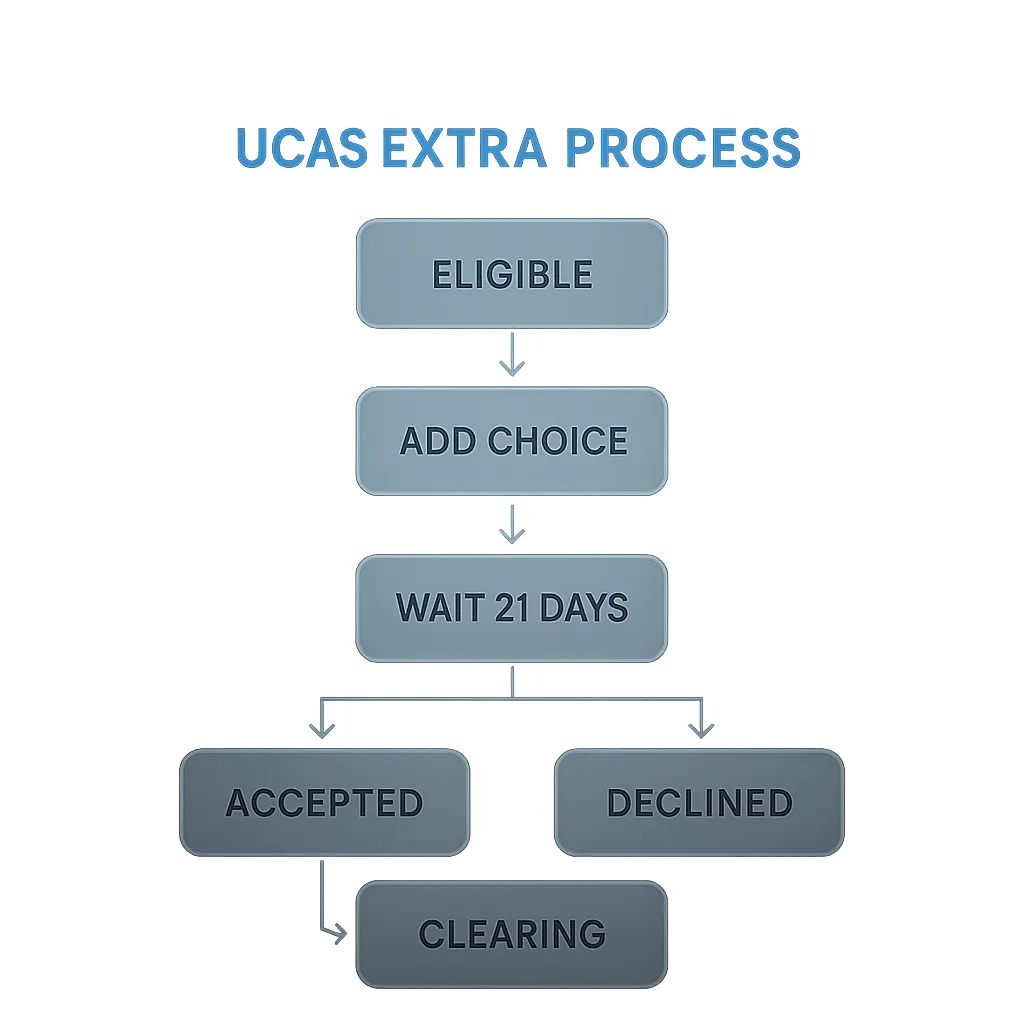
UCAS Extra runs on a strict one-at-a-time mechanic. You cannot hold two active Extra choices simultaneously, and there is no insurance option at any point - that distinction matters if you're used to the original five-choice system.
Here is how the process unfolds, step by step:
- Click 'Add Extra Choice' in the UCAS Hub. This button appears automatically once you are eligible. Select one course and submit your application to that university.
- Wait for a response. The university has up to 21 days to reply. If no decision arrives within that window, you can add a new choice straight away without waiting any longer.
- **[An offer arrives](/guides/how-to-reply-to-ucas-offers).** If you accept it, the UCAS Extra process ends for you - no further Extra applications can be made. Accept carefully.
- No offer, or you decline. If the university rejects you, or you turn down their offer, you can add another single choice and the cycle begins again.
The iterative, not simultaneous, structure is the part that catches applicants out. You cannot spread risk across two choices at once the way you could in the original round.
One specific gotcha: any offer you receive will show a reply deadline on your UCAS Hub homepage. Miss that deadline and the offer is automatically declined - UCAS will not reinstate it, and the university is under no obligation to reconsider. Set a calendar reminder the moment an offer appears.
Also worth noting: if you decline an offer to try elsewhere through Extra, that original offer is gone permanently. There is no going back.
4. UCAS Extra vs Clearing: Key Differences
The two routes are easy to confuse, but they operate at different times and serve different situations. The table below shows the core distinctions.
| UCAS Extra | Clearing | |
|---|---|---|
| Opens | 26 February 2026 | 2 July 2026 |
| Closes | 1 July 2026 | 24 September 2026 |
| Who is eligible | Used all five choices, holding no offers | Broader group: no offers held, or missed firm offer conditions on results day |
| How you apply | One course at a time through the UCAS Hub | Phone universities directly; receive a Clearing number |
| Insurance choice | Cannot hold one simultaneously | Not applicable in the same way |
Per UCAS, UCAS Extra requires that you have used all five original choices and hold no offers. Clearing, which opens 2 July 2026, is open to a wider pool, including applicants who received offers but did not meet the conditions on results day.
The less obvious point: the two routes are sequential, not competing. If you use UCAS Extra from February onwards and still have no place by 1 July, you automatically become eligible for Clearing once it opens on 2 July 2026. Using Extra does not close off Clearing as a fallback.
One practical trade-off worth noting: Extra gives you several months to research and apply at a measured pace, while Clearing compresses decisions into days around results day. If you are eligible for Extra, using it early gives you more time to assess courses carefully.
5. How to Choose a Course Through UCAS Extra
Start with the UCAS course search and filter specifically for courses still showing vacancies in Extra. Not every course participates, so checking the vacancy status before you get attached to a particular programme saves time.
The most common mistake is repeating the same pattern. If your original five choices were all for, say, Psychology at mid-to-high tariff universities and produced no offers, submitting a sixth near-identical choice is unlikely to change the outcome. Something in the pattern needs to shift: the subject, the course type, the institution profile, or all three. UCAS Extra gives you one active choice at a time, so each application carries real weight.
Match your choice to your predicted or achieved grades, not to where you hoped to end up. Look at the typical offer range published on the course page and ask honestly whether your profile fits within it, not just below the ceiling. A course where you sit comfortably in the middle of the offer range is a stronger bet than one where you are relying on the university accepting you at the lower edge.
**IB Diploma applicants need one extra step.** Convert your predicted total points and your Higher Level subject grades into the equivalent the university uses for its typical offer. A course listing "34 points with 5,5,5 at HL" is not interchangeable with one listing "32 points with 6,5,5 at HL", even when the totals look close. Choose a course where your specific HL subject combination, not just your overall points total, fits the stated requirements. You can check whether your predicted grades match a course's typical offer range using the UCAS Choices Shortlist Optimiser before committing your Extra choice.
One non-obvious gotcha: if you are applying for a different subject from the one in your original personal statement, your current statement may not support the new application. UCAS does not route a second personal statement through the system, so you would need to contact the university directly and send a revised statement by email. Confirm with the admissions team that they will accept it before you apply.
6. Common Questions About Using UCAS Extra
**Can you apply for medicine or dentistry through UCAS Extra?**
Technically yes, these courses can appear in the search tool. In practice, places are extremely rare at this stage. Most medical schools fill their cohorts through the main cycle and are unlikely to hold vacancies by February. If medicine is your only goal, applying through UCAS Extra is a long shot worth acknowledging honestly before you commit your one active slot to it.
What happens if you decline an Extra offer and change your mind?
That offer is gone. UCAS confirms that declined offers during Extra are not reinstated, so treat any acceptance decision as final.
What if you applied to fewer than five choices originally?
You are not eligible for UCAS Extra. UCAS advises that applicants who did not use all five initial choices should add a further choice directly through their UCAS Hub instead, provided they have not yet accepted or declined any offers.
Is there a timing risk near the 1 July deadline?
Yes, and it catches people out. Universities have up to 21 days to respond to an Extra application. If you add a choice in mid-June, you may not hear back before Extra closes on 1 July and Clearing opens the following day. Adding a choice in the final three weeks means you could run out of time before receiving a decision.
7. What to Do Next
The 1 July 2026 deadline is firm, and Extra vacancies shrink as the weeks pass. Act now rather than wait for results day.
This week, search courses with Extra vacancies using the UCAS Course Finder, filter specifically for courses showing Extra availability, and note two or three realistic options. One counter-intuitive point worth knowing: a course listed in Extra still has its own entry requirements, and universities can withdraw a vacancy at any time, so having several options ready matters more than fixating on one.
If Extra does not produce an offer before 1 July 2026, do not treat that as the end. Clearing opens 2 July 2026, and it is a well-used, straightforward route. Check the Course Finder for Clearing vacancies from that date and call universities directly.
FAQ
When does UCAS Extra open and close?
For 2026 entry, UCAS Extra opens on 26 February 2026 and closes on 1 July 2026, after which applicants without a place move into Clearing.
What is UCAS Extra?
UCAS Extra is a free service that lets applicants who have used all five original choices and hold no offers add one further university choice at a time before Clearing begins.
Is UCAS Extra the same as Clearing?
No - Extra runs in spring before results day (26 Feb-1 Jul 2026) and is for applicants with no offers from their five choices; Clearing opens 2 July 2026 and is a broader process open to more applicants.
Can I change my UCAS Extra choice?
You cannot hold two Extra choices simultaneously; you must withdraw from or be declined by your current Extra choice before adding a new one, and any offer you decline is not reinstated.
Is UCAS Extra worth it?
It is worth using if you approach it strategically - choosing a course that genuinely fits your grades and predicted profile rather than repeating the same applications that produced no offers.
Who is UCAS Extra for?
Extra is for applicants who applied to all five UCAS choices, have received decisions from all five, and are holding no offers - because all five were unsuccessful, withdrawn, or declined.
References
- UCAS Extra | No Offers? Add More Choices With Our 'Extra' Service - https://www.ucas.com/applying/after-you-apply/types-of-offers/extra-choices
- What is UCAS Extra? UCAS Extra 2026 Explained - https://www.lancashire.ac.uk/undergraduate/ucas-extra
- Dates and deadlines for uni applications | UCAS - https://www.ucas.com/applying/applying-to-university/dates-and-deadlines-for-uni-applications
- What is Ucas Extra - and when should students use it? | Times Higher Education - https://www.timeshighereducation.com/counsellor/admissions-processes-and-funding/what-ucas-extra-and-when-should-students-use-it