IB CAS Explained: Requirements, Ideas and Outcomes
By Michael Thompson · Education Specialist; 10 years teaching the IB at Bromsgrove School · Published 21 May 2026 · Updated 6 October 2026
IB CAS - Creativity, Activity, Service - is one of three core components of the IB Diploma Programme, sitting alongside Theory of Knowledge and the Extended Essay. It is compulsory: no CAS, no diploma, regardless of how well you score in your six subjects. Unlike your HL and SL papers, CAS carries no grade, which misleads some students into treating it as an afterthought. This guide covers exactly what the IB expects, how the seven learning outcomes work, what a valid CAS project looks like, and how to build a realistic programme around the commitments you already have.
Key Takeaways
- CAS stands for Creativity, Activity, Service and is a compulsory, ungraded core requirement of every IB Diploma - failing to complete it means no diploma is awarded.
- Seven learning outcomes must each be evidenced at least once across your CAS programme, and your reflections are the primary proof that each outcome has been met.
- Every student must complete at least one CAS project, which must be collaborative, last a minimum of one month, and can draw on all three CAS strands.
- Reflection is not a diary entry: the IB distinguishes between description (what happened) and reflection (what changed in your thinking or skills), and only the latter satisfies the requirement.
- There is no fixed hour count: the IB removed the 150-hour guideline from its official requirements; your school sets the expected duration, typically 18 months of regular engagement.
- You can map existing commitments onto CAS: sport, music, volunteering, and part-time work already in your life can count once properly framed, planned, and evidenced.
In This Article
- What IB CAS Is and Why It Cannot Be Skipped
- What Each Strand Covers: Creativity, Activity, Service
- The 7 IB CAS Learning Outcomes Explained
- CAS Hours Requirements: What the IB Actually Says
- The CAS Project: Rules, Duration, and How It Works
- How to Write IB CAS Reflections That Actually Count
- Best IB CAS Ideas: Building Around Existing Commitments
- How CAS Is Verified and What Happens If You Fail It
- Can You Get an IB Diploma Without CAS and the Extended Essay?
- Where to Go From Here
1. What IB CAS Is and Why It Cannot Be Skipped
IB CAS stands for Creativity, Activity, Service, and it is one of the three compulsory core components of the IB Diploma Programme alongside Theory of Knowledge (TOK) and the Extended Essay (EE). Where TOK is assessed through an essay and exhibition, and the EE produces a graded research paper, CAS is different: it carries no grade and contributes no points to your total score out of 45.
That last point trips up a lot of students. Because CAS is ungraded, it can feel like background noise next to six subject exams. It is not. The IB will withhold your diploma entirely if CAS is incomplete, regardless of how well you performed in every other component. A candidate with straight 7s who fails to meet CAS requirements does not receive the diploma.
The three strands work as follows:
- Creativity covers arts and other experiences that involve creative thinking, from music composition to coding a website.
- Activity means physical exertion, whether through sport, dance, hiking, or any sustained physical practice.
- Service involves genuine, unpaid action that benefits others or the wider community, without receiving academic credit for it.
One non-obvious detail: the IB does not specify a fixed number of hours per strand. The requirement is structured around seven learning outcomes and a sustained CAS project, not a simple tally of hours logged. That distinction matters when you plan your programme.
2. What Each Strand Covers: Creativity, Activity, Service
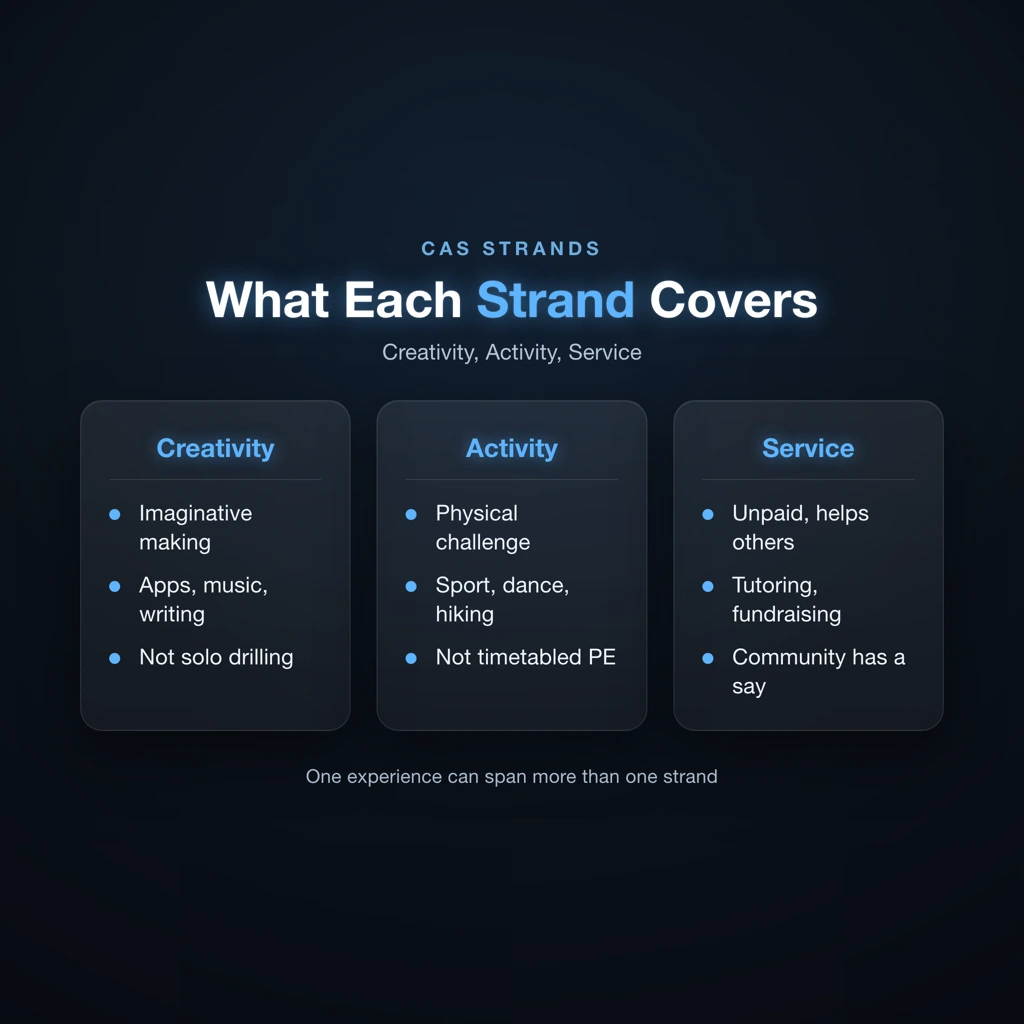
The three strands are distinct but deliberately overlapping. Understanding where each one starts and stops is more useful than memorising a definition.
Creativity covers any work that involves imaginative thinking or making something. Fine art is the obvious example, but the IB's definition is much broader: designing an app, writing a newsletter, composing music, building a set for a school play, or teaching yourself video editing all qualify. The test is whether the work required creative thinking, not whether it looks like art. One counter-intuitive point: practising scales on the piano alone does not count, because repetitive drilling is not creative output. Performing, arranging, or teaching a piece to someone else is.
Activity means physical exertion. It must be distinct from timetabled PE lessons, which the IB excludes because they are compulsory rather than chosen. Sport is the clearest case, but hiking, dance, circus skills, and competitive swimming all qualify. The strand rewards genuine physical challenge, so a student who already trains five days a week in a sport will need to show progression, not just attendance.
Service is unpaid work that benefits others. The IB is specific that service must not exploit or demean recipients, and that the community being served should have genuine input into what help they actually want. Environmental projects, tutoring programmes, and global fundraising campaigns all sit within scope.
A single experience can span more than one strand. A student who sets up a community garden satisfies Service and, if they design the layout or create communications materials, Creativity too. The IB allows this, but the reflection must address each strand separately.
3. The 7 IB CAS Learning Outcomes Explained
Every IB CAS activity you log should connect to at least one of seven defined learning outcomes. You do not need to hit all seven in every activity - the requirement is that each outcome is evidenced somewhere across your two years of CAS. That distinction matters more than most students realise when they are planning their portfolios.
Here are all seven, with a plain-language reading of what each one actually asks for:
- Identify own strengths and areas for growth. Reflect honestly on what you are good at and where you are not - and how a specific experience revealed that.
- Demonstrate that challenges have been undertaken. Show that you pushed beyond your comfort zone. The challenge must be real and named, not implied.
- Demonstrate how to initiate and plan a CAS experience. Evidence that you organised or co-organised something, rather than simply turning up.
- Show commitment and perseverance. Sustained engagement over time, including evidence that you pushed through difficulty.
- Demonstrate the skills and recognise the benefits of working collaboratively. Reflect on group dynamics, not just the outcome of the group work.
- Demonstrate engagement with issues of global significance. Connect an activity to a broader pattern - environmental, social, cultural - beyond your immediate community.
- Recognise and consider the ethics of choices and actions. Examine who is affected by your decisions in a CAS context and how.
Outcomes 1, 2, and 4 are the ones most students under-evidence - not because the activities are missing, but because the reflections treat them as self-evident. Writing "I found this challenging" does not satisfy outcome 2. The IBO expects you to name the specific challenge, describe the moment it occurred, and explain what you did next.
The counter-intuitive quirk worth knowing: outcome 3 (planning) cannot be met by your CAS project alone. The IBO expects at least one separate, self-initiated experience - a student who only plans within the formal CAS project may find a gap in their portfolio at verification.
Check your current reflections against all seven outcomes now. Any gaps are easier to fix in year one than in the final term of year two.
4. CAS Hours Requirements: What the IB Actually Says
The 150-hour figure you will see repeated on forums and revision sites is not in the current IB programme documentation. The IBO removed a fixed hour mandate from its official CAS guide, so there is no single number that applies to every student worldwide.
What fills that gap is your school. Individual schools set their own hour expectations, and your CAS coordinator or school CAS handbook is the definitive source for what your programme requires. Most school-level targets reflect roughly 18 months of sustained engagement spread across the two years of the Diploma Programme, with activity distributed reasonably across all three strands: Creativity, Activity, and Service.
The less obvious point: logging high hours in one strand does not compensate for thin engagement elsewhere. A student who racks up 200 hours of football training but does minimal service or creative work will still struggle at verification, because the IBO looks at breadth and reflection quality, not a cumulative total.
What actually matters for IBO verification:
- Evidence of engagement across all three strands over time
- Reflections that demonstrate genuine learning against the seven outcomes
- A completed CAS project involving collaboration
- Coordinator sign-off that the overall programme was sustained, not crammed
Check your school's CAS handbook this week and note the specific hour target and any strand minimums your coordinator has set.
5. The CAS Project: Rules, Duration, and How It Works
Every IB Diploma student must complete at least one CAS project alongside their individual CAS experiences. The project is a distinct requirement, not just a particularly large experience logged in your CAS portfolio.
Three rules are non-negotiable:
- Collaborative. The project must involve at least two students working together.
- Sustained. It must run for a minimum of one month, with real ongoing commitment rather than a single burst of activity.
- Student-led. You and your peers must initiate and drive it. Signing up to help a teacher run their existing programme does not count as your CAS project.
That last point catches more students out than the time requirement. The IB is looking for evidence that you identified a need, planned a response, and took ownership of the outcome. An adult can advise, but the project cannot be something an adult designed and handed to you.
A strong CAS project can span all three strands at once. A school garden, for example, involves creative design (planning the layout, building raised beds), physical activity (the digging and maintenance), and service (producing food for a local food bank or improving a shared community space). Combining strands is not required, but it tends to produce richer reflections and makes meeting the seven CAS learning outcomes more manageable.
Other valid project types include:
- A community arts event organised for local primary-school pupils
- An environmental campaign that runs across a term, combining awareness materials with practical clean-up sessions
- A sports coaching programme where older students train younger ones over several months
Choose a project where you can credibly claim the idea originated with the student group, not the coordinator. That distinction is exactly what the IB verifier will look for.
6. How to Write IB CAS Reflections That Actually Count
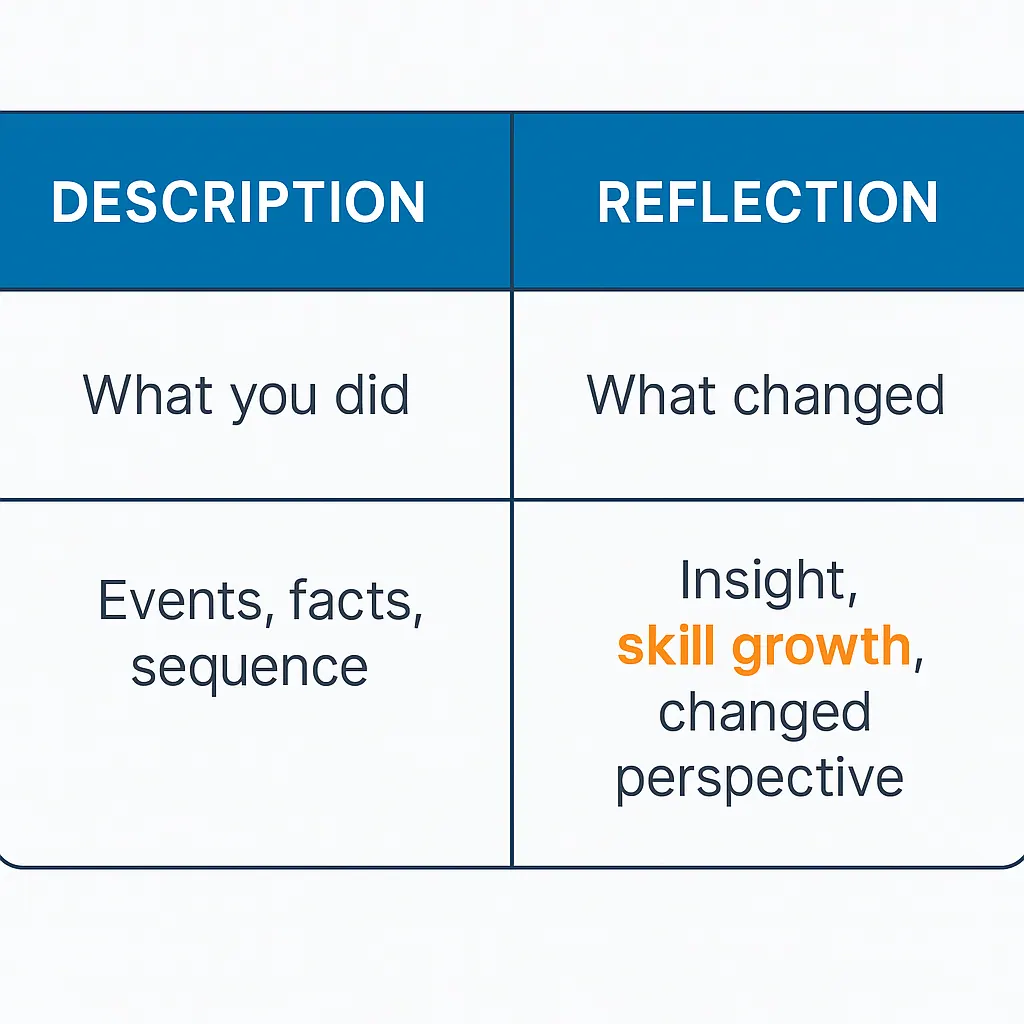
The most common mistake in IB CAS reflections is writing a summary of events rather than an account of thinking. Describing what you did ("we held a bake sale and raised money") is not a reflection. A reflection explains what shifted: in your assumptions, your skills, your understanding of a problem, or your approach to working with others.
The IB expects reflection to be ongoing, not a single piece written the day before your supervisor signs off. That means capturing something real while the experience is still live: what surprised you in week three, what went wrong in week six, how your thinking shifted across the project as a whole. A portfolio of dated entries demonstrates this continuity far more convincingly than one polished retrospective.
What makes a reflection count
A useful framing technique is the before-and-after structure:
- I expected X (your assumption going in)
- What I discovered was Y (what the experience actually showed you)
- Which changed how I think about Z (the consequence for your thinking or behaviour)
For example: "I expected teaching younger students to be straightforward, but I found that they engaged better when they set their own questions. I now think about learning as something the learner has to own, not something I deliver."
That single entry implicitly addresses the IB CAS learning outcome around collaboration and the development of new skills, without ever using the phrase "learning outcome." Show the evidence; don't just label it.
Reflections can be written journal entries, audio recordings, video logs, sketchbooks, or annotated photographs. The medium does not matter. The depth does.
One counter-intuitive gotcha: a very short, precise reflection dated mid-activity often carries more weight with a coordinator than a long, vague one written retrospectively, because it demonstrates that engagement with IB CAS was genuine and not manufactured.
7. Best IB CAS Ideas: Building Around Existing Commitments
Before searching for new activities, audit what you already do. A weekly football training session counts as Activity. Playing in a school orchestra counts as Creativity. Helping at a local food bank you already visit on weekends counts as Service. The IB CAS programme rewards honest engagement, not novelty for its own sake, so starting from real commitments saves time and tends to produce more genuine reflections.
One non-obvious trade-off worth knowing: an activity you have done for years before the Diploma Programme may be harder to evidence as a new challenge, which is central to several of the 7 IB CAS learning outcomes. If you have swum competitively since age eight, simply continuing is unlikely to satisfy outcome 2 (undertaking new challenges) unless you take on a coaching role or push into open-water swimming. Reframing existing commitments is often the right move; recycling them unchanged is not.
Strand-by-strand ideas
Creativity
- Photography project with a documented theme and edit process
- Contributing to or editing a school magazine or podcast
- Game design (Scratch, Unity) with design logs as reflection evidence
- Learning a new language independently, tracked with a learning journal
Activity
- Joining a sports team you have not played for before
- Training for a 5K or 10K with a structured plan
- Yoga, rock climbing, or another discipline that is genuinely new to you
Service
- Tutoring younger students in a subject you study at Higher Level
- Food bank volunteering with a regular, timetabled commitment
- Environmental clean-up tied to a named local conservation group
- Charity fundraising campaign with a measurable target
Breadth across two years
The IB expects variety across the full programme, not one activity repeated indefinitely. A portfolio that shows three strands, multiple contexts, and progression over time is stronger than 18 months of the same club. Ideas that connect to global issues, such as climate action, access to education, or food poverty, tend to satisfy learning outcome 6 (global engagement) most naturally, and they give CAS projects a clearer purpose when you reach that stage.
8. How CAS Is Verified and What Happens If You Fail It
The IB does not check each student's CAS portfolio directly. Instead, your school's CAS coordinator reviews your evidence, confirms that all requirements are met, and certifies completion to the IBO. That single step is the gatekeeper between you and your diploma.
The consequence of failed certification is unambiguous: the IBO withholds the full diploma. Subject grades are still issued, so a student might hold a 7 in Mathematics and a 6 in Chemistry but receive no IB Diploma, because CAS was not signed off. Universities receiving those results will see the shortfall immediately.
The less obvious risk is school-level. The IBO audits schools' CAS programmes periodically, and if a school's overall programme is found deficient, every student at that school can be affected, not just the individuals with weak portfolios. A coordinated failure at programme level is rare, but it has happened.
Your evidence portfolio, whether digital through a platform such as ManageBac or kept as a physical file, must show a continuous record across all three strands, reflections tied to the seven learning outcomes, supervisor confirmations, and a documented CAS project.
The most common reasons the coordinator cannot certify CAS:
- Only one or two strands are evidenced, typically Activity and Service with Creativity thin or absent
- Reflections describe what happened rather than analysing what changed in the student
- The CAS project is missing entirely or ran for fewer than one month
- Learning outcomes are claimed but no evidence in the portfolio supports them
One non-obvious gotcha: a reflection that quotes a learning outcome word for word without elaboration is treated as descriptive, not analytical. Coordinators are trained to flag that pattern.
9. Can You Get an IB Diploma Without CAS and the Extended Essay?
No. CAS, the Extended Essay (EE), and Theory of Knowledge (TOK) are compulsory core components of the IB Diploma Programme. None can be waived as standard, and none can be substituted with extra subject credits.
The three components affect your diploma differently, which is worth understanding precisely:
- TOK and the EE contribute to a bonus-points matrix worth up to 3 additional points on top of the 42 points available from your six subjects. They are not optional extras, though: an E grade in either component is a failing condition that denies you the diploma outright.
- CAS carries no points at all - yet failing it cancels the diploma regardless of how well you perform in your six subjects. A student with 42 subject points and incomplete CAS leaves with nothing.
The counter-intuitive consequence: CAS is simultaneously the only core component that awards zero points and the one whose failure is most absolute.
Students with long-term illness, disability, or other significant documented circumstances can apply to the IBO for alternative arrangements. This is a formal exception process requiring evidence, not a standard opt-out, and the IBO decides each case individually.
10. Where to Go From Here
Before you plan a single new activity, locate your school's CAS handbook this week. Every IB school publishes its own version, and it is the handbook, not the IBO's general guidance, that sets your coordinator's submission deadlines, the minimum evidence expected per experience, and the portfolio format used for sign-off. Missing an internal deadline is the most common reason students scramble in their final term.
Once you have the handbook, audit what you already do against all three strands: Creativity, Activity, and Service. Most students discover they are over-indexed in one area and can reframe an existing commitment to cover a gap, rather than starting from scratch.
For the full picture of IB Diploma core requirements, read the related guides on Theory of Knowledge and the Extended Essay alongside this one.
Ask your CAS coordinator this week for the exact internal sign-off deadline. It will almost certainly fall weeks before the IBO's assessment window closes.
FAQ
What does IB CAS stand for?
CAS stands for Creativity, Activity, Service - the three strands that make up the compulsory experiential learning component of the IB Diploma Programme.
How many CAS hours are required in the IB?
The IB's current official guide does not specify a fixed hour total; the old 150-hour figure has been removed, and your school sets its own expectation - check your school's CAS handbook for the number your coordinator will use.
How is IB CAS graded?
CAS is not graded or scored; it is assessed as complete or incomplete by your school's CAS coordinator, and the IBO withholds the full diploma if CAS is not certified.
What is the IB CAS project?
The CAS project is a compulsory collaborative experience that must involve at least two students, last a minimum of one month, and be student-initiated - it can span all three CAS strands.
How do you write IB CAS reflections?
A valid CAS reflection goes beyond describing what happened and instead explains what changed in your thinking, skills, or awareness - framing it as 'I expected X, but discovered Y, which changed how I approach Z' is a reliable structure.
What happens if you don't complete IB CAS?
If your CAS programme is not certified by your school's coordinator, the IBO will not award you the IB Diploma, even if your subject grades are high enough - you may receive a results document but not the full qualification.