How to Get a 7 in IB Math: A Practical Guide
By Michael Thompson · Education Specialist; 10 years teaching the IB at Bromsgrove School · Published 21 May 2026 · Updated 12 June 2026
Getting a 7 in IB Math is more achievable than most students expect - not because the maths is easy, but because a 7 rarely requires anywhere near 80% of available marks. The grade boundaries vary by course, level, and sitting, and understanding exactly what score you're aiming for changes how you revise. This guide covers the four levers that move your grade: knowing the real boundary, banking marks on the Internal Assessment, drilling past papers strategically, and applying the right technique in each exam paper. Whether you're sitting Math AA SL, AA HL, AI SL, or AI HL, the underlying approach is the same.
Key Takeaways
- A 7 is often below 70% raw: Grade boundaries shift each session, and in harder sittings a 7 can sit well below 75% - knowing the real target stops you over-preparing the wrong things.
- The Internal Assessment is worth 20%: A strong IA is the most controllable source of marks in the entire course - a top-scoring IA gives you a meaningful cushion before the exam papers begin.
- Past papers are the core revision tool: Working through past papers under timed conditions, then analysing markschemes carefully, is how exam technique is actually built.
- Paper 1 (non-calculator) needs separate preparation: Mental arithmetic fluency and formula recall matter far more on Paper 1 than on the calculator papers - they require different practice habits.
- Markschemes reward method, not just answers: IB markschemes award method marks at each step, so showing working clearly protects your score even when final answers are wrong.
- Ask for help early on specific topics: Gaps in understanding compound quickly in IB Math - identifying and fixing a weak topic six months out is far less costly than discovering it in mock week.
In This Article
- What a 7 Actually Means: Grade Boundaries in IB Math
- AA vs AI: Choosing the Right Course for Your Goals
- The Internal Assessment: How to Maximise Your 20%
- Past Paper Strategy: Which Years, How Many, and When to Start
- Paper-by-Paper Exam Technique for IB Math
- Key Topics to Prioritise in Your IB Math Revision
- When to Ask for Help and How to Use It
- What to Do This Week
1. What a 7 Actually Means: Grade Boundaries in IB Math
Most students aiming to figure out how to get a 7 in IB Math assume they need to score around 80%. That assumption can cost them. The IB uses a 1-7 grading scale, and the percentage of raw marks needed for a 7 shifts with every exam session, every course variant, and every level.
Here is the mechanism. Your marks from Paper 1, Paper 2 (and Paper 3 for HL), plus your Internal Assessment, are combined into a single weighted total. The IB then applies grade boundaries to that composite score, not to each component individually. Those boundaries are set after the papers are sat, based partly on how the cohort performed.
The practical consequence: in a difficult sitting, the boundary for a 7 can fall noticeably below 70% of the available marks. In a more straightforward session, it may sit higher. This varies between Analysis and Approaches (AA) and Applications and Interpretation (AI), and between Standard Level and Higher Level.
The non-obvious gotcha is this. Because boundaries are set on the composite score, a strong IA can quietly pull you over the line in a way that raw exam performance alone does not show. A student sitting just below the paper-based threshold may still land a 7 if their IA mark is solid.
Your real target is the historical boundary range for your specific course and level, not a generic percentage. Check past grade boundary documents for AA SL, AA HL, AI SL, or AI HL separately before you set your revision goals.
2. AA vs AI: Choosing the Right Course for Your Goals
Math AA (Analysis and Approaches) is built around algebraic proof, pure calculus, and abstract reasoning. At HL, it includes topics like complex numbers, proof by induction, and further calculus that have no equivalent in AI. Math AI (Applications and Interpretation) centres on statistics, modelling, and real-world contexts, and allows a graphical display calculator throughout most of the exam. That calculator dependency is a double-edged trade-off: AI students gain a tool, but also lose the habit of working algebraically under pressure, which matters if their degree involves any pure mathematics.
Reddit discussions on IB Math AA vs AI difficulty broadly place AA HL at the top of the difficulty ranking across all four course options (AA HL, AA SL, AI HL, AI SL). That consensus is consistent, but difficulty alone is the wrong criterion for choosing.
University destination should drive the decision. Per the UCLA IB recognition statement, Math AI at any level does not grant course credit at UCLA, while Math AA HL with a score of 5 or above does. Engineering applicants are specifically recommended to take AA wherever possible. That pattern is not unique to UCLA, and it is worth checking individual university statements before your course selection is finalised.
If your target programmes are in humanities, social sciences, or business, AI SL may be sufficient. If you are aiming for engineering, physical sciences, or mathematics-intensive economics, AA HL is the safer choice.
3. The Internal Assessment: How to Maximise Your 20%
The IA is worth 20% of your final IB Math grade, and it is the only component assessed without a clock running. That makes it different from everything else in the course. A strong IA is banked marks before exam season starts, giving you a genuine buffer if Paper 2 or Paper 3 goes badly on the day.
The IB assesses your IA against five criteria: Presentation, Mathematical Communication, Personal Engagement, Reflection, and Use of Mathematics. Most students lose marks on Reflection, not because they run out of ideas, but because they treat it as an afterthought. Reflection means critically evaluating your model or method, noting its limitations, and suggesting what you would do differently. A single paragraph at the end rarely satisfies this.
The counter-intuitive trap with topic choice: a topic that sounds impressive, such as modelling climate data or stock prices, often produces a weaker IA than a tighter, narrower question. Broad topics tend to produce descriptive write-ups with thin mathematics. Markers reward depth over ambition. Pick a question specific enough that you can fully exhaust the mathematics behind it.
Three concrete mistakes to avoid:
- Sparse notation. Write expressions using proper mathematical notation throughout, not just in graphs. Markers penalise prose that describes mathematics without showing it.
- Borrowed models without interrogation. Using a formula from a textbook without deriving or questioning it scores poorly on Use of Mathematics at Higher Level.
- Ignoring Personal Engagement. This criterion rewards genuine curiosity and independent thinking, not a statement saying "I chose this topic because I find it interesting."
Submit a complete draft to your supervisor before the school deadline, not on it. Internal deadlines are set by your school and will be earlier than you expect.
4. Past Paper Strategy: Which Years, How Many, and When to Start
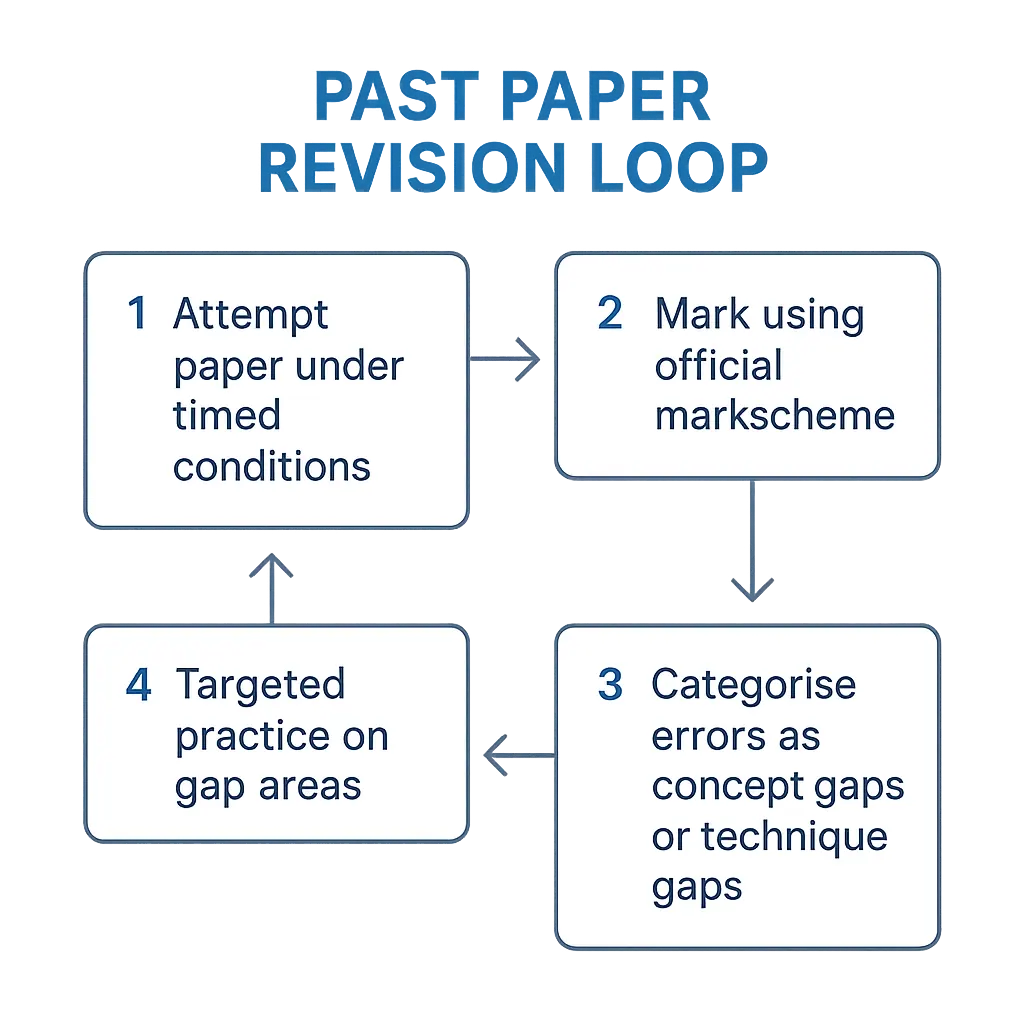
Past papers are the closest thing to a rehearsal you will get, but only if you use them correctly. The two most common mistakes are starting too late and treating them as a comfort exercise rather than a diagnostic one.
Start timed conditions no later than six months before your exams. Before that point, using individual papers to practise specific topics is fine. But timed, full-paper conditions need to begin early enough that you have time to act on what they reveal.
Which papers to use
Prioritise papers from 2021 onwards. The AA (Analysis and Approaches) and AI (Applications and Interpretation) courses launched with the 2021 examination session, and pre-2019 papers test a substantially different syllabus. Working through old papers is not wasted time, but it is lower-priority time.
How many is enough
In the final two months before the exam, aim for at least one complete paper set per week:
- SL: Papers 1 and 2 in a single sitting, or across two consecutive days.
- HL: Papers 1, 2, and 3, treated as a full exam block.
The step most students skip: markscheme analysis
After every paper, go through the markscheme question by question. For every mark dropped, categorise it as one of two things:
- A concept gap - you did not know the method. This needs directed topic revision.
- A technique gap - you knew the method but lost marks on notation, presentation, or a missed step. This needs targeted exam technique work.
The non-obvious insight here is that markschemes are a teaching document, not just an answer key. They show the exact notation the IB rewards, acceptable alternative methods, and the precise points at which method marks are awarded. Reading them carefully often reveals that a technique you have been using costs you a mark at a specific step, a problem that pure topic revision will never fix.
5. Paper-by-Paper Exam Technique for IB Math
Each IB Math paper tests a different skill set. Treating them the same is one of the more costly mistakes you can make in the exam hall.
Paper 1: Non-calculator
Fluency in algebraic manipulation is the whole game here. The IB does not permit a GDC, so any computation you cannot do by hand either slows you down or stops you entirely.
- Memorise what is NOT in the formula booklet. The booklet gives you many identities, but not all. Double-angle formulae, the quadratic formula, and standard derivative rules are in there. The exact form of the binomial theorem for specific expansions, and several integration results, require more care. Know the boundary between what you look up and what you recall automatically.
- Sign errors and unsimplified answers cost marks. Examiners award method marks, but a dropped negative at line two will cascade through the rest of your working. Write each step on its own line.
- Practise expanding and factorising without a calculator, not just checking with one.
Paper 2: Calculator paper
The counter-intuitive rule: the GDC is a checking tool, not a shortcut. Examiners expect algebraic working even when a calculator could skip to the answer. A correct numerical answer with no working shown can score zero on a "show that" or method-focused question.
Know these GDC functions precisely before the exam:
- Finding roots and intersections (graph intersection or solver)
- Running linear and quadratic regression
- Numerical integration using the definite-integral function
- Storing intermediate values to avoid rounding errors mid-problem
Rounding errors are a specific Paper 2 trap. Always carry full precision in your GDC memory and round only in the final answer, to the precision the question specifies.
Paper 3 (HL only): The problem-solving paper
Paper 3 is structured as an extended investigation built from sequential parts. Read the whole question before attempting part (a). Later parts frequently instruct you to use a result you proved two sub-questions earlier. If you skip ahead or miss that link, you lose marks you already earned.
Work sequentially. If you are stuck on one part, write what you do know, because the next part may give you an entry point back into the earlier one.
General technique across all papers
| Principle | What it means in practice |
|---|---|
| Time per mark | Budget roughly one to one-and-a-half minutes per mark. A 6-mark question should not take twelve minutes. |
| Attempt everything | Partial credit is available on nearly every structured question. A blank response scores zero; a partially correct method can still earn two or three marks. |
| Formula booklet fluency | Before the exam, know exactly which page each formula lives on. Searching under time pressure is expensive. |
The one thing most students underestimate: the formula booklet is not an index. It lists results, not methods. Knowing a formula exists in the booklet and knowing how to apply it in an unfamiliar context are two different things, and Paper 1 in particular tests the second.
6. Key Topics to Prioritise in Your IB Math Revision
Not all topics carry equal weight on IB Math papers, and spreading revision time evenly is one of the more costly mistakes you can make.
For Analysis and Approaches (AA), calculus dominates. Differentiation and integration appear across Paper 1, Paper 2, and Paper 3 (HL), often as multi-part questions worth 15 to 20 marks. Trigonometry and functions are consistently tested at both SL and HL. At HL, complex numbers are a frequent source of dropped marks, partly because students under-revise them relative to how reliably they appear.
For Applications and Interpretation (AI), statistics and probability form the backbone of the papers. Normal distribution, hypothesis testing, and chi-squared tests recur in nearly every past paper. Functions and mathematical modelling also appear heavily, often in context-based questions that require interpreting real-world scenarios rather than applying a memorised algorithm.
Across both courses, the most efficient way to identify your personal gaps is to track your mark loss by topic across past papers before moving to full timed papers. Note which question types you drop marks on consistently, then work through topic-by-topic practice questions on revision platforms such as Revision Village or IB Past Papers before returning to full-paper timed practice.
A non-obvious point: Paper 1 (no calculator) punishes students who always rely on GDC shortcuts in revision. Practise the algebraic methods separately.
7. When to Ask for Help and How to Use It
If you have spent more than 30 minutes on a concept without making progress, stop and ask. IB Math topics build on each other in a way that few courses match: if integration by parts is shaky, volumes of revolution will not make sense. Leaving a gap open is not neutral - it compounds.
Who to ask, in order:
- Your teacher first. They know the current IB syllabus version, the markscheme conventions, and which phrasings earn method marks. A tutor or forum may teach the right maths but the wrong vocabulary for the examiner.
- A peer who has already grasped the topic. Explaining it back to you forces them to articulate the mechanism, which often surfaces the exact step you missed.
- A tutor for weaknesses that persist across several weeks despite your teacher's input.
On markschemes: the most common misuse is reading the markscheme before completing the question. Once you have seen the working, you cannot unsee it. The diagnostic value - spotting precisely where your method breaks down - disappears. Attempt fully, then compare line by line.
On online resources: IB-specific forums and question banks can explain concepts clearly, but IB Math AA and AI syllabuses are updated periodically. Any topic list or worked example you find online should be cross-checked against your official IB Mathematics subject guide before you commit revision time to it. Off-syllabus material is a real cost when exam time is finite.
8. What to Do This Week
Download the official IB Mathematics subject guide for your specific course (AA or AI, SL or HL) from the IBO resources page this week. Open it alongside your revision notes and mark every topic you have not yet covered or feel uncertain about. This is more useful than it sounds: the subject guide lists the precise command terms the IBO uses in exams, such as "hence" versus "hence or otherwise," and knowing the difference tells you whether a specific method is required or optional in a given question.
Once you have your topic gap list, prioritise anything that appears in both Paper 1 and Paper 2 (or Paper 3 for HL), since those topics carry the most weight across your total mark.
For your next reads, the IB Math IA guide and the IB grade boundaries guide are worth bookmarking now.
FAQ
How to get a 7 in IB Math AA SL?
Focus on calculus, functions, and trigonometry - the heaviest-weighted topics in AA SL - and aim to bank a strong IA score before the May exams, since the grade boundary for a 7 has historically fallen below 75% in some sessions.
How to get a 7 in IB Math AA HL?
AA HL is widely regarded as the hardest of the four IB Math courses; consistent past paper practice from the 2021 syllabus onwards, mastery of the Paper 3 investigation format, and a well-executed IA are the primary levers.
How many people get a 7 in IB Math AA HL?
The IBO publishes grade statistics annually - the proportion of students achieving a 7 in Math AA HL is typically lower than in AI or SL courses, reflecting the course difficulty, though exact figures vary by session.
How to get a 7 in IB Math AI SL?
Statistics and probability dominate AI SL papers, so prioritise hypothesis testing, the normal distribution, and regression; effective GDC use on Paper 2 and a strong IA topic can push a borderline 6 to a 7.
How much of the final grade does the IB Math IA count for?
The Internal Assessment is worth 20% of the final IB Math grade across all four courses - AA SL, AA HL, AI SL, and AI HL - making it the most controllable source of marks in the course.
What are the IB Math grade boundaries for 2024?
The IBO releases official grade boundaries after each exam session; boundaries vary by course and sitting, and in recent years a 7 in some courses has required fewer than 75% of raw marks - check the IBO's statistical bulletin for the exact figures each May.