Psychology Personal Statement: 2026 UCAS Guide
By Michael Thompson · Former IB Diploma Programme coordinator; 10 years at Bromsgrove School · Published 5 July 2026
A psychology personal statement needs to show that you understand psychology is a science - one built on statistics, research methods, and peer-reviewed evidence - not a talent for reading people. Most applicants open with a line about human behaviour or a personal story; the ones who stand out follow it immediately with a named study, a genuine question the research raised for them, and a clear sense of the discipline's breadth. From 2026, UCAS splits the statement into three separate questions within a shared 4,000-character limit, so how you allocate your space matters as much as what you say. This guide maps each question to what psychology admissions tutors are actually looking for and shows you how to move from generic motivation to specific, critical engagement.
Key Takeaways
- Psychology is assessed as a science: Admissions tutors want evidence you can engage with research methods and quantitative data, not just an interest in human behaviour.
- Three separate questions from 2026: UCAS now asks why you want to study psychology, how your qualifications prepare you, and what you have done outside formal education - each within a shared 4,000-character limit.
- Named studies beat general enthusiasm: Replacing 'I have always been fascinated by why people behave the way they do' with a specific study, a methodological point, and your own evaluation is the single highest-impact revision you can make.
- IB students have specific evidence to deploy: Your Internal Assessment, any science or maths Higher Level, and a science Extended Essay all provide direct proof of statistical and methods literacy that Q2 is designed to surface.
- Super-curriculars only work with critical analysis: Reading a popular psychology book or doing relevant volunteering counts for little unless you explain what it made you question or reconsider.
- Check entry requirements before you draft: Some UK psychology degrees require a science or maths qualification; writing a statement that emphasises arts subjects is a misfire if the course profile demands quantitative preparation.
In This Article
- What psychology admissions tutors actually look for
- How the 2026 UCAS personal statement format works
- Mapping the three questions to a psychology degree personal statement
- Before and after: moving from generic motivation to critical engagement
- Super-curriculars that carry weight: reading, research, and volunteering
- IB-specific angle: using your IA, HL sciences, and Extended Essay
- Tailoring for combined degrees: criminology and psychology, counselling, and neuroscience
- Common mistakes that undermine a psychology personal statement
- Psychology conversion personal statements and postgraduate applicants
- What to do next
1. What psychology admissions tutors actually look for
A strong psychology personal statement starts with one uncomfortable truth: psychology is a science. Admissions tutors at universities across the UK are looking for applicants who understand that the degree involves statistics, research methods, experimental design, and quantitative data analysis. The student who opens with "I've always been fascinated by why people behave the way they do" is not wrong, but they have told the tutor nothing about whether they can handle a methods module.
Critical engagement with a small number of studies beats a long reading list every time. Being able to name a study, describe its methodology, and identify a genuine limitation signals the kind of thinking that undergraduate seminars reward. Listing ten books without analysis signals the opposite.
Tutors also look for breadth of awareness. Undergraduate psychology covers cognitive, developmental, social, biological, clinical, and forensic areas. An applicant who references only one corner of the field looks as though they have not read the course page.
The single most common framing mistake is pop-psychology. Opening with Myers-Briggs, personality "types", or a claim about being good at "reading people" is an immediate flag. These are not part of academic psychology's evidence base, and invoking them suggests the applicant's preparation has not moved beyond self-help books.
The counter-intuitive insight worth knowing: tutors report that applicants often over-explain their personal motivation and under-explain their intellectual engagement. The personal history matters less than the question you walked away asking after you read something that challenged you.
2. How the 2026 UCAS personal statement format works
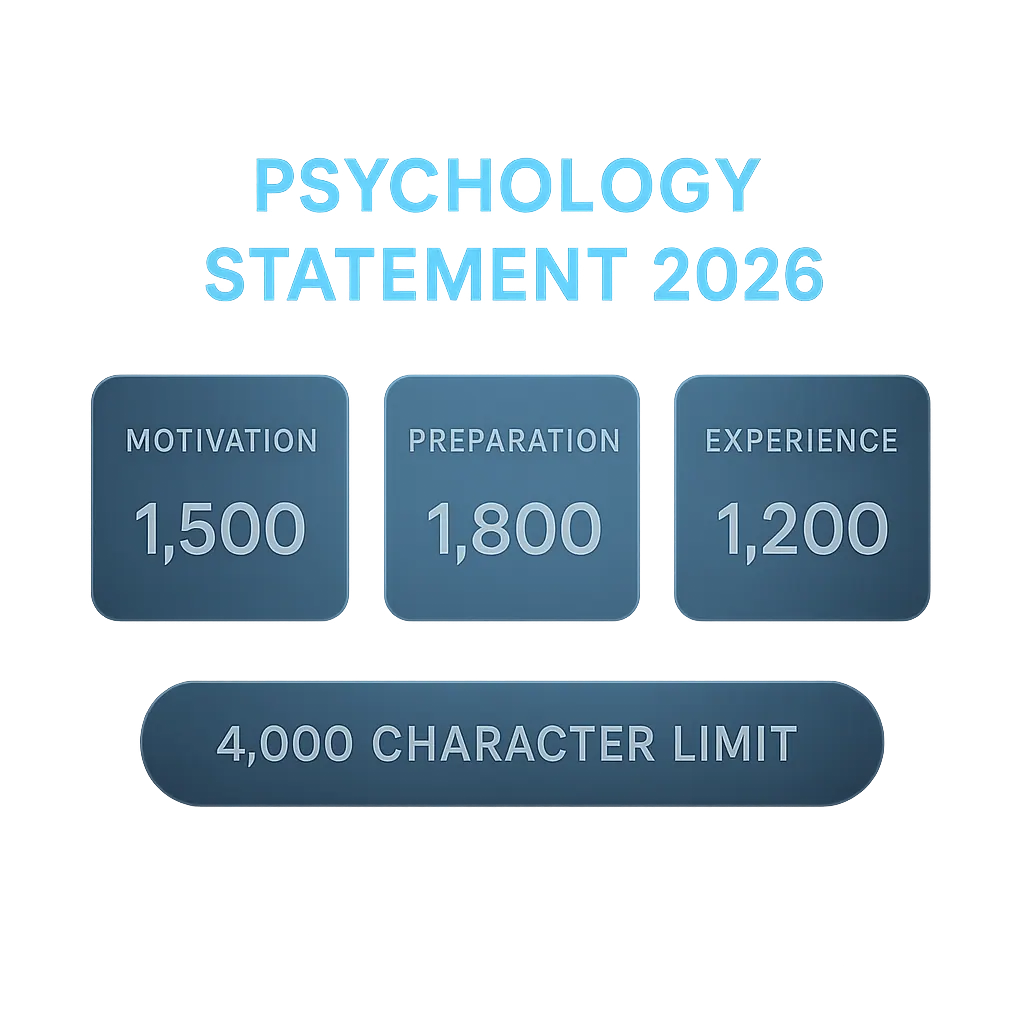
From 2026 entry, the personal statement is no longer a single free-form essay. UCAS has replaced it with three separate questions, all sitting within a shared 4,000-character limit (including spaces).
The three questions are:
- Q1: "Why do you want to study this course or subject?"
- Q2: "How have your qualifications and studies helped you to prepare for this course or subject?"
- Q3: "What else have you done to prepare outside of education, and why are these experiences useful?"
Each answer has a minimum of 350 characters, but the remaining budget can be distributed unevenly. You could write 1,800 characters for Q1 and split the rest between Q2 and Q3 if that reflects your strongest evidence.
One counter-intuitive point: Q2 explicitly excludes grades. UCAS instructs applicants not to discuss them, because admissions staff already see predicted grades elsewhere in the application. Q2 is for content and skills covered in your studies, not for listing A-level subjects and predicted marks.
Admissions staff review all three answers as a whole, so repeating the same material across questions wastes your character budget. The structure is actually useful: each question demands a distinct type of evidence, which makes planning a psychology personal statement more straightforward than the old blank-page format.
3. Mapping the three questions to a psychology degree personal statement
The 2026 UCAS format gives you 4,000 characters across three questions, each with a 350-character minimum. Thinking in thirds is a reasonable starting point, but the questions are not equal in weight for psychology applicants. Here is a practical budget and what each question actually demands.
| Question | What it asks | Suggested budget | Core task |
|---|---|---|---|
| Q1: Why psychology? | Motivation and intellectual fit | ~1,500 characters | Anchor to a specific area or debate |
| Q2: Qualifications | How your studies prepare you | ~1,300 characters | Demonstrate scientific and statistical literacy |
| Q3: Outside education | Experience beyond the classroom | ~1,200 characters | Critical reflection, not a list |
Q1: Why psychology?
Admissions tutors are not looking for a general interest in "understanding human behaviour." They want evidence that you have grasped that psychology is a science with competing theoretical frameworks, and that you have an opinion about a specific area within it. Ground your motivation in a named area, a particular debate (such as the replication crisis in social psychology), or a named researcher's work. Showing awareness that findings are contested, not settled, signals scientific maturity.
Q2: How your qualifications prepare you
This is where A-level or IB psychology, biology, maths, and statistics earn their place. Be explicit about research methods units: AQA A-level Psychology's Year 1 and Year 2 research methods content, or the IB Psychology HL internal assessment, are worth naming directly because they show statistical and methodological grounding. Per UCAS guidance, short online university courses count here too, so a completed statistics or research methods course from a university platform is legitimate evidence.
Q3: Outside education
UCAS describes Q3 as asking "What else have you done to prepare outside of education, and why are these experiences useful?" The emphasis is on "why." Listing volunteering hours or books read is not enough. A short critical observation, what you expected, what you actually found, and what question it raised for you, carries far more weight than a summary.
One non-obvious gotcha: UCAS explicitly warns against repeating information across answers. If a study or experience anchors your Q1 motivation, do not let it reappear as supporting evidence in Q3. Admissions staff read all three answers together, and repetition reads as running out of material.
4. Before and after: moving from generic motivation to critical engagement
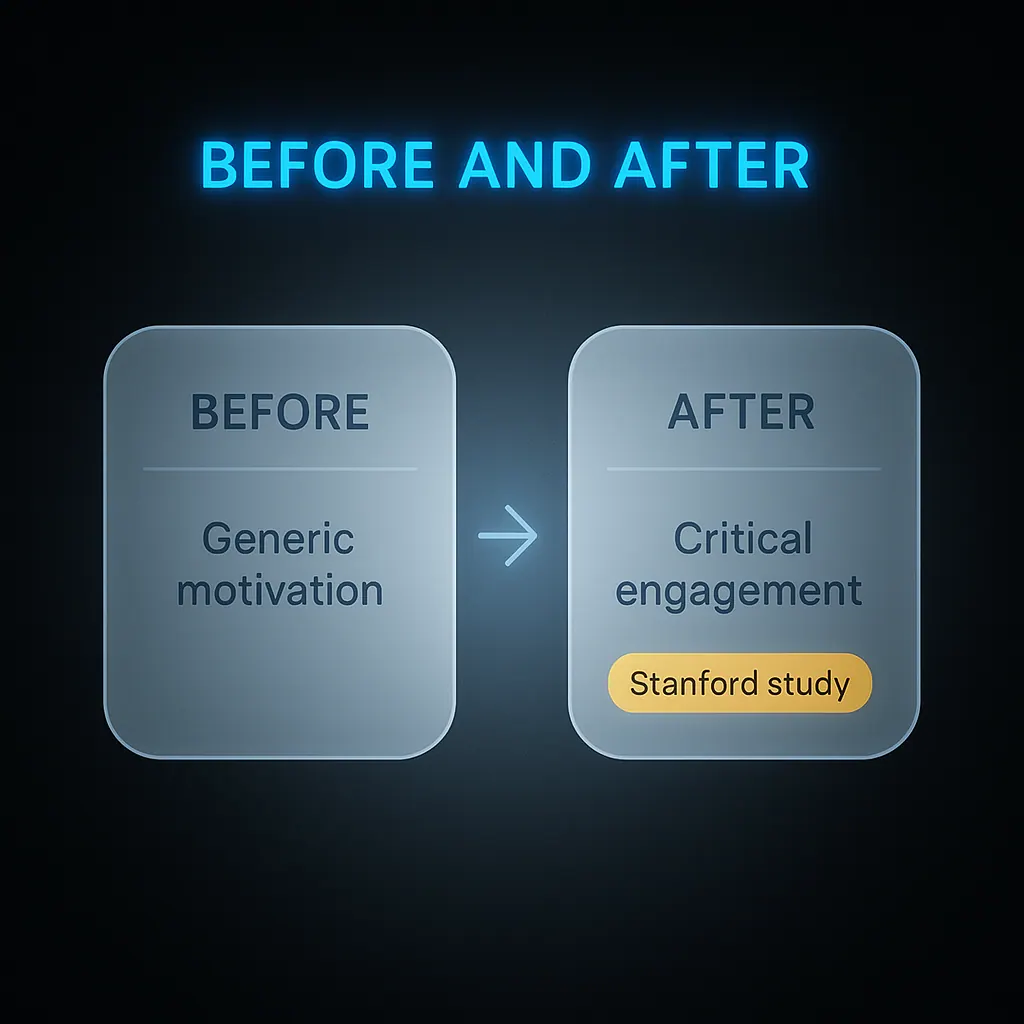
Admissions tutors read hundreds of psychology personal statements. A named study gives them something concrete to anchor your motivation - and something specific to ask about at interview. Vague enthusiasm is forgettable; a methodological question you genuinely haven't resolved is not.
Motivation rooted in research
Before: "I have always wanted to understand why people behave the way they do."
This tells the tutor nothing about how you think. It could describe anyone who has ever watched a documentary.
After: "Reading about Loftus and Palmer's 1974 study on eyewitness testimony, I was struck by how a single word change - 'smashed' versus 'contacted' - altered participants' speed estimates. What interested me more than the result, though, was the methodology. The recall task was laboratory-based, which raises an ecological validity problem: remembering a film clip under controlled conditions may not reflect the fragmentary, emotionally charged encoding that happens at a real accident scene. That gap between experimental control and real-world applicability is the question I keep returning to."
The revision names the study, identifies a specific methodological concept (ecological validity), and closes with an open question rather than a neat conclusion. That structure signals scientific literacy, not just content knowledge. The counter-intuitive point worth noting: tutors are often more impressed by a well-framed limitation than by a student who treats a classic study as settled fact.
Clinical interest rooted in evidence
Before: "I want to help people with mental health problems."
Compassionate, but it could equally describe a social worker, a GP, or a nurse.
After: "Volunteering on a mental health helpline, I noticed that callers often wanted to understand why a particular coping strategy had stopped working for them. That question led me to read about the evidence base for CBT, specifically the role of randomised controlled trials in establishing which components of a treatment produce change versus which are inert. I started wondering whether the RCT model, designed to isolate variables, can fully capture the relational factors that practitioners describe as central to therapeutic outcomes."
This version shows awareness that clinical practice rests on trial evidence while also identifying a genuine tension in how that evidence is generated. A child psychology or counselling psychology applicant can use the same structure: name the observation, name the concept it raised, leave the question open.
The underlying principle: specificity works because it converts a feeling into an intellectual position. That is what a psychology degree asks you to do from week one.
5. Super-curriculars that carry weight: reading, research, and volunteering
Admissions tutors can tell the difference between an applicant who read about psychology and one who read psychology. The gap is mostly visible in what you choose to cite and how you discuss it.
Reading peer-reviewed work beats reading about it. Pick up an issue of Psychological Science or the British Journal of Psychology rather than reaching for a popular title. When you reference a paper, go beyond the finding: what was the sample, what was the design, and what would a stronger follow-up look like? An applicant who says "I read a paper using experience-sampling methodology to track mood variability across a week, and I wondered whether the prompt frequency itself altered the results" signals critical thinking. An applicant who says "I read about how emotions work" does not.
The pop-psychology trap is real. Books by practising researchers, such as work discussing experimental design and null results alongside headline findings, give you material for genuine analysis. Self-help titles dressed as science do not. If you cannot name the methodology in a book's central study, it probably belongs in a different part of your shelf.
Named studies need depth, not just recall. Knowing that Loftus ran eyewitness-testimony experiments is A-level knowledge. Knowing that her 1974 work with Palmer used a between-subjects design, that the verb change ("smashed" vs "hit") affected speed estimates, and that later replication attempts have complicated the original framing: that is degree-level engagement. The same applies to Milgram, Asch, Bandura, and Kahneman's dual-process work.
Volunteering counts only when it generates a question. A befriending scheme or a mental health charity role is not evidence of psychology knowledge on its own. What did you observe that you could not fully explain? A shift in a service user's behaviour, a pattern in how people disclosed information, a mismatch between what someone said and how they acted: observations like these, tied to a concept you later read about, give the experience analytical weight.
A quick framework for assessing your own super-curriculars:
- Peer-reviewed reading: can you name the journal, the method, and one methodological limitation?
- Books: does the author discuss evidence and design, or just conclusions?
- Named studies: do you know sample size, design type, and replication status?
- Volunteering: have you identified one thing it made you question about psychological processes?
If the answer to any of these is no, you have more work to do before it belongs in your psychology personal statement.
6. IB-specific angle: using your IA, HL sciences, and Extended Essay
IB students have a genuine structural advantage in the 2026 format, but only if they use the right components and check entry requirements carefully.
The IB Psychology IA is one of the strongest pieces of Q2 evidence available. It is a mini-replication study with a clear hypothesis, operationalised variables, inferential statistics, and a discussion of limitations. That maps almost exactly onto what UK psychology departments want to see: evidence that you understand how psychological claims are generated and tested. In Q2, name the study you replicated, the statistical test you used, and one thing the data could not tell you. Tutors notice candidates who acknowledge the boundaries of their own findings.
A science-based Extended Essay, particularly in Biology or an experimental design topic, provides additional methods and statistical literacy that sits outside the standard curriculum. If your EE involved a research question, a control condition, or quantitative data, describe it explicitly in Q2 rather than letting it sit quietly in your predicted grades.
IB Maths, whether Analysis and Approaches or Applications and Interpretation, is worth naming. Some UK psychology programmes are data-heavy from year one, and flagging HL or SL Maths as direct preparation for statistical modules makes the connection concrete.
One non-obvious gotcha: several UK universities list a 'science subject' requirement on their general entry pages, then specify on the individual course page that IB Psychology HL does not satisfy it. Biology or Chemistry HL often does; IB Psychology alone sometimes does not. Always check the specific course entry requirements, not just the faculty-level guidance. This is the step most IB applicants skip, and it matters most for programmes with a strong neuroscience or biological psychology component.
7. Tailoring for combined degrees: criminology and psychology, counselling, and neuroscience
Combined degrees create a specific trap: applicants write half a statement about one subject, then half about the other. Admissions tutors for joint courses are looking for the opposite. Q1 should show how the disciplines speak to each other from the first sentence, not after a hard pivot halfway through.
Criminology and psychology personal statements need to bridge the two fields through a shared concept, not list them side by side. Decision-making under risk is one natural junction point: psychological research on impulsivity and reward sensitivity connects directly to criminological questions about offending behaviour. Naming a specific concept from each side, such as dual-process theory from cognitive psychology alongside rational choice theory from criminology, and then showing where they conflict or complement each other, is more persuasive than two separate paragraphs of interest.
Counselling psychology personal statements carry a counter-intuitive requirement. At undergraduate level, counselling modules are largely theoretical and research-based, not clinical practice. Demonstrating awareness of the empirical foundations of CBT or person-centred therapy, including the evidence base that distinguishes them, reads as far more credible than describing a general wish to help people. Admissions tutors have noted that the "desire to help" framing suggests a student expects placement hours before they are academically ready.
Psychology and neuroscience personal statements should flag scientific preparation explicitly. Reference to neuroimaging methods such as fMRI or EEG, and how brain-behaviour relationships are studied, signals readiness for the quantitative and biological demands of the programme. A-level or IB HL Biology and Chemistry are worth naming directly.
Child psychology personal statements should anchor motivation in research methods specific to developmental work, particularly observational studies and longitudinal designs, alongside any school, nursery, or care placement experience.
| Combined degree | Core discipline bridge | Specific signal to include |
|---|---|---|
| Criminology and psychology | Risk and decision-making | Named theory from each field and how they interact |
| Counselling psychology | Therapeutic models | Empirical basis of CBT or person-centred approach |
| Psychology and neuroscience | Brain-behaviour methods | fMRI/EEG literacy, relevant science A-levels or IB HL |
| Child psychology | Developmental research | Longitudinal designs, observational methodology, placement |
Across all four routes, the shared 4,000-character limit does not grow to accommodate two subjects. Budget Q1 to weave both disciplines together rather than treating the word count as two separate essays stapled at the middle.
8. Common mistakes that undermine a psychology personal statement
Five errors appear repeatedly in psychology personal statements and each one signals a different kind of unpreparedness to an admissions tutor.
Leading with pop-psychology. Opening with Myers-Briggs, MBTI personality types, or "body language expertise" positions you as someone who consumes pop-science rather than interrogates it. Admissions tutors at research-intensive departments will read MBTI framing as a red flag, not a hook. The same applies to self-diagnosed conditions presented as the reason you want to study the subject: it centres you rather than the discipline.
Describing without analysing. Recounting Milgram's obedience findings without acknowledging the ethical review failures, the problem of generalising from an American male sample, or the mixed picture from later replication attempts shows surface-level reading. The non-obvious version of this mistake: students who do mention ethics often stop at "the participants were deceived" and miss the deeper methodological question of whether demand characteristics invalidated the findings entirely.
Ignoring the science identity. Psychology degrees typically open with statistics and research methods in the first weeks. A psychology personal statement that contains no reference to quantitative preparation, research design, or data collection leaves a structural gap that tutors notice immediately.
Misreading the course profile. A statement built around counselling placements sent to a heavily experimental programme, or one foregrounding cognitive neuroscience sent to a course with a clinical or social emphasis, suggests you have not read the module list. Check whether the department leans experimental, clinical, or social before drafting.
Wasting the three-question structure. Writing Question 1 as a version of the old single UCAS essay and leaving Questions 2 and 3 thin squanders the format. Each question should carry distinct, non-overlapping evidence.
9. Psychology conversion personal statements and postgraduate applicants
A psychology conversion personal statement serves a different purpose from an undergraduate one. Admissions tutors on GBC-accredited conversion MSc programmes already know you studied something else - the question they are actually asking is: what have you done about that, and can you handle graduate-level research methods?
Frame the discipline shift as a reasoned decision, not a reaction. Explain what drew you toward psychology from within your first subject: a linguistics graduate might point to psycholinguistics, an economics graduate to behavioural decision-making, a biology graduate to neuroscience and neuropsychology. The connection should be specific, not just "I've always been interested in the mind."
On transferable skills, be precise rather than general:
- If your undergraduate degree involved regression analysis, factor analysis, or SPSS, name those methods directly - conversion programmes are statistics-heavy and this is concrete preparation evidence.
- If your prior degree had little psychology content, name what you have done since: a named online course (for example, a BPS-linked CPD resource), structured reading, or relevant work placement. Silence on the gap reads as unawareness of it.
For postgraduate applicants, clinical and research experience carries considerably more weight than at undergraduate level. Research assistant work, mental health volunteering with a named organisation, or employment in a care setting should be described with outcomes, not just listed.
One important technical point: the 2026 three-question UCAS format applies to undergraduate applications only. Most conversion and postgraduate programmes use either UKPASS or direct application through the institution's own portal, each with different word counts and question structures. Check the individual programme requirements before drafting anything.
10. What to do next
Before you draft a single word of Q2, pull up the entry requirements for every course on your UCAS list this week. Note whether each specifies a science or maths qualification, then decide which of your IB or A-level subjects to foreground. This matters more than most applicants realise: a course that lists Biology as "preferred" in its small print can quietly deprioritise a candidate whose Q2 never mentions it, even if the 2026 UCAS format distributes 4,000 characters across three questions.
Once you know your courses, compare psychology courses and check which require a science across UK universities so you are not caught out at submission.
Then get your draft read before you finalise it. Submit it for a line-by-line read-through via our personal statement review.
FAQ
How do I start a psychology personal statement?
Open Q1 with a specific study, concept, or observed phenomenon that raised a genuine question for you, then explain why that question points toward psychology as a science - avoid opening with a general statement about human behaviour or a personal story unconnected to research.
What should I include in a psychology personal statement?
Cover your motivation grounded in a named study or area (Q1), your quantitative and research-methods preparation from formal study (Q2), and critical reflections on reading, volunteering, or other experience outside the classroom (Q3), all within the 4,000-character limit.
How hard is it to write a psychology personal statement?
The main difficulty is demonstrating scientific literacy rather than just enthusiasm - most applicants find it easier once they identify one or two specific studies they can analyse critically rather than trying to cover the whole field.
What books are good for a psychology personal statement?
Books written by practising researchers that discuss evidence and methodology - rather than popular self-help titles - give better material for critical analysis; the key is to read something you can comment on methodologically, not just summarise.
Can IB students apply for psychology degrees in the UK?
Yes, but some courses specify a science or maths qualification at Higher or Standard Level alongside IB Psychology, so check each course's official entry requirements rather than assuming IB Psychology alone satisfies the science condition.
How is the 2026 UCAS personal statement different for psychology applicants?
From 2026, the personal statement is split into three separate questions within a shared 4,000-character limit, which for psychology means allocating distinct space to motivation, academic preparation, and outside-education experience rather than blending them into one essay.
References
- How to write your personal statement: 2026 entry onwards | UCAS - https://www.ucas.com/applying/applying-to-university/writing-your-personal-statement/how-to-write-your-personal-statement-for-2026-entry-onwards
- Personal statement tips for international students: 2026 entry | UCAS - https://www.ucas.com/applying/applying-university/writing-your-personal-statement/personal-statement-tips-international-students-2026-entry