Oxford Economics Interview Questions: Oxbridge 2026 Guide
By Michael Thompson · Education Specialist; 10 years teaching the IB at Bromsgrove School · Published 26 October 2026 · Updated 28 October 2026
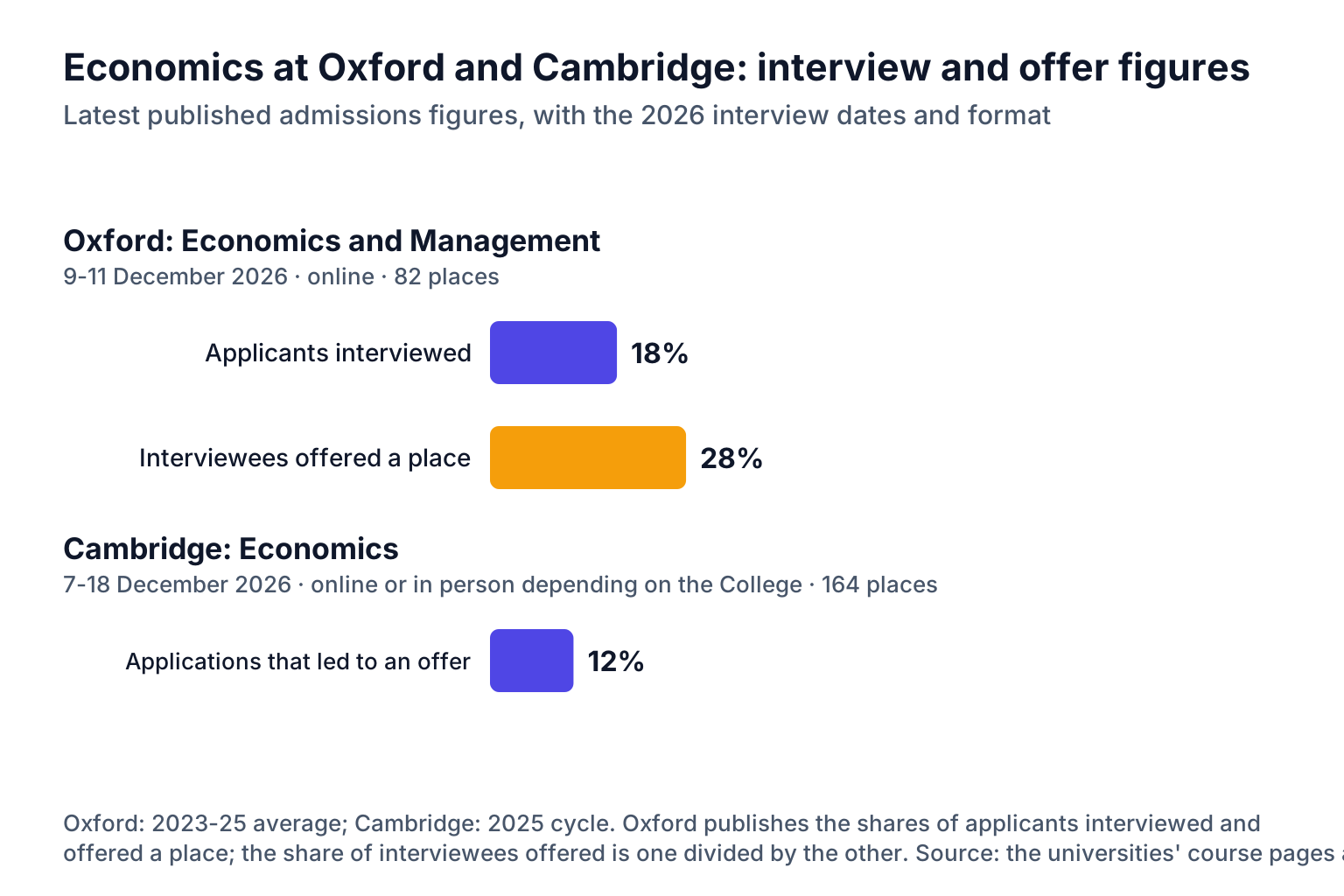
Oxford economics interview questions, and their Cambridge equivalents, usually give you a problem, a graph or a short piece of data and ask you to reason through it aloud, with mathematics also in play at Cambridge. At Oxford, Economics and Management interviews run online on 9-11 December 2026, typically with two academic tutors. At Cambridge, Economics interviews run from 7 to 18 December 2026, online or in person depending on the College. Places are tight: on a three-year average, Oxford interviewed 18% of Economics and Management applicants and offered places to 28% of those it interviewed. This guide sets out how each interview runs, what the course pages say tutors are looking for, and how to use the weeks between the TARA or TMUA and the interview.
Key Takeaways
- Oxford interviews are online: Economics and Management interviews run on 9-11 December 2026, with additional dates on 15-16 December, and are usually led by two Oxford academic tutors.
- Cambridge varies by College: Most applicants have one or two interviews, some have three or four, and the total is usually 35 minutes to one hour, online or in person depending on the College.
- Expect unfamiliar material: Hertford College says its economics interviews are likely to include puzzle questions, and it asks applicants to think aloud rather than work silently.
- Hints are part of the method: Hertford says a tutor's hint does not mean you are doing badly, because hints are how tutors judge what teaching you would be like.
- Subject knowledge is not the test: Hertford states that not all E&M applicants have studied economics or management, so its interviews assess how you engage with the thinking rather than what you already know.
- Check your invitation for pre-reading: Cambridge does not usually ask for written work, but a College may set reading or a task and will say so in the interview invitation.
In This Article
- What an Oxbridge economics interview actually involves
- How the Oxford Economics and Management interview runs
- How the Cambridge Economics interview runs
- Oxford vs Cambridge economics interviews: where they differ
- How competitive the Oxbridge economics interview stage is
- Questions reported at Oxford Economics interviews, and practice questions
- What tutors assess behind Oxford economics interview questions
- Preparing for Oxford and Cambridge economics interview questions
- Common misreadings in an Oxbridge economics interview
- What to do next before your December interview
1. What an Oxbridge economics interview actually involves
Oxford economics interview questions are rarely tests of recall. An Oxbridge economics interview gives you a problem, a graph or a short piece of data and asks you to reason about it aloud while tutors listen and probe. At Cambridge, mathematics is also part of the picture. Tutors are watching how you get somewhere, not whether you arrive with a memorised answer.
At Oxford, this guide covers the Economics and Management (E&M) interview. The course is taught jointly by the Department of Economics and Saïd Business School, and its course page states that it "is not a Business Studies degree". At Cambridge, it covers the Economics BA.
The difficulty is deliberate. Hertford College, Oxford says its economics puzzle questions "are supposed to be puzzling!" and that applicants are not expected to reach the right answer straight away. The college also notes that not every applicant has studied economics, so interviews do not test subject knowledge. Instead, it asks candidates to share their thinking out loud rather than work silently in their heads.
Later sections set out who interviews at each university, how long the interviews last and what each says it is looking for, quoting the course pages' own wording.
2. How the Oxford Economics and Management interview runs
Oxford has no standalone Economics degree for undergraduates, so this guide covers the Oxford Economics and Management (E&M) interview. According to the Economics and Management course page, the University's format is:
- Dates: 9-11 December 2026, with additional dates on 15-16 December 2026.
- Mode: online. You will not travel to Oxford for it.
- Number: at least one interview.
- Interviewers: Oxford academic tutors, typically two per interview.
- Who is invited: all shortlisted applicants.
- Before shortlisting: the TARA admissions test.
The order matters. TARA comes before shortlisting, so an interview invitation means your test result and written application have already been through a first filter. The Oxford economics interview questions you face sit on top of that, not in place of it.
One college's version: Hertford
Colleges arrange the detail. Hertford College says E&M applicants may have two interviews within one hour, each lasting 20 minutes, with a short break between them. One covers economics and one covers management. That is Hertford's practice only. Other colleges may run things differently, so read your own invitation closely.
Hertford describes the management interview as broad questions facing those "running, working in, investing in and regulating organisations." The conversation may reach current affairs, ethics, psychology and sociology, so it is not a business-studies quiz.
Hertford also notes that the University recommends access to a Miro whiteboard for sharing material during E&M interviews. Test it before the day, and keep your set-up running through the short break rather than logging off.
3. How the Cambridge Economics interview runs
At Cambridge, the College sets the format of your economics interview, not the Faculty. According to the Cambridge Economics course page, the University-wide framework is:
- Dates: main interview period 7-18 December 2026, with a winter pool in mid to late January 2027
- Number: most applicants have one or two interviews, and some have three or four
- Total length: 35 minutes to one hour for most applicants, depending on the College
- Mode: online or in person, depending on the College
- Interviewers: two or three in subject interviews. General academic interviews may be with academics from other subjects, so expect to explain economic ideas to someone who is not an economist.
Before the interview, written work is not usually required. Pre-interview reading or tasks are possible, and your College will say so in the invitation. Read that email carefully, because it is the only place you will find out. The TMUA (Test of Mathematics for University Admissions) is a pre-registered admissions test that sits alongside the Cambridge Economics interview, not in place of it.
One College example: Homerton
This applies to Homerton only. Homerton College lists Economics among the subjects interviewed online for all applicants. It usually holds two academic interviews of 25 minutes each, typically with two interviewers. These may involve a pre-prepared piece of work or problems relevant to the subject. The College also says online and in-person interviews use the same level of assessment and the same type of questions, so an online slot is not a lighter version.
Homerton's two 25-minute interviews add up to 50 minutes, which sits inside the University's 35-minute to 1-hour range. Another College could fit the same range in a single interview. Plan around your own College's invitation, not a friend's.
4. Oxford vs Cambridge economics interviews: where they differ
Oxford E&M and Cambridge Economics both shortlist and then interview, but their logistics differ in ways that change how you prepare. The table below covers each format in one place, so the later sections on Oxford economics interview questions and Cambridge preparation can stay focused on content.
| Feature | Oxford Economics and Management | Cambridge Economics |
|---|---|---|
| Number of interviews | At least 1 | Varies by College: most applicants have 1-2, some have 3-4 |
| Total length | Not stated on course page | 35 minutes to 1 hour in total for most applicants, varying by College |
| Mode | Online | Online or in person, depending on the College |
| Interviewers | Oxford academic tutors, typically two per interview | Two or three interviewers in subject interviews. General academic interviews may be with academics from other subjects |
| Admissions test | TARA | TMUA (Test of Mathematics for University Admissions), a pre-registered test |
| Written work or pre-reading | Not stated on course page | Written work not usually required. Pre-interview reading or tasks are possible, and the College says so in the invitation |
The Cambridge row that catches applicants out is the general academic interview. It can be led by someone outside economics, so you may need to explain your reasoning to a non-specialist rather than rely on subject shorthand.
Takeaway: Oxford's format is uniform and online, so every shortlisted E&M applicant prepares for the same set-up. Cambridge's format depends on your College, so read your invitation closely for the mode, the number of interviews and any pre-reading.
5. How competitive the Oxbridge economics interview stage is
Both courses are heavily oversubscribed, and the interview stage is where many shortlisted applicants are separated. The published figures are worth knowing precisely:
- Oxford Economics and Management (three-year average, 2023-25): an annual intake of 82, with 18% of applicants interviewed and 5% of all applicants successful, per the Oxford Economics and Management course page. Of those interviewed, 28% were offered a place. Oxford publishes the shares of all applicants interviewed and offered a place; the share of interviewees offered is one divided by the other.
- Cambridge Economics (2025 cycle): 1,647 applications, 195 offers and 164 places, according to the Cambridge undergraduate admissions statistics for the 2025 cycle.
Resist the urge to line these numbers up against each other. Oxford's figures are a three-year average for a joint Economics and Management degree. Cambridge's cover a single cycle for standalone Economics. Any ratio comparing the two would mislead you.
The useful point is this. At Oxford, most applicants who reached interview still did not receive an offer. Getting shortlisted means you are already in a strong group, so the time you spend practising with Oxford economics interview questions and unseen material is well spent.
6. Questions reported at Oxford Economics interviews, and practice questions
Every question below can be traced to its source: one is published by the University of Oxford on the linked page; eight come from a practice pack Lucy Cavendish College, Cambridge, compiled to show the kind of question asked at Oxbridge interviews; and two were reported by applicants describing their own Economics interview (The Student Room reports are named but not linked). Tutors write new material each year, so read these for the kind of thinking they call for, not as a list to learn.
| Question | Reported at | Source |
|---|---|---|
| The Holiday Puzzle: 'Alex and Brian are cousins. ... If Brian has these preferences how would you expect him to allocate his spending over the four days? Is there a better way for Brian to allocate his spending and, if so, how might he achieve this better outcome? Does your analysis of this problem have any implications for any current economic policy issues?' | Oxford | University of Oxford, published sample question |
| Given two driving routes with distances, maximum speeds and gaps between cars, how many cars would take each route? | Oxford | Applicant report, Quora |
| Why is income per head between 50 and 100 times larger in the United States than in countries such as Burundi and Malawi? | Oxford | Applicant report, The Student Room (not linked) |
| Sketch the graph of sin²x+2=y | Oxbridge practice pack | Lucy Cavendish College, Cambridge, Oxbridge practice pack |
| Why are rich countries rich and poor countries poor? | Oxbridge practice pack | Lucy Cavendish College, Cambridge, Oxbridge practice pack |
| Would it be feasible to have an economy entirely based on the service sector? | Oxbridge practice pack | Lucy Cavendish College, Cambridge, Oxbridge practice pack |
| What would you say if Theresa May were to take a report which shows that people who go to university earn more than those who do not, and then proclaim that going to university causes you to earn more? | Oxbridge practice pack | Lucy Cavendish College, Cambridge, Oxbridge practice pack |
| What is the difference between buying and selling of slaves and the buying and selling of football players? | Oxbridge practice pack | Lucy Cavendish College, Cambridge, Oxbridge practice pack |
| What role should the state play in the economy? | Oxbridge practice pack | Lucy Cavendish College, Cambridge, Oxbridge practice pack |
| What are the arguments for and against the minimum wage? | Oxbridge practice pack | Lucy Cavendish College, Cambridge, Oxbridge practice pack |
| What is the point of privatisation? | Oxbridge practice pack | Lucy Cavendish College, Cambridge, Oxbridge practice pack |
Our dataset holds 147 further questions reported for these courses, mostly from preparation companies' lists and forum threads that cannot be traced to a university page or a first-hand account, so they are not reproduced here.
7. What tutors assess behind Oxford economics interview questions
Both universities publish what interviewers are looking for, and neither list mentions how many economics facts you know. For Economics and Management, Oxford assesses an interest in and a motivation for studying the organisation of businesses and the economy, and a capacity to construct and critically assess arguments. For the Cambridge Economics interview, the stated criteria are:
- understanding of the subject
- readiness for high-level study
- fit with the Cambridge learning environment
- critical and independent thinking
- curiosity and enthusiasm
Homerton College, Cambridge, describes interviews as assessing the ability to discuss topics, listen, bring concepts together and evaluate arguments (Homerton College).
What this looks like across the table
Tutors can only judge reasoning they can hear. Hertford College's E&M guidance says its economics puzzles "are supposed to be puzzling!" and asks applicants to "please tell us your thoughts, don't try to do it in your head!" (Hertford College). In practice:
- Say your working out loud, including the assumption you are unsure about.
- Treat a hint as part of the test. Hertford says a hint "doesn't mean you're doing badly". It is how tutors judge "how it would go for us to teach you" (Hertford College).
- Change your mind when pushed, and say why the new point changes your answer.
- Reason from what you have been taught. Supply and demand or a graph from your A-Level or IB course, applied carefully, shows more than a memorised paragraph recited from a book.
For the management half, Hertford says tutors are "not looking for how much you know, but how much you enjoy exploring new ideas" (Hertford College).
Oxford tutors in other subjects describe the same aim. On Oxford's sample questions page, Biochemistry tutor Kathryn Scott writes that "getting the correct answer isn't important here". She explains that tutors care more about how candidates apply knowledge, justify conclusions and consider alternatives (University of Oxford). That is not an economics rule, but it is a useful way to read Oxford economics interview questions: the route you take is the evidence tutors are collecting.
8. Preparing for Oxford and Cambridge economics interview questions
Preparing for Oxford economics interview questions, and their Cambridge equivalents, comes down to two jobs: knowing your own application inside out and getting comfortable reasoning aloud about material you have never seen.
Know your own application
Re-read your personal statement and treat every book, article or idea in it as open for discussion. For each one, be ready to explain it, say where you disagree with it, and extend it to a case you have not written about. Cambridge does not usually ask for written work, but Colleges may set pre-interview reading or a task. Your invitation will say if yours has. Homerton notes that applicants may be asked about a pre-prepared piece of work.
Practise unseen material out loud
Hertford College warns E&M applicants that its puzzle questions "are supposed to be puzzling!" and asks them to share their thoughts rather than work silently. So practise with someone who keeps asking "why?" Use the kinds of material tutors describe:
- a graph you have to interpret
- a short data extract
- a scenario or policy problem
Talk through what the material shows, what might explain it and what would change your mind. Hertford also says a hint "doesn't mean you're doing badly", so practise picking up a hint and building on it instead of defending your first answer. For Cambridge, add regular maths practice: algebra, reading functions and working with numbers by hand.
Admissions test timing
Oxford E&M applicants sit the TARA and Cambridge Economics applicants sit the TMUA. Both are sat before interview season, so by the time an invitation arrives the test is behind you. Put the time into talking, not test practice. The official test details are on the Oxford E&M course page or Cambridge Economics course page.
A quiet online set-up
Oxford E&M interviews are online. At Cambridge the format depends on the College, and Homerton interviews Economics applicants online. Hertford says the University recommends access to a Miro whiteboard for sharing material in E&M interviews. Open it and try it before the day. You will also need:
- a stable internet connection
- a quiet room where nobody will interrupt you
- a camera and microphone you have tested in advance
At Homerton, applicants eligible for Free School Meals can get help accessing suitable technology, and disability adjustments can be requested through a form. That is Homerton's policy, so check what your own College offers as soon as your invitation arrives.
9. Common misreadings in an Oxbridge economics interview
Applicants often lose more ground by misreading what a tutor's response means than by getting stuck on the problem itself. College guidance addresses four of these misreadings directly.
- "A hint means I'm failing." Hertford College, Oxford says a hint does not mean you are doing badly. Tutors use hints to judge "how it would go for us to teach you", so the useful response is to take the hint and build on it.
- "Only one economics question means I was slow." Hertford notes that some economics questions are longer than others and that tutors "probably didn't expect to ask more than one." The number of questions you get through tells you very little about how you did.
- "I should work it out quietly first." Hertford asks the opposite: "please tell us your thoughts, don't try to do it in your head!" If you stay silent, the tutors have nothing to assess and nowhere to aim a hint.
- "Saying 'I don't know' ends my answer." Homerton College, Cambridge states that "The answer 'I don't know' is not a wrong answer" and says it asks no trick questions. That is Homerton's own stated policy. To use it well, follow four steps:
- Say plainly what you don't know.
- State an assumption you can work with.
- Reason forward from that assumption out loud.
- Check whether your conclusion still holds if the assumption changes.
Treat a hint or a long silence from the tutor as part of the teaching conversation, not as a verdict on you.
10. What to do next before your December interview
Start with the logistics, not the economics. This week, open your interview invitation or the official course page and write down your interview date, the mode and any pre-reading. Oxford Economics and Management interviews run online on 9-11 December 2026, with additional days on 15-16 December. At Cambridge, the main period is 7-18 December 2026. Your College decides whether you interview online or in person, and its invitation tells you about any reading or task beforehand.
In the fortnight before:
- Practise aloud on unseen material in two or three sessions with someone who keeps asking why.
- Re-read your personal statement so you can extend any point in it.
- Test your online set-up, including a Miro whiteboard if your Oxford E&M invitation mentions one.
Check your camera, sound and connection in the room you will actually use.
Related guides
- Oxford interview dates 2026, every course
- What an Oxford interview is like
- Oxford interview and offer rates by course
- Cambridge interview dates 2026
- What a Cambridge interview is like
- Cambridge offer rates by course
- Oxford PPE interview questions
- Oxbridge maths interview questions
- Every Oxbridge and medicine interview guide
Course pages
Entry requirements and the latest admissions figures: Oxford Economics and Management and Cambridge Economics.
FAQ
When are Oxford Economics and Management interviews in 2026?
Oxford's course page gives interview dates of 9-11 December 2026, with additional dates on 15-16 December 2026, and all interviews are online.
How long is a Cambridge Economics interview?
Cambridge says most applicants spend 35 minutes to one hour in interview in total, across one or two interviews (three or four at some Colleges), depending on the College.
Are Cambridge Economics interviews online or in person?
It depends on the College: Cambridge's course page says interviews are online or in person by College, and Homerton, for example, interviews all Economics applicants online.
Do I need to have studied economics for an Oxford Economics and Management interview?
Hertford College says not all E&M applicants have studied economics or management, so its interviews assess how you engage with the type of thinking rather than subject knowledge.
Is it a bad sign if the tutor gives me a hint?
No: Hertford College says hints during economics questions do not mean you are doing badly and are how tutors judge what teaching you would be like.
References
- Economics and Management | Oxford University - https://www.ox.ac.uk/admissions/undergraduate/courses/course-listing/economics-and-management
- Economics, BA (Hons) | Undergraduate Study - https://www.undergraduate.study.cam.ac.uk/courses/economics-ba-hons
- Economics and Management - Hertford College | University of Oxford - https://www.hertford.ox.ac.uk/applicants/subjects/em-interviews
- Interviews - https://www.homerton.cam.ac.uk/study-here/undergraduate-study/how-apply/interviews
- Undergraduate Admissions Statistics, 2025 cycle, University of Cambridge - https://www.undergraduate.study.cam.ac.uk/sites/default/files/2026-05/ug_admissions_statistics_2025_cycle.pdf
- Sample interview questions | Oxford University - https://www.ox.ac.uk/admissions/undergraduate/applying/guide-for-applicants/interviews/sample_questions
- Applicant report: Quora - https://www.quora.com/What-questions-did-they-ask-you-in-your-interview-when-you-applied-to-Oxford-University-or-even-any-other-great-university
- Interview question pack (arts, humanities and social sciences), Lucy Cavendish College - https://www.lucy.cam.ac.uk/sites/default/files/inline-files/Interview%20Question%20Pack%20%28AHSS%29.pdf