Oxford Philosophy Interview Questions: Oxbridge 2026 Guide
By Michael Thompson · Education Specialist; 10 years teaching the IB at Bromsgrove School · Published 27 October 2026 · Updated 28 October 2026
Oxford philosophy interview questions are not a quiz on what you have read. Tutors put a philosophical problem in front of you and follow your reasoning wherever it goes. At Oxford, Philosophy and Theology interviews run online from 7 to 10 December 2026 and last about 25 to 30 minutes, typically with two academics. At Cambridge, Philosophy interviews run from 7 to 18 December 2026, online or in person depending on the College, for 35 minutes to one hour in total for most applicants. This guide sets out how each university runs the interview, what the course pages say tutors are assessing, and how to use the weeks before December to prepare for an argument rather than a script.
Key Takeaways
- A philosophy interview is a guided argument: Tutors give you a problem or some stimulus material and test how you reason about it, not what you have memorised.
- Oxford Philosophy and Theology interviews are online: They run 7 to 10 December 2026, last about 25 to 30 minutes each, and include at least two Theology and Religion interviews plus a Philosophy interview.
- Cambridge arrangements vary by College: Interviews run 7 to 18 December 2026, online or in person, with most applicants having one or two interviews totalling 35 minutes to one hour.
- Oxford names three things it assesses: Interest in the proposed fields of study, a critical and analytical approach to abstract questions, and the ability to defend a viewpoint by reasoned argument.
- Cambridge has no pre-registered admission test for Philosophy: Jesus and Trinity set a College admission assessment instead, and some Colleges ask for written work or pre-interview reading.
- Rehearsed answers do not help: A Cambridge College interview pack notes that questions change each year and interviewers are not looking for pre-prepared answers.
In This Article
- What an Oxbridge philosophy interview actually is
- How the Oxford and Cambridge philosophy interviews run
- How competitive the Oxford Philosophy and Theology interview is
- Before the interview: written work, pre-reading and admissions tests
- What Oxford and Cambridge tutors say they are assessing
- Thinking aloud, changing your mind and using what you know
- Questions reported at Oxford Philosophy interviews, and practice questions
- How to prepare for Oxford philosophy interview questions in the final weeks
- Common mistakes with Cambridge philosophy interview questions
- What to do next before your December interview
1. What an Oxbridge philosophy interview actually is
Oxford philosophy interview questions are not a quiz. A philosophical problem is put to you, and the tutors follow your reasoning wherever it goes, pushing on each step. At Oxford, you are given stimulus material to discuss: a text, an object, an image or an issue. The Cambridge philosophy interview follows the same logic, though the format varies more from College to College.
The basic arrangements differ between the two universities:
| Oxford (Philosophy and Theology) | Cambridge (Philosophy) | |
|---|---|---|
| Interviewers | Typically two academics | Two or three in subject interviews |
| Length | About 25 to 30 minutes | 35 minutes to 1 hour in total for most applicants |
| Mode | Online | Online or in person, depending on the College |
One detail is easy to miss. Oxford's figure is the length of one interview, and an Oxford Philosophy and Theology interview round involves several of them. Cambridge's figure covers all your interviews added together. The two numbers are not directly comparable.
Oxford details in this guide come from the Philosophy and Theology course page only. If you have applied for PPE or Maths and Philosophy, check your own course page for interview arrangements.
Takeaway: treat the interview as a supervised argument, not an oral exam.
2. How the Oxford and Cambridge philosophy interviews run
The table sets out the format at each university for 2026 entry.
| Oxford Philosophy and Theology | Cambridge Philosophy | |
|---|---|---|
| Interview dates 2026 | 7-10 December 2026 | 7-18 December 2026 (main period); winter pool mid to late January 2027 |
| Number of interviews | At least two Theology and Religion interviews in at least two colleges, plus a Philosophy interview in at least one college | Varies by College: most applicants have one or two, some have three or four |
| Length | About 25-30 minutes | 35 minutes to 1 hour in total for most applicants; varies by College |
| Mode | Online | Online or in person, depending on the College |
| Interviewers | Typically two academics; tutors from each subject on this joint course | Two or three in subject interviews; general academic interviews may be with academics from other subjects |
| Material at the interview | Stimulus material (a text, object, image or issue) to discuss | Details come from the relevant College; Jesus and Trinity set a College admission assessment |
Every shortlisted applicant is interviewed at both universities.
The two systems differ in one main way. Oxford's format is fixed, while Cambridge's depends on your College. Every Oxford applicant for this course has the same online set-up, in the same four-day window. At Cambridge, the number of interviews, their total length and whether you sit them online or in person all vary from College to College.
Two details in the table are easy to misread:
- The Cambridge length is a total, not a single interview. "35 minutes to one hour" covers all your interviews together. If you have two, each may be shorter than one Oxford interview.
- The Oxford Philosophy and Theology round is not only about philosophy. At least two of your interviews are with Theology and Religion tutors, and at least one is with Philosophy tutors. Prepare for both subjects. Do not plan for an Oxbridge philosophy interview that only covers philosophy.
A Cambridge applicant may also meet someone outside philosophy. General academic interviews can be with academics from other subjects. You still need to reason clearly, but you cannot rely on specialist vocabulary.
What to do: when your invitation arrives, read it for the College-specific details before you plan anything else. This matters most at Cambridge. Check how many interviews you have, how long each one is, whether it is online or in person, and whether there is an assessment on the day.
3. How competitive the Oxford Philosophy and Theology interview is
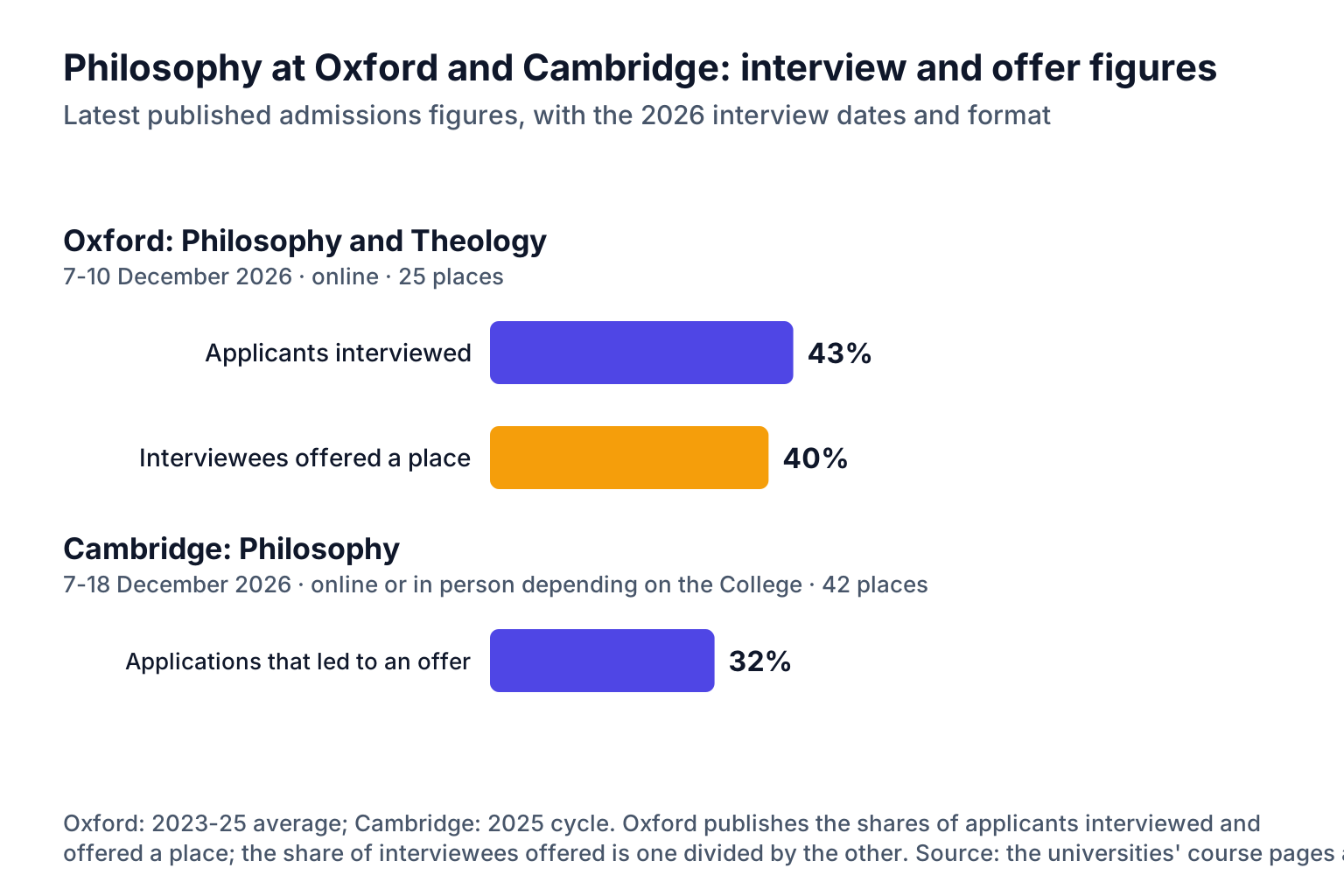
An interview invitation already puts you in a minority. Across 2023 to 2025, Oxford interviewed 43% of Philosophy and Theology applicants, for an average intake of 25. Of those interviewed, 40% were offered a place. Oxford publishes the shares of all applicants interviewed and offered a place; the share of interviewees offered is one divided by the other. Once you reach the shortlist, the conversation with tutors carries real weight.
For Cambridge Philosophy in the 2025 cycle, there were 223 applications, 71 offers and 42 places. That cycle covers applications made from September 2024 for entry in October 2025, or deferred entry in October 2026, per Cambridge's admissions statistics.
Resist putting these side by side:
- Different measures: Oxford publishes rates averaged over three years. Cambridge publishes counts for a single cycle.
- Different courses: Oxford's figures are for the joint Philosophy and Theology degree. Cambridge's are for Philosophy alone.
- Different routes to a place: Oxford also reports that a further 3% of applicants were successful for a different course, a route that its headline rates for this course do not capture.
Neither set of figures can tell you how your own interview will go. Spend your preparation time practising reasoning on unseen material aloud rather than recalculating the odds. That is the skill behind Oxford philosophy interview questions, which tutors use to test a critical approach to abstract problems and the ability to defend a view by reasoned argument.
4. Before the interview: written work, pre-reading and admissions tests
What you hand in or sit before the interview varies more than the interview itself. At Cambridge, it depends on your College rather than the course.
Oxford Philosophy and Theology. You submit one piece of written work before the Oxford Philosophy and Theology interview. If you are applying for PPE or Maths and Philosophy, check your own course page for test requirements. Do not assume they match this course.
Cambridge Philosophy. The requirements differ by College:
- No pre-registered admission test. There is nothing to sign up for in advance.
- A College admission assessment at Jesus and Trinity. Details are provided by the relevant College.
- Written work at some Colleges. Not every College asks for it.
- Pre-interview reading or tasks are possible. The College says so in your invitation.
The College-by-College split creates a common trap. A friend's Cambridge philosophy interview tells you nothing reliable about yours if they applied to a different College.
Why the written work matters. Tutors may refer to it, so treat it as a position you may have to extend or defend, not a finished piece. Re-read it and find the step in the argument you are least sure of. If you now disagree with part of it, be ready to explain why.
Takeaway: use your invitation and the course page, not hearsay, to list every item your College or course asks for, with its deadline.
5. What Oxford and Cambridge tutors say they are assessing
Both universities publish what their Philosophy interviewers look for, and neither list mentions how much you have read. For Oxford Philosophy and Theology, the stated criteria are "interest in the proposed fields of study, a critical and analytical approach to abstract questions and the ability to defend a viewpoint by reasoned argument".
Cambridge's list for Philosophy is longer: "understanding of the subject, readiness for high-level study, fit with the Cambridge learning environment, critical and independent thinking, curiosity, enthusiasm".
| Quality | Oxford | Cambridge |
|---|---|---|
| Critical thinking | "a critical and analytical approach to abstract questions" | "critical and independent thinking" |
| Interest in the subject | "interest in the proposed fields of study" | "curiosity, enthusiasm" |
| Defending a position | "defend a viewpoint by reasoned argument" | Not named separately |
| Readiness for high-level study | Not named | Named |
| Fit with the learning environment | Not named | Named |
The two lists overlap on critical thinking and genuine interest. Cambridge also names readiness for high-level study and fit with its learning environment.
That "fit" criterion is less vague than it sounds. According to the Cambridge Philosophy course page, students prepare for supervisions by doing topical reading and writing an essay, which they then discuss with their supervisor. An interview works like a short version of that discussion. Tutors want to see whether you can hold a line of argument while an academic presses on it, and accept a good objection without abandoning everything.
Every item on both lists describes something you do in a conversation, not something you know. Memorising facts for Oxford philosophy interview questions will not show any of these qualities. Practise the behaviours instead: explain a view aloud, defend it when someone pushes back, and say plainly when an objection changes your mind.
6. Thinking aloud, changing your mind and using what you know
Oxford lists a critical and analytical approach to abstract questions and the ability to defend a viewpoint by reasoned argument among the things it assesses. Cambridge names critical and independent thinking, curiosity and readiness for high-level study. In an Oxbridge philosophy interview, those criteria only become visible through what you say out loud.
Think aloud so the steps show. Tutors can't mark reasoning they can't hear. When you meet a scenario, a short passage, an image or object, or an issue, say what you notice, what you are assuming and where the argument seems to turn. A tidy conclusion with no visible route tells them very little.
Changing your mind is not the same as giving up. The difference lies in the reason:
- Revising a view: you name the objection, explain why it works, and adjust your claim to survive it. That is reasoned argument.
- Abandoning a view: you drop it the moment you are challenged, with no account of what was wrong. That shows only that you were pushed.
Defend a viewpoint actively. Say what would count against your claim before the tutor does. Draw distinctions, for instance between two senses of a key word. When the tutor introduces a new case, test your principle on it honestly, even if it costs you.
Use what you have been taught, not what you have memorised. A concept from A-Level Religious Studies, the IB's Theory of Knowledge course or your own reading is useful when you apply it to unfamiliar material. Reciting a named position rarely helps. The format rewards this. Oxford teaches through tutorials, usually two students and a tutor, and Cambridge students discuss their essays with a supervisor. The interview works like a short version of that conversation.
Aim to show your reasoning clearly. You do not need to reach the "right" answer quickly.
7. Questions reported at Oxford Philosophy interviews, and practice questions
Every question below can be traced to its source: one is published by the University of Oxford on the linked page; nine come from a practice pack Lucy Cavendish College, Cambridge, compiled to show the kind of question asked at Oxbridge interviews; and two were reported by applicants describing their own Philosophy interview. Tutors write new material each year, so read these for the kind of thinking they call for, not as a list to learn.
| Question | Reported at | Source |
|---|---|---|
| Is someone who risks their own life (and those of others) in extreme sports or endurance activities a hero or a fool? | Oxford | University of Oxford, published sample question |
| Is there any justification for abortion that is not also a justification for infanticide? | Oxford | Applicant report, Quora |
| What is the difference between belief and knowledge? | Oxford | Applicant report, Quora |
| What's the importance of literacy in the development of religions? Can you give some examples? | Oxbridge practice pack | Lucy Cavendish College, Cambridge, Oxbridge practice pack |
| Is emotion an important part of religion? | Oxbridge practice pack | Lucy Cavendish College, Cambridge, Oxbridge practice pack |
| What exactly do you think is involved in blaming someone? | Oxbridge practice pack | Lucy Cavendish College, Cambridge, Oxbridge practice pack |
| Differentiate between power and authority. | Oxbridge practice pack | Lucy Cavendish College, Cambridge, Oxbridge practice pack |
| I agree that air transport contributes to harmful climate change. But whether or not I make a given plane journey, the plane will fly anyway. So there is no moral reason for me not to travel by plane.' Is this a convincing argument? | Oxbridge practice pack | Lucy Cavendish College, Cambridge, Oxbridge practice pack |
| If I deconstruct someone, record their structure, and send that information elsewhere to reconstruct them, is it the same person? | Oxbridge practice pack | Lucy Cavendish College, Cambridge, Oxbridge practice pack |
| Is it a matter of fact or knowledge that time travels in only one direction? | Oxbridge practice pack | Lucy Cavendish College, Cambridge, Oxbridge practice pack |
| If you wanted to form a government of Philosophers, what selection criteria would you use? | Oxbridge practice pack | Lucy Cavendish College, Cambridge, Oxbridge practice pack |
| Suppose that you could plug yourself into a machine for the rest of your life, which would give you all the experiences you find enjoyable and valuable. Once in the machine, you would not know that you are plugged in, and that these experiences are not real. Would you go into the machine? If so, why? If not, why not? | Oxbridge practice pack | Lucy Cavendish College, Cambridge, Oxbridge practice pack |
Our dataset holds 67 further questions reported for these courses, mostly from preparation companies' lists and forum threads that cannot be traced to a university page or a first-hand account, so they are not reproduced here.
8. How to prepare for Oxford philosophy interview questions in the final weeks
The last few weeks are for rehearsing the conversation, not memorising answers. Lists of Oxford philosophy interview questions show you what someone else was asked. They do not train you to reason out loud while a tutor pushes back.
Re-read everything you submitted. Go through your personal statement and any written work line by line. For each claim, note how you would extend it, where it needs qualifying, and how you would defend it if challenged. For the Oxford Philosophy and Theology interview, this includes the one piece of writing you sent in. At Cambridge, only some Colleges ask for written work, and any pre-interview reading or task will be set out in your invitation.
Practise unseen material aloud. Ask a teacher, parent or friend to bring something you have not seen: a short passage, a scenario or an issue. Neither of you prepares in advance, and their only job is to keep asking why. Oxford's stimulus material can be a text, an object, an image or an issue, so do not rehearse with passages alone.
Check admissions test timing. The rules differ by course and College:
| Course | What applies before the interview |
|---|---|
| Cambridge Philosophy | No pre-registered admission test. Jesus and Trinity run a College admission assessment, and details come from the College. |
| Oxford Philosophy and Theology | Written work, not a test. |
| Other Oxford courses with Philosophy | Check that course's own page for any test and its dates. |
Set up for an online interview. Oxford interviews are online, and the Philosophy and Theology interviews run from 7 to 10 December 2026. A Cambridge philosophy interview is online or in person depending on the College, so read your invitation carefully. If yours is online, sort out:
- A quiet room where nobody will walk in or knock.
- A stable connection, tested at the same time of day as your slot.
- A working camera and microphone, checked the day before and again an hour beforehand.
- Plain paper and a pen for sketching out an argument as you go.
Keep January free. Cambridge applicants should put the winter pool period, mid to late January 2027, on the calendar now. Avoid booking anything you could not move.
Two or three timed practice conversations a week will do more for you than reading lists of philosophy interview questions from university forums. Make each one about 25 to 30 minutes long to match the Oxford interview length.
9. Common mistakes with Cambridge philosophy interview questions
The most common mistake is treating a question list as a revision sheet. A Lucy Cavendish College, Cambridge interview pack for arts, humanities and social sciences says its questions are "NOT intended for you to prepare specific answers," that interview questions change each year, and that interviewers "are not looking for pre-prepared answers."
That warning matters most in Philosophy. At Oxford, Philosophy and Theology tutors assess the ability to defend a viewpoint by reasoned argument. At Cambridge, they look for critical and independent thinking. Both show up in the follow-up, not the first reply. A memorised answer has no reasoning behind it to defend, so it breaks down as soon as a tutor asks why or offers a counterexample.
Prepare ways of thinking, not scripts. Practise building an argument from scratch, testing it and revising it out loud.
10. What to do next before your December interview
This week, open your course page and your interview invitation, and write down your interview dates, the mode, any written work, and any pre-reading or College assessment you have been asked for. At Oxford, Philosophy and Theology interviews run online from 7 to 10 December 2026. At Cambridge, the main period is 7-18 December 2026, and both the mode and any College assessment depend on your College, so go by your invitation.
In the fortnight before the interview:
- Re-read your personal statement and written work, and be ready to explain why you made each claim.
- Practise unseen material aloud under time pressure, with someone who keeps asking why.
- Test your camera, microphone, connection and a quiet room if your interview is online.
Check your invitation again the day before the interview.
Related guides
- Oxford interview dates 2026, every course
- What an Oxford interview is like
- Oxford interview and offer rates by course
- Cambridge interview dates 2026
- What a Cambridge interview is like
- Cambridge offer rates by course
- Oxford PPE interview questions
- Oxbridge modern languages interview questions
- Every Oxbridge and medicine interview guide
Course pages
Entry requirements and the latest admissions figures: Oxford Philosophy and Theology and Cambridge Philosophy.
FAQ
Can I learn Oxford philosophy interview questions and answers in advance?
A Cambridge College interview pack states that interview questions change each year and interviewers are not looking for pre-prepared answers, so practise reasoning rather than scripts.
What do Oxford philosophy interviewers look for?
Oxford's Philosophy and Theology course page lists interest in the proposed fields of study, a critical and analytical approach to abstract questions, and the ability to defend a viewpoint by reasoned argument.
Is the Oxford Philosophy and Theology interview online?
Yes: Oxford Philosophy and Theology interviews are online, run 7 to 10 December 2026 and last about 25 to 30 minutes each.
How long is a Cambridge philosophy interview?
Cambridge says most Philosophy applicants spend 35 minutes to one hour in interview in total, though the number and length of interviews vary by College.
Does Cambridge Philosophy have an admissions test?
There is no pre-registered admission test for Cambridge Philosophy, but Jesus and Trinity set a College admission assessment, with details provided by the College.
References
- Philosophy and Theology | Oxford University - https://www.ox.ac.uk/admissions/undergraduate/courses/course-listing/philosophy-and-theology
- Undergraduate Admissions Statistics, 2025 cycle, University of Cambridge - https://www.undergraduate.study.cam.ac.uk/sites/default/files/2026-05/ug_admissions_statistics_2025_cycle.pdf
- Philosophy, BA (Hons) | Undergraduate Study - https://www.undergraduate.study.cam.ac.uk/courses/philosophy-ba-hons
- University of Oxford, published sample question - https://www.ox.ac.uk/admissions/undergraduate/applying/guide-for-applicants/interviews/sample_questions
- Applicant report: Quora - https://www.quora.com/How-can-I-prepare-for-an-interview-for-philosophy-at-Oxford-or-Cambridge
- Applicant report: Quora - https://www.quora.com/What-questions-did-they-ask-you-in-your-interview-when-you-applied-to-Oxford-University-or-even-any-other-great-university
- Interview question pack (arts, humanities and social sciences), Lucy Cavendish College - https://www.lucy.cam.ac.uk/sites/default/files/inline-files/Interview%20Question%20Pack%20%28AHSS%29.pdf