Economics Personal Statement: What Tutors Actually Want
By Michael Thompson · Former IB Diploma Programme coordinator; 10 years at Bromsgrove School · Published 5 July 2026
An economics personal statement needs to do one thing above all else: show that you think like an economist, not a news commentator. Admissions tutors at competitive universities - Oxford, Cambridge, LSE, Warwick - read hundreds of statements that mention the financial crisis or inflation; what separates the shortlisted candidates is analytical reasoning applied to a specific idea. For 2026 entry onwards, UCAS has replaced the single open-text box with three structured questions, all sharing a 4,000-character limit. This guide maps each question to what economics departments want, gives worked phrasing examples, and covers the maths and super-curricular evidence that carries real weight.
Key Takeaways
- Three questions, one limit: From 2026 entry, UCAS splits the personal statement into three separate questions with a shared 4,000-character cap and a minimum of 350 characters per question.
- Economic reasoning beats current-affairs commentary: Naming a concept - incentives, elasticity, trade-offs - and applying it to a specific situation you have thought through is far stronger than describing news events you found interesting.
- Maths is non-negotiable at competitive courses: St John's College Cambridge, for example, requires A-level Mathematics and Further Mathematics, or IB Higher Level Mathematics Analysis & Approaches (Maths AA).
- IB students have ready-made evidence: An IA commentary, an economics Extended Essay, or HL Maths AA are concrete proof of applied reasoning - name and analyse them in Question 2, don't just list them.
- Question 3 is for outside-education preparation: Serious reading, policy engagement, competitions, and data projects belong here - written up with your reasoning, not as a bare reading list.
- Joint-honours applicants need a coherent thread: For economics and finance, economics and management, or philosophy and economics, identify the intellectual overlap and make it the spine of your statement.
In This Article
- What economics admissions tutors are actually looking for
- The 2026 UCAS format: three questions, one economics statement
- Question 1: showing your motivation through an economic idea
- Question 2: demonstrating analytical and quantitative preparation
- Question 3: super-curriculars that carry real weight in economics
- The maths requirement: what competitive economics courses actually expect
- Joint honours: economics and finance, management, politics, philosophy, and more
- Common mistakes that weaken an economics personal statement
- What to do next
1. What economics admissions tutors are actually looking for
An economics personal statement has to do three distinct things, and most applicants only manage one. Tutors are looking for evidence of mathematical ability, genuine economic reasoning applied to a real situation, and wider reading that goes beyond current-affairs opinion. Tick only the first, and you look like a strong maths student who hasn't engaged with the subject. Tick only the third, and you look like someone who reads the news and calls it research.
The most common failure is a variant of "I follow the economy and find it fascinating." That sentence describes an interest in events. It says nothing about whether you can think like an economist. Tutors want to see you apply a concept, such as price elasticity, incentive structures, or opportunity cost, to a specific situation and reason through what it implies. That is a different skill, and the statement is one of the few places you can demonstrate it before interview.
The stakes sharpen considerably at highly selective courses. At St John's College Cambridge, the minimum offer includes an A\* in Mathematics, and all applicants must sit the Test of Mathematics for University Admission (TMUA). The degree is a three-year BA, and the mathematical load is substantial from the first term. Tutors reading your statement are not just checking interest. They are assessing whether you understand what you are signing up for, and whether your preparation matches the rigour the course demands from day one.
2. The 2026 UCAS format: three questions, one economics statement
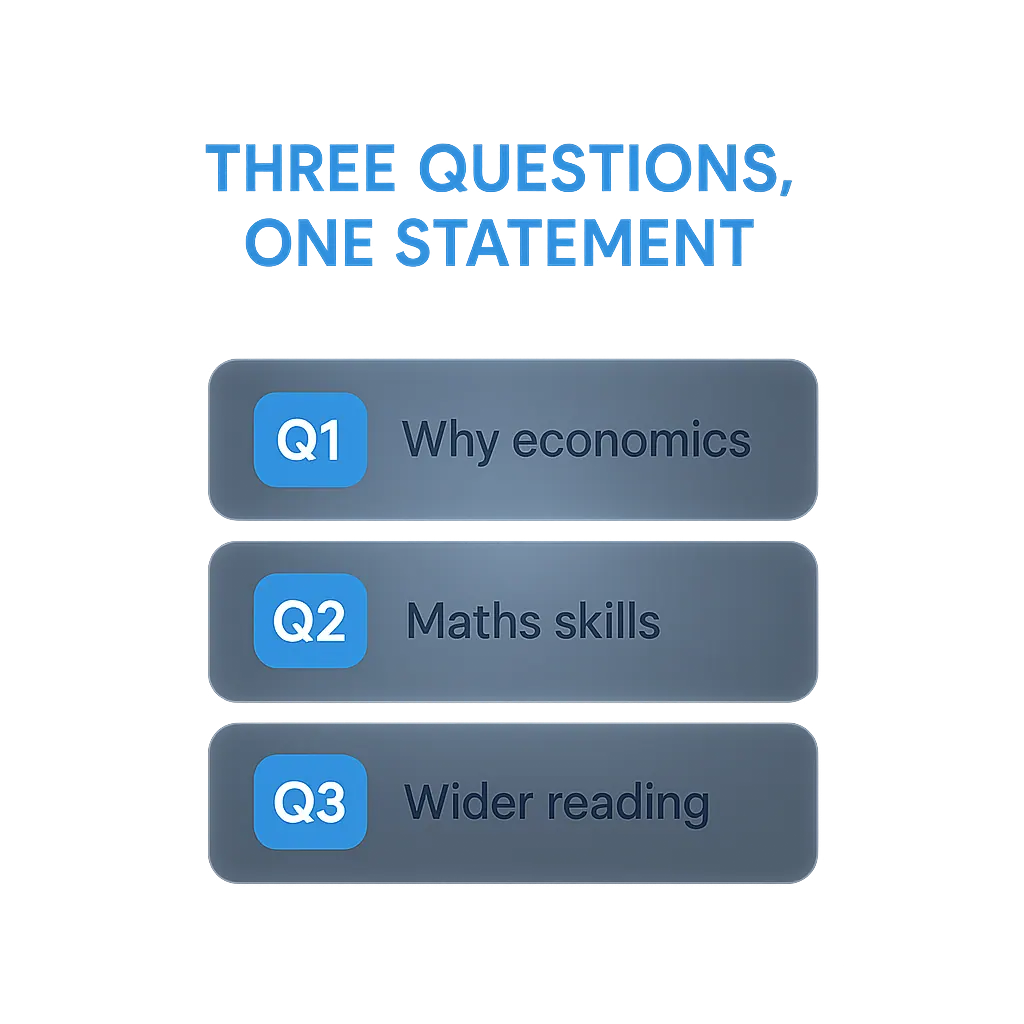
From 2026 entry onwards, UCAS replaced the single open-ended personal statement with three structured questions. The overall character limit stays at 4,000 characters including spaces, and each question requires a minimum of 350 characters. How you distribute the remaining space is your choice.
The three questions are:
- Why do you want to study this course or subject?
- How have your qualifications and studies helped you to prepare for this course or subject?
- What else have you done to prepare outside of education, and why are these experiences useful?
Admissions staff read all three answers as a single whole, so the logic and tone need to hold together across questions, not just within each one.
One counter-intuitive gotcha: the format can tempt applicants to use Question 2 as a second chance to flag their predicted grades. UCAS explicitly advises against this because grades appear elsewhere on the application. Repeating them wastes characters and signals to the reader that you have run out of things to say about your actual preparation.
For an economics personal statement, the practical implication is that most applicants will want to weight Question 1 and Question 3 heavily, reserving Question 2 for specific course content, relevant modules, and analytical skills built through study.
3. Question 1: showing your motivation through an economic idea
UCAS Question 1 asks simply: "Why do you want to study this course or subject?" Economics departments read the answer looking for one thing: evidence that you have engaged with an economic idea, not just a headline. A life story ("I've always been interested in money") or a news peg ("the cost-of-living crisis made me think") is the baseline every applicant hits. What separates stronger applications is anchoring motivation in a concept you have actually worked through.
The counter-intuitive point: vagueness about an event looks engaged; precision about a concept looks like an economist. Tutors read hundreds of statements that open with a striking real-world observation and then stop there. The question they are asking themselves is whether you have moved from observation to analysis.
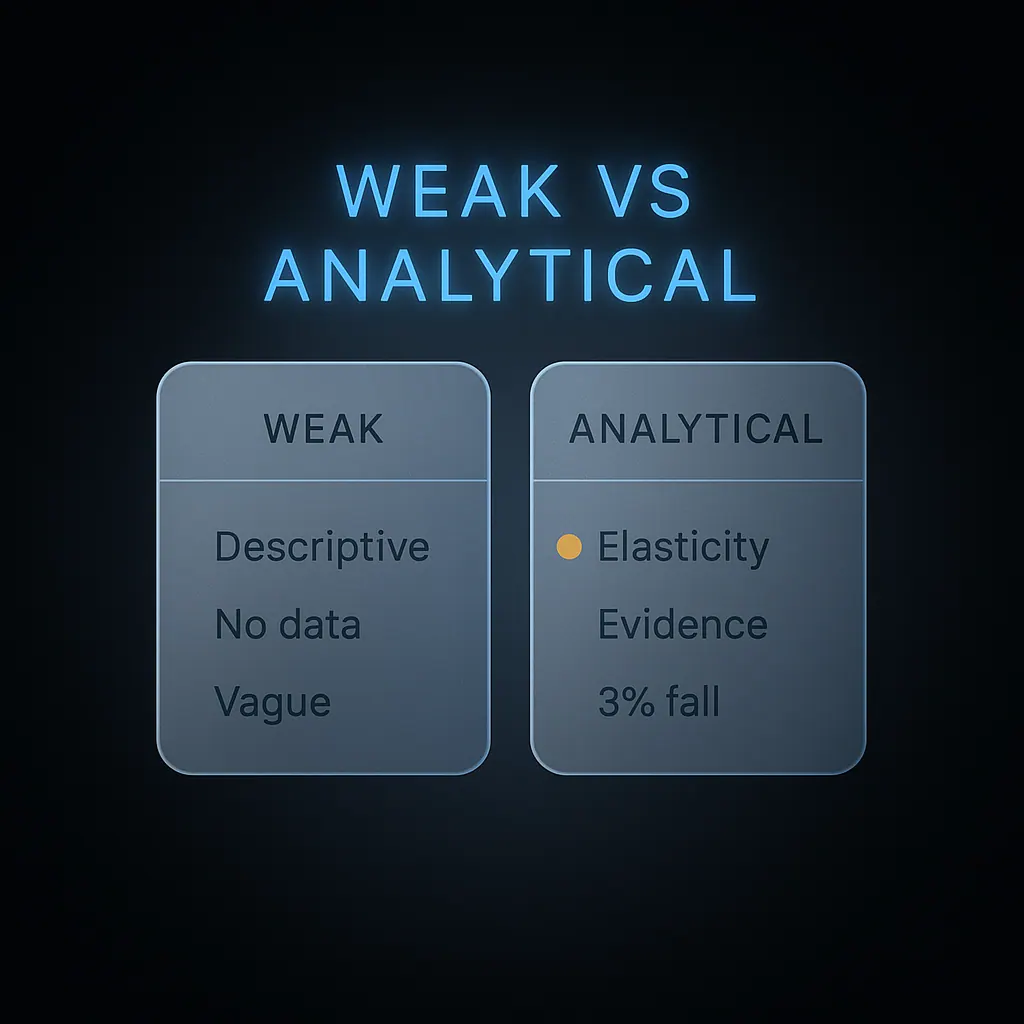
**Before and after: the same motivation, two very different signals**
| Draft | |
|---|---|
| Before | "I follow the economy and find it fascinating, especially how the cost of living affects people." |
| After | "Studying price elasticity in my A-level helped me realise that firms selling essential goods can pass cost increases almost entirely to consumers. I could see that pattern directly in supermarket data during the 2022-23 energy shock. That asymmetry between market power and household budgets is what I want to understand more rigorously." |
The "after" version names a concept (price elasticity), links it to observable evidence, and identifies a specific tension worth investigating. The "before" version names an event and a feeling.
How to find your concept anchor
Pick one idea from your A-level, IB, or SQA Higher syllabus that genuinely surprised you:
- Incentives and unintended consequences
- Asymmetric information (adverse selection, moral hazard)
- Trade-offs at the margin
- Elasticity and market power
Then ask: where did I see this behave unexpectedly? One specific, honest answer to that question is the entire substance of a strong Question 1.
4. Question 2: demonstrating analytical and quantitative preparation
UCAS Question 2 asks how your qualifications and studies have prepared you for the course. The trap most applicants fall into is treating this as a module list. Admissions tutors already have your grades. What they want is a reflection on what specific intellectual skills your studies actually built.
For economics, that means foregrounding mathematics. St John's College Cambridge requires A-level Mathematics and Further Mathematics, or IB Higher Level Mathematics Analysis and Approaches, and sets a minimum IB offer of 42 points with a 7 in HL Maths AA. That requirement signals what the degree actually is: a mathematical discipline. Saying you studied A-level Maths is not enough. The stronger move is to explain what the maths made possible. Calculus gave you a way to think about marginal cost without hand-waving. Probability theory gave you a framework for evaluating whether a claimed effect in economic data could be noise.
The non-obvious gotcha: applicants who took Further Maths often undersell it by treating it as a grade rather than a lens. Mentioning eigenvalues or coupled differential equations by name, and linking them to how economists model dynamic systems, tells a tutor far more than "I enjoy problem-solving."
For IB students, three components carry particular weight here:
- HL Mathematics Analysis and Approaches signals the quantitative preparation competitive offers demand.
- Economics IA commentaries demonstrate applied economic reasoning. Rather than simply naming the commentary, write about what the analysis showed: for example, "my commentary on price floors in the UK rental market forced me to distinguish between short-run supply inelasticity and the longer-run response, a distinction that shifted how I read empirical housing studies."
- An Economics Extended Essay is concrete evidence of independent analytical writing at near-undergraduate level.
Each of these is a mechanism to reflect on, not a credential to list.
5. Question 3: super-curriculars that carry real weight in economics
Question 3 asks: "What else have you done to prepare outside of education, and why are these experiences useful?" That final clause is the one most applicants ignore. The question is not asking for a reading list or a job title. It is asking for evidence of intellectual preparation and, crucially, your reasoning about it.
What actually counts:
- Reading a serious book or working paper and identifying a specific argument you found contestable. If you read Freakonomics, that is fine, but the entry that lands says something like: "Levitt and Dubner's incentives argument assumes agents have perfect information about consequences, which the literature on present bias suggests is often not the case." That is a position. A bare mention of the title is not.
- Engaging with a real dataset. Downloading ONS regional productivity data and writing up what you found, even informally, shows more analytical intent than most candidates demonstrate.
- Named competitions with a track record in economics admissions: the Bank of England's Target 2.0 competition (monetary policy forecasting) and university-run economics olympiads are the ones tutors recognise by name.
- Policy engagement with a concrete output, such as a written response to a local council consultation or a Model UN economics committee paper.
What does not count:
- Vague work experience ("I shadowed an accountant") with no intellectual hook attached.
- Reading lists without argument. Listing six books signals that you own them, not that you read them critically.
The counter-intuitive point: one activity explained in depth outperforms four activities listed briefly every time. Tutors are reading for analytical voice, not volume.
6. The maths requirement: what competitive economics courses actually expect
The maths bar for economics varies sharply across UK universities, and the gap between a mid-ranking offer and a top-tier one can be an entire A-level subject.
St John's College Cambridge lists A-level Mathematics and Further Mathematics as essential subjects, or IB Higher Level Mathematics Analysis and Approaches (Maths AA) as the equivalent. Their minimum IB offer is 42 points with 776 at HL, including a 7 in Maths AA. That is a notably high bar: a 6 in Maths AA is not sufficient, even with a perfect score elsewhere.
The counter-intuitive gotcha: Further Mathematics is listed as essential at St John's, not merely preferred. If you are applying without it, you need to check each course's entry profile before submitting. Do not assume that strong A-level Maths alone meets the requirement at selective colleges.
For your economics personal statement, the practical implication is direct:
- If you are taking Further Maths or IB Maths AA, name it in Question 2 and connect specific topics (proof, calculus, statistics) to the quantitative methods used in the degree.
- If you are not, verify the entry requirements for every course on your list before finalising your choices.
For a side-by-side comparison of economics courses and their maths requirements across UK universities, see the economics subject guides.
7. Joint honours: economics and finance, management, politics, philosophy, and more
The central problem for joint-degree applicants is structural. UCAS allows only one personal statement per application, covering up to five courses simultaneously. If those courses include Economics and Finance at one university, Philosophy and Economics at another, and Maths and Economics at a third, a single statement has to serve all of them without reading like two half-essays stapled together.
The counter-intuitive fix is to resist the temptation to split your statement by subject. Instead, find the intellectual question that genuinely sits at the intersection of both disciplines and build from there. UCAS advises addressing each discipline within the statement without including specific degree titles, partly because universities cannot see which other courses you have applied to, so naming a specific programme title gains nothing and can sound oddly directed at one institution.
Here is how the thread works for the most common combinations:
- Economics and Finance - both disciplines rest on decision-making under uncertainty and quantitative modelling. Frame your interest around that shared logic: asset pricing theory, risk, or the behavioural gaps between textbook rationality and real markets.
- Economics and Management - microeconomic theory (firm behaviour, principal-agent problems) maps directly onto organisational questions. The overlap is real, not cosmetic, so write about it as a single question, not two separate interests.
- Philosophy and Economics - rational choice theory, welfare economics, and Pareto efficiency are already normative. Arrow's impossibility theorem is as much a philosophical result as an economic one. Start there.
- Maths and Economics - emphasise model-building, proof, and the moment when a mathematical structure clarifies an economic mechanism. This combination attracts the most technically demanding programmes, so analytical precision in the writing itself signals fitness.
- History and Economics - institutional change, path dependency, and political economy connect the two naturally. The history of central banking or the origins of property rights are the kind of specific topics that hold both disciplines without straining.
The non-obvious gotcha: if one of your five choices diverges significantly from the others, a tutor reading your statement for that course may sense the mismatch even if they cannot see your full application list. Coherence across disciplines is not just an admissions requirement. It is evidence that you have actually thought about why the combination interests you.
8. Common mistakes that weaken an economics personal statement
Five errors appear so often in economics personal statements that admissions tutors recognise them on first read.
- **Opening with a quote or rhetorical question.** Starting with "As Keynes once said..." or "Have you ever wondered why prices rise?" signals padding. Tutors want an economic idea in the first sentence, not a preamble.
- Narrating news events without applying a concept. Describing what happened is not economics. Analysis is.
- Repeating grades or module names. UCAS explicitly states that grades are visible elsewhere on the application and should not be restated. Listing "I studied macroeconomics, microeconomics, and statistics" wastes characters that could show what those subjects taught you to do.
- A reading list with no commentary. Naming Daron Acemoglu's Why Nations Fail means nothing unless you explain which argument you found weak and why.
- Burying or ignoring the maths requirement. Mentioning A-Level Mathematics once in passing is not the same as demonstrating quantitative preparation. Competitive courses notice the difference.
The news-event fix: a before/after
Before (narration): "When the Bank of England raised interest rates in 2023, mortgage costs increased and consumer spending fell."
After (analysis): "The Bank of England's 2023 rate rises illustrated the transmission lag in monetary policy: the full effect on household disposable income took several quarters to appear, which complicated the MPC's attempts to calibrate tightening."
The second version uses a named mechanism (transmission lag) and identifies a specific trade-off. That is what tutors are reading for.
Coherence across all three answers
UCAS confirms that admissions staff read all three questions as a single whole statement. An inconsistency between answers is therefore a concrete risk: claiming enthusiasm for econometrics in Question 1 while Question 2 contains no quantitative evidence reads as either dishonest or unaware. Before submitting, read your economics personal statement from top to bottom as one document and check that the same intellectual character runs through every answer.
9. What to do next
Your most useful move right now is to open the UCAS personal statement guidance for 2026 entry and lay your draft against all three questions as separate texts. One gotcha catches a lot of applicants: each answer has a minimum of 350 characters, so a strong Question 1 cannot compensate for a skeletal Question 3. Admissions staff read all three as a single whole, which means a weak answer anywhere pulls the overall impression down.
This week, open the entry requirements page for each of your five choices and read the exact maths condition listed by that department. Do not rely on a third-party summary, as requirements differ between faculties even within the same university.
Then get your economics personal statement reviewed by a subject specialist before you submit.
FAQ
How do you start an economics personal statement?
Open with a specific economic idea, concept, or problem that genuinely changed how you think - not a quote, a rhetorical question, or a description of a news event - so the first sentence signals analytical thinking rather than general interest.
What should you include in an economics personal statement?
Across the three UCAS questions you need to cover: a precise motivation grounded in economic reasoning (Q1), evidence of analytical and quantitative preparation including your maths study (Q2), and outside-education engagement such as serious reading, data work, or competitions written up with your own reasoning (Q3).
Do economics personal statements really matter?
Yes - at highly selective courses such as Cambridge and LSE, the personal statement is read alongside the TMUA or other admissions tests to assess whether an applicant can think rigorously about economic problems, not just whether they are interested in the subject.
How hard is it to write an economics personal statement?
The main difficulty is the shift from describing interest to demonstrating reasoning - most applicants find it straightforward once they pick one or two concrete economic ideas they genuinely understand and build outward from those rather than trying to cover everything.
What maths do you need for an economics personal statement?
Most competitive courses require A-level Mathematics as a minimum; Cambridge additionally requires Further Mathematics or IB HL Mathematics Analysis & Approaches, so you should check each university's entry profile directly and reflect whatever maths you are taking in Question 2 of your statement.
How should IB students approach the economics personal statement?
IB students should use Question 2 to analyse specific work - an IA commentary that tested a real-world price change, or an economics Extended Essay - explaining the economic reasoning involved rather than simply listing the assessments; HL Maths AA should be named explicitly given the maths bar at competitive courses.
References
- Economics - Undergraduate Subjects at St John's College, Cambridge - https://www.joh.cam.ac.uk/live-and-study/subjects/undergraduate-subjects/economics
- How to write your personal statement: 2026 entry onwards | UCAS - https://www.ucas.com/applying/applying-to-university/writing-your-personal-statement/how-to-write-your-personal-statement-for-2026-entry-onwards
- Personal statement tips for international students: 2026 entry | UCAS - https://www.ucas.com/applying/applying-university/writing-your-personal-statement/personal-statement-tips-international-students-2026-entry
- How to write a personal statement that works for multiple courses | UCAS - https://www.ucas.com/applying/applying-to-university/writing-your-personal-statement/how-to-write-a-personal-statement-that-works-for-multiple-courses-0