Economics Degree Entry Requirements: A Complete UK Guide
By Michael Thompson · Former IB Diploma Programme coordinator; 10 years at Bromsgrove School · Published 5 July 2026
Economics degree entry requirements in the UK centre almost entirely on Mathematics - not Economics - as the subject that separates applicants who get offers from those who don't. Whether you're aiming for Cambridge or looking for a foundation-year route, the maths requirement shapes every decision you'll make before applying. This guide covers what grades you need at A-level and IB, why the BA versus BSc distinction matters more than most guides admit, and where accessible entry points exist for applicants who don't yet meet the standard offer.
Key Takeaways
- A-level Mathematics is the near-universal requirement: Almost every competitive UK economics course lists Maths as a compulsory or strongly preferred subject - the grade demanded ranges from A at LSE-tier to A* at Oxbridge.
- Economics A-level is not required: Most universities, including Cambridge, do not require Economics at A-level, and taking it does not substitute for the Maths requirement.
- BSc routes tend to be more mathematical than BA routes: BSc Economics and single-honours degrees usually carry higher Maths grade requirements and heavier quantitative content than joint-honours BA courses.
- IB applicants should take Mathematics Analysis and Approaches at Higher Level: Cambridge specifies IB Mathematics Analysis and Approaches HL (grade 7) as its preferred IB Maths qualification for economics applicants.
- Foundation-year and contextual offer routes exist: Applicants who don't yet meet standard entry grades can access economics programmes through foundation years or contextual admissions adjustments at several UK universities.
- Admissions tests are required at Oxford and Cambridge: Oxford uses the Test of Academic Reasoning for Admissions (TARA); Cambridge uses the Test of Mathematics for University Admission (TMUA) at some colleges.
In This Article
- Why Mathematics Is the Real Gate for Economics
- Do You Need Economics A-Level?
- BA vs BSc Economics: How the Degree Type Shapes Entry Requirements
- Entry Requirements Compared: From Oxford and Cambridge to Accessible Options
- The IB Route into Economics Degrees
- Foundation Years and Contextual Offers: Routes for Applicants Without the Grades
- Admissions Tests and What to Expect Beyond Grades
- What to Do Next
1. Why Mathematics Is the Real Gate for Economics
Economics degree entry requirements catch many applicants off guard for the same reason: the subject most people associate with the degree, Economics A-level, is rarely what universities care about most. A-level Mathematics is the near-universal requirement for competitive economics programmes, and the gap between "recommended" and "essential" closes quickly once you look at what universities actually offer places on.
UCAS notes that quantitative maths skills are heavily relied upon throughout economics study, and advises applicants to highlight maths ability in their personal statement. This is not incidental. Standard undergraduate economics modules include Probability and Statistics, Mathematics for Economists, and Econometrics, none of which are accessible without a solid grounding in calculus and algebra.
At the more demanding end, the requirement sharpens considerably. Cambridge's Faculty of Economics makes A-level Mathematics mandatory and sets the conditional offer bar at an A* in A-level Maths, or grade 7 in IB Mathematics Analysis and Approaches HL. Crucially, in previous years the great majority of successful Cambridge A-level applicants had also taken Further Mathematics, and some Colleges list it as a requirement outright.
The non-obvious gotcha: if your school does not offer Further Mathematics, Cambridge points to the Advanced Mathematics Support Programme as a route to sitting it. Not knowing that option exists has cost otherwise strong applicants a realistic shot at the application.
Economics A-level, by contrast, is neither required at Cambridge nor the deciding factor at most other universities. Maths is the gate. Economics is the context.
2. Do You Need Economics A-Level?
No. Most UK universities, including Cambridge, do not require Economics A-level for their economics degrees. The subject that gates entry is Mathematics, not Economics. Section 1 covers why; the point here is that these two subjects serve entirely different purposes on your application.
Cambridge's Faculty of Economics is direct on this: A-level or IB Higher Level Economics is not required, but the typical successful applicant has taken it. That phrasing matters. "Not required" means applicants without it are not disadvantaged in principle. "Typical successful applicant" is a gentle signal that most strong candidates do hold it. Read it as useful context, not a hidden condition.
A less obvious quirk: at Cambridge, if Economics is not available at your school, Business Studies is accepted as a substitute subject. Accounting, however, may not count toward entry requirements at most Colleges. If your school offers Accounting but not Economics, check directly with your target College before finalising your A-level choices.
The practical takeaway is simple. A grade short in Maths will sink an application; the absence of Economics on your UCAS form almost certainly will not. Spend your energy securing the strongest possible Maths result, and treat the Economics A-level as a bonus rather than a box to tick.
3. BA vs BSc Economics: How the Degree Type Shapes Entry Requirements
BSc Economics programmes tend to demand a higher Maths grade and carry heavier quantitative content from the start. BA routes, and joint-honours programmes, often set a slightly lower Maths bar and may suit applicants who bring strong humanities subjects alongside their Maths.
Oxford's joint courses show this split clearly. Economics and Management requires Mathematics at grade A or above within its A*AA offer. Economics and History lists Maths as "highly recommended" rather than mandatory, reflecting that the course draws on historical analysis as much as formal modelling. PPE sits in a different position again, with an AAA offer and no compulsory Maths grade stated.
The less obvious gotcha: the BA or BSc label itself tells you very little. Some universities award a BA in Economics that is just as mathematically demanding as a BSc elsewhere, because the title reflects the institution's degree conventions rather than the curriculum. A programme badged BSc Economics and Finance at one university might require the same Maths grade as a BA Economics at another.
The practical rule: look at the module list for Year 1 and the specific Maths grade requirement, not the award name. If the first year includes econometrics or calculus-heavy micro, the entry bar for Maths will reflect that regardless of what the certificate says.
4. Entry Requirements Compared: From Oxford and Cambridge to Accessible Options
The gap between the most selective economics courses and the most accessible ones is wider than most applicants realise. Oxford and Cambridge typically ask for A\A\A or A\*AA with specific subject conditions, while the Government Economic Service Degree Apprenticeship at the University of Kent sets a floor of 96 UCAS points (CCC equivalent). That is a significant range, and the table below makes it easier to see where each route sits.
| University / Course | Typical A-level offer | Further Maths | IB requirement | Admissions test |
|---|---|---|---|---|
| Oxford Economics and Management | A\*AA (Maths at A or above required) | Not stated as required | 39 points, 7-6-6 HL | TARA |
| Oxford PPE | AAA | Not stated as required | 39 points, 7-6-6 HL | TARA |
| Cambridge Economics BA | A\A\A | Strongly preferred (see note) | 41-42 points, 776 HL | TMUA (some colleges) |
| GES Degree Apprenticeship (Univ. of Kent) | Min. 96 UCAS points (CCC equivalent) | Not required | Not specified | Civil Service selection process |
Cambridge Further Maths note. The Faculty of Economics states that in previous years the great majority of successful A-level applicants took Further Mathematics. Some colleges require it outright. If you are applying to Cambridge and your school does not offer it, the Advanced Mathematics Support Programme can provide access - but you need to arrange this early.
One non-obvious quirk: Oxford's TARA is sat by PPE, Economics and Management, and Economics and History candidates alike, but the interview for Economics and Management is described as not primarily a test of existing knowledge. A strong TARA score matters more than having pre-read economics textbooks.
At the other end of the spectrum, the Government Economic Service Degree Apprenticeship requires a minimum of 5 GCSEs including Maths at grade B/6 and English at grade C/4, plus 96 UCAS points. The degree is fee-free and includes four years of paid Civil Service experience, making it a structurally different route rather than simply a lower-bar version of the same thing.
To compare published entry requirements across UK economics courses in one place, browse the economics courses listed on our courses page.
5. The IB Route into Economics Degrees
The single most important choice an IB applicant makes is which Mathematics course to take. Mathematics Analysis and Approaches (AA) at Higher Level is what selective economics departments want, and Cambridge names it explicitly: IB Higher Level Mathematics Analysis and Approaches is a mandatory requirement, and a grade 7 is expected at offer stage.
The other IB maths option, Mathematics Applications and Interpretation (AI), is built around statistics and modelling tools rather than pure analysis. For quantitative economics, that distinction matters. AI HL may satisfy a general numeracy requirement at some universities, but AA HL signals the proof-based reasoning that economics degrees depend on from the first term.
Top-offer benchmarks for IB applicants
| Course | University | Points overall | HL grades required |
|---|---|---|---|
| Economics | Cambridge | 41-42 | 7, 7, 6 (including Maths AA HL grade 7) |
| Economics and Management | Oxford | 39 (inc. core) | 7-6-6 at HL |
| PPE | Oxford | 39 (inc. core) | 7-6-6 at HL |
| Economics and History | Oxford | 38 (inc. core) | 6-6-6 at HL |
Sources: Cambridge Faculty of Economics, King's College Cambridge, Oxford Department of Economics.
One counter-intuitive point: the IB core (Theory of Knowledge, Extended Essay, and CAS) contributes to the Cambridge total. Scoring 3 points on TOK and the Extended Essay is not just a formality when the threshold sits at 41-42.
IB Economics HL is not required at either Oxford or Cambridge, but, as with A-level Economics, the typical successful Cambridge applicant has taken it. If you are choosing HL subjects and economics is available, it is worth including.
6. Foundation Years and Contextual Offers: Routes for Applicants Without the Grades
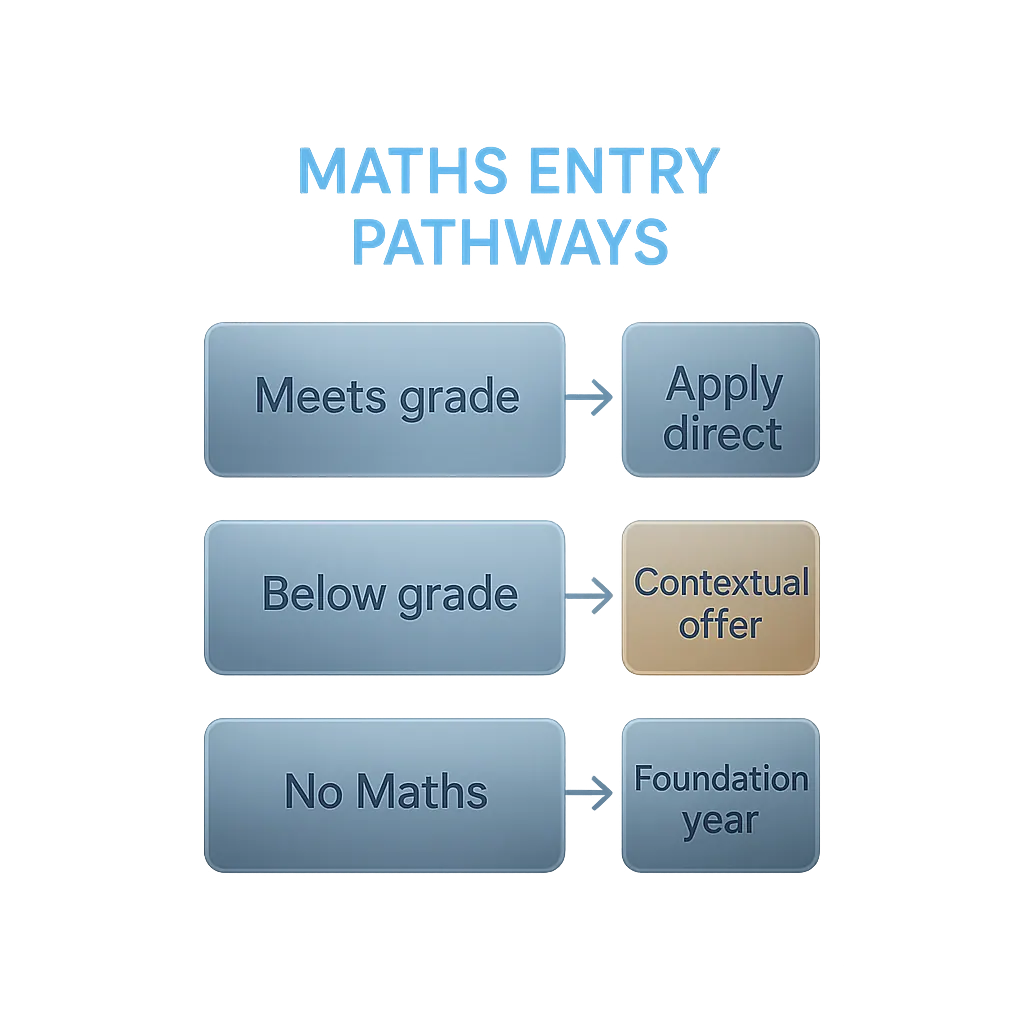
Not every applicant arrives with A*A in Maths and a Further Maths AS under their belt. Two routes exist that most generic guides overlook.
Foundation years let you build the mathematical groundwork before joining a full honours programme. They are especially relevant if your school did not offer Further Maths. The non-obvious detail here: Cambridge itself references the Advanced Mathematics Support Programme as a resource for A-level students whose schools cannot deliver Further Maths. If Cambridge acknowledges the gap, you can reasonably assume most admissions teams are aware it exists. A foundation year solves the same problem for applicants who need more than a self-study supplement.
Contextual offers lower the standard grade threshold for students from under-represented backgrounds. The adjustment varies by university and is not published as a single national figure. Check each university's widening-participation page directly rather than relying on aggregator sites, which often show only the standard offer.
**The Government Economic Service Degree Apprenticeship** is the most underused option. Delivered with the University of Kent, it requires a minimum of 96 UCAS points (equivalent to CCC at A-level) and five GCSEs including Maths at grade 6 and English at grade 4. You earn a full economics degree fee-free while working four days a week in a government department. The entry bar is substantially lower than any Russell Group offer, and 97% of the most recent graduating cohort achieved a 2:1 or above.
If the standard economics degree entry requirements feel out of reach right now, check your eligibility for the apprenticeship at GOV.UK before your next application cycle opens.
7. Admissions Tests and What to Expect Beyond Grades
Grades alone will not get you into Oxford or Cambridge economics courses. Both universities use pre-interview admissions tests, and missing the registration deadline is a separate failure mode from a weak UCAS application.
Oxford requires all applicants to its economics-related courses, including PPE, Economics and Management, and Economics and History, to sit the Test of Academic Reasoning for Admissions (TARA). One counter-intuitive detail: the Economics and Management interview is not primarily a test of existing knowledge of economics or management, so cramming textbook theory beforehand misses the point. TARA performance feeds into offer decisions alongside your school report, personal statement, and interview.
Cambridge uses the Test of Mathematics for University Admission (TMUA). King's College Cambridge explicitly requires it, and applicants to other Cambridge colleges should check their specific college's requirements, as they vary. The pre-interview process at King's has an additional layer worth knowing: interview candidates receive both economics-related reading material and mathematical questions one hour before the interview itself, not the night before.
Both tests require separate registration with deadlines that fall earlier than the UCAS deadline. Check your target university's admissions pages as soon as you begin your application, and note the test registration deadline in a place you will actually see it.
8. What to Do Next
The most impactful move you can make this week is to check whether your school timetables Further Mathematics. Cambridge's Faculty of Economics notes that some Colleges require it, and that in previous years the great majority of successful A-level applicants took it. If your school does not offer it, the Advanced Mathematics Support Programme provides access to Further Maths tuition outside school, so the route is open even without a cooperative timetable.
That single step matters more than any other this early in the process, whether you are targeting Oxford, Warwick, or a mid-table department.
For a structured overview of what different economics programmes look for, visit our economics subject guide to compare courses, entry routes, and realistic grade targets in one place.
FAQ
What A-levels do you need for an economics degree?
A-level Mathematics is required or strongly preferred by almost all competitive UK economics programmes; the grade demanded ranges from A to A* depending on the university, while Economics A-level is beneficial but not compulsory.
Do you need Economics A-level to study economics at university?
No - Cambridge, Oxford, and most UK universities do not require Economics A-level, and the typical successful applicant is judged primarily on their Mathematics qualification, not whether they have studied Economics before.
What are the entry requirements for economics at Cambridge?
Cambridge requires AAA at A-level (with A* in Maths) or 41-42 IB points with 776 at Higher Level including Mathematics Analysis and Approaches HL at grade 7; the great majority of successful applicants also took Further Mathematics.
What are the entry requirements for economics at Oxford?
Oxford's requirements vary by course: Economics and Management requires A*AA including Maths at A or above and IB 39 with 7-6-6 HL; PPE requires AAA and IB 39 with 7-6-6 HL; all economics-related applicants must sit the TARA admissions test.
Are there economics degree options with lower entry requirements?
Yes - foundation-year routes and contextual offers reduce the standard grade threshold at many universities, and the Government Economic Service Degree Apprenticeship at the University of Kent requires only 96 UCAS points (CCC equivalent) and a Maths GCSE at grade B/6.
Is a BA in Economics a good degree?
A BA in Economics can be just as rigorous as a BSc depending on the university - the key difference is that BA routes, often joint-honours, may place slightly less weight on Further Mathematics at entry and include more humanities content in the curriculum.
References
- Economics Subject Guide | Why Study Economics At Uni? | UCAS - https://www.ucas.com/explore/subjects/economics
- Course Requirements | Faculty of Economics - https://www.econ.cam.ac.uk/apply/undergraduate/course-requirements
- Undergraduate: Admissions Criteria | Department of Economics - https://www.economics.ox.ac.uk/undergraduate-admissions-criteria
- The Government Economic Service Degree Level Apprenticeship - GOV.UK - https://www.gov.uk/government/publications/the-government-economic-service-degree-level-apprenticeship
- Economics | King's College Cambridge - https://www.kings.cam.ac.uk/subjects/economics