Required A-Level Subjects for University: What You Need
By Michael Thompson · Former IB Diploma Programme coordinator; 10 years at Bromsgrove School · Published 5 July 2026
Required A-level subjects for university are not the same for every degree - and confusing a hard requirement with a soft preference can cost you an offer before you've even written your personal statement. Some courses, like medicine and engineering at competitive universities, will reject an application outright if you lack a specific subject, regardless of your grades in everything else. Others name preferred subjects but will consider you without them. Many degrees have no subject requirement at all. The decisions that shape your options start in Year 11 at GCSE, and the wrong A-level or IB Higher Level choice can close doors two years before you apply.
Key Takeaways
- Hard requirements are non-negotiable gates: missing Chemistry for Medicine or Maths for Engineering means no offer, no matter how strong your other grades are.
- Facilitating subjects open the most doors,: but guidance on which subjects count has changed, so check current university course pages rather than older lists.
- Further Maths is often preferred, not just Maths,: for top Computer Science and Engineering programmes - treating it as optional can put you at a disadvantage at competitive universities.
- IB students face the same stakes at HL choice: HL Chemistry is required for Medicine and HL Maths is expected for Economics, Engineering, and Computer Science at universities like Cambridge.
- Most universities base offers on three A-levels,: and taking a fourth does not normally improve your chances - but the choice of which three matters enormously.
- Some doors close at GCSE stage,: because you cannot take A-level Further Maths without GCSE Maths at a strong grade, so subject planning must start earlier than most students expect.
In This Article
- Required, preferred, or open? How to tell which category your course falls into
- A-level subject requirements by degree: at-a-glance table
- Facilitating subjects and the Russell Group: what the guidance actually says now
- The gotchas most students miss: Further Maths, Medicine's double science, and more
- IB students: which subjects must be Higher Level, not Standard Level
- Why these decisions start in Year 11, not Year 12
- What to do next
1. Required, preferred, or open? How to tell which category your course falls into
Understanding the required A-level subjects for university starts with a distinction most school guides skip: not all subject conditions on an offer work the same way. There are three distinct categories, and confusing them is one of the most common reasons students find themselves locked out of a course they wanted.
Required means a hard gate. No grade, no matter how strong, compensates for the missing subject. Veterinary Science at most UK universities will not consider applicants without Chemistry and Biology, full stop. This is non-negotiable regardless of your personal statement or predicted grades.
Preferred or facilitating means the university strongly recommends the subject, and most successful applicants will hold it. This category is where students get into trouble: if a History department at a selective university routinely sees applicants with an essay-based A-level alongside History (English Literature, for instance), not having one becomes a practical disadvantage even if the prospectus never calls it compulsory.
Open means no subject is specified at all. Foundation year engineering courses sometimes fall here, as do some humanities access routes.
How do you tell which category your target course falls into? Check the individual course entry requirements page on the university's own website, not a general admissions overview page, and not a third-party aggregator. Requirements differ between institutions offering the same subject title, and they change year on year.
One non-obvious gotcha: facilitating-subject guidance published by university groups has been updated over time. Always trust the current course page over any printed list or older online resource, including advice from the year above.
2. A-level subject requirements by degree: at-a-glance table
The table below covers the most common degree subjects. Requirements shown for Cambridge are drawn from the Trinity College Cambridge subject combinations page and Cambridge Undergraduate Study guidance. Requirements at other universities vary, so always verify on the individual course entry requirements page or search the UCAS Course Finder.
| Degree | Required A-level(s) | Preferred / strongly recommended | Open slot notes |
|---|---|---|---|
| Medicine | Chemistry | Biology, plus one from Physics, Maths, or Further Maths | At Cambridge: Chemistry plus two from Biology, Physics, Maths, Further Maths |
| Engineering | Maths, Physics | Further Maths | At Cambridge, Maths, Further Maths, and Physics are all expected |
| Computer Science | Maths | Further Maths (essential at Cambridge) | Physics or Computing accepted as third subject at many universities |
| Economics | Maths | Further Maths recommended at Cambridge | Third subject is generally open |
| Mathematics | Maths, Further Maths | Physics | Cambridge normally expects all three; a second facilitating subject may substitute for Physics |
| Law | No single hard requirement | Essay-based humanities subjects | Third subject open at most universities |
| Psychology | No single hard requirement | One science or Maths | Cambridge (PBS) requires at least one of Maths, Biology, Chemistry, Computer Science, or Physics |
| History | No single hard requirement | History A-level preferred | Cambridge requires History A-level |
| English | No single hard requirement | English Literature or combined English Language and Literature | Cambridge requires one of these two |
| Business / Management | No single hard requirement | Maths useful for quantitative programmes | Vocational Business A-level is listed as less useful for Cambridge applications |
One counter-intuitive point worth noting: Further Maths is listed by Cambridge as essential for Computer Science, not merely helpful. Students who assume Maths alone is sufficient for a top-university CS application are likely to find themselves at a disadvantage when offers are made.
Requirements shift between institutions, and occasionally between years. Check the course's own entry requirements page before finalising your A-level choices.
3. Facilitating subjects and the Russell Group: what the guidance actually says now
Facilitating subjects are those most commonly required or preferred by universities across the widest range of degrees. The original list, published under the Russell Group's "Informed Choices" guidance, typically included Maths, Further Maths, English Literature, Physics, Biology, Chemistry, Geography, History, and modern or classical languages. The idea was straightforward: pick subjects from this list and you keep the most doors open.
The practical problem is that "Informed Choices" has been updated over the years, and some students still work from older printed versions or secondhand summaries. Always check individual university course pages directly rather than relying on any cached version of the list.
More importantly, appearing on a facilitating list does not guarantee entry to any specific course, and the wrong combination of facilitating subjects can still close doors. A student holding History and English Literature has two well-regarded A-levels, but neither qualifies them to apply for Medicine, which requires sciences regardless of how "broadly useful" the subjects are in other contexts.
Cambridge makes this concrete. For STEM applicants, Cambridge recommends choosing 3 subjects from Biology, Chemistry, Physics, Mathematics, and Further Mathematics. For arts, social science, and humanities applicants, the recommendation is 2 from English Literature, a language (French, German, Spanish, or Latin), History, and Mathematics.
The counter-intuitive gotcha: Maths appears on both lists. A humanities student who drops Maths thinking it is "too sciencey" may inadvertently narrow their options even within arts subjects like Economics and Law at competitive universities.
Choose subjects because they suit your target degrees, not because a list says they look good.
4. The gotchas most students miss: Further Maths, Medicine's double science, and more
The subject combinations that catch students out are rarely the obvious ones. Here are the specific traps worth knowing before you commit to your Year 12 choices.
**Further Maths is not truly optional at Cambridge for several courses.** Cambridge lists Further Maths as essential for Mathematics and Computer Science, and strongly recommended for Engineering, Economics, Chemical Engineering and Biotechnology, and Natural Sciences (Physics specialism). "Strongly recommended" at Cambridge is not the same as optional elsewhere. The counter-intuitive point: taking four A-levels does not normally give you an advantage in the application, but dropping Further Maths from a three-A-level set for these courses is a real risk. The subject choice matters far more than the count.
**Medicine's double science trap.** A student with Chemistry plus one other science assumes they are covered. They are not. Trinity College Cambridge requires Chemistry plus two further A-levels drawn from Biology, Physics, Maths, and Further Maths for Medicine. One science alongside Chemistry leaves a gap.
Vocational A-levels and non-standard qualifications. Cambridge explicitly names Business, Health, Photography, Performing Arts, Travel and Tourism, PE, and Media Studies as less useful for its applications. Separately, Critical Thinking and Key Skills are not counted as an A-level at Cambridge, so building them into your combination as a third subject would leave your application short.
No Further Maths at your school? Students in England can join the Advanced Mathematics Support Programme, which provides access to Further Maths tuition outside school. Raise this with your teacher before the end of Year 11, not after timetables are set.
5. IB students: which subjects must be Higher Level, not Standard Level
IB students lock in their three Higher Level and three Standard Level subjects early, often at the end of Year 11. Taking a subject at SL when a university requires HL is as blocking as not taking the subject at all. The level matters as much as the subject itself.
Cambridge specifies that a minimum of 6 IB subjects are required, and offers are based on HL grades in appropriate subjects. The "appropriate subjects" part is where IB students most often come unstuck.
Key HL requirements by degree area:
- **Economics, Engineering, Computer Science, Mathematics** - HL Mathematics (Analysis and Approaches) is required. SL Maths, including the Applications and Interpretation course, will not satisfy this requirement, even if the grade is high.
- Medicine - HL Chemistry is standard, plus a second science at HL. Chemistry at SL alongside Biology at HL is a common but problematic combination.
- Engineering - many universities require HL Physics in addition to HL Maths.
The non-obvious gotcha with IB Maths: Analysis and Approaches and Applications and Interpretation are treated as different subjects, not just different levels. An admissions requirement for "HL Maths" almost always means Analysis and Approaches. Confirming both the course name and the level is essential.
Cambridge lists minimum IB offer levels for specific courses on its qualifications page, and requirements can differ between Colleges. Check the course entry requirements directly before finalising your IB subject choices.
6. Why these decisions start in Year 11, not Year 12
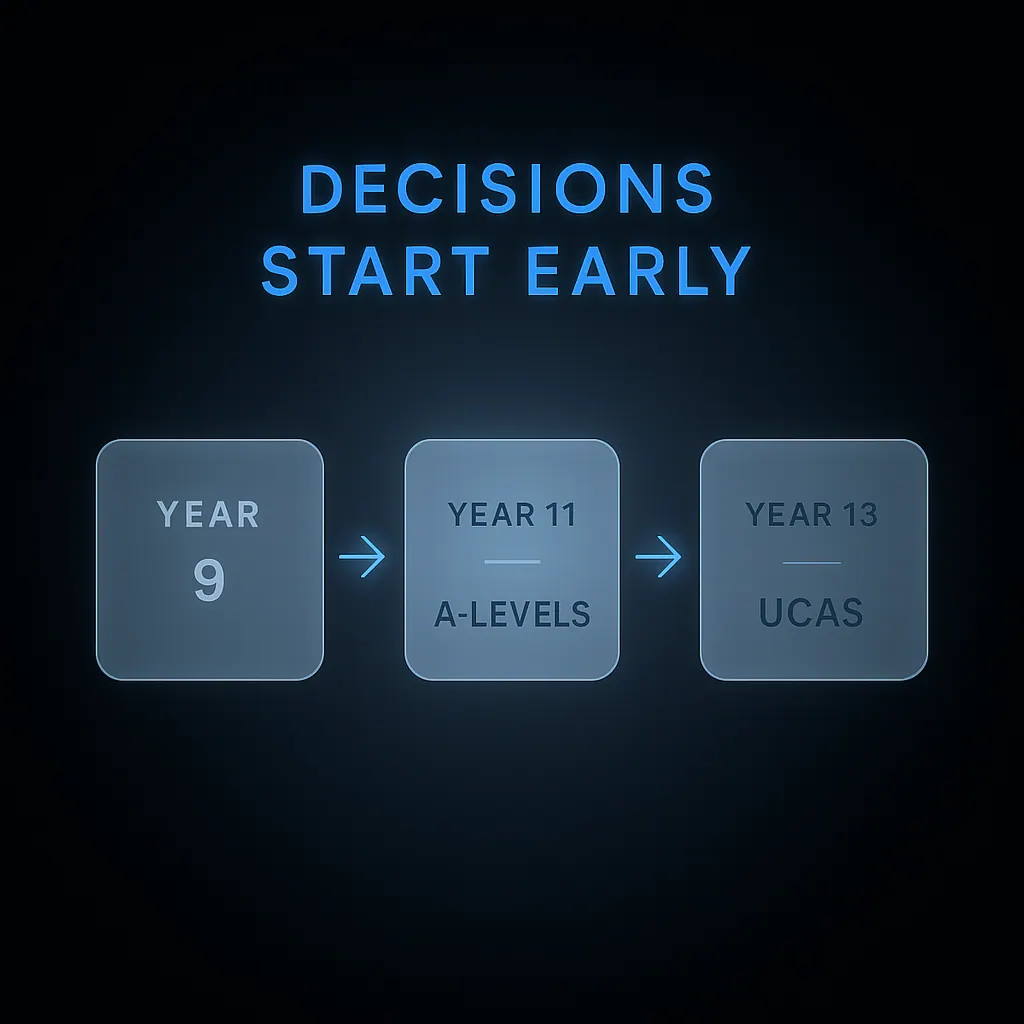
The chain that determines your university options runs further back than most students realise: GCSE choices (Year 9) feed into A-level choices (Year 11), which feed into your UCAS application (Year 12/13). Break a link early and it is very hard to repair later.
The non-obvious gotcha is how GCSE grades gate specific A-levels. Without a strong GCSE Maths grade, most sixth forms will not let you take Further Maths A-level, which closes off several competitive engineering and mathematics pathways. Without GCSE Latin or a classical language, A-level Classics is often inaccessible regardless of enthusiasm. These are structural blocks, not soft preferences.
Most universities base their offers on three A-level grades, so the three subjects you sit in Year 13 carry almost all the weight. Some universities also specify a fourth AS subject, but three remains the standard minimum for university entry. Choosing the wrong three in Year 11 because you did not check requirements early is one of the most common and most avoidable problems.
By Year 11, you do not need a single target course, but you should have a rough target degree area. Cross-reference the A-level entry requirements for two or three universities in that area, not just your first-choice institution. Requirements vary more than students expect, even within the same subject.
Concrete action: before you finalise your A-level or IB subject choices, look up the entry requirements for your target degree at two or three universities on their admissions pages this week.
7. What to do next
Before you confirm your A-level or IB subject choices with your school, open the entry requirements pages for two or three universities offering your target degree and note, for each subject, whether it is listed as required or preferred. That distinction is the one most students skim past, and it is the one that closes doors.
Use our course finder to see which subjects are required for your target degree across different institutions, then cross-check individual course pages in our course directory for exact subject requirements at the specific universities on your list.
Do this before your school's options deadline, not after. Entry requirements sit on the university's own admissions page, not in a prospectus, and they can differ between campuses offering nominally the same course. Check, compare, then confirm.
FAQ
How many A-level subjects are required for university?
Three A-levels is the standard minimum for university entry in the UK, and most universities base their offers on three A-level grades taken together in Year 13.
Are three A-levels enough for university applications?
Yes, three A-levels is enough for the vast majority of UK university applications - taking a fourth does not normally improve your chances, but the choice of which three subjects matters enormously for competitive courses.
What A-levels do you need for Medicine?
Chemistry is a hard requirement for Medicine at almost all UK medical schools; Biology is also strongly required or expected at most, and at Cambridge you need Chemistry plus two further subjects from Biology, Physics, Maths, and Further Maths.
Do you need Maths A-level for Economics at university?
At competitive universities, including Cambridge, Maths A-level is a firm requirement for Economics, and Further Maths is strongly recommended; IB students should take Maths at Higher Level.
What are facilitating subjects for the Russell Group?
Facilitating subjects are those most commonly required or preferred across the widest range of degrees - traditionally including Maths, Further Maths, Sciences, English Literature, History, Geography, and languages - but the official guidance has been updated and students should check current course pages rather than older lists.
Can IB students take subjects at Standard Level instead of Higher Level for university entry?
No - where a university specifies a subject at Higher Level, Standard Level will not meet the requirement; IB students applying for Medicine, Engineering, or Economics must confirm which subjects their target universities require at HL before finalising their IB subject choices.
References
- Preferred A level Subject Combinations - Trinity College Cambridge - https://www.trin.cam.ac.uk/undergraduate/applying/a-level-subject-combinations
- How to choose A levels or high school subjects | Undergraduate Study - https://www.undergraduate.study.cam.ac.uk/apply/before/choosing-high-school-subjects
- Check which qualifications we accept | Undergraduate Study - https://www.undergraduate.study.cam.ac.uk/apply/before/accepted-qualifications
- What is an A Level? | Worcestershire County Council - https://www.worcestershire.gov.uk/skills-4-worcestershire/support-education-meet-gatsby-benchmarks/general-career-resources/what-level