Campus vs City University: Which Suits You?
By Michael Thompson · Former IB Diploma Programme coordinator; 10 years at Bromsgrove School · Published 5 July 2026
Campus vs city university is one of the most practical choices you face when picking where to study - and it shapes your day-to-day life far more than league table position. A campus university puts lectures, halls, the library and the students' union on a single site, so everything is a short walk away. A city university spreads its buildings across an urban centre, weaving student life into the fabric of the city. Neither model is better in the abstract; the right answer depends on whether you want a tight-knit self-contained community or direct access to the cultural and economic life of a major city.
Key Takeaways
- Campus universities centralise everything: Lecture halls, accommodation, sports facilities and social venues share one site, so you rarely need to leave - useful if you want minimal commute and a ready-made social circle.
- City universities integrate with urban life: Buildings are spread across a city, meaning you get richer transport links, a wider cultural scene and, often, a graduate job market on the doorstep.
- Living costs tend to be higher in large cities: Rent and transport in major urban centres typically run above the national average, so weigh accommodation savings against the cost of commuting from cheaper areas.
- More than 700,000 students in the UK commute to university: HESA data shows over 40% of UK students were living at home during term time in 2023/24 - a figure that has been rising steadily.
- The campus-or-city binary is not clean: Collegiate universities, split-site institutions and campus universities inside city centres all break the simple two-way split, so check the actual map of a university before deciding.
- An in-person visit answers things no prospectus can: Walking distances, evening atmosphere and how self-contained the halls feel only become clear when you are standing there - go before you firm your choice.
In This Article
- What campus and city universities actually mean
- Campus vs city university: side-by-side comparison
- Living costs: what the campus vs city difference means for your finances
- Which type of university suits which student?
- When the label breaks down: collegiate, split-site and urban campus universities
- What to check on a visit or open day
- What to do next
1. What campus and city universities actually mean
The campus vs city university decision is one of the first real forks in the road when choosing where to study, and the difference is more structural than it first appears.
A campus university places everything on a single, self-contained site. Lecture halls, libraries, gyms, the students' union, and student accommodation are all within walking distance of each other, per UCAS. The University of Bath and the University of Warwick are clear examples: both sit on discrete sites where you can go from bed to lecture theatre without leaving the grounds. The campus itself can be inside a city, on its outskirts, or in a rural area entirely. That last point matters more than most prospectuses admit. A countryside campus means travel time for anything the university does not provide on site.
A city university integrates its academic facilities and student accommodation into an existing urban centre, often spread across several locations but generally clustered in certain areas, per UCAS. Newcastle University is a well-known example, with a city-centre campus that puts students inside Newcastle upon Tyne rather than apart from it. City St George's, University of London takes this further, with facilities spread across London boroughs.
The non-obvious gotcha: the difference between campus and city university is not the same as the difference between living on or off campus. City universities still offer student accommodation, and campus universities still have students who commute. The question is really about how your university environment is physically organised, and whether that matches how you want your daily life to feel.
2. Campus vs city university: side-by-side comparison
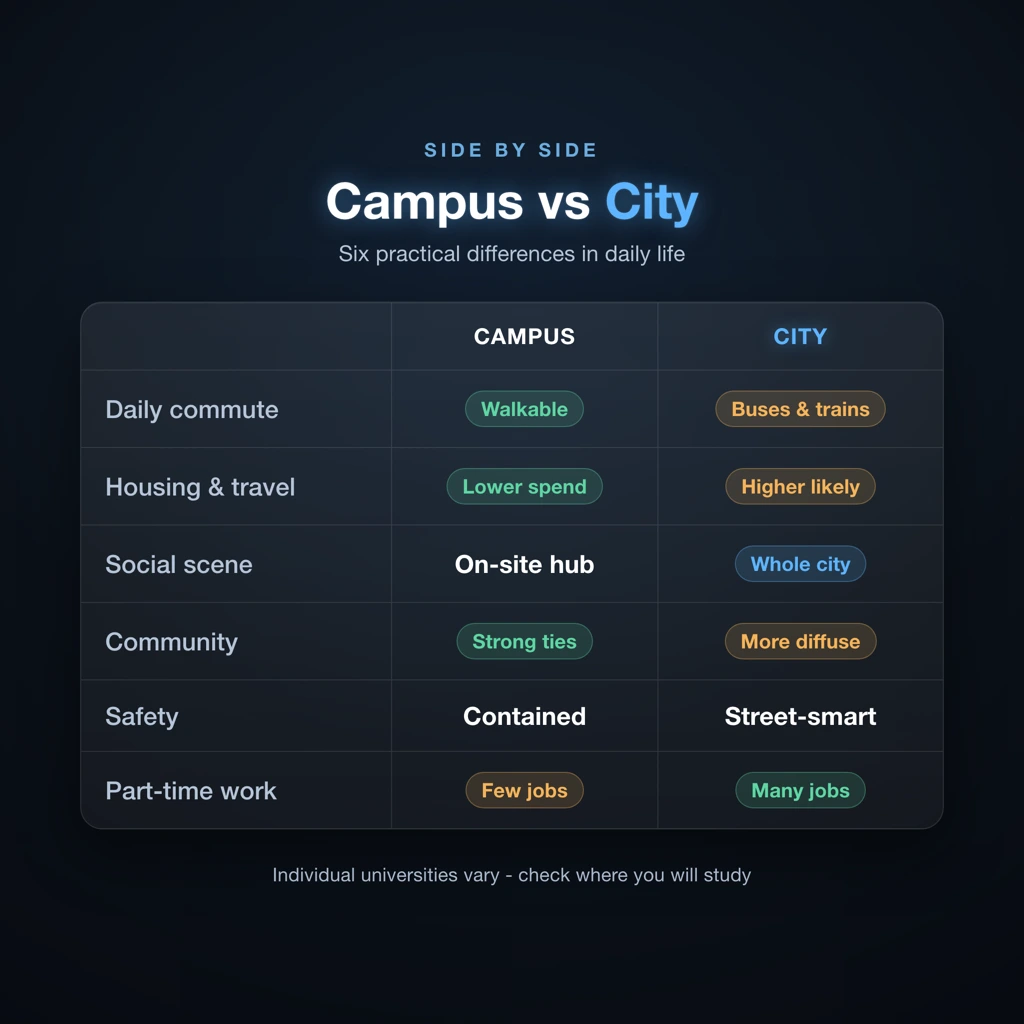
The table below maps the practical differences across six categories. As UCAS notes, campus universities put lecture halls, libraries, gyms, and accommodation in one walkable area, while city universities spread academic and residential buildings across the urban landscape.
| Category | Campus University | City University |
|---|---|---|
| Daily commute | Minimal - most facilities within walking distance | Varies by site; buses, trains, or cycling likely needed between buildings |
| Accommodation and travel costs | On-site halls common; lower transport spend | Wider choice of private rentals; higher travel costs likely |
| Social scene | Concentrated on site; events, bars, and venues clustered together | Access to the full city: independent venues, restaurants, cultural events |
| Sense of community | Strong shared identity; hard to avoid fellow students | More diffuse; requires more active effort to build social ties |
| Safety considerations | Contained environment, often with campus security; countryside sites may feel isolated at night | Urban street awareness required; well-lit city campuses can feel safer than remote rural ones |
| Ease of finding part-time work | Limited local employers; may need to travel into town | Far more local job opportunities within walking or cycling distance |
One counter-intuitive trade-off: a countryside campus can feel both safer (contained, staffed security) and more isolated (no easy escape if you find the community claustrophobic). That pressure is real, and worth stress-testing on an open day.
Individual universities vary significantly within each category. UCAS advises checking exactly where you will spend most of your academic time before drawing any conclusions about a specific institution. The campus vs city university label is a starting point, not a guarantee of what daily life will look like.
3. Living costs: what the campus vs city difference means for your finances
City universities in large urban centres tend to carry higher accommodation and transport costs than smaller campus towns, and London sits in its own category entirely. That gap is real and worth pricing out before you fall for a course.
The University of Manchester puts a concrete number on it. Its own estimate for first-year accommodation runs to £7,875, with total living costs for the year estimated at £13,685 for 2025/26, according to a BBC report. That is the figure for a student living in halls. It does not include tuition.
That cost is exactly why some students bypass halls entirely. The BBC profiled Amelka Zambrzycka, a first-year biology student at Manchester who commutes daily from Horwich near Bolton, spending roughly £700 a year on public transport and saving approximately £7,000 on halls. Her daily round trip takes three hours: a walk to the station, a train to Manchester Oxford Road, a walk to campus, then the reverse. She leaves home around 07:00 and gets back around 20:00.
She is far from alone. HESA data shows over 40% of UK students lived at home during term time in 2023/24, a proportion that has been rising steadily.
The non-obvious trade-off is this: **commuting saves money but costs social integration.** Spontaneous post-lecture plans, evening society events, and the kind of low-key flat socialising that builds friendships are all harder when your last train leaves at 22:00. Campus universities, where most students live within walking distance of each other, close that gap almost by default. City universities increasingly know this, with Manchester opening a dedicated commuter lounge in late 2024, but a lounge is not the same as living on your street.
Run your own numbers before assuming commuting is obviously the right call.
4. Which type of university suits which student?
No single answer fits everyone, but the pattern is consistent enough to be useful.
Campus universities tend to suit students who:
- Are moving far from home for the first time and want a ready-made social environment without having to seek it out
- Prefer short walks between lectures, the library, and their accommodation, as noted by UCAS, which describes campus universities as having everything accessible within walking distance
- Want a strong on-campus social life where most activity happens in one place
- Are less interested in, or less experienced with, living independently in a large city
City universities tend to suit students who:
- Want access to a wider cultural and social scene beyond the student bubble
- Are looking for part-time work, since employers, venues, and transport links are on the doorstep
- Have a clear career direction and want proximity to a graduate job market from year one
- Already know the city, or feel confident finding their feet in an urban environment
**Commuter students sit in a third category.** More than 700,000 students in the UK commute to university, and many choose city universities partly because the transport infrastructure makes it feasible. The financial logic is real: the University of Manchester puts first-year accommodation at £7,875 for 2025/26, a saving that a commuter from nearby Bolton can almost entirely pocket. But the time cost matters. One Manchester student commuting from Horwich logs around three hours of travel daily, leaving home at 07:00 and returning at 20:00.
The non-obvious trade-off: commuter students at city universities can feel less connected than commuter students at campus universities, where the social infrastructure is more concentrated and harder to miss. The University of Manchester recognised this directly, opening a dedicated commuter lounge in late 2024 with study pods, lockers, and kitchen facilities. Check whether your shortlisted city universities have similar provision before assuming the social gap will take care of itself.
5. When the label breaks down: collegiate, split-site and urban campus universities
The campus/city binary is a useful starting point, but a significant number of UK universities don't sit neatly in either category. Three types in particular can catch applicants off guard.
Collegiate universities are structured as a collection of semi-autonomous colleges, each sitting within the wider institution but handling its own accommodation, welfare support, and social life. Cambridge describes itself as part of a "vibrant city community" while running a College accommodation system that means your immediate community is your College, not the university as a whole. The practical consequence: two Cambridge students studying the same subject can have noticeably different day-to-day experiences depending on which College they belong to. When researching a collegiate university, treat each College as a separate environment worth investigating.
Split-site universities operate across a mix of city and campus locations. Per UCAS, many UK universities run multiple campuses, and your experience depends almost entirely on which faculty or department you join. A student in one school might be on a leafy out-of-town site; a student in another at the same university might be based in the city centre. The university's overall reputation tells you very little about where you will actually spend your time.
Urban campus universities have a self-contained campus layout but sit inside a city centre rather than on its outskirts. Newcastle University is city-centre based and offers the walkability of a campus alongside immediate access to a major city. This breaks the common assumption that "campus university" implies a quiet, somewhat isolated setting. If that assumption is shaping your decision, it is worth checking the actual location before ruling anything out.
6. What to check on a visit or open day
No prospectus photograph or Reddit thread tells you how long it actually takes to walk from your halls to a 9am lecture in the rain. That distance, and how it feels at 8.45am in February, is often what determines whether you enjoy a place.
UCAS advises that prospective students should check where they will spend most of their academic time when selecting a university. For split-site institutions, that means asking specifically which campus your department uses, not just which campus the university is known for. A university might market its city-centre campus heavily while your chemistry department sits on a suburban site three miles away.
On your visit, sense-check the following:
- Walking distances between your likely accommodation and your department's teaching buildings. Time it, don't estimate it.
- Evening atmosphere around the campus or neighbourhood. Visit after 6pm if you can. A place that feels fine at noon can feel isolated or, conversely, uncomfortably busy after dark.
- Accommodation self-containment. Does the hall have a common room, laundry, and kitchen access, or do you need to leave the building for basics?
- What's within five minutes on foot. A supermarket, cash machine, café, and a bus stop matter more day-to-day than the city centre being two miles away.
- Students' union activity. Check the SU noticeboard and events calendar on the day. An empty SU at lunchtime on a Wednesday is a data point worth noting.
7. What to do next
You have a preference forming. The next move is to test it against reality before you commit.
This week, go to the admissions pages of the two or three universities on your shortlist and check which specific site your department sits on, not just which institution. A university that markets itself as a campus university may house your school of art or your law faculty in a city-centre building a bus ride from the main grounds. That single detail changes the commuter student life calculation entirely, and most students only discover it after accepting an offer.
Browse the UK universities directory to compare institutions side by side, then book open days directly through each university's official admissions page. Before you book, confirm the department location. Arriving with that question already answered is a better use of a visit day than finding out on arrival.
FAQ
Is Leeds a campus or city university?
The University of Leeds is broadly considered a campus-style university with most of its buildings concentrated in a walkable cluster just north of the city centre, though it sits close enough to Leeds city centre to give students easy access to urban amenities.
Is Durham a campus or city university?
Durham University is collegiate and city-based, with colleges and teaching buildings spread through the small historic city centre - it is neither a traditional self-contained campus nor a large civic city university.
Is Bath a campus or city university?
The University of Bath is a classic campus university: nearly all teaching, accommodation and social facilities sit on a single hilltop site above the city, making it one of the most self-contained examples in the UK.
What is the difference between a campus and a city university?
A campus university consolidates all its buildings - lecture halls, libraries, halls of residence and the students' union - on one site accessible on foot, while a city university distributes its facilities across an urban centre, integrating academic life with the wider city.
Is living on campus better than commuting?
Living on campus typically means easier social integration and no commute, but it costs more; over 40% of UK students lived at home in 2023/24 according to HESA data, with some commuting three hours a day to save thousands of pounds on accommodation.
Is Manchester a campus or city university?
The University of Manchester is a city university, with buildings spread across the Oxford Road corridor in central Manchester - it has a strong campus feel in that area but is not self-contained on a single site.
References
- University life in the UK | UCAS - https://www.ucas.com/international/international-students/studying-uk/university-life-uk
- Newcastle University | Student life | UCAS - https://www.ucas.com/explore/unis/9528a5b4/newcastle-university/student-life?studyYear=2026
- History | City St George's, University of London | UCAS - https://www.ucas.com/explore/courses/1839b571-2d54-4800-9314-ba214a3d8d7f/course
- My three-hour university commute is worth the £7,000 saving on halls - BBC News - https://www.bbc.co.uk/news/articles/c4g09p93m29o
- Student life at Cambridge | Undergraduate Study - https://www.undergraduate.study.cam.ac.uk/student-life