IB to UCAS Points: The Complete Conversion Guide
By Michael Thompson · Former IB Diploma Programme coordinator; 10 years at Bromsgrove School · Published 5 July 2026
IB to UCAS points conversion works by adding up the tariff values of your individual Higher Level subjects, Standard Level subjects, and your combined Extended Essay and Theory of Knowledge grade - not by translating your overall IB Diploma total into a single tariff number. A student with three HL grades of 6, three SL grades of 6, and a B/B core combination will land at a different UCAS total than someone with the same 36-point diploma but a different spread of HL and SL grades. The official values are published in UCAS's tariff tables, and they are the only figures universities are required to honour. Understanding how the calculation works matters because most competitive UK courses set IB offers as a named points total plus specific HL grade requirements - satisfying both conditions is what gets you a place.
Key Takeaways
- No single tariff for the full diploma: UCAS awards points separately for each HL subject, each SL subject, and the combined EE/TOK core - the diploma total itself does not map to a single tariff number.
- HL grades carry roughly double the tariff weight of SL grades: A grade 7 at Higher Level is worth 56 UCAS points, while a grade 7 at Standard Level is worth 28 points.
- CAS contributes zero UCAS tariff points: Creativity, Activity, Service is compulsory for the diploma but is ignored entirely in the tariff calculation.
- Most competitive offers name both a points total and specific HL grades: Meeting the UCAS tariff equivalent is not enough - you must also hit the individual HL grade conditions named in the offer.
- The EE/TOK core can add up to 12 UCAS points: An A in both the Extended Essay and Theory of Knowledge earns the maximum; an E in either component reduces that total.
- Two students with the same IB score can have different UCAS totals: Because tariff points depend on your personal mix of HL and SL grades, identical diploma scores do not guarantee identical tariff totals.
In This Article
- What Is the IB to UCAS Points Conversion and Why Does It Matter?
- The IB Diploma to UCAS Points Conversion Table
- How to Calculate Your UCAS Points from IB Grades Step by Step
- Why HL Grades Carry More Tariff Weight Than SL Grades
- The Diploma Core: How Extended Essay and TOK Count (and What Doesn't)
- The Key Gotcha: IB Offers at UK Universities Are Not Just a Tariff Number
- IB Grades to A-Level Equivalent: How the Two Qualifications Compare
- From IB Points to Real UK Courses: Using Your Grades to Find the Right Match
- What to Do Next
1. What Is the IB to UCAS Points Conversion and Why Does It Matter?
The ib to ucas points conversion is the process of translating IB Diploma grades into the numerical scale UK universities use to compare applicants across different Level 3 qualifications. That scale is the UCAS Tariff, a single scoring system that sits alongside A-Levels, BTECs, Scottish Highers, and other qualifications, so that admissions teams can read all of them in the same currency.
The counterintuitive part: the IB Diploma as a whole carries no single UCAS Tariff value. Points are calculated component by component, with Higher Level subjects, Standard Level subjects, the Extended Essay, and Theory of Knowledge each scored separately. CAS contributes nothing to the tariff at all, per Lanterna Education.
Why does the conversion matter? Some UK universities use tariff thresholds when filtering applications or when making contextual offers to students from widening-participation backgrounds. But the most competitive courses go further than a single number. Many Russell Group universities name specific HL grade requirements alongside an overall IB Diploma points total, meaning a high tariff score built largely on SL grades may not meet an offer that explicitly demands a 6 or 7 in a relevant HL subject, as University Direct notes.
All official tariff values are published by UCAS. Verify any figures for a specific course directly through the UCAS course search tool or the university's own entry requirements page, since individual course conditions can go beyond the tariff alone.
2. The IB Diploma to UCAS Points Conversion Table
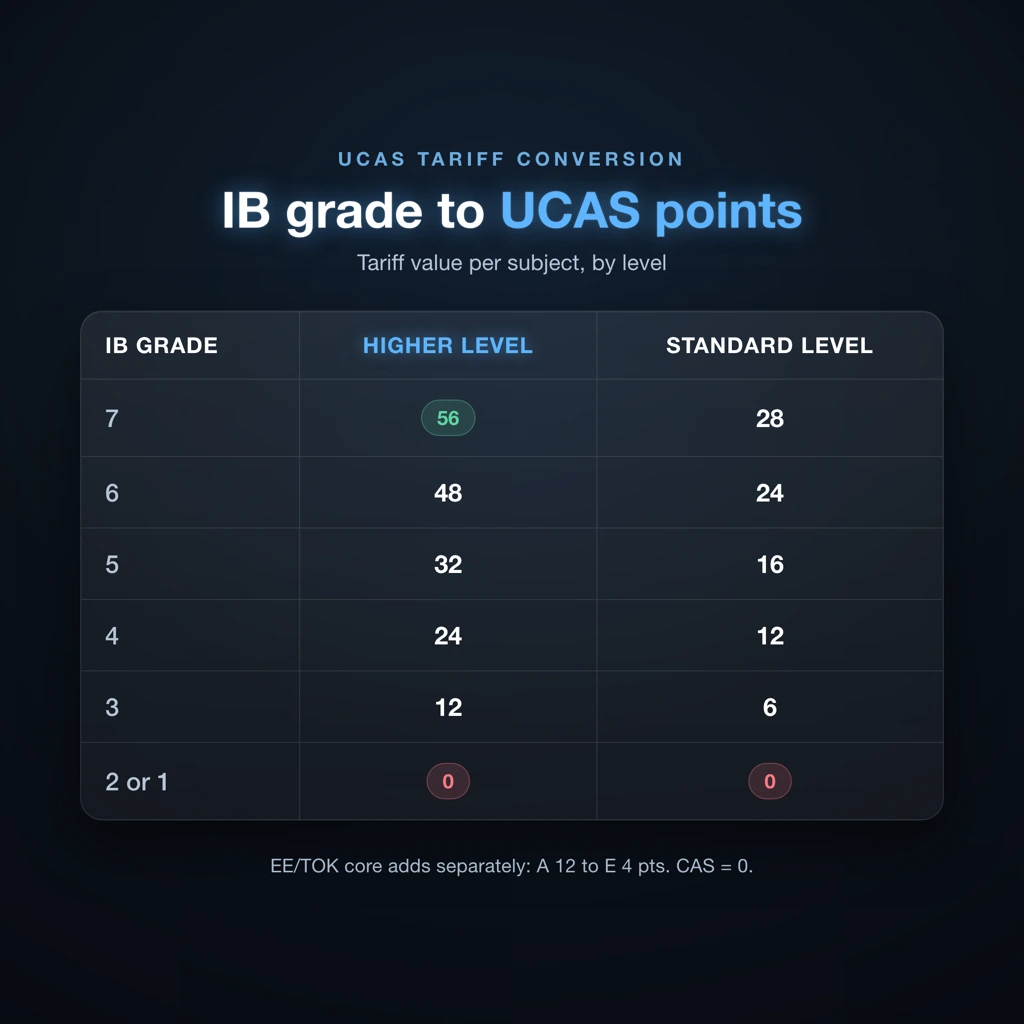
The IB Diploma as a whole has no single UCAS Tariff value. Points are calculated separately for each HL subject, each SL subject, and the combined EE/TOK core. The tables below show the current conversion values from Lanterna Education and University Direct.
Higher Level (HL) subjects
| IB Grade | UCAS Tariff Points |
|---|---|
| 7 | 56 |
| 6 | 48 |
| 5 | 32 |
| 4 | 24 |
| 3 | 12 |
| 2 or 1 | 0 |
Standard Level (SL) subjects
| IB Grade | UCAS Tariff Points |
|---|---|
| 7 | 28 |
| 6 | 24 |
| 5 | 16 |
| 4 | 12 |
| 3 | 6 |
| 2 or 1 | 0 |
Extended Essay and Theory of Knowledge (combined core)
| Combined EE/TOK Grade | UCAS Tariff Points |
|---|---|
| A | 12 |
| B | 10 |
| C | 8 |
| D | 6 |
| E | 4 |
One non-obvious point worth noting: the EE and TOK grades feed into a single combined matrix value, not two separate tariff awards. You do not add EE points and TOK points independently. The grade you see in this table is the output of that matrix, so a strong EE paired with a weak TOK score will pull the combined figure down from what either component might suggest in isolation.
CAS (Creativity, Activity, Service) contributes zero UCAS Tariff points, regardless of how it is graded by your school.
These values can change when UCAS updates its tariff tables. Before you use any figure for a real application, check directly against the current tariff tables on ucas.com.
3. How to Calculate Your UCAS Points from IB Grades Step by Step
The calculation has three parts: Higher Level subjects, Standard Level subjects, and the combined EE/TOK core. Add the three totals together and you have your UCAS tariff figure.
Step 1: Convert each HL grade. Using the UCAS tariff values for IB HL subjects, each grade maps as follows: 7=56, 6=48, 5=32, 4=24, 3=12.
Step 2: Convert each SL grade. SL points run at roughly half the HL rate: 7=28, 6=24, 5=16, 4=12, 3=6.
Step 3: Add the core value. The EE and TOK grades combine into a single figure worth between 0 and 12 UCAS points. An EE grade A with TOK grade A gives 12; an EE grade B with TOK grade A gives 10.
Worked example
| Component | Grades | Points |
|---|---|---|
| HL subjects | 6, 6, 5 | 48 + 48 + 32 = 128 |
| SL subjects | 7, 6, 5 | 28 + 24 + 16 = 68 |
| EE B / TOK A core | - | 10 |
| Total | 206 |
This student's 36 IB diploma points convert to 206 UCAS tariff points.
The non-obvious part: two students can finish with the same overall IB score, say 36 points, and produce meaningfully different UCAS totals. Because HL grades are worth up to twice as many tariff points as the equivalent SL grade, the student whose stronger marks sit at HL will accumulate more tariff points than one who relied on SL grades to prop up their diploma total. If a university sets a UCAS tariff threshold, the HL-heavy student clears it with less margin for error elsewhere on their application.
Check your own combination before assuming a given diploma score is enough.
4. Why HL Grades Carry More Tariff Weight Than SL Grades
The gap between HL and SL is not arbitrary. UCAS weights the two tiers differently because HL subjects require around 240 guided learning hours compared to roughly 150 for SL. That extra classroom and study time is recognised directly in the tariff.
The practical gap is large. A grade 6 at HL is worth 48 UCAS points. The same grade 6 at SL is worth 24 points, exactly half. The pattern holds at every grade level, as the conversion table in section 2 shows (Lanterna Education).
For a student choosing subject levels at the start of the IB, this creates a real strategic consideration. If your strongest subject sits at SL rather than HL, you are leaving 24 points on the table for a single grade. Move that subject to HL and, assuming your grade holds, your UCAS total rises by 24 points without any change to your raw IB score.
The less obvious consequence concerns course matching. Some UK courses set minimum UCAS tariff thresholds rather than specifying IB points directly. For those courses, a student with HL breadth across strong subjects can reach a tariff threshold that an equally-scoring IB student with weaker HL choices cannot, even if their total IB Diploma points look similar. Subject level selection at Year 1 of the IB is therefore an early decision with late consequences for UK applications (university-direct.com).
5. The Diploma Core: How Extended Essay and TOK Count (and What Doesn't)
The IB Diploma core has three components: Theory of Knowledge (TOK), the Extended Essay (EE), and Creativity, Activity, Service (CAS). Only two of them affect your UCAS tariff. CAS contributes no UCAS points at all, despite taking a significant slice of your time in school.
TOK and EE are awarded letter grades (A to E) and their UCAS value is calculated as a combined figure, not two separate scores. The pairing determines a single points total:
| EE / TOK grade combination | UCAS tariff points |
|---|---|
| A + A | 12 |
| A + B or B + A | 10 |
| B + B or A + C | 8 |
| C + C or B + D | 6 |
| D + D or any E | 4 |
| E in either component | 0 (diploma not awarded) |
Source: Lanterna Education, University Direct.
The non-obvious detail: TOK and EE also generate up to 3 bonus IB diploma points, which influence subject grade totals and therefore feed into the tariff indirectly as well. A student sitting at 42 IB points can reach 45 through a strong EE and TOK performance, and that shift registers in the UCAS calculation.
In practical terms, the difference between an A+A and a B+B on the core is 4 UCAS tariff points. An SL grade jump from 5 to 6 is worth 8 points, so the core alone is roughly half that. It is not marginal.
**Do not leave EE and TOK preparation until the last minute.** The combined 12-point ceiling from the core is roughly equivalent to a grade improvement on one SL subject, without any extra exam to sit.
6. The Key Gotcha: IB Offers at UK Universities Are Not Just a Tariff Number
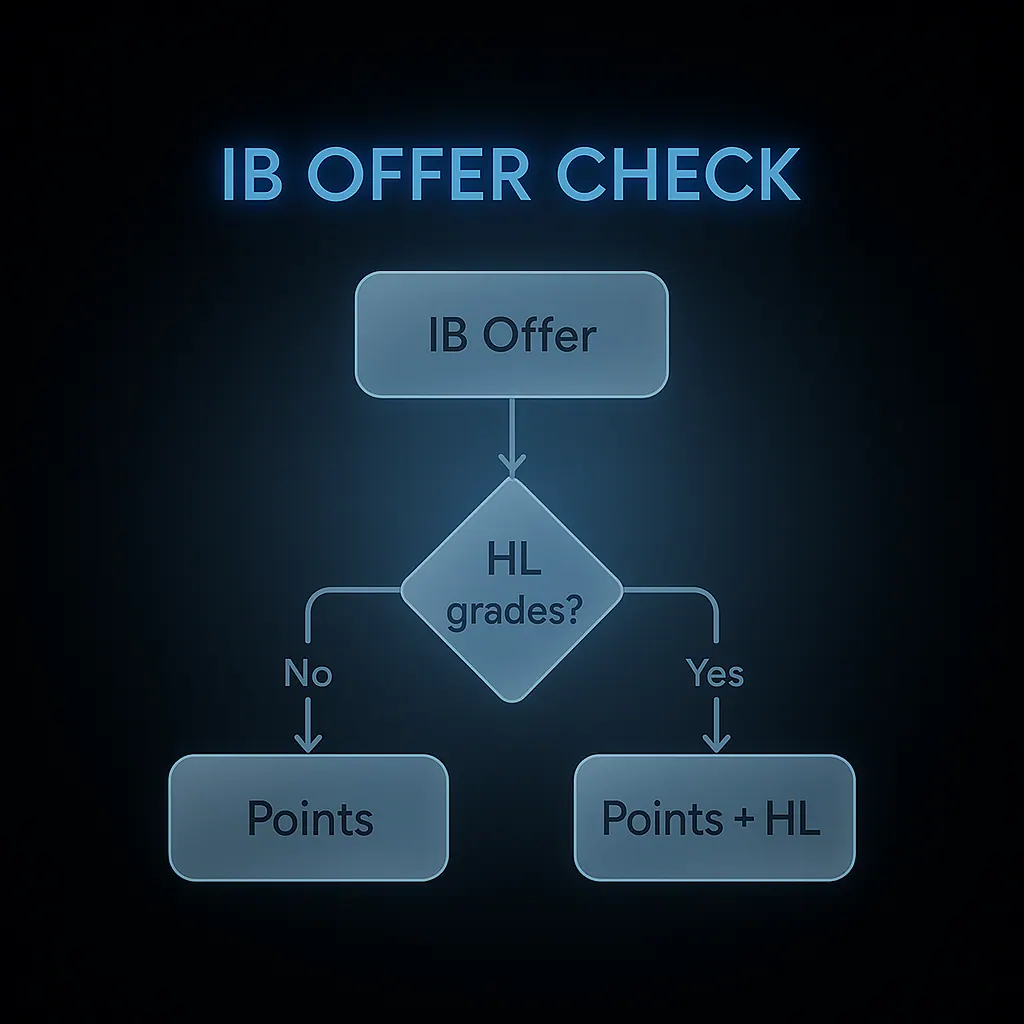
Converting your IB diploma score to a UCAS tariff figure is useful background knowledge, but **selective UK universities rarely phrase conditional offers in tariff terms**. They state an overall IB points total alongside named Higher Level grade requirements, and both conditions must be met independently.
The numbers are specific. Imperial College London sets minimum overall scores of 38 to 40 points, with grades of 6 or 7 required in specified HL subjects depending on the course. The University of St Andrews runs standard offers from 36 points (HL 6,5,5) up to 38 points (HL 6,6,6 with SL 6,6,6), with most Arts and Medicine offers sitting at the upper end or higher.
The gotcha is this: you can satisfy the implied tariff equivalent while still failing the HL condition. A student with a strong SL profile and a solid core score might hit 38 total points, but if their HL Chemistry is a 5 when the course requires a 6, the university will not honour the offer. The tariff total is irrelevant at that point.
This distinction matters most for medicine, engineering, and law, where HL subject requirements are often non-negotiable. As Lanterna Education notes, many competitive universities make offers directly in IB diploma points and specific HL grades rather than UCAS tariff totals.
Read the exact offer wording on each course page. Do not rely on a tariff conversion alone to judge whether you meet a condition.
7. IB Grades to A-Level Equivalent: How the Two Qualifications Compare
The rough mapping most admissions tutors use looks like this:
| IB HL Grade | Approximate A-Level Equivalent |
|---|---|
| 7 | A* |
| 6 | A |
| 5 | B or C (course-dependent) |
| 4 | D or E |
These are broad-brush equivalences. Universities set their own benchmarks, and the same HL 5 can satisfy one department's offer while falling short of another's.
The figure that surprises most students: *HL 6,6,6 maps to roughly AAA at A-Level, not A\A\A\.* To reach A\A\A\ equivalence, you need approximately IB 41-42 overall, according to Structural Learning's analysis of the conversion. That gap is larger than it looks on paper, because squeezing a 7 out of a subject you were comfortably scoring 6 in is a significant step.
Published 2024-25 entry requirements give a clearer picture of where the bars actually sit:
- **Oxford and Cambridge:** IB 39-41 for most courses
- LSE and UCL: IB 36-39
- Manchester and Edinburgh: IB 32-36
(Source)
One important nuance: for Oxbridge and medical school applications, UCAS tariff points are largely irrelevant. Those admissions teams work directly from raw IB points and individual HL grades. A student with IB 40 but weak HL scores in relevant subjects will not be assessed the same as one with IB 40 built on strong HL performance in the subject areas the course demands.
8. From IB Points to Real UK Courses: Using Your Grades to Find the Right Match
Once you know your UCAS tariff total, the more useful move is to search courses using IB-native language. As Lanterna notes, most competitive universities state offers directly in IB Diploma points with specific HL grade requirements, such as "38 points overall with 6,6,5 at Higher Level" rather than a UCAS tariff number. Searching by UCAS tariff alone means you may miss the HL subject conditions that can disqualify an otherwise matching total.
A practical way to think about IB points bands and course access:
- 40+ IB points opens the most selective institutions. Structural Learning puts Oxford and Cambridge 2024-25 offers at IB 39-41 for most courses, and LSE and UCL at 36-39.
- 36-38 IB points with appropriate HL grades covers a wide range of competitive options, including many Russell Group courses.
- 32-36 IB points represents a large middle tier covering strong universities outside the most selective bracket, consistent with Manchester and Edinburgh's published ranges.
The non-obvious gotcha here: two students with the same total IB score can sit in different positions relative to an offer if their HL grades differ. A student with 37 points built on HL 6,6,5 meets "37 with 6,6,5 HL"; one with HL 5,5,7 does not, even with an identical total.
If you have predicted grades, check the points gap to your firm offer now, before subject or level choices are fixed. Adjusting one SL subject to HL is easier at the start of Year 2 than after mock exams.
9. What to Do Next
Understanding the IB to UCAS points conversion is only the starting point. A tariff total tells you where you sit on a numerical scale; it does not tell you whether a specific course will accept you, because most competitive programmes list HL grade requirements separately from any points threshold.
This week, write down your three strongest HL subjects and their predicted grades. Use the tables earlier in this article to calculate your likely UCAS tariff total. Then open the Course Finder, which is built for IB students and lets you filter UK courses by IB points range and HL subject requirements at the same time.
One counter-intuitive reminder before you search: a higher total with weaker HL grades in a relevant subject will often lose out to a lower total with a strong HL grade in the subject the department actually cares about. Search by both filters, not just the points number.
FAQ
How do I calculate UCAS points from my IB grades?
Add the tariff values for each of your three HL subjects, your three SL subjects, and your combined EE/TOK core grade, using the UCAS tariff tables - HL grade 7 is worth 56 points, SL grade 7 is worth 28 points, and the core adds up to 12 points for an A/A combination.
Does the overall IB Diploma score convert directly to a UCAS points total?
No - UCAS does not assign a single tariff value to the full diploma score; points are calculated separately for each HL subject, each SL subject, and the EE/TOK core, so two students with the same diploma total can have different UCAS tariff totals.
Do all UK universities accept UCAS tariff points from the IB Diploma?
Most UK universities recognise the IB Diploma and many use UCAS tariff thresholds for some courses, but the most selective institutions typically phrase their offers in IB-native language - an overall points total plus specific HL grade requirements - rather than as a UCAS tariff figure.
How many UCAS points is 40 IB points equivalent to?
There is no fixed answer because the tariff depends on your individual HL, SL, and core grades rather than the diploma total - a 40-point diploma built on high HL grades will generate more UCAS tariff points than one with the same total spread across strong SL grades.
Does CAS count towards UCAS tariff points?
No - Creativity, Activity, Service is a compulsory part of the IB Diploma Programme but contributes zero UCAS tariff points; only HL subjects, SL subjects, and the combined EE/TOK core grade are counted.
Why do universities make IB offers in points rather than UCAS tariff?
Selective universities find it more precise to set offers in IB-native language - specifying an overall diploma score and minimum HL grades - because this tells them exactly what a student has achieved in the subjects relevant to their course, which a UCAS tariff total alone cannot convey.
References
- IB to UCAS Tariff Guide 2026 | Lanterna Education - https://lanterna.com/resources/ib-to-ucas-tariff-guide-2026
- How to Calculate UCAS Points from IB Explained - https://university-direct.com/study-in-uk/ucas-points-calculator/ucas-points-from-ib
- Translating IB Diploma Points to UCAS Tariffs: The Unvarnished Truth - https://www.structural-learning.com/post/translating-ib-diploma-points-ucas-tariffs